Retire in Ecuador: $1,500/Month in a Dollar Economy
11 min read · 2,693 words
Most people building a retirement abroad shortlist default to Portugal, Mexico, or Panama. Ecuador doesn’t get the same marketing budget — which is exactly why it’s one of the best deals on the planet right now.
Here’s the stat that stops people cold: Ecuador ditched its own currency in 2000 and adopted the US dollar. Permanently. That means a retired American couple living in Cuenca has zero currency risk — their Social Security deposits land in USD, their rent is priced in USD, and a medical bill at a private clinic is also in USD. The dollar is simply what Ecuador uses. No exchange rate math, no watching the peso crater 30% overnight.
And that couple? They’re likely spending $1,500 to $2,000 a month — total — for rent, food, private healthcare, transport, and occasional dinners out at places that would cost $80–100 per head in the US. A set-course lunch at a local Cuencano restaurant: $2.50. A taxi across town: $2. A private specialist appointment: $40.
If your Social Security alone clears $1,500/month, Ecuador’s retirement visa is attainable. This guide walks through exactly how it works.
Why Ecuador Works When Others Don’t
Several things separate Ecuador from the crowded field of “cheap retirement destinations”:
The dollar economy is the biggest deal. When the Argentine peso collapsed, when the Colombian peso slumped in 2015, when Turkey’s lira imploded — none of that touched Ecuador. Americans don’t need to hedge currency exposure or maintain a dual-currency budget. What you earn in the US is what you spend in Ecuador, full stop.
The income threshold is realistic. Ecuador’s Pensionado visa requires just $1,446/month in pension or retirement income. The average Social Security benefit in 2025 is around $1,900/month. The average for a 65-year-old American is closer to $2,100. Most retirees qualify without touching savings, rental income, or investment distributions.
Foreign income is tax-free in Ecuador. Ecuador operates on a territorial tax system. Social Security, US pensions, IRA distributions, and foreign investment income are not taxed by Ecuador. You only owe Ecuadorian tax if you earn money from Ecuadorian sources. For most retirees, the Ecuador tax bill is $0.
Cuenca ranked as the safest large city in South America in 2025. Azuay province recorded a 54% drop in homicides in the first half of 2025. This matters when retirement planning — it changes what’s possible day-to-day.
The Pensionado Visa: What It Costs and What It Requires
Ecuador’s retirement visa (officially the Pensionado Visa) is one of the most accessible in the Americas. Here’s what you need:
| Requirement | Details |
|---|---|
| Minimum income | $1,446/month (2026) — 3× Ecuador’s unified minimum wage |
| Income sources | Social Security, US pension, military pension, government pension, corporate defined-benefit plan |
| Age requirement | None — any age qualifies |
| Health insurance | Proof of coverage valid in Ecuador required |
| Clean criminal record | Background check from home country + Interpol clearance |
| Government fees | $325 total ($50 application + $270 grant + $5 cedula). Ages 65+ pay $190 due to 50% senior discount |
| Visa duration | 2 years, renewable. After 21 months of physical presence, eligible for permanent residency |
| Processing time | 8–16 weeks total |
Couples can combine income to meet the threshold — if one spouse earns $900/month and the other $800/month from Social Security, the combined $1,700 qualifies. Each spouse files their own visa application (each pays the $325 fee), but income is pooled for qualification. There is no minimum age requirement — it’s called the Pensionado visa but anyone with qualifying pension income can apply.
One critical detail: Ecuador requires health insurance valid in Ecuador. The public IESS (Instituto Ecuatoriano de Seguridad Social) plan covers new visa holders for approximately $80–100/month and includes doctor visits, specialists, hospitalization, and prescriptions. Private plans run $70–230/month per person depending on age and coverage level. SafetyWing’s Nomad Insurance covers Ecuador and is accepted for visa purposes — it starts around $56/month for those under 40, rising to roughly $150/month for those in their 60s. For the full breakdown of expat health insurance options, see our Expat Health Insurance Guide.
Real Cost of Living: Cuenca, Quito, and the Coast
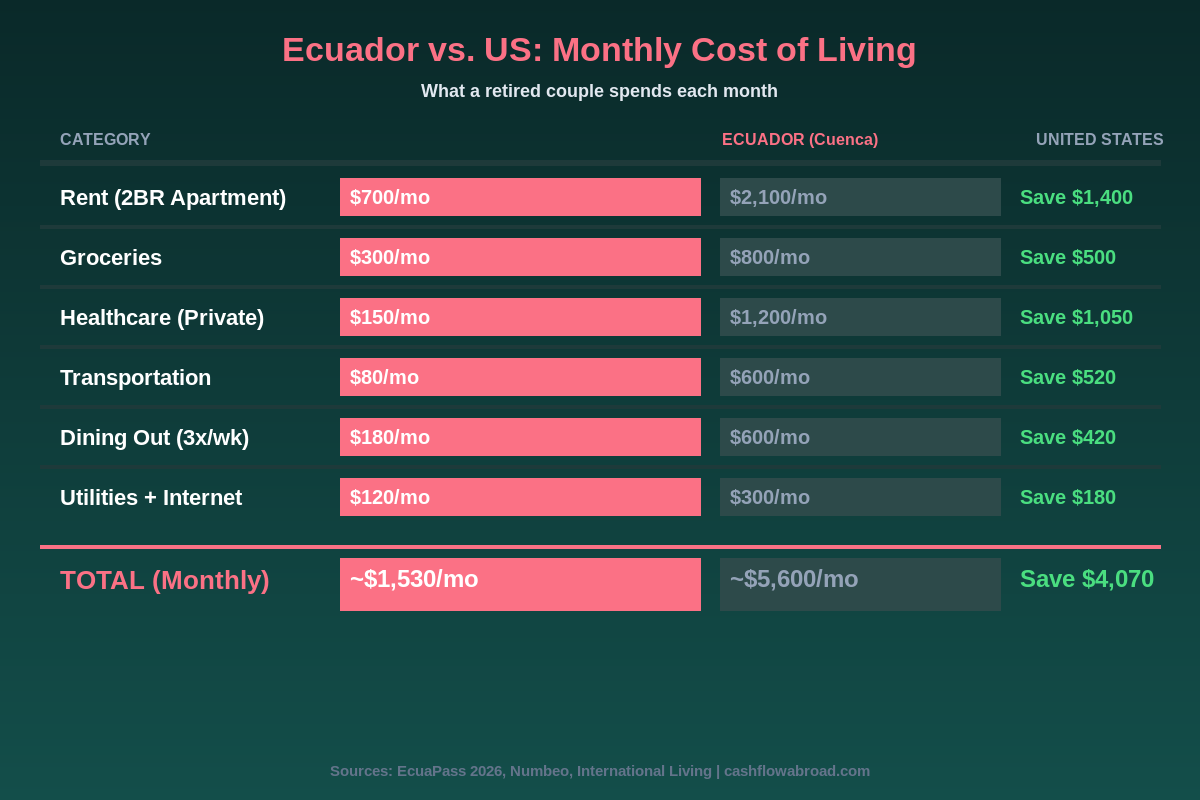
Ecuador isn’t one-size-fits-all. Where you live changes the math significantly.
Cuenca: The Expat Capital
Cuenca is the go-to for most retiring Americans — a UNESCO World Heritage city in the southern Andes at 8,400 feet elevation. The climate is “eternal spring”: highs in the mid-60s°F year-round, minimal humidity, and clear skies most days. No AC, no heating bills, no seasonal wardrobe switching.
A modern 2-bedroom apartment in a good neighborhood — mountain views, secure building, covered parking — runs $700–900/month furnished. Basic one-bedrooms in local neighborhoods start at $400. A weekly maid who cleans, does laundry, and handles light cooking costs $20–25 for a full day.
Realistic monthly budget for a couple living an “expat lifestyle” in Cuenca:
| Expense | Budget | Comfortable |
|---|---|---|
| Rent (2BR, furnished) | $600 | $900 |
| Groceries | $200 | $350 |
| Healthcare (IESS or private, 2 people) | $160 | $300 |
| Dining out (3–4×/week) | $120 | $220 |
| Utilities + internet | $80 | $120 |
| Transport (bus/taxi, no car) | $40 | $100 |
| Entertainment + misc | $100 | $200 |
| Monthly Total | $1,300 | $2,190 |
The “comfortable” column includes regular restaurant dinners, weekend trips, streaming subscriptions, and the occasional splurge on imported goods. This is not a budget that requires sacrifice.
Quito: Bigger City, Slightly Higher Costs
Quito runs about 15–20% more expensive than Cuenca, mostly due to higher rents in desirable neighborhoods. A furnished 2BR in upscale Cumbayá or González Suárez areas: $900–1,300/month. The tradeoffs: an international airport with more direct US flights, more English spoken broadly, stronger selection of international restaurants, and better access if you need specialist medical care beyond what Cuenca offers.
Total monthly budget for a couple in Quito: roughly $1,800–2,600.
The Coast: Salinas, Manta, and Montañita
Ecuador’s Pacific coast is significantly cheaper and warmer. Salinas has a long-established expat community; Manta is the growing hub with an international airport. A 2BR furnished apartment on the beach in Salinas: $500–700/month. The heat (low 80s°F year-round) is either a feature or a bug. Healthcare access is more limited on the coast — budget for quarterly trips to Guayaquil for specialist care.
Ecuador Taxes for US Retirees: The Two-Country Picture
Ecuador’s territorial tax system is straightforward for retirees: residents pay tax only on income from Ecuadorian sources. Your US Social Security, IRA distributions, pension checks, rental income from a US property, and brokerage dividends — none of it is subject to Ecuadorian income tax.
Ecuador’s progressive income tax brackets top out at 37% on Ecuadorian-source income above $180,000/year. For retirees whose income comes entirely from the US, that rate is academic.
The US side is the more complex piece. The IRS doesn’t care that you moved to Cuenca — you still file a US return every year. But the tools available can significantly reduce or eliminate your US tax burden:
- Foreign Earned Income Exclusion (FEIE): Excludes up to $130,000 of foreign-earned income (wages, freelance income) if you pass the Physical Presence or Bona Fide Residence test. Passive income — Social Security, pensions, investment income — is not “earned income” and doesn’t qualify. But since Ecuador doesn’t tax that income either, most retirees have no double-taxation problem at all.
- Social Security taxation: Up to 85% of your Social Security benefit is included in US taxable income regardless of where you live. Ecuador’s zero-tax treatment doesn’t change what the IRS does. This is the same as if you lived in a no-income-tax US state like Florida or Texas.
- No US–Ecuador tax treaty. Ecuador and the US don’t have a bilateral tax treaty. Most retirees aren’t affected significantly — the Foreign Tax Credit handles most double-taxation scenarios on investment income.
The practical bottom line: a couple with $3,000/month in Social Security and $20,000/year in investment distributions will typically owe US tax roughly equivalent to living in a no-income-tax state — possibly less. See our detailed breakdown in How to Pay Zero Federal Tax as a US Expat.
Healthcare: The Real Reason to Consider Ecuador

Ecuador’s private healthcare system costs 10–20% of equivalent US prices with none of the insurance pre-authorization headaches. Some concrete numbers:
- Primary care visit: $30–60
- Specialist appointment: $40–80
- MRI: $150–350
- Full bloodwork panel: $30–80
- Dental cleaning: $20–40; a crown: $200–350
- Hip replacement at a private hospital: $6,000–9,000 vs. $40,000+ in the US
Cuenca has several internationally accredited hospitals and a strong concentration of US-trained or US-board-certified physicians, many of whom speak English. Hospital Monte Sinaí and Hospital Santa Inés are the most frequently cited by long-term expats for quality inpatient care. Private clinics for outpatient appointments are plentiful and walk-in friendly — no three-week wait for a same-day issue.
For visa purposes, IESS enrollment ($80–100/month) is the most common choice. Private insurance from Ecuadorian carriers (Humana Ecuador, BMI) provides broader coverage with shorter wait times for $130–230/month per person at age 60+. If you want international coverage valid both in Ecuador and during visits back to the US, a plan like SafetyWing covers global care and can supplement local insurance for ~$150–170/month at age 60.
One caveat: Medicare does not cover you outside the US. If you plan to travel back to the US for major procedures, factor that into your insurance strategy. Medicare will still be there when you return, but you’re on your own in Ecuador for anything Medicare was handling stateside.
Banking and Money: How Expats Handle It
Ecuador has a functional local banking system — Banco Pichincha, Banco del Pacífico, and Produbanco are the main options. Opening a local account requires your visa, cedula (Ecuadorian national ID), and patience with the paperwork. Most expats maintain a US bank account and a local account simultaneously, using the US account for Social Security direct deposit and the local account for paying rent and utilities.
For your US account, Charles Schwab’s checking account is the standard recommendation for expats: zero foreign transaction fees, unlimited ATM fee reimbursements worldwide, and no account minimums. Ecuador’s ATMs dispense actual US dollars — withdraw from any ATM in Cuenca and you’re getting $20 bills. No conversion, no surprise fees if you use a Schwab card. This matters more than most people realize: in most countries, foreign ATM withdrawals involve a 1–3% currency conversion fee plus the ATM operator’s fee. In Ecuador, none of that applies — you’re just withdrawing dollars.
For moving larger sums from your US bank to an Ecuadorian account, Remitly handles USD-to-USD transfers efficiently. Since Ecuador runs on dollars, there’s no conversion spread — you send $1,000, the Ecuadorian bank receives $1,000 minus a flat transfer fee, typically $3–8.
Maintaining a US mailing address matters more than most retirees expect. The IRS requires a US address on your return. Social Security needs a valid address for correspondence. Most US banks will flag or close accounts if they detect you’re living abroad without a maintained US address. A virtual mailbox solves all of this: Traveling Mailbox provides a real US street address in your choice of 50+ cities, scans all physical mail, and lets you deposit checks digitally — starting at $15/month. We cover the full setup in our Virtual Mailbox Expat Guide.
Ecuador vs. the Other Retirement Hotspots
| Destination | Couple Monthly Budget | Visa Income Requirement | Currency Risk | Tax on Foreign Income |
|---|---|---|---|---|
| Ecuador (Cuenca) | $1,400–$2,200 | $1,446/mo | None (USD) | $0 (territorial) |
| Portugal (interior) | $2,200–$3,000 | €760/mo + D7 | Euro exposure | 10–20% (NHR-adjacent if eligible) |
| Mexico (San Miguel) | $1,800–$2,800 | $1,620/mo income | Peso exposure | $0 (territorial) |
| Panama (interior) | $1,600–$2,400 | $1,000/mo income | None (USD) | $0 (territorial) |
| Costa Rica | $1,800–$2,800 | $1,000/mo income | Colón exposure | $0 (territorial) |
| Colombia (Medellín) | $1,400–$2,200 | ~$750/mo income | Peso exposure | Progressive on global income after 5 years |
Ecuador’s dollar economy is a genuine differentiator — only Panama shares that advantage in Latin America. And Ecuador runs cheaper than Panama at nearly every price point, while Cuenca offers better safety, cooler climate, and stronger expat infrastructure compared to most of Panama’s expat zones.
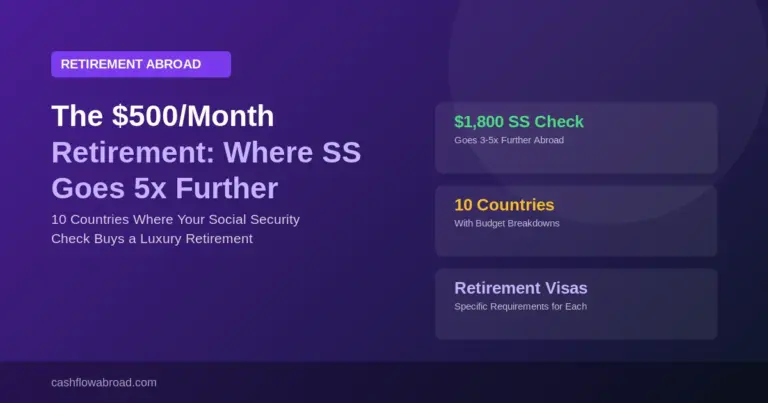
For a broader comparison of where Social Security stretches furthest globally, our Retirement Abroad: Where Social Security Goes 5× Further guide covers a dozen countries with head-to-head numbers. Ecuador consistently ranks in the top tier for the combination of dollar economy, healthcare quality, and cost.
What Living There Actually Looks Like
English availability: Cuenca has an unusually large English-speaking expat community (estimated 10,000+ permanent residents) and strong English proficiency in medical, legal, and real estate sectors. Day-to-day Spanish is needed for markets, taxis, and most services. Spanish fluency isn’t a barrier to a good life, but even basic Spanish dramatically expands your options and lowers prices — locals will give you better deals and better service when you make the effort.
Internet and connectivity: Fiber-optic internet at 100–200 Mbps runs $35–50/month in Cuenca and is available in most residential buildings. Co-working spaces are well-established for those doing remote work. Ecuador’s mobile infrastructure (Claro and Movistar) covers Cuenca and Quito thoroughly; rural areas are patchier.
Getting there: No direct flights from most US cities — typically a connection through Bogotá, Lima, or Miami to Quito (UIO) or Guayaquil (GYE). From Quito or Guayaquil, Cuenca is a 30-minute domestic flight or 3.5–4-hour bus ride. Total trip time from the US East Coast: 8–12 hours depending on routing.
The bureaucracy reality: Ecuador’s immigration system is functional but slow. Budget $800–1,500 for an immigration attorney if you want to avoid the paperwork maze — it’s worth every dollar. The legal framework is stable, and Ecuador has welcomed foreign retirees for decades without sudden rule changes.
Who Ecuador Is (and Isn’t) For
Ecuador makes the most sense if you:
- Have income entirely in USD and want zero currency exposure
- Have $1,500–$3,000/month in retirement income and want to live well rather than frugally
- Value safety, walkability, and a strong expat community over beaches or nightlife
- Care about healthcare cost and quality more than US-level specialist subspecialties
- Are willing to learn conversational Spanish over time
Ecuador is a harder fit if you:
- Want close proximity to the US mainland — flights are longer than Mexico or Panama
- Have heart or lung conditions that may be aggravated by high altitude (Cuenca at 8,400 feet is a genuine consideration — spend 2+ weeks there before committing)
- Need cutting-edge medical subspecialties only available at major US academic medical centers
- Prefer a warm, beachside retirement — Ecuador’s coast is an option, but healthcare access there requires more planning
For context on the full geographic arbitrage landscape, our Geographic Arbitrage Playbook covers 10 countries with head-to-head comparisons across taxes, cost, visas, and banking.
Getting Started: Practical Checklist
- Get a virtual US mailbox — set up Traveling Mailbox before you leave. This becomes your IRS address, Social Security address, and banking address.
- Open a Schwab bank account — unlimited international ATM reimbursements, no foreign transaction fees. Set this up while you still have a US address.
- Get a Social Security income verification letter — the SSA issues these free at SSA.gov or any field office. You’ll need it for the visa application.
- Visit for 30–60 days on a tourist entry — you can stay up to 90 days without a visa. Use the time to find a neighborhood, vet apartments, and confirm the altitude suits you before signing anything long-term.
- Hire an immigration attorney in Cuenca — budget $800–1,200 for full-service visa processing. The Cuenca Bar Association has referral lists, and expat Facebook groups (Expats in Cuenca) have vetted recommendations.
- Enroll in IESS or a private health plan — required for visa approval. IESS enrollment can happen after arrival; private insurance can be arranged beforehand.
- Apply for your cedula after visa approval — Ecuador’s national ID card, which simplifies banking, healthcare, and daily bureaucracy significantly.
If you want a step-by-step relocation checklist beyond just the visa, our Expat Relocation Kit covers the full financial and logistical setup for moving abroad, including banking transition, mail forwarding, tax filing timeline, and asset protection basics.
The Bottom Line
Ecuador doesn’t appear on most Americans’ radar because it doesn’t have the marketing machine of Portugal or Panama. But the combination of a permanently dollarized economy, a $325 visa fee, under-$2,000/month comfortable living for a couple, and zero taxation of foreign income is genuinely rare. Cuenca specifically offers something unusual in the retirement-abroad market: an affordable, safe, culturally rich city with strong infrastructure and a large English-speaking expat community that’s been established for over two decades.
The math is straightforward. If your Social Security and pension clears $1,500/month, you can retire in Cuenca — not barely survive, but actually live well — without touching a dollar of principal. That calculation is harder to find than most people assume.
Financial Disclaimer: This article is for informational purposes only and does not constitute financial, tax, or legal advice. Tax laws in both the US and Ecuador change regularly. Visa income thresholds are recalculated annually based on Ecuador’s unified minimum wage. Consult a qualified US expat tax professional and a licensed Ecuadorian immigration attorney before making relocation decisions. All costs and figures cited are estimates based on publicly available data as of early 2026 and may vary by individual circumstances.
Liked this article?
Get the next one delivered straight to your inbox — plus a free Expat Tax Cheat Sheet.
Join our subscribers. No spam — just expat finance intel and new post notifications.