IOSS VAT Number Guide for US Online Sellers
Set up the right IOSS VAT number flow for €150 EU orders, monthly returns, marketplaces, intermediaries, and customs clearance.

- IOSS covers eligible B2C goods imported into the EU in consignments with an intrinsic value of no more than €150.
- A US-established seller generally needs an EU-established intermediary to register for and operate the Import One Stop Shop.
- IOSS returns cover one calendar month and are due by the end of the following month, including required nil returns when no covered sales occur.
- IOSS transaction records must generally be retained electronically for 10 years from the end of the transaction year.
- A marketplace deemed to be the VAT supplier uses its own IOSS number; sellers must not reuse that number for direct-store orders.
A €149 parcel can clear into the European Union with VAT collected at checkout, while a €151 parcel falls outside the Import One Stop Shop entirely. For a US online seller, that two-euro difference changes the tax workflow, customs data, customer experience, and the number that must reach the carrier.
This guide is for a US-based ecommerce operator shipping physical goods from outside the EU directly to EU consumers. It explains what an IOSS VAT identification number does, how to obtain and protect one, and how to build a monthly control system without confusing IOSS with the broader rules in our EU VAT guide for US ecommerce sellers.
What is an IOSS VAT number?
An IOSS VAT number identifies a seller or marketplace using the EU Import One Stop Shop for eligible low-value consumer shipments. The scheme allows VAT to be charged when the customer pays, reported through one Member State of identification, and matched to a VAT-exempt import when the valid number appears in the customs declaration.
The European Commission describes the number format as IM followed by 10 digits in the pattern IMxxxyyyyyyz. A Member State allocates one number per taxable person. If an intermediary represents multiple sellers, the intermediary receives a separate IOSS VAT number for each seller, plus its own intermediary identification number beginning with IN; that IN number is not a VAT number.
IOSS has been available since July 1, 2021. It is optional, but once a seller chooses a One Stop Shop scheme, supplies within that scheme must be handled consistently rather than selectively by favorite destination countries.
Which orders qualify for IOSS?
IOSS covers distance sales of goods imported from outside the EU in consignments whose intrinsic value does not exceed €150. The buyer must be a consumer or another non-taxable person in the EU, and the goods must actually start their journey outside EU territory.
The five-part eligibility test
- The transaction is business-to-consumer, not an ordinary B2B supply.
- The goods are dispatched from a non-EU country or territory.
- The consignment's intrinsic value is €150 or less.
- The product is not subject to excise duty.
- The seller or deemed-supplier marketplace uses a valid IOSS registration for the sale.
Goods already stored in an EU warehouse are not imported distance sales for IOSS. They may instead create domestic VAT or Union OSS obligations. Likewise, IOSS is not the scheme for consulting, software, or other services; a non-EU business selling services to EU consumers may need the non-Union OSS.
Intrinsic value and consignments
The €150 ceiling applies per consignment, not per customer, month, or product line. Operationally, the order system must prevent ineligible orders from being transmitted as IOSS shipments and must not split a genuine single order artificially to fit under the ceiling.
The Commission's official IOSS declaration guidance also excludes goods subject to excise duties. Alcohol and tobacco therefore need a different customs and VAT workflow even when their price is below €150.
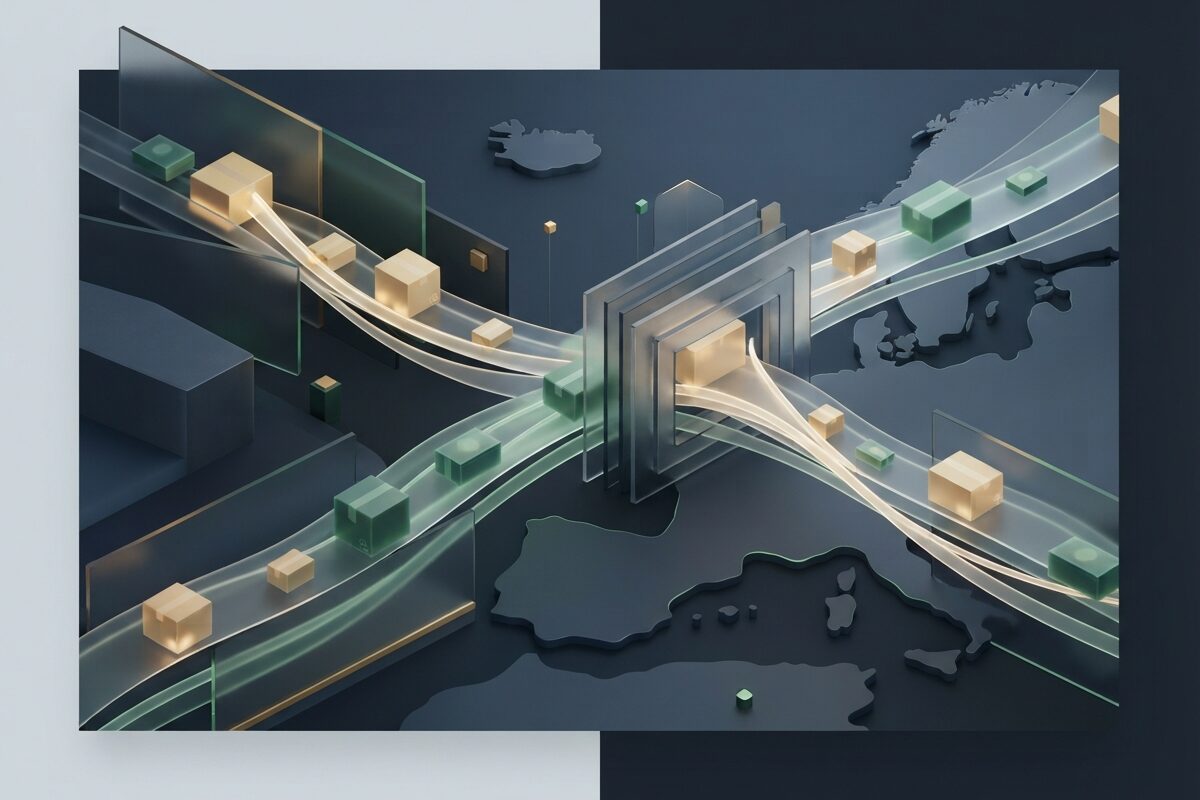
Do US sellers need an IOSS intermediary?
Generally, yes: a business established outside the EU must appoint an EU-established intermediary to use IOSS. The intermediary registers in its Member State of identification, registers the seller, files monthly returns, pays VAT, keeps required records, and is liable for IOSS obligations in the seller's name.
The official European Commission registration guide says the IOSS registration becomes effective when the seller or intermediary is allocated the identification number. That means a pending application is not a valid number and should not be used to promise VAT-paid delivery.
Intermediary pricing is commercial rather than fixed by EU law, so obtain written quotes instead of relying on an unsourced market average. Compare setup fees, monthly minimums, per-order fees, foreign-exchange spreads, required deposits or guarantees, included countries, return corrections, exit support, and liability terms.
Do you use the marketplace's number or your own?
Use the marketplace's IOSS number for a sale when that marketplace is the deemed supplier; use your own registration for qualifying direct-store sales. Never substitute one channel's number for another merely because the customer, product, or carrier is the same.
| Sales path | Who handles VAT | IOSS number flow | Main operator risk |
|---|---|---|---|
| Own webstore, eligible import | Seller through its IOSS intermediary | Seller-specific number goes securely to carrier or customs declarant | Wrong VAT rate or missing customs transmission |
| Marketplace is deemed supplier | Marketplace | Marketplace number passes under its controlled process | Reusing the marketplace number on direct sales |
| Own webstore, consignment above €150 | Outside IOSS; use the applicable import arrangement | No IOSS number | Promising VAT-paid delivery under the wrong scheme |
| Goods already in EU stock | Domestic VAT or Union OSS analysis | No IOSS treatment for the import sale | Misclassifying warehouse stock as imported distance sales |
| Digital or professional service | Often non-Union OSS or another place-of-supply rule | No IOSS number | Confusing services with imported goods |
EU rules can treat an electronic interface as the supplier for VAT when it facilitates qualifying imported-goods sales up to €150. In that case, the platform collects and remits VAT. The underlying seller still needs the platform's order-level tax and customs instructions, but it does not become the owner of the platform's number.
This distinction also keeps the article separate from the question of whether a US company needs a general EU VAT number. IOSS is a transaction-specific import simplification, not a blanket answer for every EU sale.
How should the IOSS number move through fulfillment?
The number should move from the responsible seller or marketplace to the carrier or customs declarant through a restricted electronic data path. It should not be printed in marketing materials, exposed on a public product page, or reused by unrelated parties.
Seven-step order flow
- Classify the channel. Mark the order as direct-store or marketplace and record which party is VAT-responsible.
- Test eligibility. Confirm EU destination, consumer status, origin outside the EU, product eligibility, and intrinsic value no more than €150.
- Calculate destination VAT. Apply the rate of the customer's Member State and keep product tax-code evidence.
- Collect VAT at checkout. Store item value, VAT rate, VAT amount, currency, customer country, order number, and payment date.
- Route the correct number. Pass the seller-specific or marketplace-specific IOSS number only to the party preparing the customs declaration.
- Reconcile proof of shipment. Match the commercial order to the consignment and transport reference so the VAT return does not drift from customs data.
- Close the month. Reconcile gross sales, refunds, VAT, eligible consignments, excluded orders, currencies, and carrier exceptions before the return deadline.
The Commission's low-value-consignment guidance says customs checks the number electronically against the IOSS registry. If the number is absent or invalid, the import cannot receive IOSS treatment; VAT can be collected at import, potentially making the customer pay a second time and generating a support case.
A €100 taxable value sold into a country with a 20% applicable rate produces €20 of VAT and €120 collected at checkout. If the valid IOSS number is missing at customs and another €20 is collected on delivery, the operator now has a €20 customer problem plus any carrier handling charge.
What are the monthly IOSS return controls?
An IOSS return is due electronically by the end of the month following each monthly tax period, even when the period has no sales. A nil return is required for a month with no covered supplies and no corrections.
Month-end checklist
- Export eligible orders separately from marketplace-deemed-supplier orders.
- Group taxable amounts and VAT by Member State of consumption and VAT rate.
- Reconcile checkout currency to the reporting currency using the required exchange-rate convention.
- Trace refunds and credit notes back to the original return period for correction.
- Confirm all consignments stayed at or below €150 and excluded excise goods.
- Match the return total to the amount funded with the intermediary before its cutoff.
- File a nil return when required; do not interpret zero sales as zero compliance.
- Archive the filed return, payment reference, transaction detail, and carrier exception report.
The return and payment deadline does not roll forward when month-end falls on a weekend or public holiday. The Member State of identification sends the data and money to the Member States of consumption. A payment must carry the unique reference number assigned to its return so authorities can match it correctly.
Repeated noncompliance has operational consequences. Commission guidance says three consecutive return periods with an ignored reminder can count as persistent failure and cause exclusion. An intermediary's deletion can also exclude every represented seller that depends on it.
How long must IOSS records be kept?
IOSS records must generally be retained for 10 years from the end of the year in which the transaction occurred. The official OSS record-keeping guidance says they must be made available electronically and without delay when requested by the Member State of identification or consumption.
Minimum control file
Keep the Member State of consumption, supply type and date, taxable amount, currency, VAT rate and amount, payments on account, customer-location evidence, invoice data where applicable, order identifier, refund or correction, and shipment reference. Your intermediary may require additional fields or a standard audit-file format.
Treat the IOSS number like a restricted credential. Limit it to staff and systems that prepare eligible shipments, prevent it from entering customer emails or public documents, log exports, remove access promptly when vendors change, and review carrier mappings after any integration update.
Registration changes also have deadlines. The Commission says changes to registered information generally must be reported no later than the tenth day of the month after the change. Build ownership for legal name, address, contact, establishment, and channel changes into the same compliance calendar as returns.
What could change after August 2026?
The current article uses the €150 IOSS scope and August 2026 European Commission guidance, but EU ecommerce VAT and customs reforms continue to develop. Revised Commission materials published in July 2026 include changes scheduled to enter into force from January 1, 2027, so operators should recheck official guidance before changing checkout or customs logic.
VAT rates vary by destination and product classification. National portals can also impose local procedures, guarantees, languages, and intermediary conditions. An expat founder's residence does not by itself determine where the company is established for VAT, where inventory sits, or which entity makes the sale.
Data notes / Sources checked
Rules were checked in August 2026 against the European Commission's Your Europe OSS overview, One Stop Shop operating guide, registration page, declaration-and-payment page, record-keeping page, and current VAT ecommerce guides. National VAT rates, registration procedures, intermediary fees, customs reforms, and effective dates can change.
Conclusion
An IOSS VAT number is useful only when the transaction, checkout tax, intermediary return, and customs declaration agree. For a US seller, the durable system is simple to describe but demanding to run: gate orders at €150, separate direct and marketplace channels, charge destination VAT, transmit the correct number securely, close every month, and retain the evidence for 10 years.
Frequently asked questions
What is an IOSS VAT identification number?
It is the seller-specific number used to identify eligible Import One Stop Shop sales in EU VAT reporting and customs declarations for qualifying low-value consignments.
Does a US seller need an IOSS intermediary?
Generally yes. A business established outside the EU normally appoints an EU-established intermediary to register, file monthly returns, pay VAT, and keep IOSS records.
Can IOSS be used for orders over €150?
No. The current IOSS scope is limited to eligible imported-goods consignments whose intrinsic value does not exceed €150, and it excludes excise goods.
Should an IOSS number appear on the customer invoice?
Treat the number as restricted customs data. Pass it securely to the carrier or customs declarant under the responsible seller or marketplace workflow, not as a public identifier.
This guide is general information, not personalized tax, legal, or investment advice. Rules change; verify current thresholds with official sources or a qualified professional before acting.
Related guides
 Expat Business & Remote WorkSeptember 3, 2026
Expat Personal Loans: Borrow While Living Abroad
Compare five US personal loan paths for expats: military credit unions, co-signers, secured loans, and what SoFi requires when you live overseas.
 Expat Business & Remote WorkSeptember 1, 2026
Portugal 4× RMMG: The €3,680 AIMA Floor
Hit Portugal’s €3,680 4× RMMG test, file the art. 61-B consular sticker, then convert it at AIMA without mixing a D7 file.
 Expat Business & Remote WorkAugust 31, 2026
Spain Telework Permit: The €2,849 SMI Bar
Hit Spain 2026 telework SMI bar of €2,849, file the UGE 3-year route, and keep US tax plus Beckham Law on a separate clock.