Crypto Staking & DeFi Yield: US Expat Tax Guide
IRS Rev. Rul. 2023-14 made staking rewards ordinary income the day you receive them. FEIE does not apply. Here is what US expats holding crypto actually owe.

- IRS Revenue Ruling 2023-14 (August 2023) confirmed staking rewards are ordinary income at fair market value on the day you receive them — not capital gains.
- The Foreign Earned Income Exclusion (FEIE) does not apply to staking or DeFi yield — these are passive investment income, not earned income under the tax code.
- Foreign crypto exchange accounts (Kraken EU, Binance.com, OKX) trigger FBAR reporting if your aggregate balance exceeded 0,000 at any point during the year; self-custody hardware wallets do not.
- DeFi lending principal deposits (Aave, Compound) are not taxable events, but interest received is ordinary income at FMV on receipt — the same rule as bank interest.
- Liquidity pool impermanent loss is not deductible until you exit the pool and realize the difference — paper losses on Uniswap V3 positions cannot be claimed annually.
- The Foreign Tax Credit (Form 1116) can offset US tax on staking income dollar-for-dollar for foreign taxes paid on the same income, often eliminating most double-taxation.
Disclosure: this article contains affiliate links. If you open an account through one of them, Cashflow Abroad may earn a referral commission at no extra cost to you.
If you earned $40,000 in ETH staking rewards last year while living in Lisbon, Chiang Mai, or Medellín, the IRS considers every coin taxable as ordinary income — not a capital gain — on the day it landed in your wallet. Revenue Ruling 2023-14 settled this question in August 2023, and the Foreign Earned Income Exclusion provides zero protection. The rules for expats holding staking positions, DeFi yield, and governance token rewards are specific enough that getting them wrong can mean a five-figure tax bill plus penalties. This guide covers the exact mechanics.
What the IRS Says About Staking Rewards
Revenue Ruling 2023-14 resolved the debate that had been building since the Jarrett v. United States case. The IRS held that staking rewards — tokens received for validating transactions on a proof-of-stake blockchain like Ethereum, Solana, Cardano, or Cosmos — are ordinary income when received or credited, valued at fair market value on that date.
The "created property" argument failed. Some taxpayers had claimed that newly minted tokens were like a farmer growing crops — created property with a zero basis, not income until sold. The IRS rejected that position. The controlling rule is IRC Section 61: income from whatever source derived. Staking rewards are taxable in the year you receive them, regardless of when you sell.
The same logic applies to all proof-of-stake rewards: Ethereum validators, Solana delegator rewards, Cosmos ATOM staking, Cardano ADA delegation rewards, and yield tokens earned through liquid staking protocols. If you receive crypto for participating in network validation or delegation, it is ordinary income on receipt.
Why FEIE Won't Cover This Income
The Foreign Earned Income Exclusion (FEIE) is one of the most powerful tools in the expat tax toolkit, letting qualifying Americans exclude a substantial portion of their earned income from U.S. taxation. But staking and DeFi yield is not earned income under the tax code. It is passive investment income — closer to dividends and interest than to wages or self-employment income.
Earned income for FEIE purposes means wages, salaries, professional fees, and net earnings from self-employment. Investment returns, passive income, and capital gains are excluded categories regardless of where you live. A long-term Ethereum validator sitting in a low-cost city in Southeast Asia owes U.S. income tax on every reward received, without any FEIE offset.
For a detailed comparison of your options when passive income is your main stream, see our FEIE vs. Foreign Tax Credit guide. The Foreign Tax Credit (Form 1116) is a better tool here: if your host country also taxes your staking income, you can claim a dollar-for-dollar credit against your U.S. tax bill for the foreign taxes paid on the same income.
You receive $30,000 in staking rewards. Portugal's IFICI non-habitual regime taxes 20% on this income → $6,000 foreign tax paid. Your U.S. ordinary income tax at 22% bracket → $6,600. After Foreign Tax Credit, U.S. tax owed: $600. Without the credit: the full $6,600. The FTC does not eliminate U.S. tax, but it prevents most of the double taxation.
DeFi Income: Lending, Liquidity Pools, and Governance Tokens

DeFi protocols create several distinct taxable events. Each has a different treatment. IRS Notice 2014-21 established the foundational rule that virtual currency is property, and subsequent guidance has extended that framework to most DeFi activities.
Lending Protocols (Aave, Compound, Morpho)
Depositing crypto into a lending protocol — locking ETH or USDC as collateral or supplying it for others to borrow — is not a taxable event. You still own the underlying asset; you are simply making it available. The interest you receive (in aUSDC, cETH, or similar yield tokens) is ordinary income at fair market value when it accrues or is distributed, whichever happens first.
When you withdraw your deposited collateral, compare the proceeds to your original cost basis. If the protocol returned a different quantity of tokens due to rebasing or protocol mechanics, you may have a taxable exchange event. Track exact quantities carefully.
Liquidity Pools (Uniswap, Curve, Balancer)
Depositing two assets into a liquidity pool in exchange for an LP token is treated by most practitioners as not a taxable exchange — you are not disposing of property, you are receiving a claim on a proportionate share of the pool. However, the IRS has not issued definitive guidance on this point, and some advisors treat it as a taxable swap.
Trading fees earned by the pool while your funds are deployed are ordinary income when distributed or when you have the right to claim them. Incentive rewards (governance tokens paid by the protocol) are also ordinary income at FMV on receipt.
Impermanent loss — the reduction in the dollar value of your position relative to simply holding the assets — is not a deductible loss until you actually exit the pool. Many expats misunderstand this. The paper loss on a Uniswap V3 position cannot be claimed on your return until you burn the LP token and realize the underlying asset amounts.
Governance Token Rewards (COMP, UNI, AAVE, CRV)
When a DeFi protocol distributes governance tokens to liquidity providers, stakers, or users, those tokens are ordinary income at fair market value on the date received. It does not matter that the tokens are intended as a voting mechanism rather than a yield payment. The fact that you received property with market value is enough to trigger income recognition under Section 61.
Your cost basis in the governance tokens equals the amount you recognized as income. When you eventually sell them, the gain or loss is calculated from that basis using your chosen method.
Liquid Staking Tokens: The Unresolved Question
Liquid staking — depositing ETH into Lido to receive stETH, depositing with Coinbase to receive cbETH, or using Rocket Pool to receive rETH — sits in legal gray territory. The IRS has not issued specific guidance on whether exchanging ETH for a liquid staking token is a taxable event.
The conservative and most widely recommended position among crypto-specialist CPAs is to treat the exchange as two separate events: a taxable swap of ETH for the liquid staking token (triggering gain or loss on your ETH at the time of exchange), and then ongoing recognition of ordinary income as the staking rewards accrue inside the token's mechanics. Your basis in the liquid staking token is then the FMV of ETH at the time you deposited it, adjusted for the income already recognized.
The aggressive (and riskier) position is that no taxable event occurs at deposit because you retain beneficial ownership of the same economic interest. The IRS has not explicitly approved this view. If you hold significant liquid staking positions, flag this specifically with a cross-border CPA before filing.
Reporting Requirements: Four Forms Expats Need

US expats holding crypto face up to four separate reporting obligations depending on where their assets are held and their total value. These are in addition to standard income reporting.
| Form | Threshold | What Triggers It | Penalty for Failure |
|---|---|---|---|
| Schedule 1 / 1040 | Any amount | All staking rewards, DeFi interest, yield token income | Accuracy-related penalty; underreported income |
| Form 8949 + Schedule D | Any disposal | Every crypto sale, swap, exchange, or spend | Accuracy-related penalty; underreported gain |
| FinCEN 114 (FBAR) | $10,000 aggregate foreign accounts | Accounts on foreign crypto exchanges (Kraken EU, Binance.com, OKX) | Up to $10,000/year (non-willful); 50% of balance (willful) |
| Form 8938 (FATCA) | $200,000 single / $400,000 MFJ (abroad) | Foreign financial assets including foreign exchange accounts, foreign-held crypto | $10,000 per failure to disclose; extended statute of limitations |
FBAR and Foreign Crypto Exchanges
The FBAR (FinCEN Form 114) applies to any US person with a financial interest in or signature authority over foreign financial accounts exceeding $10,000 in aggregate at any point during the calendar year. Accounts on foreign-registered crypto exchanges — including the European or international arms of major platforms — are treated as foreign financial accounts for FBAR purposes by the IRS and FinCEN even though no final rule explicitly codifying this has been published.
Crypto held in a self-custody wallet (Ledger, Trezor, hardware wallet) is not subject to FBAR because there is no foreign financial institution account involved. Your private keys in a hardware wallet do not constitute an account. This distinction matters if you want to hold crypto without triggering additional reporting.
The FinCEN Form 114 is due April 15 with an automatic extension to October 15 and is filed through the BSA E-Filing System, not with your tax return. Many expat crypto holders who owe no U.S. income tax still need to file the FBAR if their exchange balances crossed $10,000.
Form 8938 and FATCA
Form 8938 (Statement of Specified Foreign Financial Assets) is filed with your federal income tax return and applies if you hold specified foreign financial assets above the threshold. For US citizens living abroad, the threshold is $200,000 on the last day of the tax year, or $300,000 at any point during the year (double for married filing jointly). Foreign crypto exchange accounts count as specified foreign financial assets. Cold wallets do not.
For more on the full landscape of US tax and banking requirements as an expat, see our US expat banking and tax guide. If you also hold foreign mutual funds or ETFs in your crypto portfolio, those positions may trigger PFIC rules — covered in detail in our expat investing PFIC guide.
Cost Basis Methods and 2025 Rule Changes
The IRS accepts three cost basis methods for cryptocurrency. Choosing the right one can meaningfully affect your annual tax bill, especially with large staking income being added to your basis each year.
- FIFO (First-In, First-Out) — Default if no method is elected. Oldest units are treated as sold first. In a rising market, this often means selling low-basis coins and triggering higher gains.
- HIFO (Highest-In, First-Out) — Highest-cost units are sold first, reducing taxable gains in a rising market. Requires detailed per-transaction records.
- Specific Identification — Identify exactly which coins you are selling by acquisition date and price. Maximum flexibility but requires the most recordkeeping.
Starting with 2025 tax returns, brokers that are "digital asset brokers" under new reporting regulations must apply FIFO as the default for assets held at that broker unless you explicitly elect another method. This default applies per account at the broker, not across all your wallets globally. If you self-custody or use non-reporting foreign exchanges, you choose your own method and document it on Form 8949.
The key compliance step: keep a complete transaction log for every wallet and exchange — date, quantity, FMV at receipt, sale price, method used. Blockchain explorers (Etherscan, Solscan) can help reconstruct missing history but crypto tax software (Koinly, Cointracker, TaxBit) makes audit defense far easier.
Pre-Tax-Season Checklist for Crypto-Holding Expats
- Export complete transaction histories from every exchange, protocol, and wallet before January 31. Major platforms let you export CSVs. DeFi transactions require a blockchain address export.
- Separate income events from disposal events. Staking rewards, DeFi interest, and governance token receipts are income items (Schedule 1). Sales, swaps, and LP exits are capital events (Form 8949). They go on different forms.
- Track FMV at time of each staking reward receipt. Your tax software should do this automatically using price feeds, but verify against your exchange records. The difference between $3,200 ETH and $3,400 ETH on the reward date matters.
- Check if your foreign exchange account crossed $10,000 at any point. Even briefly touching the FBAR threshold creates an obligation for the full year. Log your balance on the highest day of the year.
- Calculate your foreign tax credit eligibility. If your host country taxed the same crypto income, gather the tax receipts or assessments. File Form 1116 to claim the credit. Do not leave money on the table.
- Evaluate your liquid staking position's tax treatment. If you received stETH, cbETH, or rETH during the year, discuss with a CPA whether you are treating the deposit as a taxable swap or as a continuing ownership interest. Document your position in writing.
- Verify your cost basis method is consistent. Switching methods mid-stream requires care. If you have elected HIFO in prior years, document that election and apply it consistently or file a proper method change.
- Make quarterly estimated tax payments. Staking income has no withholding. If you expect $1,000 or more in annual tax from staking, the IRS expects quarterly payments. Missing them triggers underpayment penalties.
For year-round management, keeping a simple spreadsheet of each staking reward with date, amount received, and FMV takes five minutes per week and prevents a nightmare come April. If you are earning significant DeFi income, a purpose-built crypto tax platform saves hours and gives you a defensible audit trail.
US expats who also want a US banking home base for converting crypto to fiat can use Charles Schwab — which maintains accounts for established expat clients — as a USD landing account. For running a US business entity around your crypto services or consulting income, Mercury Bank offers fee-free US business banking for non-residents and expats. See our broader US expat crypto tax guide for the full picture on capital gains treatment, wash sale rules, and Section 1031 exchange limitations for crypto.
Data Notes / Sources Checked
IRS guidance on virtual currency, DeFi, and staking was verified as of July 2026. The IRS has not issued explicit guidance on liquid staking tokens or liquidity pool LP token treatment — positions described reflect the dominant practitioner interpretation, not a formal IRS ruling. Monitor IRS.gov for future notices on DeFi-specific issues.
- IRS Revenue Ruling 2023-14 — Staking rewards as ordinary income when received
- IRS Notice 2014-21 — Foundational virtual currency as property ruling, applies to DeFi
- IRS Form 8949 — Sales and Other Dispositions of Capital Assets (crypto sales and swaps)
- FinCEN.gov — FBAR filing requirements for foreign financial accounts including crypto exchange accounts
- IRS Form 8938 — FATCA reporting of specified foreign financial assets
Disclaimer: This article is educational only and does not constitute tax or legal advice. Cryptocurrency tax rules are complex and evolving. Consult a qualified cross-border CPA or tax attorney with cryptocurrency expertise before making filing decisions.
Frequently asked questions
Are crypto staking rewards taxable as ordinary income or capital gains?
Staking rewards are ordinary income, not capital gains. IRS Revenue Ruling 2023-14 (August 2023) confirmed they are taxed at fair market value on the date received. Your cost basis in the staking rewards equals the amount recognized as income. When you later sell them, any additional gain or loss is a capital event taxed at the short-term or long-term rate.
Does the Foreign Earned Income Exclusion protect my staking income if I live abroad?
No. The Foreign Earned Income Exclusion (FEIE) covers wages, salaries, and net self-employment income — not passive investment income. Staking rewards, DeFi yield, and governance token distributions are passive income and cannot be excluded under FEIE regardless of where you live.
Do I need to file an FBAR for my Binance or Kraken account?
Yes, if your aggregate balance across all foreign financial accounts exceeded 0,000 at any point during the calendar year. Accounts on foreign-registered crypto exchanges are treated as foreign financial accounts for FBAR purposes. Self-custody cold wallets (Ledger, Trezor) are not reportable because there is no foreign financial institution involved.
Is depositing crypto into an Aave or Compound lending pool a taxable event?
Depositing collateral into a DeFi lending protocol is generally not a taxable event — you retain ownership of the underlying asset. However, the interest you receive (aUSDC, cETH, etc.) is ordinary income at fair market value when distributed or credited. Governance token rewards from the protocol are also ordinary income on receipt.
What is the tax treatment of liquid staking tokens like stETH or cbETH?
The IRS has not issued specific guidance on liquid staking tokens. The dominant practitioner position is to treat the initial ETH deposit as a taxable swap (triggering gain or loss on the ETH given up), followed by ongoing ordinary income recognition as staking rewards accrue. This remains a judgment call requiring a crypto-specialist CPA for significant positions.
Can I use the Foreign Tax Credit to reduce my US tax on crypto staking income?
Yes, if your host country imposes its own tax on the same staking income, you can claim a Foreign Tax Credit on Form 1116 to offset your US tax obligation dollar-for-dollar, up to the US tax on that income. This prevents most double-taxation for expats in countries that tax crypto yield. Gather documentation of the foreign tax paid before filing.
This guide is general information, not personalized tax, legal, or investment advice. Rules change; verify current thresholds with official sources or a qualified professional before acting.
Related guides
 Crypto & Tax for ExpatsOctober 2, 2026
1099-DA When Brokers Leave Basis Blank
A blank basis box on Form 1099-DA is not a free pass. See what US brokers report, what foreign exchanges skip, and how to file the real gain.
 Crypto & Tax for ExpatsMarch 31, 2026
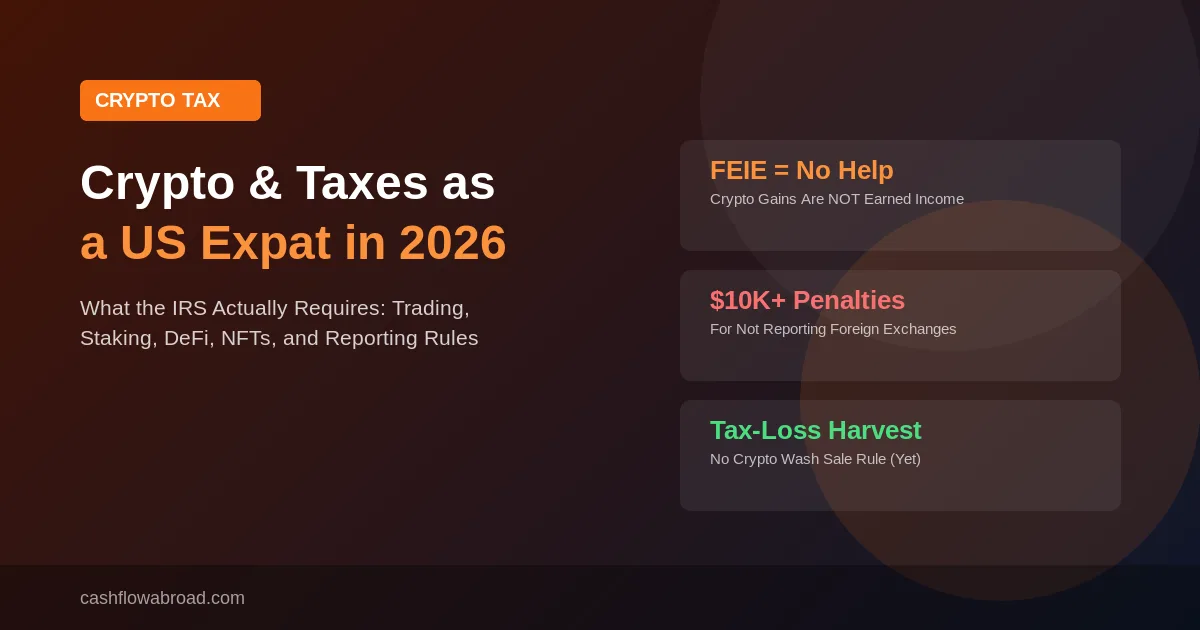
Crypto and Taxes as a US Expat: What the IRS Actually Requires in 2026
The IRS has made one thing abundantly clear: they are coming for unreported crypto. Crypto gains are not earned income — they're investment income.