Crypto and Taxes as a US Expat: What the IRS Actually Requires in 2026
The IRS has made one thing abundantly clear: they are coming for unreported crypto. Crypto gains are not earned income — they're investment income.
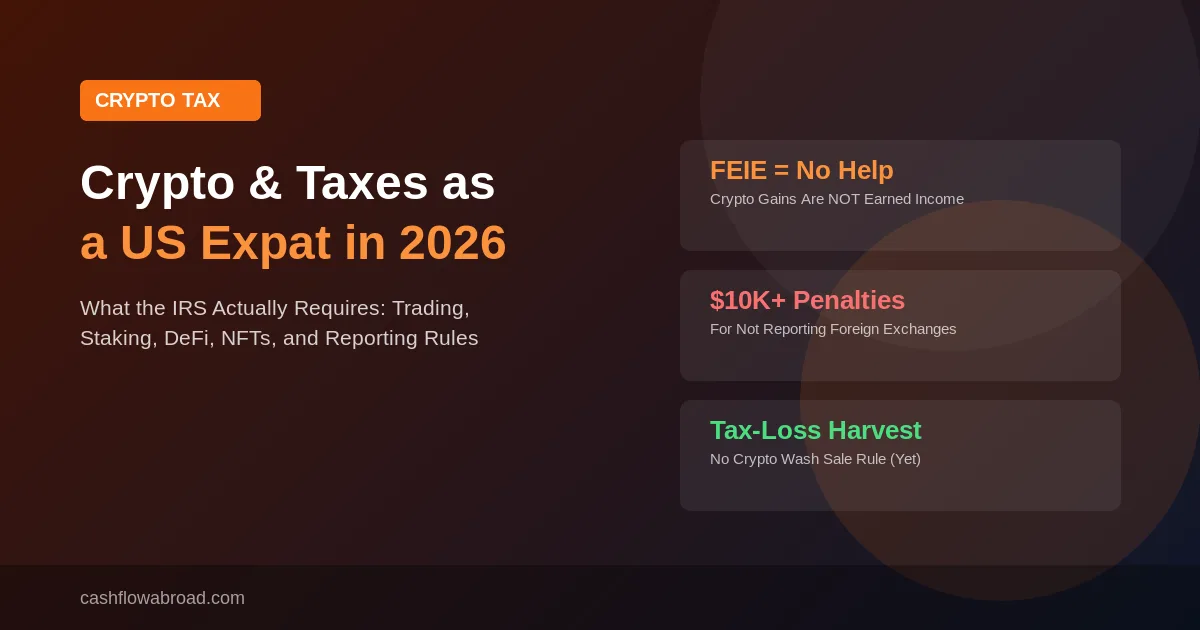
The IRS has made one thing abundantly clear: they are coming for unreported crypto. Crypto gains are not earned income — they're investment income.
Disclosure: this article contains affiliate links. If you open an account through one of them, Cashflow Abroad may earn a referral commission at no extra cost to you.
How the IRS Classifies Crypto
The IRS treats cryptocurrency as property, not currency. This means every disposal — selling, trading, spending, or exchanging — is a taxable event that must be reported.Taxable Events
- Selling crypto for fiat (USD, EUR, etc.)
- Trading crypto-to-crypto (BTC → ETH is a taxable sale of BTC)
- Spending crypto on goods or services
- Earning crypto as payment for work (income tax rates)
- Staking rewards — taxed as ordinary income at fair market value when received
- Mining income — taxed as ordinary income (and potentially self-employment tax)
- Airdrops — taxed as ordinary income at fair market value
- DeFi yields (liquidity pools, yield farming) — generally taxed as ordinary income
Non-Taxable Events
- Buying crypto with fiat
- Transferring between your own wallets
- Gifting under $18,000/year (2025 annual exclusion)
- Donating to a qualified charity
Related: stablecoin savings guide
Capital Gains Rates
| Holding Period | Tax Rate |
|---|---|
| Short-term (under 1 year) | 10-37% (ordinary income rates) |
| Long-term (over 1 year) | 0%, 15%, or 20% |
FBAR and Crypto: The Gray Area
FinCEN has indicated that foreign crypto exchanges will be subject to FBAR reporting, but enforcement has been inconsistent. As of 2025-2026:- If you hold crypto on a foreign exchange (e.g., Binance international, KuCoin, Bybit) with aggregate value exceeding $10,000 at any point during the year, you should file an FBAR to be safe
- US-based exchanges (Coinbase, Kraken, Gemini) are US accounts and don't trigger FBAR
- Self-custodied wallets (hardware wallets, MetaMask) are currently not reportable on FBAR — but this may change
Form 8949 and Schedule D
Every crypto sale must be reported on Form 8949 with:- Date acquired
- Date sold
- Proceeds
- Cost basis
- Gain or loss
Cost Basis Methods
- FIFO (First In, First Out): IRS default — oldest coins sold first
- Specific Identification: You choose which coins to sell — allows tax optimization
- HIFO (Highest In, First Out): Minimizes gains by selling highest-cost coins first
DeFi: The Tax Nightmare
DeFi activities create complex tax situations:- Liquidity pools: Adding/removing liquidity may trigger taxable events. Impermanent loss is not clearly deductible.
- Yield farming: Rewards generally taxed as ordinary income when received
- Wrapped tokens: Wrapping ETH → WETH may or may not be taxable (IRS hasn't clarified)
- Token swaps: Each swap is a taxable event
Related: FEIE zero tax guide
Tax-Loss Harvesting: The Crypto Advantage
As of 2025, the wash sale rule does NOT apply to crypto (it only applies to securities and, starting 2026, may extend to crypto under proposed legislation). This means you can:- Sell crypto at a loss
- Immediately repurchase the same crypto
- Claim the capital loss
Best Crypto Exchanges for US Expats
| Exchange | Expat-Friendly? | Notes |
|---|---|---|
| Kraken | Yes | Serves US citizens abroad, strong security, many pairs |
| Coinbase | Varies | May restrict from certain countries; US address usually needed |
| Gemini | Limited | US-focused, limited international access |
| Interactive Brokers | Yes | Best for expats who also trade stocks/commodities |
Crypto Tax Software
- Koinly — Supports 350+ exchanges, DeFi, NFTs. Free for tracking; $49-279 for tax reports.
- CoinTracker — Integrates with TurboTax. Free up to 25 transactions; $59-199/year.
- TaxBit — Government-grade compliance tool. Free basic tier.
- CoinTracking — Tracks 13,000+ coins across every major exchange. Real-time portfolio tracking plus tax reports for 100+ countries. Free up to 200 transactions.
Penalties for Non-Reporting
- Failure to file: 5% of unpaid tax per month, up to 25%
- Failure to pay: 0.5% per month, up to 25%
- FBAR penalties: Up to $16,536 per violation (non-willful) or $165,353/50% of balance (willful)
- Criminal penalties: Up to $250,000 and 5 years imprisonment for tax evasion
- The 1040 checkbox: Answering "No" when the answer is "Yes" is a false statement on a federal return
Crypto is just one piece of your expat portfolio. For the full picture — including which brokerages work abroad, how to avoid the PFIC trap on traditional investments, and three complete portfolio models — read our Expat Investor's Playbook.
Crypto tax compliance is complex but not optional. The IRS receives data from US exchanges, and international information-sharing agreements are expanding. Report everything, use tax-loss harvesting while you can, and consider a crypto-savvy expat tax professional. See our complete expat tax guide for the broader picture. Disclaimer: This is not tax advice. Crypto tax law is evolving rapidly. Consult a qualified tax professional for your specific situation.This guide is general information, not personalized tax, legal, or investment advice. Rules change; verify current thresholds with official sources or a qualified professional before acting.
Related guides