1099-DA When Brokers Leave Basis Blank
A blank basis box on a 1099-DA does not erase the sale. See what US brokers report, what foreign exchanges skip, and how to file the gain.

- Form 1099-DA gross proceeds start with sales US brokers effect after 2025. Basis is required only for covered lots acquired after 2025 and held in that broker’s custody until the sale.
- A blank box 1g with box 9 checked means the broker did not report basis. The instructions say to enter zero only when basis really is zero, so do not treat a blank as a zero cost.
- Foreign exchanges and non-custodial DeFi platforms generally do not send Form 1099-DA. Taxable sales, swaps, and crypto spending still go on the US return.
- The optional stablecoin shortcut is $10,000 of aggregate designated gross proceeds per broker, and specified NFTs use $600. Those figures skip a broker form. They are not a personal tax exclusion.
- Notice 2025-33 drops backup withholding on digital-asset sales in 2025 and 2026. The flat rate when withholding applies is 24 percent, and a foreign address does not make a W-9 US person into a foreign person.
- After 2025, specific identification of units held by a broker must be given to that broker by the sale, using the broker’s identifiers. If you do not, the earliest units in that account are treated as sold.
A US broker can put $18,400 of digital-asset proceeds on Form 1099-DA and leave the basis box empty. Report that $18,400 as the gain and you invent $11,200 of income you already paid for. If that overstatement is taxed at the 15 percent long-term capital-gains rate, the extra bill is $1,680. As of October 2026, a blank box is normal for older coins. It is not a reason to skip the sale.
This is a filing article for an operator who still uses a US exchange while living abroad, and who may also trade on a foreign platform or move coins to a wallet. Retirees with a leftover US account, and beginners who only bought and held, get a shorter path below. The wider map of what is taxable sits in the US expat crypto tax guide. This page stays on the new broker form and the basis gap. More reporting pieces live in Crypto & Tax for Expats.
Moving did not turn digital assets into foreign earned income. The IRS treats them as property. A sale, a coin-for-coin swap, or spending coins on rent is a disposition. The foreign earned income exclusion does not cover that gain.
Do you still report crypto if no 1099-DA arrives?
Yes. You report the taxable result whether or not a broker sends Form 1099-DA. The IRS says a missing form, including from a foreign broker, does not erase the income.
For 2025, the filing requirement generally hits US brokers. A taxpayer using an exchange based outside the United States may never see the form. Decentralized platforms that never take custody are also outside the current broker rules. The sale is still on your Form 1040 if it produced gain, loss, or ordinary income.
The checkbox on Form 1040
Every Form 1040, 1040-SR, and 1040-NR asks whether, at any time during the year, you received a digital asset as a reward, award, or payment, or sold, exchanged, or otherwise disposed of one. You must check Yes or No. Leaving it blank is not an option. You answer it even when no Form 1099-DA shows up.
What a US broker must put on the form
Gross proceeds come first. Basis comes later, and only for some lots. Under the 2026 Instructions for Form 1099-DA, brokers must report gross proceeds for digital-asset sales they effect after 2025, must report basis for covered securities, and may report basis for noncovered securities.
A covered security, for this form, is a digital asset acquired after 2025 for cash, stored-value cards, different digital assets, or other property or services, in an account where that broker provided custody, and held in that same account until the broker effects the sale. Buy in April 2026 on a US custodial exchange, leave it there, and sell in 2027: that lot is covered, and boxes for date acquired and basis are required. Buy the same coin in 2024, or transfer it in from a wallet the broker did not custody at purchase: that lot is noncovered. The broker may check box 9 and leave basis blank.
Data note: phase-in dates were checked against IRS digital-asset guidance and the Form 1099-DA instructions in October 2026. Broker software can still get a lot wrong.
| What happened | Form 1099-DA | Basis on the form | What you still do |
|---|---|---|---|
| US custodial sale of coins bought after 2025 and held there until sale | Yes, proceeds required | Required (covered security) | Reconcile box 1f and box 1g to your lot log, then Form 8949 and Schedule D |
| US custodial sale of coins bought before 2026, or transferred in | Yes, proceeds required | Often blank if box 9 is checked | Compute basis yourself. A blank box 1g is not zero |
| Sale on a foreign exchange | Usually none for 2025 | None | Report the gain or loss in US dollars anyway |
| Non-custodial DeFi swap | Not required under the current custody rules | None | Report it from your own records |
| Designated qualifying-stablecoin sales at one broker, optional method, $10,000 or under | Broker may omit them | Not provided | Taxable gain is still yours to report |
| Specified NFT sales at one broker, optional method, $600 or under | Broker may omit them | Not provided | Report any taxable gain or loss yourself |
Why box 1g is blank when you know the cost
Box 1f is gross proceeds. Box 1g is cost or other basis. The instructions tell the broker to enter -0- in box 1g only when basis really is zero. If the broker checks box 9 for a noncovered security and chooses not to report basis, it leaves box 1g blank. Blank means "not reported," not "your cost was nothing."

IRS Fact Sheet FS-2025-06, dated September 25, 2025, told tax professionals that most statements for 2025 transactions would not include basis, and that basis had to be calculated before the return was filed. Brokers were told to furnish that first statement by February 17. That February date is the first-wave deadline in the fact sheet, not a promise that every later year uses the same day.
One sale can become three forms
The instructions use a custodial customer who bought the same asset in April 2022, April 2026, and August 2026, then sold all of it in one trade in June 2027. The broker reports three 2027 forms: short-term for the August 2026 covered lot, long-term for the April 2026 covered lot, and a third form for the April 2022 noncovered lot. If you only copy the form that shows proceeds, you will mix holding periods and drop the old basis.
$18,400 box 1f proceeds − $11,200 records basis (cash paid plus the purchase fee) = $7,200 gain. Reporting $18,400 as the gain overstates income by $11,200. At a 15 percent long-term rate, that mistake is $1,680. Your rate depends on taxable income and on whether the lot was held more than one year.
Which sales never generate a 1099-DA?
Four gaps matter more once you live outside the United States. A foreign exchange, a self-custody wallet, a staking position, and a stablecoin balance can each be economically real and still produce no form.
Foreign brokers, wallets, and DeFi
The instructions say that, generally, only a US digital asset broker reports on Form 1099-DA. That is a US person other than a foreign branch or office, or a US branch treated as a US person, that effects sales for others. An exchange organized abroad usually will not send the form. The IRS digital-asset page also says the final rules do not require reporting by decentralized or non-custodial brokers that never take possession of the asset.
A transfer between wallets you own is not, by itself, a sale. Paying the network fee in the coin is a disposition of that fee, and the checkbox instructions treat it as a digital-asset transaction. Spending coins on a flight, a landlord, or a contractor is a sale for the fair market value of what you received, measured in US dollars.
Staking, lending, and Notice 2024-57
Notice 2024-57 tells brokers they are not required to file Form 1099-DA, until further guidance, for wrapping and unwrapping, liquidity-provider transactions, staking transactions, digital-asset lending, short sales, and notional principal contracts. The exception does not cover rewards or other compensation. Staking rewards are still income. The missing form only means the broker is not the IRS's informant for that slice.
- List every venue: US broker, foreign exchange, hosted wallet, and unhosted wallet.
- For each disposal, record asset, units, date and time, USD proceeds, and which account held the units.
- For each acquisition, record cash paid or the USD fair market value you included in income, plus transaction fees that belong in basis.
- Separate covered lots (acquired after 2025 in that broker's custody and held there) from everything else.
- If you sell only part of a broker-held position after 2025, tell the broker which units, using the identifiers that broker accepts, no later than the sale. If you do not, the default is the earliest units in that account.
- Translate foreign-currency proceeds to US dollars. Brokers must use the spot rate (or a reasonable spot-rate convention) on the date they receive, credit, or pay the amount.
Do stablecoin sales under $10,000 skip tax?
No. The $10,000 figure is a broker reporting shortcut, not a personal exclusion. A broker using the optional method for qualifying stablecoins does not have to report designated sales when the customer's aggregate gross proceeds from those designated sales, after allocable transaction costs, do not exceed $10,000 for the year at that broker. Cross $10,000 and the broker reports each stablecoin type on its own form. Specified NFT sales have a parallel optional threshold of $600 of aggregate gross proceeds at that broker.
Optional aggregate reporting also lets the broker leave basis blank even for covered units. You can still have a gain if you bought a stablecoin below $1, or a loss if a peg broke. Living abroad does not change that. It only makes it more likely you used a stablecoin to pay rent without a US form in the mailbox.
A fiat balance at a foreign platform is a different problem from the coin itself. FinCEN requires an FBAR when the aggregate value of foreign financial accounts exceeds $10,000 at any time in the year. FinCEN Notice 2020-2 says the FBAR rules, at that time, did not treat a foreign account holding only virtual currency as reportable, unless the account also held other reportable assets. FinCEN said it intended to propose a change. Re-check that notice before you skip a filing on the cash sitting next to the coins.
How do you report the gain when basis is blank?
Use your records, then Form 8949 and Schedule D, unless the broker gave you both gross proceeds and basis and the form instructions allow you to rely on that pair. IRS FAQ A109 points individuals to Form 8949 for capital transactions when the 1099-DA does not include both numbers. Ordinary items such as staking rewards that are not a sale go on Schedule 1, not on the proceeds line.
Basis and which units you sold
FAQ A56 says basis in coins bought for cash includes the cash paid plus the amount paid for transaction services to effect the purchase. FAQ A59 says coins received for services take a basis equal to the US-dollar fair market value you included in income. Holding period follows the same clock the IRS uses for other capital assets: one year or less is short-term, more than one year is long-term.
After December 31, 2025, specific identification inside a broker account has to be made to that broker, no later than the sale, using identifiers the broker designates, and you have to keep records. A standing order works only if it is in place with the broker on those terms. If the broker offers only one method, that method is the standing order and you cannot substitute a private spreadsheet. Miss the identification and FAQ A87 says you treat the units as sold from the earliest acquisition date in that wallet, even if you transferred newer coins in later.
For 2025 sales only, Notice 2025-7 was more forgiving: you could identify units on your own books, including a standing order that the broker never saw. Do not use that 2025 shortcut on a 2026 sale.
Wash-sale disallowance on this form is narrow. The instructions require box 1i for wash sales of tokenized securities treated as stock or securities under section 1091, when the sale and the repurchase happen in the same account with the same CUSIP. Their example: buy 100 units for $1,000 in September 2026, sell them for $600 in October, repurchase 75 units within 30 days, and the disallowed loss is $300, added to the basis of the new units. That example is not a rule that every bitcoin loss is a wash sale. Do not apply it to a plain coin unless you have authority that the asset is a section 1091 security.
If the gain is large and you did not pay estimates during the year, interest on a late balance is a separate cost. The mechanics for paying from overseas are in how IRS interest runs when you pay late from abroad.
Will a foreign address trigger backup withholding?
Not in 2025 or 2026, under the relief now on the books, and a foreign address does not reclassify a US citizen as a foreign person. Topic No. 307 says backup withholding, when it applies, is a flat 24 percent if you do not give a correct taxpayer identification number or the IRS tells the payer to withhold. Notice 2025-33 says the IRS will not require backup withholding on digital-asset sales effected in calendar years 2025 and 2026.
For 2027 the notice is narrower. There is relief if the broker matches the customer's name and TIN before the sale. There is separate relief for a preexisting account, opened before January 1, 2026, with a non-US residence address, but only if the broker has not already classified that customer as a US person. A US citizen who filed Form W-9 has been classified as a US person. Updating the street address to Lisbon or Mexico City does not switch that account into the foreign-person bucket, and it does not stop a 1099-DA on sales the broker effects.
- Keep the name on the W-9 identical to the Social Security card or ITIN letter.
- Update the mailing address so the statement is not returned, without telling the broker you are a non-US person.
- If box 4 shows backup withholding in a later year, claim that 24 percent as federal income tax withheld on the return for the year you received the income.
- Ask the broker for a corrected form when units, dates, or proceeds are wrong. The IRS says it cannot fix the issuer's form for you.
Data notes and sources checked
Thresholds, box rules, and relief dates below were read in October 2026. Congress, a later notice, or a broker's own optional method can change what gets mailed. They do not, by themselves, change the duty to report a taxable disposition.
- Instructions for Form 1099-DA — covered versus noncovered securities, box 9, the $10,000 stablecoin and $600 NFT de minimis rules, and foreign-currency translation.
- Understanding your Form 1099-DA — foreign brokers may not send the form; you still report.
- IRS digital assets — the checkbox, basis in US dollars, the January 1, 2025 and January 1, 2026 phase-in, and Notice 2024-57.
- Digital asset FAQs — basis, specific identification, and Form 8949 when basis is missing.
- IRS Fact Sheet FS-2025-06 — first-year statements mostly omit basis; furnish by February 17.
- Notice 2025-33 — backup-withholding relief for 2025 and 2026, and the 2027 preexisting-account limit.
- Topic No. 307 — 24 percent backup withholding rate when the rules apply.
- FinCEN FBAR page and Notice 2020-2 — $10,000 account test, and the virtual-currency position as published in that notice.
File the gain you actually have
Form 1099-DA tells the IRS what a US custodial broker saw: proceeds now, basis only for covered lots acquired after 2025 and kept in that account. Everything else — a pre-2026 lot, a wallet transfer, a foreign exchange, a stablecoin spend under the broker's $10,000 optional threshold — still belongs on your return if it was taxable. The cash-flow move is to keep the lot log so a blank box 1g does not turn cost into phantom profit.
Frequently asked questions
Do I still owe US tax on crypto if my foreign exchange never sends Form 1099-DA?
Yes, if the transaction was taxable. The IRS says 2025 Form 1099-DA filing generally applies to US brokers, so a foreign exchange may not send one. You still report sales, swaps, and other dispositions, and you still answer the digital-asset question on Form 1040.
What does a blank basis box on Form 1099-DA mean?
If box 9 is checked, the asset is a noncovered security and the broker chose not to report basis, so box 1g is left blank. Blank is not the same as zero. Zero is entered only when the basis actually is zero. You compute cost from your own records.
Are stablecoin sales under $10,000 tax-free for expats?
No. A broker using the optional method may skip reporting designated qualifying-stablecoin sales when your aggregate gross proceeds at that broker do not exceed $10,000 for the year. Any real gain or loss is still reportable on your return.
Does moving abroad stop backup withholding on a US crypto account?
Not by itself. Notice 2025-33 provides that backup withholding is not required on digital-asset sales effected in 2025 and 2026. A US citizen who already filed Form W-9 remains a US person. Changing the mailing address does not reclassify that account as foreign.
This guide is general information, not personalized tax, legal, or investment advice. Rules change; verify current thresholds with official sources or a qualified professional before acting.
Related guides
 Crypto & Tax for ExpatsJuly 9, 2026
Crypto Staking & DeFi Yield: US Expat Tax Guide
Rev. Rul. 2023-14: staking rewards are ordinary income when received. FEIE does not apply. Learn DeFi yield, FBAR, and Foreign Tax Credit rules for
 Crypto & Tax for ExpatsMarch 31, 2026
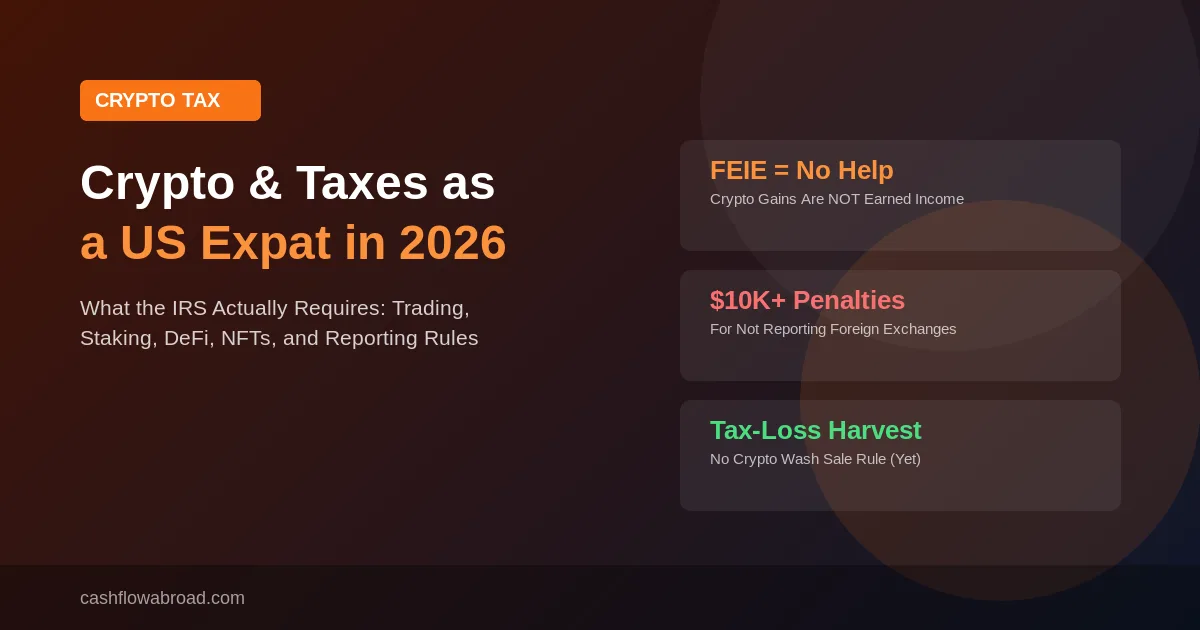
Crypto and Taxes as a US Expat: What the IRS Actually Requires in 2026
The IRS has made one thing abundantly clear: they are coming for unreported crypto. Crypto gains are not earned income — they're investment income.