AI Translation Business: Earn $5K/Month From Anywhere
9 min read · 2,270 words
A translator in Colombia is charging $0.18 per word, running DeepL and GPT-4o in parallel, and billing $6,200 a month — while her US-based competitor charges the same rate but spends three times as much just to keep the lights on. That’s geographic arbitrage meeting the AI translation wave, and the math is almost embarrassingly good.
The global translation and localization market hit $71.77 billion in 2025 and is projected to grow at 9.3% annually through the decade. Every software company going global, every e-commerce brand targeting new markets, every legal firm with multinational clients — they all need translation, and they need it continuously. What changed is that AI tools now let a solo operator in Medellín or Chiang Mai handle the output of a 5-person agency. You’re not replacing human quality; you’re multiplying your capacity so radically that the unit economics flip entirely.
This isn’t a theoretical hustle. The workflow exists, the tools are cheap, the clients are abundant, and the barrier to entry — some language skills, a few subscriptions, and a reliable internet connection — is low enough to start while sitting in a $600/month apartment abroad.
Why AI Translation Is the Best Expat Business Right Now
Most AI income models require either technical skills (building SaaS) or a large content library (affiliate sites). AI-assisted translation requires neither. If you speak two languages — or can hire subcontractors who do — you can run a lean, high-margin agency with under $300/month in tool costs.
Traditional translation agencies struggle right now. They carry overhead: project managers, office space, legacy workflows, enterprise-priced TMS licenses. A solo operator using Smartcat, DeepL Pro, and GPT-4o can undercut their rates by 20–30%, turn around projects twice as fast, and still make 80%+ margins. The clients don’t care who handles the project — they care about quality, speed, and price.
The key insight: you’re not competing as a “translator.” You’re competing as a language services provider who uses AI as infrastructure. Framing matters enormously when pitching clients.
The AI Translation Tool Stack (With Real Pricing)
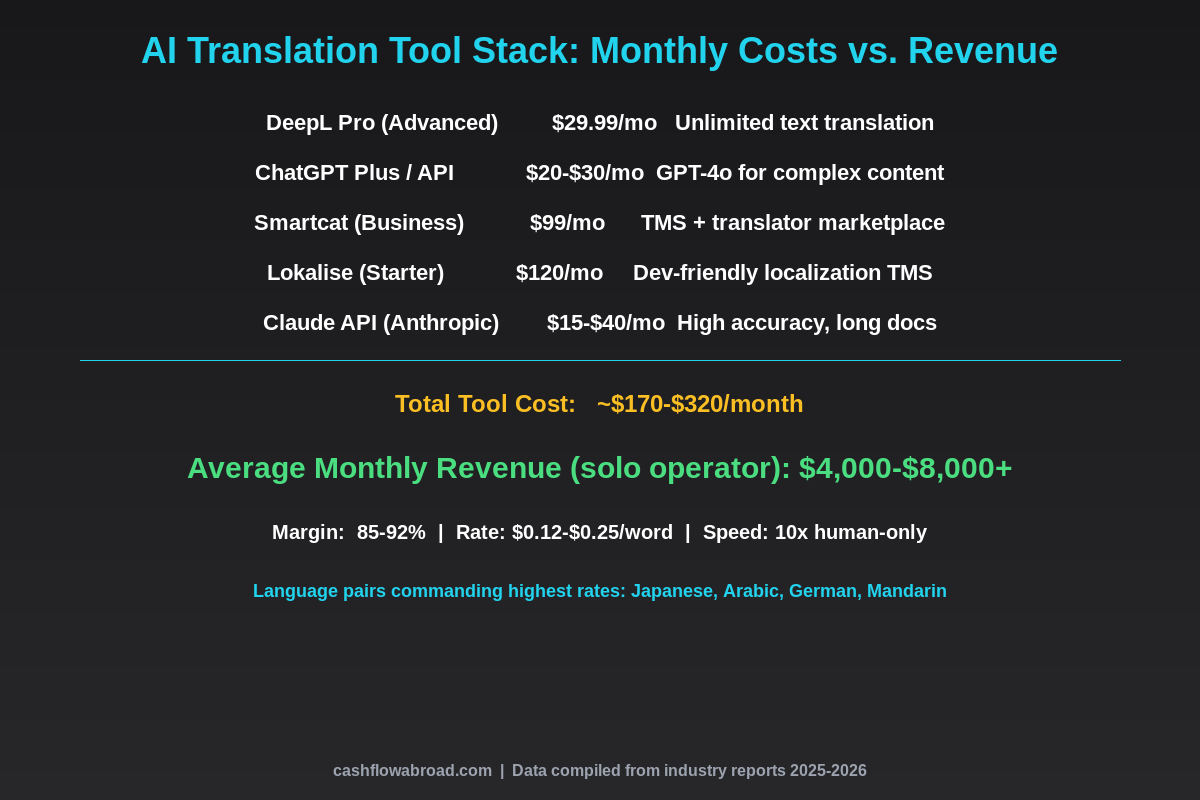
Here’s what a working solo operator uses in 2026. Total cost: $170–320/month depending on volume.
| Tool | Monthly Cost | What It Does | Best For |
|---|---|---|---|
| DeepL Pro Advanced | $29.99 | Neural MT, unlimited text, 20 file translations/mo | European languages, general content |
| ChatGPT Plus / API | $20–$50 | GPT-4o for nuanced, tone-sensitive content | Marketing copy, creative content |
| Claude API (Anthropic) | $15–$40 | Long-document translation, high accuracy | Legal, technical, financial docs |
| Smartcat Business | $99 | Translation management system + payment automation | Managing multiple clients and subcontractors |
| Lokalise Starter | $120 | Dev-friendly localization, integrates with GitHub | SaaS/app localization clients |
You don’t need all of these on day one. Start with DeepL Pro Advanced ($29.99/mo) and a $20 ChatGPT Plus subscription. That’s your entire tool cost in the first 90 days. Add Smartcat when you hit more than 3 active clients — it pays for itself by cutting project management time in half.
The MTPE Workflow That Runs at 10x Speed
MTPE stands for Machine Translation Post-Editing, and it’s the core workflow of every AI-assisted translation business. The idea: you run text through one or more machine translation engines, then a human editor (you, a subcontractor, or a native speaker you hire) reviews and refines the output. The result is professional-quality translation at 3–5x the speed of traditional human-only work.
The actual workflow, step by step:
- Intake the source file. Client sends a Word doc, PDF, Figma export, or JSON strings. Accept all of them — Smartcat handles conversion automatically.
- Run through DeepL first. For most European and Asian languages, DeepL is still the most accurate neural MT engine. It handles idiom, gender agreement, and register better than Google Translate at this price point.
- Layer GPT-4o or Claude for tricky segments. Marketing headlines, legal disclaimers, UI microcopy — anything where tone or precision matters gets a second pass through an LLM with a structured prompt:
"Translate the following to [language]. Maintain a [formal/casual] register. Preserve all product names and legal terms verbatim." - Post-edit in Smartcat. Smartcat shows you the source and MT output side by side with TM (translation memory) suggestions. You’re editing, not translating — which is the entire point.
- QA and delivery. Run a final check for terminology consistency, tag preservation, and formatting. Export in the client’s preferred format. Smartcat handles invoicing.
Time on a typical 2,000-word general business document: 45–90 minutes with MTPE versus 3–4 hours for pure human translation. You’re billing the same rate. The math writes itself.
Rates, Language Pairs, and What Clients Actually Pay
Translation is priced per word, per hour, or per project. For AI-assisted services, most successful solo operators use per-word pricing because it’s industry-standard and scales cleanly.
| Service Type | Rate Range | Notes |
|---|---|---|
| General translation (EN↔ES, EN↔FR) | $0.10–$0.15/word | Competitive, high volume available |
| Technical / software localization | $0.15–$0.22/word | Dev platforms, SaaS products |
| Legal / financial documents | $0.20–$0.30/word | Requires precision, commands premium |
| Japanese, Arabic, Mandarin pairs | $0.22–$0.35/word | Fewer qualified operators, premium rates |
| Website localization (full project) | $500–$3,000/project | Package pricing, higher total revenue |
| Ongoing retainer (SaaS client) | $800–$2,500/mo | Monthly recurring, most valuable contract type |
At $0.15/word, a 5,000-word project pays $750. With MTPE, you can handle 3–4 of those per week. That’s $2,250–$3,000/week from a single language pair. Add a second pair or bring in a native-speaker subcontractor and the ceiling moves fast.
The highest-leverage clients are SaaS companies going international. They generate continuous, predictable translation volume — new features, changelogs, help docs, marketing pages. Land 3–4 of these on monthly retainers and you have a stable base before you touch one-off projects.
The Geographic Arbitrage Layer
This is where the model really compounds. You’re charging US or European clients professional rates. Your operating costs — rent, food, lifestyle — are priced at Colombian or Southeast Asian rates. The gap is the business.
Running this operation from Medellín, Colombia: rent for a furnished 2-bedroom apartment in El Poblado runs $600–$900/month. High-speed fiber internet: $30. Co-working space membership: $80–$120/month. Total overhead: under $1,200/month. At $5,000 in monthly revenue, you’re keeping 75%+ after tools, housing, and living expenses.
From Chiang Mai or Bali, the numbers are similar. The key is that your clients never know — nor do they care — where you’re sitting when you deliver a perfect translated document on time.
The practical requirements: a reliable internet connection (grab a Saily eSIM for mobile data failover when your building’s fiber goes down) and a US banking setup for receiving client payments. A Mercury account works cleanly for international wires with no monthly fees — Mercury is what most expat solo founders use. For maintaining consistent US IP access to platforms, NordVPN handles it for $4–$6/month.
For a US mailing address — needed for business registration, bank accounts, and client correspondence — a virtual mailbox service is the standard setup. See our expat guide to virtual mailboxes for how to handle this before you leave.

Where to Find Clients (And What Actually Works)
Three channels that produce real volume:
Upwork — for building a track record fast
Upwork charges 20% on the first $500 per client, 10% up to $10,000, then 5% above that. It’s expensive early on, but it’s the fastest way to build a portfolio and get reviews. Spend your first 60 days taking underpriced jobs — $0.08–$0.10/word — to build 10–15 five-star reviews. Then raise rates. Established Upwork translators with specializations in legal or technical content regularly bill $0.20+/word.
The pitch that works: don’t say “I’m a translator.” Say “I run a localization service using AI-assisted workflows for faster turnaround without quality compromise.” Clients who’ve been burned by slow agencies respond to this immediately.
Direct outreach to SaaS companies
Find SaaS companies that are English-only but have users in Europe, Latin America, or Asia. Their G2 reviews, App Store listings, and LinkedIn pages will tell you which languages their users actually speak. Cold email their marketing or product teams directly: “I noticed your app doesn’t have a [Spanish/German/Japanese] interface. I’ve localized similar products in under 3 weeks for [rate] — here’s a sample translated section of your own help docs.”
Send 10 of these per week. Expect 1–2 responses per week. Close 1 deal per month in the first quarter. That’s all you need to hit $2,500–$3,000 MRR.
Smartcat’s marketplace
Smartcat connects freelancers directly with agencies and enterprises. Once your profile is complete with language pairs, specializations, and TMS tool proficiencies, inbound project requests start coming in. The client quality is higher than generic freelance platforms — you’re dealing with localization buyers, not general project managers who don’t understand what MT post-editing is.
High-Value Specializations Worth Pursuing
General translation is commoditized. These niches are not:
Software localization: UI strings, error messages, onboarding flows. These require understanding character limits, variable placeholders ({{user_name}}), and UI context. Most translators don’t understand this. If you can handle a Lokalise or Phrase project end-to-end — connect to GitHub, translate strings in context, export back to the dev pipeline — you’re worth $0.18–$0.25/word minimum.
Legal and financial translation: Contracts, compliance documents, prospectus filings. Claude handles long, formal documents remarkably well with a structured system prompt instructing it to preserve all legal terms verbatim, maintain formal register, and flag ambiguous source text for human review. The rate premium is 40–60% over general content.
Game localization: Video games need character dialogue, UI elements, marketing copy, and cultural adaptation. Dialogue must fit character lip-sync constraints; UI strings must fit within pixel budgets. Complex enough that most translators avoid it, which means rates stay at $0.20–$0.35/word at established studios.
E-commerce listing optimization: An Amazon seller expanding to Germany, France, or Japan needs more than translated titles — they need SEO-optimized listings that rank in local search. This is a translation + copywriting hybrid that commands $50–$150 per product listing, and sellers often have hundreds of SKUs.
The 90-Day Ramp: From Zero to $3K/Month
This is the realistic timeline, not the “six figures in 30 days” version:
Days 1–15: Setup. Create Smartcat profile, subscribe to DeepL Pro Advanced, open Mercury for business banking. Register an LLC in Wyoming (~$50/year) to keep liability separate. Pick 1–2 language pairs where you have genuine fluency or can subcontract reliably.
Days 16–45: First projects on Upwork. Submit 5–10 customized proposals per day. Use ChatGPT to help tailor each pitch to the client’s specific project type. Accept jobs at slightly below-market rates to build reviews fast. Target 10 completed projects with five-star ratings by the end of this phase.
Days 46–75: Direct outreach begins. While still working Upwork jobs, send 10 cold emails per week to SaaS companies. Use Apollo.io (free tier) or Hunter.io ($49/mo) to find marketing/product contacts. Include a sample translation of their own content in each email — takes 20 minutes, converts at 5–10x the rate of generic outreach.
Days 76–90: First direct client. You should have 1–2 direct client conversations in progress. Close at least one on a project or monthly retainer. Direct clients bypass Upwork’s 20% fee and create the recurring revenue foundation.
By month 3, a realistic target is $2,500–$4,000/month from a mix of Upwork and 1–2 direct clients. Every new retainer adds $500–$2,500 MRR from there. This is the same compounding model behind passive income streams that work from any country — slow first, then steep.
Scaling Past $5K: The Subcontractor Model
A solo MTPE operator at full utilization can process 15,000–25,000 words per day. That’s a hard ceiling on throughput. Breaking through it means hiring subcontractors — and Smartcat’s payment automation makes this operationally simple.
The economics: hire a qualified native-speaking post-editor on Smartcat’s marketplace for $0.04–$0.06/word. Charge your client $0.15/word. Keep the $0.09–$0.11/word spread as your project margin. On a 50,000-word/month client, that’s $4,500–$5,500/month gross from one client relationship, with most of the actual editing work handled by a subcontractor.
You’ve transitioned from translator to agency operator. Your job becomes: client management, quality oversight, and sales. AI handles 80% of the translation. Subcontractors handle post-editing. You own the client relationships and the margin.
This is the model that generates $20,000–$80,000/month for established language service operators — the same approach behind the $100K/year online business blueprint.
Tax Angle: What You Owe on Translation Income Earned Abroad
If you’re a US citizen, you owe US taxes on worldwide income regardless of where you live. But the Foreign Earned Income Exclusion (FEIE) lets you exclude up to $126,500 (2024) of earned income if you pass the physical presence or bona fide residence test. Translation income from self-employment qualifies as earned income.
The catch: self-employment tax (15.3% on the first $168,600) still applies, because FEIE covers income tax only, not SE tax. Structure your business through an S-corp and pay yourself a reasonable salary to reduce SE tax exposure. Consult a US expat CPA for the mechanics. Full breakdown in our FEIE guide for expats.
Non-US citizens living in Colombia, Panama, Georgia, or other territorial tax countries generally pay zero local tax on income earned from foreign clients. That’s an additional 15–25% that stays in your pocket versus staying in your home country.
The Bottom Line
The AI translation business model is one of the most accessible high-margin service businesses available to expats right now. The tools cost less than a gym membership, the market is measured in the billions, and the geographic arbitrage multiplier is immediate. You don’t need technical skills, venture funding, or a social following. You need language proficiency, $200/month in tools, and the discipline to send 10 cold emails per week until you have enough retainer clients to stop.
The translation industry isn’t dying — it’s bifurcating. Legacy agencies that can’t adapt are losing ground. Solo operators who can run an AI-augmented workflow are capturing that market share from a $600/month apartment in Medellín or a co-working space in Chiang Mai. The timing is close to perfect.
Financial disclaimer: Income figures cited reflect industry data and reported freelancer and operator earnings. Individual results will vary based on language pairs, client base, work volume, and specialization. This post contains affiliate links — we may receive a commission at no extra cost to you. This is not financial or tax advice; consult a licensed professional for your specific situation.
Liked this article?
Get the next one delivered straight to your inbox — plus a free Expat Tax Cheat Sheet.
Join our subscribers. No spam — just expat finance intel and new post notifications.