AI Runs My Shopify Store: $8K/Month, Living Abroad
Run a full AI-powered Shopify dropshipping business from abroad for $141/month in tools. Real workflow, exact tools, and the geographic arbitrage math that makes it work.

Run a full AI-powered Shopify store from anywhere for $141/month. Exact tools, workflows, income math, and expat banking setup included.
A Shopify store owner I know runs six product lines, handles 300+ orders a month, and hasn't replied to a customer email in over a year. He lives in Medellín, Colombia, pays $900/month for a two-bedroom apartment, and clears about $8,200/month net after tool costs. His AI stack costs $141.50/month. Total staff: zero.
This isn't a flex. It's a blueprint. AI has fundamentally changed what it takes to run a profitable e-commerce business — and it's uniquely well-suited for people living abroad. When your operating costs drop by 60–70% because you relocated to a low-cost country, you only need a fraction of the revenue to clear the same profit that would fund a comfortable US life. AI covers the labor that used to eat that margin.
Here's the exact system, tool by tool, step by step.
Why E-Commerce Is Built for Expats
Traditional e-commerce margins are thin. On a typical Shopify dropshipping store, you're looking at 15–25% net profit on revenue. On $10,000/month in sales, that's $1,500–$2,500 take-home. In Austin or San Francisco, that barely covers rent. In Bangkok, Tbilisi, or Buenos Aires, it's a comfortable middle-class life with money to reinvest.
Geographic arbitrage — earning in dollars while spending in local currency — is the unfair advantage. It turns a modest e-commerce side hustle into a legitimate income stream. And when you layer AI on top to handle the repetitive work (product research, copywriting, customer service, email flows), you remove the bottlenecks that keep most solo operators stuck below $3K/month.
The global dropshipping market is expected to hit nearly $500 billion, and AI-driven tools have pushed top performers' net margins from 15% toward 30%. That's not a typo. AI isn't just saving time — it's improving conversion, reducing returns, and cutting support costs simultaneously.
Step 1: Finding Winning Products with AI
Most failed Shopify stores picked products based on gut instinct. Winning stores pick products based on data — and AI makes reading that data fast and cheap.
Helium 10 (for Amazon-linked product research)
Cost: $29/month (Starter plan)
Helium 10 has 30+ tools covering product research, keyword tracking, and listing optimization. Even if you're running a Shopify store rather than selling directly on Amazon, Helium 10 is invaluable for spotting what's selling. The Xray Chrome extension shows you estimated monthly revenue, review counts, and demand trends for any Amazon product category in seconds.
The workflow: open Amazon, browse a niche you're interested in (say, ergonomic office accessories), run Xray, filter for products with 1,000+ monthly sales and fewer than 200 reviews. Products that fit this filter have proven demand with gaps in competition — exactly what you want to launch against on Shopify.
ChatGPT for Cross-Platform Research
Once you have a shortlist, run each product through ChatGPT (o4-mini is free, GPT-4o is $20/month via ChatGPT Plus) with this prompt:
I'm considering dropshipping [product name] on Shopify, targeting US customers.
Analyze: (1) typical customer pain points this product solves, (2) the most likely
winning customer demographics, (3) 5 Facebook/Meta ad angles I should test,
(4) the top 3 objections customers have before buying, and (5) potential upsell
or bundle opportunities. Be specific.
In 30 seconds you get a customer psychology breakdown that used to require a $2,000 market research report. That becomes the foundation for your entire store — copy, ads, email sequences, everything.
Step 2: Building the Store + AI Copywriting
Shopify Basic: $39/month
Shopify Basic gives you everything you need: custom domain, unlimited products, two staff accounts, and built-in payment processing (2.9% + 30¢ per transaction via Shopify Payments). For dropshipping, pair it with DSers (free) or Zendrop ($49/month with automation features) to connect AliExpress suppliers.
Shopify Magic — Shopify's built-in AI tool, free on all plans — generates product descriptions, SEO-optimized page titles, and even email subject lines from a single paragraph of input. The average merchant saves 15–20 hours per week on content creation. At freelancer rates, that's $450–$900/week in labor costs avoided.
For a new product listing, the workflow looks like this:
1. Import product from AliExpress via DSers
2. Paste the raw supplier description into Shopify Magic
3. Specify: tone (conversational/premium/urgent), target audience, key benefit
4. Magic rewrites it into conversion-ready copy with SEO keywords
5. Adjust the headline manually (AI headlines are often too generic)
6. Done — full product page in under 10 minutes
For homepage copy, FAQ sections, and About pages, Claude (claude.ai, free tier available, Pro is $20/month) consistently produces better long-form brand copy than Shopify Magic. Give it 3–4 sentences about your store's positioning and ask it to write as a senior DTC copywriter with deep direct-response experience. The output is often better than what most agencies produce at $3,000/month.
Step 3: Product Images Without a Photography Studio
Professional product photography costs $25–$100 per image. For a 20-product store, that's $500–$2,000 before you've made a single sale. AI has mostly eliminated this barrier.
Midjourney ($10/month basic, $30/month standard)
Midjourney generates photorealistic lifestyle images from text prompts. For product visualization:
1. Get a clean product photo from your supplier (even a mediocre one works)
2. Use /blend to merge your product photo with a lifestyle scene, OR
3. Use this prompt: "[product] on [surface], [setting], [lighting],
   product photography, commercial, 4k, soft shadows --ar 1:1"
4. Generate 4 variations, pick the best, upscale to 2048px
5. Run through Adobe Firefly (free tier) to clean edges or swap backgrounds
For product-on-white backgrounds (standard for marketplaces), Remove.bg ($0.20/image or free for low-res) isolates the product in seconds. For a lean startup stack, Shopify Magic's built-in image editor + Remove.bg covers 80% of image needs for under $5/month.
Step 4: AI Customer Service — The Biggest Time Saver
At 100 orders/month, you're fielding 15–30 support tickets weekly. At 300 orders, that's 45–90. Without AI, that's a part-time job.
Tidio Lyro ($32.50/month)
Tidio's Lyro AI agent connects directly to your Shopify store, reads your product catalog, order history, and shipping data, and answers customer questions autonomously. Setup is two hours — feed it your FAQ, connect it to Shopify, go live.
Lyro's Actions feature lets the AI perform real tasks: check order status, update shipping addresses, process returns — not just answer questions but actually take action inside your store backend. Shopify sellers running AI chatbots report 28% increases in conversion rates and 60% drops in support tickets. Lyro handles 80% of pre-purchase inquiries without human involvement.
| Tool | Best For | Starting Price | AI Feature |
|---|---|---|---|
| Tidio Lyro | Stores under $15K/mo revenue | $32.50/month | Full AI agent, 2-hr setup |
| Gorgias | High-volume Shopify Plus brands | $10/month (50 tickets) | AI automation + deep Shopify data |
| eesel AI | Stores with extensive documentation | $49/month | Custom AI trained on your content |
Step 5: Email Marketing on Autopilot with Klaviyo
Klaviyo: Free up to 500 contacts, then $30/month for up to 1,000
Email delivers $42 return per $1 spent on average — still the highest-ROI marketing channel in e-commerce. Klaviyo is the standard for Shopify stores, and its AI features have dramatically lowered the skill floor for building high-converting flows.
The five automated flows every store needs:
- Welcome series (3 emails over 5 days): introduce the brand, share the origin story, offer a 10% discount. AI writes the copy; you set the trigger.
- Abandoned cart (2 emails: 1 hour later, 24 hours later): AI personalizes subject lines based on the specific product abandoned.
- Post-purchase follow-up (3–5 days after delivery): request a review, suggest related products. AI recommends complementary items based on purchase data.
- Win-back (90 days of inactivity): Klaviyo AI predicts churn and triggers a targeted offer before you lose the customer permanently.
- Browse abandonment (triggered when someone views a product 2+ times without buying): gentle nudge with exactly what they were looking at.
A fully automated Klaviyo setup generates 20–35% of total store revenue for most DTC brands — without any ongoing maintenance after initial setup. That's recurring passive revenue baked into the operation.
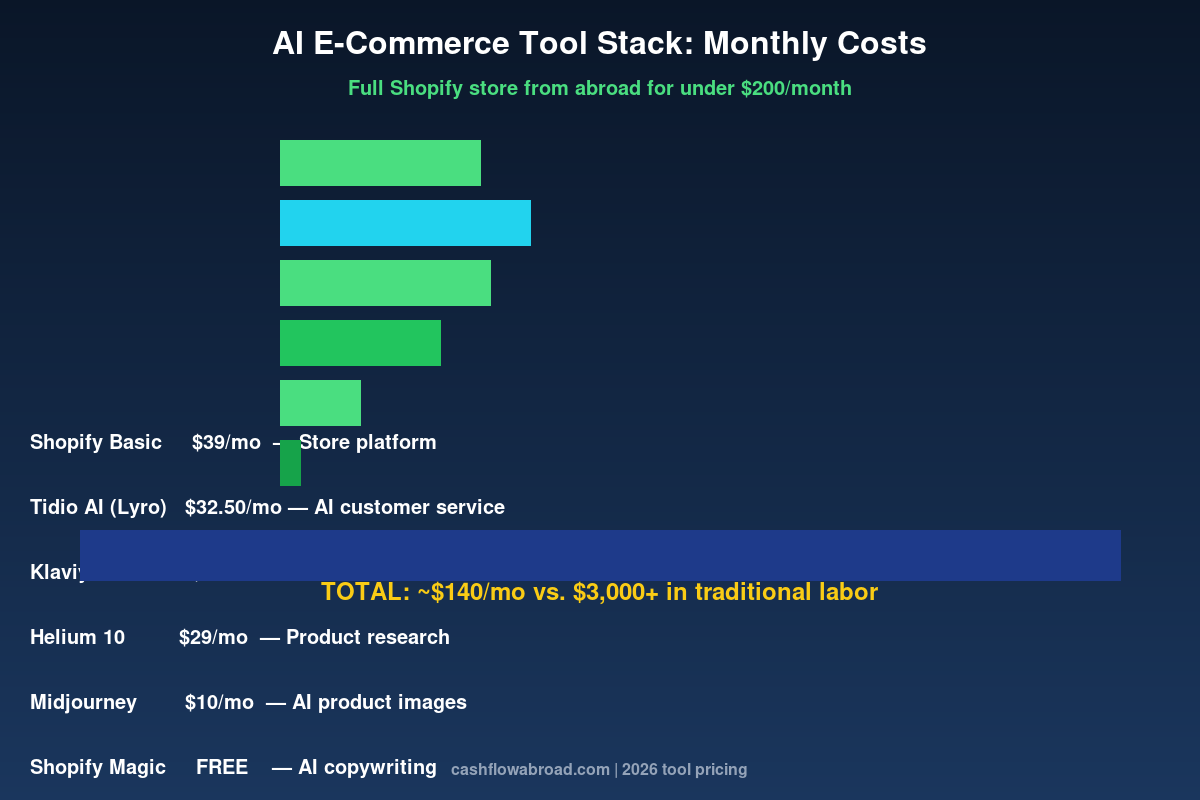
The Complete AI Stack: $141.50/Month Total
| Tool | Purpose | Monthly Cost |
|---|---|---|
| Shopify Basic | Store platform + checkout | $39.00 |
| Tidio Lyro | AI customer service | $32.50 |
| Klaviyo | Email automation | $30.00 |
| Helium 10 Starter | Product research | $29.00 |
| Midjourney Basic | AI product images | $10.00 |
| Shopify Magic | AI copywriting | Free |
| ChatGPT Plus (optional) | Research + ad copy | $20.00 (optional) |
| Total (without ChatGPT) | $140.50/mo |
Compare that to hiring a VA for customer service ($400–$800/month), a freelance copywriter ($500–$2,000/month for ongoing work), an email marketing manager ($1,500–$3,000/month), and a product photographer ($200–$500/month for new listings). Traditional labor costs run $2,600–$6,300/month for the same functions. AI does it for $140.50.
The Math: Why This Works Better from Abroad
Run the numbers on a store doing $10,000/month in revenue with 20% net margin ($2,000 profit after cost of goods, ads, and tools):
- Living in New York: $2,000/month doesn't cover rent. You're losing money on paper.
- Living in Medellín, Colombia: $2,000/month funds a very comfortable life — nice apartment, restaurants, gym, travel. You're banking $400–$600/month after everything.
- Living in Chiang Mai, Thailand: $2,000/month is upper-middle-class. You're saving $800–$1,000/month consistently.
- Living in Tbilisi, Georgia: $2,000/month is borderline wealthy. $1,200+ in monthly savings with a flat 20% income tax.
Scale to $25,000/month revenue (achievable in 12–18 months for a store that nails product-market fit), and you're looking at $5,000/month take-home from an operation running itself 80% autonomously. For a deeper breakdown of the geographic arbitrage calculation across 10 countries, we've done the full math.

Getting Paid and Managing Money From Abroad
Running a Shopify store from abroad requires a US business entity and US banking — both to use Shopify Payments and to maintain credibility with suppliers.
Business Structure
Register a US LLC in Wyoming or Delaware (both have no state income tax on foreign-member LLCs). You can do this remotely via Northwest Registered Agent or similar for $49–$149 setup fee. Wyoming has no franchise tax and strong privacy protections for members.
You'll need a US address for the LLC registration and to receive business mail. A Traveling Mailbox virtual mailbox ($15–$25/month) gives you a real street address in any US state — mail gets received, scanned, and forwarded to you digitally wherever you are. We break down the full setup in the expat virtual mailbox guide.
Banking
Mercury is the go-to US business bank for remote founders. It's free, online-only, and designed for startups and e-commerce businesses. Shopify Payments deposits go directly to Mercury, you can send international wires, and the interface beats traditional banks by miles. No monthly fees, no minimum balances.
For personal transfers from your Mercury business account to your local bank abroad, use Remitly — consistently better rates than bank wires with faster settlement (same-day to most LATAM and Asian markets).
Keep Your Accounts Secure
Operating from multiple countries can trigger fraud flags on Shopify, Stripe, and ad accounts when your IP jumps between countries. A reliable NordVPN subscription ($3.79–$6.99/month) maintains a consistent US IP for business accounts and protects your connection on public café WiFi. Non-negotiable when your store is doing real revenue.
Tax Considerations for Expat E-Commerce Sellers
US citizens abroad still owe US taxes on worldwide income — including Shopify revenue. However, if you qualify for the Foreign Earned Income Exclusion (FEIE), you can exclude up to $126,500 in earned income from US federal taxes. The key word is "earned" — which includes self-employment income from actively running your store.
The catch: self-employment tax (15.3%) still applies to net self-employment income even under FEIE. One structural solution is running your store through an S-Corp and paying yourself a "reasonable salary," with remaining profits distributed as owner dividends not subject to SE tax. Talk to an expat CPA before implementing — the math varies significantly by revenue level. See our full breakdown of how FEIE works for expats with online income.
Where to Start This Week
The most common paralysis point: "I don't know what to sell." Here's the fastest path from zero to your first validated product:
- Sign up for Helium 10's free plan and install the Chrome extension
- Browse Amazon in 3–4 niches you find genuinely interesting
- Filter: minimum 500 monthly sales, max 300 reviews, product price $15–$80
- Shortlist 5–8 products that meet the criteria
- Run each through ChatGPT with the prompt in Step 1 to assess customer psychology fit
- Pick the one you could write 10 ad angles for without effort — that's your market
- Source via DSers from AliExpress, use Shopify Magic for listings, deploy Tidio in 2 hours
- Budget $300–$500 for initial Meta ads to validate demand before scaling spend
The full setup — Shopify store live, product sourced, listings written by AI, customer service active, email flows triggered — takes about two weeks of focused evening work. After that, AI handles the operations and your job is finding the next winning product and optimizing ad spend.
For more context on building sustainable online income from anywhere, see our guide to building a $100K online business from abroad and passive income streams that work in any country.
Conclusion
AI hasn't just made e-commerce easier — it's made it viable for one person, working from anywhere, with a $140/month tool budget. The combination of AI handling operations and geographic arbitrage compressing your cost of living creates a margin structure that's genuinely hard to replicate if you're trying to do this from a high-cost city.
The $141.50/month stack isn't about being cheap. It's about replacing $3,000–$6,000/month in labor with software that works 24/7, doesn't call in sick, and gets incrementally better every quarter. Add the cost advantage of living on $1,200–$1,800/month abroad instead of $4,000+ in the US, and even a modest Shopify store becomes a cash-flowing lifestyle business worth taking seriously.
The model is proven. The tools exist and are priced for solo operators. The only thing left is to pick a product and start.
Financial disclaimer: Income figures referenced in this post are illustrative examples based on publicly available industry data from sources including Sell The Trend, Qikify, and Grand View Research. Individual results vary significantly based on niche selection, advertising spend, execution quality, and market conditions. E-commerce involves real financial risk including product sourcing costs, advertising expenditure, and potential chargebacks. This post contains affiliate links; we may earn a commission if you purchase through them at no extra cost to you. This is not financial or legal advice. Consult a qualified financial advisor and tax professional before making business or investment decisions.
This guide is general information, not personalized tax, legal, or investment advice. Rules change; verify current thresholds with official sources or a qualified professional before acting.
Related guides
 AI Income & Cash FlowMay 6, 2026
AI Affiliate Sites: $5K/Month on $160 in Tools
Build an AI-powered affiliate site earning $5K/month from abroad using just $160/month in tools. Real workflow, income timeline, and arbitrage math
 AI Income & Cash FlowMay 21, 2026
Sell AI Services on Upwork: $5K/Month From Abroad
Demand for AI skills on Upwork grew 109% in 2026. Use this step-by-step guide to sell AI services and earn $5K–$10K/month while living abroad.
 AI Income & Cash FlowMay 16, 2026
The $200/Month AI Stack That Makes $10K/Month
Exact tools, real prices, 3 business models: how one-person AI businesses generate $10K/month from abroad on under $200/month in software.