The $200/Month AI Stack That Makes $10K/Month
The exact AI tool stack — under $200/month — that one-person businesses use to generate $10K/month from abroad. Real tools, real prices, real workflows.

Exact tools, real prices, 3 business models: how one-person AI businesses generate $10K/month from abroad on under $200/month in software.
A solo developer in Medellín recently cleared $11,400 in a single month — after tool costs — running three AI-enhanced service contracts simultaneously. His total monthly software spend: $117.82. His rent: $650. The math isn't complicated; it's just geographic arbitrage applied to the AI business model, and it works better than almost anything else available to independent professionals right now.
This post breaks down the exact tools, their real pricing, the three business models generating that income, and the step-by-step workflow for getting from zero to $5K/month in your first 90 days. No vague "AI is changing everything" preamble. Just the stack, the numbers, and the playbook.
Why the Math Works So Well Abroad
Here's the core dynamic: your clients are paying you in USD (or EUR) at rates set by markets in San Francisco, London, or Toronto. Your costs — rent, food, transport, coworking — are denominated in Colombian pesos, Indonesian rupiah, or Georgian lari. The AI tools that multiply your output? Priced in USD but identical regardless of where you sit.
At $10,000/month gross revenue with $1,500/month in living expenses and $118/month in tools, your take-home is around $8,382 before taxes — roughly an 83% margin. That same work done from a San Francisco apartment costs you $4,200–$5,500/month to live, turning that 83% margin into something closer to 40%.
The geographic arbitrage doesn't just make you more comfortable. It fundamentally changes the risk calculus of building an AI business. You can test, pivot, and experiment when your burn rate is $1,600/month total. You can't do that at $6,000/month.
For the full breakdown of the best countries for running this play, see our geographic arbitrage playbook. For Colombia specifically — which has become a top destination for AI freelancers — this guide on running a US business from Colombia covers the tax and banking setup.
The Core Stack: Exact Pricing, No Fluff
The stack below is optimized for a one-person AI business running content services, automation builds, or consulting. Every price is current as of 2026. Free tiers are noted — use them until you hit the limits, then upgrade.
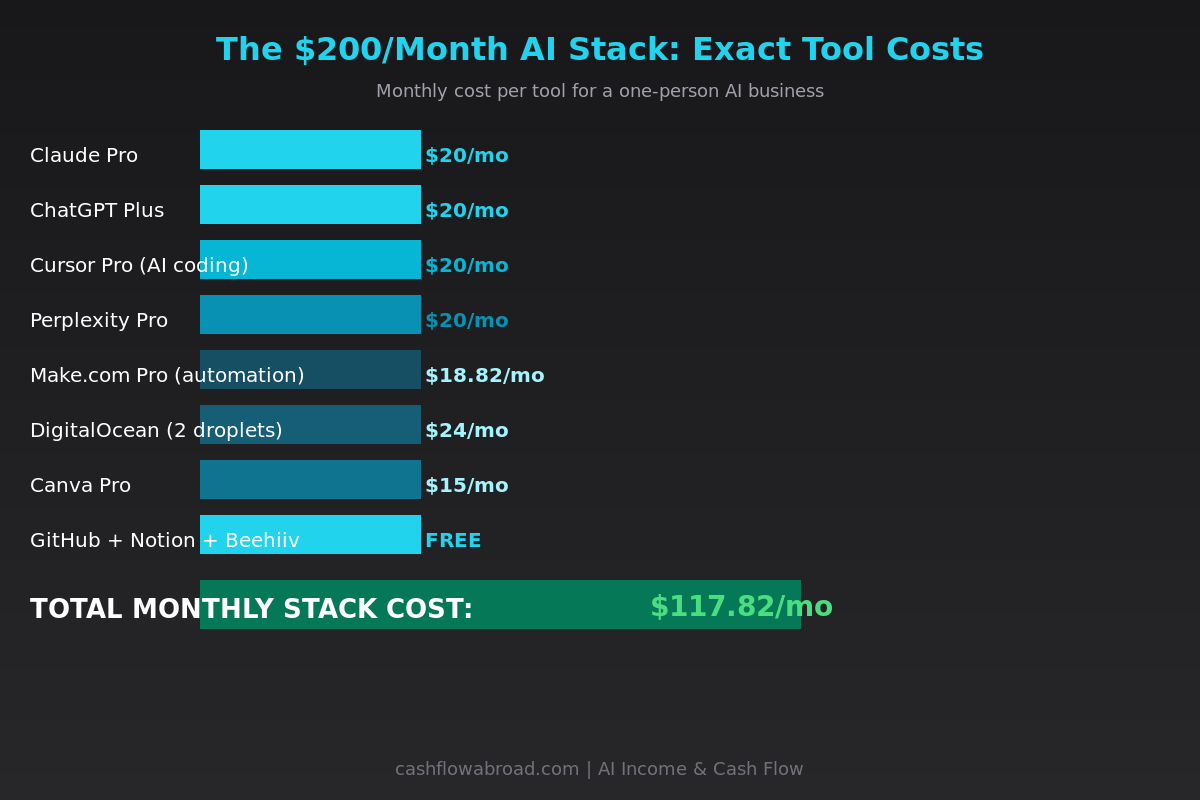
Tier 1: AI Assistants ($40/month)
Claude Pro — $20/month. Claude is your primary workhorse for long-form content, complex analysis, code review, and anything requiring extended context. The 200K token context window makes it non-negotiable for processing large client briefs, codebases, or research documents in a single pass. At $20/month, it's the highest-ROI tool in this stack for writers and consultants. Use Claude for client-facing deliverables where quality matters most.
ChatGPT Plus — $20/month. GPT-5.5 in the Plus tier adds DALL-E image generation, Sora video previews, and Codex for rapid code generation. The real value here is breadth: when Claude refuses a task or handles it awkwardly, ChatGPT usually picks it up. Running both costs $40/month and eliminates the "my AI can't do this" bottleneck entirely. Many solo operators drop to one after 60 days — keep both during ramp-up.
Tier 2: Research + Coding ($40/month)
Perplexity Pro — $20/month ($200/year = $16.67/month). Perplexity replaces Google for research-heavy work. For AI consultants and content creators who need to cite real data — pricing, case studies, market numbers — Perplexity gives you sourced, up-to-date answers instead of hallucinated ones. Buy the annual plan: $200/year instead of $240.
Cursor Pro — $20/month. If any part of your business involves building products — a client-facing dashboard, an internal automation script, a custom API integration — Cursor is the essential coding tool. It's a VS Code fork with deep AI integration: you can generate an entire Python script by describing it in plain English, then have Cursor debug, refactor, and optimize it. For non-technical founders, Cursor plus Claude is the fastest path to shipping functional software without hiring a developer. Cursor's free tier gives 2,000 auto-completions/month — enough to evaluate it before committing.
Tier 3: Automation + Hosting ($42.82/month)
Make.com Pro — $18.82/month. Make (formerly Integromat) is how you chain AI tools together without writing glue code. A typical workflow: a new client submits a form → Make triggers a Claude API call → Claude generates a draft → Make emails it to the client → Make logs everything to Notion. That entire pipeline runs unattended. Make's Pro tier gives 10,000 operations/month with custom variables — enough for hundreds of client deliverables. Compare that to Zapier's Professional plan at $29.99/month for 750 tasks. Make wins on volume every time.
DigitalOcean — $24/month (2× Basic Droplets). You need somewhere to host client-facing tools, API endpoints, and automation scripts. Two DigitalOcean Basic Droplets ($12/month each for 2vCPU/2GB RAM) covers a portfolio of 4–8 client projects. Managed databases (PostgreSQL, Redis) start at $15/month and handle everything from a simple chatbot backend to a content management API. DigitalOcean pricing is predictable, the UI is clean, and one-click app deployments get you running in minutes — far less overhead than AWS for a solo operator.
Tier 4: Design + Delivery ($15/month)
Canva Pro — $15/month. Clients paying $2K–$5K/month for content packages expect polished deliverables: social graphics, report covers, slide decks. Canva Pro's brand kit lets you maintain separate visual identities for 5–10 clients simultaneously. The AI background remover and "Magic Write" feature save 30–45 minutes per design session. At $15/month, it's among the cheapest hours of your time you'll buy.
The Free Tier Stack ($0/month)
GitHub Free — unlimited public/private repos, GitHub Actions for CI/CD. Use this to host all your code and automate deployments to DigitalOcean.
Notion Free — client project management, SOPs, knowledge base. The free tier handles unlimited blocks and up to 5 guests — more than enough for a solo operator.
Beehiiv Free — newsletter infrastructure for up to 2,500 subscribers. If content creation is your primary model, Beehiiv's free tier runs your newsletter until revenue justifies the $42/month Growth plan.
Claude API + OpenAI API — pay-as-you-go, typically $5–$30/month for most solopreneur workloads. Claude 3.5 Haiku is $0.80 per million input tokens — a bargain for high-volume automation tasks like email triage, document summarization, or client intake processing.
Total Monthly Stack Cost
| Tool | Plan | Monthly Cost | Primary Use |
|---|---|---|---|
| Claude Pro | Pro | $20.00 | Content, analysis, code review |
| ChatGPT Plus | Plus | $20.00 | Image gen, Codex, breadth tasks |
| Cursor Pro | Pro | $20.00 | AI-assisted coding & product building |
| Perplexity Pro | Annual ($200/yr) | $16.67 | Sourced research, competitive analysis |
| Make.com | Pro | $18.82 | Workflow automation, client pipelines |
| DigitalOcean | 2× Basic Droplets | $24.00 | Hosting, APIs, databases |
| Canva Pro | Pro | $15.00 | Client design deliverables |
| GitHub / Notion / Beehiiv | Free | $0.00 | Code, project management, newsletter |
| Total | $134.49 |
Add $20–$30/month in API credits during active project months and you're at roughly $155–$165/month. Comfortably under $200.
Three Business Models That Hit $10K/Month With This Stack
The stack above is infrastructure. Here's how it generates revenue.
Model 1: AI-Enhanced Content Packages ($3K–$6K/month per client)
The productized content package is the fastest path to recurring revenue. You're not selling "AI content" — you're selling a content operation: strategy, production, editing, and distribution. AI handles the heavy lifting on first drafts while you handle quality, brand voice, and strategic direction.
A mid-market SaaS company needs: 4 long-form blog posts (2,000+ words each), 12 LinkedIn posts, 2 email sequences, and monthly SEO reporting. That's a $3,000–$4,500/month package. Three clients = $9,000–$13,500/month. Your actual production time: 40–60 hours using AI assistance, versus 120–150 hours without it. According to Jobbers.io's 2026 Freelance Benchmark Report, AI-enabled freelancers earn approximately 40% more per hour than peers who don't use AI tools — and deliver 25–40% faster output.
Workflow: Client brief → Perplexity for topic research and competitive analysis → Claude for first draft (often 1,800+ words in under 5 minutes) → human editing pass → Canva for featured images and social graphics → delivery via shared Notion workspace. Make.com automates client reporting emails and tracks deliverable status.
Model 2: AI Automation Builds ($3K–$6K setup + $500–$1,500/month retainer)
Small businesses are drowning in repetitive tasks that AI can automate: customer intake, invoice processing, lead qualification, email triage, report generation. You diagnose the bottleneck and build the Make.com + AI workflow that solves it. One-time build fee of $3,000–$6,000. Monthly maintenance retainer of $500–$1,500.
A real estate agency spends 15 hours/week manually qualifying leads and drafting property descriptions. You build: (1) a lead intake form that triggers a Claude API call to score and qualify the lead, (2) a Make.com workflow that generates a property description draft from listing data, (3) a Slack notification system routing hot leads to agents instantly. Total build time: 20–30 hours. Fee: $4,500. Monthly retainer: $750 to handle updates and new automations.
Two clients like this generates $1,500/month in pure retainer revenue with almost no ongoing time investment. Add one new build per month at $4,500 and you're at $10,500/month.
Here's the core Make.com scenario structure (simplified):
# Make.com: AI Lead Qualification Pipeline

Trigger: Typeform webhook (new lead submitted)
  → Module 1: HTTP request to Claude API
      Prompt: "Score this lead 1-10 based on: {lead_data}
               Return JSON: {score, reasoning, priority_flag}"
  → Module 2: Router
      Branch A (score >= 7):
        → Send Slack alert to sales team
        → Add to Airtable "Hot Leads" base
      Branch B (score < 7):
        → Add to Airtable "Nurture" base
  → Module 3: HTTP request to Claude API
      Prompt: "Draft a personalized follow-up email for {lead_name}
               interested in {product}. Tone: consultative, not salesy."
  → Module 4: Gmail — send draft to agent for approval
That's a complete AI-powered lead qualification pipeline, built in Make.com without writing a single server. Your DigitalOcean droplet hosts the webhook endpoint if the client needs custom integration beyond what Make.com's native connectors support.
Model 3: AI Implementation Consulting ($100–$200/hour)
This is the highest-margin model. You're hired to help companies figure out where and how to implement AI — which tools, which workflows, what to automate first, how to train the team. Prompt engineers now average $70.61/hour according to ZipRecruiter, with specialists on Upwork and Toptal billing $100–$300/hour for project work.
The sweet spot: mid-size companies (50–500 employees) that know they need to "do AI" but don't have an internal AI lead. They need someone to assess their current stack, identify the 3–5 highest-ROI automation opportunities, build a proof-of-concept, and create a roadmap. That's a $5,000–$15,000 engagement, delivered remotely over 4–8 weeks.
Twenty hours a month of consulting at $150/hour = $3,000. Combined with one content client ($3,500/month) and one automation retainer ($750/month), you're at $7,250/month before any new builds. Add one consulting engagement or content client and you're past $10K.
Platform Fees and Where to Find Clients
| Platform | Fee Structure | Best For | Notes |
|---|---|---|---|
| Upwork | 0–15% (typically ~10%) | Consulting, automation builds | Switched from tiered 20/10/5% to variable in 2025; AI job postings grew ~300% YoY |
| Fiverr | Flat 20% | Packaged content services | Highest platform cut; works best for fixed-price productized offers |
| Toptal | 0% (you negotiate rate) | High-end AI consulting | Strict vetting; very high rates post-acceptance ($150–$300/hr typical) |
| LinkedIn DMs (direct) | 0% | All three models | Best long-term ROI once you have 2–3 case studies to reference |
| Cold email | 0% | Automation builds | Target operations managers at SMBs; use Clay.com + Apollo for list building |
Start on Upwork for your first 2–3 clients — the platform's vetting mechanism helps land initial trust without a portfolio. Transition to direct outreach once you have case studies to show. At that point, eliminating platform fees adds 10–20% to your effective hourly rate immediately.

The 90-Day Ramp: From Zero to $5K/Month
This is the timeline that works — not the optimistic version, the realistic one.
Month 1 — Build the foundation ($0 revenue, $0 tool cost): Use free tiers exclusively. Set up Claude free, ChatGPT free, Cursor free (2,000 auto-completions), Make.com free (1,000 operations), Notion free. Build three portfolio pieces: one content sample (2,000-word article in your target niche), one automation demo (a recorded Make.com walkthrough with mock client data), one consulting report (AI opportunity analysis for a fictional business in your sector). Use Perplexity free tier for all research. Do not spend money until you have clients.
Month 2 — Land first clients ($1,500–$3,000 revenue): Upgrade to Claude Pro ($20) and Make.com Core ($10.59) only — $30.59/month total. Post your portfolio on Upwork. Target one content client ($1,500/month) and one small automation build ($1,000–$2,000 one-time). The goal isn't profit; it's testimonials and case studies. Spend 80% of your time delivering excellent work and 20% in outreach.
Month 3 — Scale to full stack ($4,000–$6,000 revenue): Upgrade to the full stack ($134/month). Add Cursor Pro for any coding projects, DigitalOcean for hosting client tools, Canva Pro for design deliverables. Land a second content client, raise your consulting rate to $100/hour, take on one retainer automation client. By end of Month 3, you should have 2–3 active clients generating $4,000–$6,000/month.
Months 4–6 are about replacing lower-paying clients with higher-paying ones and systematizing delivery so each client requires fewer hours. The economics compound: as reputation builds, you raise rates; as processes tighten, you need fewer hours per client; as income grows, tool costs become rounding errors.
Banking and Getting Paid From Abroad
Getting paid is straightforward if you set it up before you leave. Mercury is the cleanest US business banking option for expats — free, no minimum balance, wire transfers in 1–2 business days, and a debit card that works globally. Clients pay your Mercury account via ACH or wire; you withdraw from ATMs abroad or transfer to local accounts via Remitly.
If you're maintaining a US address for your LLC — which you should, for contract credibility and banking purposes — Traveling Mailbox gives you a real US street address, scans physical mail, and forwards important documents. At $15–$20/month it's one of the most underrated tools in the remote business operator's stack. We cover the full setup in our virtual mailbox guide for expats.
Working from cafes and coworking spaces means you're regularly on public WiFi. NordVPN at $4–5/month (on the 2-year plan) is non-optional when you're transmitting client data and API keys on networks you don't control. It's also a legitimate business expense.
What This Stack Can't Do (Honest Limits)
AI tools don't replace client acquisition. The hardest part of this model is landing the first 3–5 clients, not building deliverables. Budget 10–15 hours/week on outreach during your first two months. The stack also doesn't replace domain expertise: the highest-paid AI consultants aren't AI generalists — they're industry specialists (healthcare, legal, e-commerce, real estate) who understand AI's application to their sector. Build AI skills on top of something you already know well.
The stack is also optimized for service businesses, not product businesses. If you want to build a SaaS product, you'll eventually need Stripe subscriptions, proper customer support tooling, and more robust infrastructure. That's a different — and more expensive — model. The service model outlined here is the fastest path from zero to $10K/month.
For a broader view of building a location-independent income portfolio beyond AI services, see our passive income streams guide and the full $100K online business playbook.
Conclusion
The $200/month AI stack isn't hypothetical — it's the actual infrastructure thousands of solo operators are running right now to generate $5K–$15K/month from service businesses while living in cities where $1,500 covers a great apartment, good food, and a coworking membership. The geographic arbitrage multiplier makes the margins look almost absurd by Western standards. That's the point.
Start with free tiers. Build three portfolio pieces. Land one client. Upgrade the tools as revenue justifies it. The stack costs $30/month for the first 60 days — a real barrier to exactly no one.
Financial disclaimer: Income figures cited represent reported earnings from freelancers and solo founders and are not guarantees of individual results. Actual earnings depend on skills, client acquisition, work quality, and market conditions. Tool pricing is accurate as of publication but subject to change. This post contains affiliate links — we may earn a commission if you purchase through them, at no additional cost to you. All recommendations are based on genuine research and use.
This guide is general information, not personalized tax, legal, or investment advice. Rules change; verify current thresholds with official sources or a qualified professional before acting.
Related guides
 AI Income & Cash FlowMay 21, 2026
Sell AI Services on Upwork: $5K/Month From Abroad
Demand for AI skills on Upwork grew 109% in 2026. Use this step-by-step guide to sell AI services and earn $5K–$10K/month while living abroad.
 AI Income & Cash FlowMay 9, 2026
AI Freelancing Abroad: Earn $8K/Month on Upwork
AI freelancers earn 44% more on Upwork. Learn which services pay most, exact tool costs, and step-by-step workflows to earn $5K+/month from anywhere.
 AI Income & Cash FlowApril 30, 2026
Geographic Arbitrage + AI: Earn $8K/Month Abroad
Earn $75-$150/hr with AI skills while living on $1,500/month abroad. Real tools, rates, cities, and a 60-day client-landing plan.