Paraguay Tax Residency: Earn Globally, Pay Zero
Paraguay taxes 0% on foreign income, costs $1,800 to get residency, and only requires a visit once every 3 years. Here is the complete expat guide.
Most expats hunting for zero-tax residency spend months researching Cyprus, Malta, or Panama. Yet fewer than 2% ever look at the country sitting quietly at the center of South America — a place where the total cost to get legal residency is roughly what you'd spend on a long weekend in Miami.
Paraguay offers 0% tax on all foreign-sourced income, no minimum stay requirement (you must visit once every three years), a cost of living where $1,200/month buys a genuinely comfortable life, and a path to citizenship in three years. The government residency fee runs $357. With a local lawyer, you're looking at $1,400–$1,800 total to be done.
That's the whole pitch. Everything below is the proof.
Why Paraguay Flies Under the Radar
Paraguay doesn't make listicles. It has no Michelin-starred restaurant scene, no "fastest-growing digital nomad hub" headline, no Instagram-famous coastline. What it has is a territorial tax system, political stability by South American standards, and a government that genuinely wants foreign income earners to park their residency there.
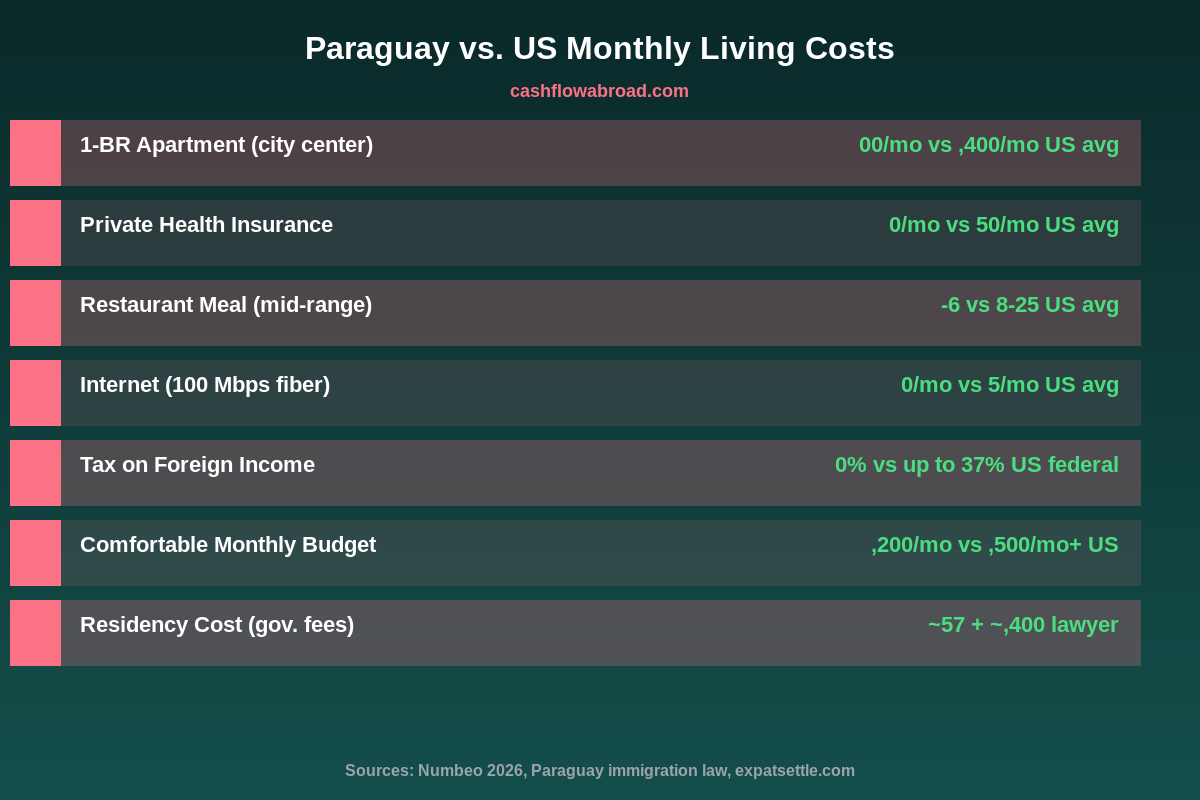
The country ranks among the cheapest in the Western Hemisphere on the World Bank's price-level index. A 1-bedroom apartment in Villa Morra — Asuncion's upscale neighborhood — goes for $400–600/month. A comedor lunch (the equivalent of a sit-down local restaurant) runs $3–6. Fiber internet: $30/month. Monthly bus pass: $34. Private health insurance for a healthy 35-year-old: $50–150/month depending on coverage level.
Compare that to the median US household spending $5,500+ per month just to break even in a mid-tier American city, and the arbitrage becomes obvious fast.
How Paraguay's Tax System Works for Expats
Paraguay operates on a strict territorial tax principle: only income generated within Paraguay is taxed. Dividends from a US brokerage, freelance income from foreign clients, rental income from a property in another country, proceeds from selling foreign stocks — all taxed at exactly 0% in Paraguay.
Local Paraguayan income is taxed at a 10% flat rate (Impuesto a la Renta Personal, or IRP) once it exceeds approximately $12,500/year — a threshold most expats with foreign-sourced income never trigger.
There is no wealth tax. No inheritance tax. No capital gains tax on foreign-held assets. VAT runs 10% on most goods (5% on basic necessities), which you pay as a consumer but don't file separately.
The US Expat Angle: FEIE + Paraguay = Your Lowest Legal Tax Bill
US citizens owe US tax on worldwide income regardless of where they live — that's the deal. But Paraguay residency stacks cleanly with the two main tools US expats use to reduce that bill:
- Foreign Earned Income Exclusion (FEIE): If you pass the physical presence test (330+ days outside the US per year) or the bona fide residence test, you can exclude up to $126,500 (2024, indexed for inflation) of foreign earned income from US federal tax. Paraguay's 0% rate means no foreign taxes paid — but the FEIE still works on earned income regardless of the host country's rate.
- Foreign Tax Credit (FTC): For passive income that Paraguay doesn't tax (dividends, interest, foreign rents), you won't have a credit to claim against US tax — but you also won't owe Paraguay anything on it. Your US passive income obligations remain unchanged. This isn't a passive income elimination strategy.
The practical result: a self-employed digital nomad earning $130,000/year from foreign clients, living in Paraguay, meeting the FEIE physical presence test, owes US federal income tax only on the $3,500 above the exclusion. The self-employment tax (15.3%) still applies to net self-employment income above the exclusion, so factor that in.
There is no US-Paraguay tax treaty. That means no savings-clause complications and no treaty shopping issues. You file as a US citizen abroad using the FEIE or FTC framework you'd use anywhere else. If you're unsure how FEIE and the FTC interact, our FEIE vs. FTC breakdown is required reading before you file — getting it wrong is a common and expensive mistake.
How to Get Paraguay Residency: The Step-by-Step
There are two main routes for most expats. The SUACE investor program grants immediate permanent residency in exchange for a $70,000 investment in a Paraguayan business and creating 5 local jobs — relevant if you're setting up a physical operation. For everyone else, the temporary residency route is the standard path.
Temporary Residency (The Common Path)
Requirements are straightforward:
- Proof of stable income: pension statements, foreign employment contract, remote work income, investment account statements — roughly $750–1,500/month in practice, though no hard number is written into law
- Apostilled birth certificate from your home country
- Apostilled criminal background check (FBI report for Americans; must be apostilled by the US State Department)
- Valid passport with at least 6 months remaining
- Police clearance certificate from Paraguay (obtained after arrival in-country)
- Basic medical health certificate from a Paraguayan clinic
Government fees total approximately $357. A reputable local immigration lawyer adds $1,000–1,400, bringing your all-in cost to roughly $1,400–1,800. Processing runs 3–6 months. You receive a temporary residency card (cédula) valid for 2 years, then apply for permanent residency — which requires no additional investment beyond government processing fees.
| Route | Cost | Timeline | What You Get |
|---|---|---|---|
| Temporary Residency | $1,400–$1,800 | 3–6 months | 2-year cédula, path to PR |
| Permanent Residency (after temp) | ~$500 + lawyer fees | After 2 years temp | Indefinite residency card |
| SUACE Investor | $70,000+ investment | 45 days–6 months | Immediate 10-year PR card |
| Citizenship (naturalization) | Nominal filing fees | 3 years continuous residence | Paraguayan passport |
The No-Stay Advantage: Visit Once Every Three Years
This is where Paraguay diverges sharply from most residency programs. Paraguay does not impose a minimum annual stay requirement to maintain your residency card. The law requires you to return once every three years to avoid your residency being considered abandoned. That's it.
This makes Paraguay residency compatible with being physically based elsewhere — whether you're splitting time between multiple countries, living in Southeast Asia, or moving between monthly rentals in Europe. Your Paraguay cédula and tax residency certificate remain valid without requiring 183 days on the ground every year.
Compare this to Uruguay, which requires physical presence for tax residency purposes; Panama's Friendly Nations Visa, where 3+ consecutive days per year is the practical norm; or Portugal's D7, which requires 8 months of physical presence in the first year. Paraguay is in a different category for location-independent earners.
Becoming a Paraguay Tax Resident (It's Not Automatic)
Holding a Paraguay residency card (cédula) is not the same as being a Paraguay tax resident. To file tax returns and obtain the tax residency certificate — which is what you'd show a foreign bank or US tax advisor as proof of residency — you need a RUC number (Paraguay's taxpayer ID) from the tax authority DNIT.
Once your RUC is active, you must file monthly returns through Paraguay's Marangatu online tax system. Even if you have zero local income and owe nothing, the filings are required. Most expats pay a local accountant $50–100/month to handle this — a minor overhead for a complete, documented record of your tax residency status.
The tax residency certificate you obtain can then be used to restructure brokerage accounts, demonstrate non-residence to states that try to chase you for state income taxes, and serve as documentation for foreign financial institutions. For US expats dealing with states that refuse to let go, see our guide on which states follow you abroad — a Paraguay tax residency certificate is one of the strongest tools for severing those ties.
Banking and Money in Paraguay
Paraguay's local banking system is functional but basic by Western standards. The major banks — Banco Continental, Banco GNB, BBVA Paraguay — offer peso (PYG) and dollar-denominated accounts. Opening a local account as a foreign resident requires your cédula, RUC, and proof of income. Expect slower service and limited English-language support compared to Panama or Belize.
For day-to-day spending, most expats rely on a Charles Schwab International account — which reimburses all ATM fees worldwide, has no foreign transaction fees, and requires no minimum balance — combined with a local account for rent payments and utilities. Schwab's international checking account is the expat banking standard for a reason.
Sending money internationally to fund your life in Paraguay? Remitly consistently beats bank wire rates for USD-to-PYG transfers, with typical delivery in minutes.
If you're maintaining a US banking presence while living abroad — which you should, for IRS correspondence addresses, banking continuity, and state domicile management — a Traveling Mailbox gives you a real US street address starting at $15/month. It's essential for keeping US bank accounts open, receiving IRS notices, and maintaining a credible US address on file. We cover the full picture in our virtual mailbox guide for expats.
Healthcare and Daily Life in Asuncion
Asuncion's private hospital system is competent and cheap by US standards. The Hospital Privado Frances and Sanatorio Migone are well-regarded private facilities where a specialist consultation runs $30–60. Private health insurance for a healthy 35-year-old starts at $50–80/month for a solid local plan.
For international coverage that works in Paraguay and everywhere else you travel, SafetyWing Nomad Insurance runs roughly $45–60/month depending on age and is built for exactly this use case. For a full side-by-side of international health insurance options, see our expat health insurance guide.
Safety in Asuncion requires the same situational awareness you'd apply in any Latin American capital. Villa Morra, Carmelitas, Las Mercedes, and Manora are the expat-friendly neighborhoods where most foreigners concentrate. Street crime exists — avoid displaying expensive electronics or jewelry in unfamiliar areas. By regional standards, Paraguay is significantly safer than parts of Guatemala, Honduras, or Venezuela, and comparable to Panama City in terms of livable expat zones.
| Monthly Expense | Asuncion, Paraguay | US Average |
|---|---|---|
| 1BR apartment (city center) | $400–600 | $2,100–2,600 |
| Utilities + fiber internet | $60–90 | $200–280 |
| Groceries (1 person) | $150–250 | $350–500 |
| Restaurant meal | $3–15 | $15–35 |
| Private health insurance | $50–150 | $450–700 |
| Total comfortable monthly | $1,000–1,500 | $5,000–6,500+ |
Paraguay vs. Other Territorial Tax Jurisdictions
For comparison, here's where Paraguay stands against other commonly discussed options for expat tax residency:
- Panama (Friendly Nations Visa): Similar territorial tax, comparable residency cost (~$1,500–3,000), but Asuncion's cost of living is 20–30% cheaper than Panama City, which has seen meaningful real estate and rental inflation over the past 3 years. Panama has stronger English-language infrastructure and more established expat services. See our geographic arbitrage country comparison for side-by-side numbers.
- Georgia: 1% flat tax for small business structure, very low cost of living, but you must physically be present to benefit and it lacks Paraguay's citizenship-in-3-years track. Full breakdown in our Georgia tax guide.
- Malaysia (MM2H): Territorial tax system, but the program now requires a $130,000+ minimum fixed deposit, 90 days/year on the ground, and has become significantly more expensive and bureaucratic since the 2021 restructure.
- Uruguay: Solid rule of law, territorial tax option with a foreign income tax holiday for new residents, but requires genuine physical presence and costs significantly more to live comfortably ($2,500–3,500/month in Montevideo is typical). We cover Uruguay's setup in our Uruguay tax residency guide.
Paraguay's edge is straightforward: lowest all-in cost to obtain, lowest minimum stay obligation, and one of the lowest costs of living among territorial tax jurisdictions with stable governments.
What Paraguay Is Not
Honesty matters here. Paraguay doesn't work for everyone:
- It is not cosmopolitan. Asuncion is a metro area of 2.4 million, but it's not Buenos Aires or Bogota. English-speaking expat services are limited. You'll need functional Spanish for daily life — and the willingness to adapt to a slower pace of administrative bureaucracy.
- Banking infrastructure is basic. Opening accounts, processing international wires, and navigating local bureaucracy requires patience and a reliable local contact or lawyer. Don't show up expecting fintech-level service.
- It is landlocked. If beaches are non-negotiable, Paraguay eliminates itself immediately. (Though the Rio Paraguay, the Pantanal wetlands, and the Iguazu Falls region are genuinely remarkable for nature lovers.)
- It does not fix your US passive income problem. Paraguay's 0% rate on foreign income doesn't reduce what the IRS charges on qualified dividends, long-term capital gains, or rental income from US properties. This is primarily a strategy for earned income and self-employed earners — not passive investors living off US stock portfolios.
Who Should Seriously Consider Paraguay
The profile that benefits most: remote employees or self-employed earners making $50,000–$200,000/year in foreign income, interested in legally minimizing taxes while dramatically cutting living costs, willing to learn Spanish and spend time in South America, and wanting flexible residency that doesn't chain them to one location 183 days a year.
If that describes you, $1,800 to get started is a low price of admission. The hardest part is committing to the initial trip — Asuncion's international airport connects through São Paulo, Lima, and Bogota, making it less remote than it sounds on a map.
For a complete picture of how territorial tax countries stack up and which US tax tools apply where, our US expat banking and taxes guide covers the full framework. And if you're working through FBAR obligations while setting up foreign residency, the FBAR penalties guide is required reading before you open any foreign financial accounts.
The Bottom Line
Paraguay won't make your Instagram followers jealous. There's no glossy "nomad visa" PR campaign, no lifestyle influencer pipeline, no oversaturated Facebook group with 40,000 members arguing about appointment slots. That's precisely why the cost of entry is still $1,800 and the competition is low.
If territorial taxation, a very low cost of living, and flexible residency that doesn't demand your physical presence year-round match what you're building — Paraguay deserves a serious look before you spend $50,000 on Malta or $130,000 on Malaysia.
This post is for informational purposes only and does not constitute legal or tax advice. US citizens living abroad should consult a qualified expat tax professional before making residency or tax decisions. Paraguay tax and immigration law can change — verify current requirements with a licensed local attorney before applying.
Related guides
 Geographic ArbitrageMay 1, 2026
Paraguay Residency: Permanent Status for Under $2,000
Paraguay permanent residency costs under $2,500 with no minimum investment and 0% foreign income tax. Here's the full step-by-step guide for
 Geographic ArbitrageMay 28, 2026
Panama Residency: Live on $2,000/Month, Zero Local Tax
Panama taxes zero on foreign income and runs on the US dollar. Full guide to visas, costs, banking, and Pensionado discounts for expats.
 Geographic ArbitrageMay 28, 2026
Vietnam Expat Guide: $1,200/Month, Zero Foreign Tax
Vietnam costs ~$1,200/month for a comfortable expat life and taxes foreign income at 0% if you stay under 183 days. Complete guide for US expats.