Tbilisi's Tax Edge: How Expats Actually Pay 1% in Georgia
Most guides claim Georgia has 0% tax on foreign income. That's half true. Here's the 1% Small Business Status path that actually works for expats in Tbilisi.

Georgia's '0% foreign income' claim is half true. Learn how the 1% Small Business Status makes Tbilisi a top tax setup for remote workers.
Disclosure: this article contains affiliate links. If you open an account through one of them, Cashflow Abroad may earn a referral commission at no extra cost to you.
Most guides about Georgia start the same way: "Move to Tbilisi and pay zero tax on your foreign income." That claim is technically true — and also how a lot of Americans end up owing the full 20% flat rate they were trying to avoid. Georgia's territorial tax system is real, but the "foreign income" exemption doesn't cover what most freelancers and consultants actually do. If you're working from Georgia — answering emails from a Vera apartment, joining Zoom calls from a Vake café — the Georgian Revenue Service may classify that income as Georgian-sourced and tax it at 20%.
The actual low-tax path in Georgia runs through two structures: the Small Business Status that caps your total tax at 1% of turnover, and the Virtual Zone LLC that eliminates corporate tax entirely for IT and software businesses. Neither requires you to hide anything. Both are fully legal, widely used, and administered through the same Revenue Service portal every freelancer in Tbilisi uses. Here's how they work — and what the real numbers look like when you layer in your US obligations.
The Georgia Tax Reality Check
Georgia runs a territorial tax system, which means residents are only taxed on income sourced in Georgia. Dividends from a US brokerage account, rental income from property back home, capital gains from a Schwab portfolio — all of that is genuinely exempt from Georgian tax even if you're a full-time resident.
The problem starts when you're doing active work — consulting, freelancing, coding, writing — and you're physically located in Georgia while doing it. Under Georgian tax law, the source of employment or service income is generally where the work is performed, not where the client is. An American freelancer sitting in Tbilisi invoicing a German client is almost certainly generating Georgian-source income. The territorial exemption doesn't help you.
You become a Georgian tax resident after 183 days in any 12-month period. Before that threshold, you're a non-resident and your foreign income isn't taxable in Georgia at all — a perfectly legitimate strategy if you're planning a shorter stay or using Georgia as a base for part of the year. But if you're building a life in Tbilisi long-term, residency kicks in, and you need one of the two structures below.
Path 1: Small Business Status — 1% on Everything
The Small Business Status (SBS) is what most solo freelancers, consultants, and remote workers use. You register as an Individual Entrepreneur at the House of Justice (takes about two hours and costs roughly $30-50 in government fees), then apply for SBS through the Revenue Service portal. Once approved, you pay 1% income tax on gross turnover. Not profit. Not net. Total revenue.
The annual turnover ceiling is 500,000 GEL — approximately $185,000 at current exchange rates (Georgian Lari trades around 2.7 to the dollar). If you hit that ceiling, you flip to 3% on all income from that month forward for the remainder of the tax year. Exceed it two years running and SBS is revoked on January 1 of year three, pushing you back to the standard 20% rate.
There's one more threshold to watch: if your rolling 12-month turnover exceeds 100,000 GEL (~$37,000), you're required to register for VAT, currently at 18%. This catches a lot of mid-tier freelancers off guard. If you're invoicing clients outside Georgia, you apply the 0% export VAT rate and file a zero-liability return — still an extra compliance obligation, but not a tax burden.
Monthly tax reporting is mandatory even in months with zero income. The Revenue Service's online portal (eservices.rs.ge) handles everything. Most expats manage it themselves after the first few months, though accountants in Tbilisi charge $50-150/month if you'd rather outsource it.
What SBS Costs on Different Income Levels
| Scenario | Annual Income | Georgian Tax | Effective Rate |
|---|---|---|---|
| Below VAT threshold | $35,000 | $350 | 1% |
| Mid-range freelancer | $80,000 | $800 | 1% |
| Near SBS ceiling | $150,000 | $1,500 | 1% |
| Standard 20% (comparison) | $80,000 | $16,000 | 20% |
SBS is not available for every business type. Gambling, excise-taxed goods, staffing services, and businesses requiring special licenses are excluded. Service-based businesses — consulting, software development, design, writing, marketing — almost universally qualify.
Path 2: Virtual Zone LLC — 0% Corporate Tax for IT Businesses
The Virtual Zone Person (VZP) status is Georgia's headline offer for technology companies. An LLC registered as a Virtual Zone Person pays 0% corporate income tax on revenue from clients outside Georgia. The standard corporate tax rate is 15% on profit distribution, so the exemption is significant for profitable software businesses.
Qualifying activities are specifically IT-oriented: software development, SaaS products, mobile app creation, IT services and system management for international clients. A general consulting firm doesn't qualify. A pure-play software company does.
The setup process runs through a Georgian law firm and costs approximately $1,500-2,000 through a professional service, or $200-500 if you're comfortable navigating the Public Registry and Revenue Service applications yourself. There's no ongoing annual license fee for the Virtual Zone status itself, though you'll need a Georgian corporate bank account and a physical registered address in the country.
The Revenue Service has tightened scrutiny here since 2023. Having a physical office presence and at least one local employee significantly reduces the risk of the status being challenged. For a solo operator or small team, SBS is generally the cleaner path. VZP makes more financial sense once your company is generating $150,000+ in annual revenue and the 1% SBS rate starts becoming meaningful in absolute terms.
One critical point: VZP status eliminates corporate tax, but it doesn't eliminate personal income tax if you distribute profits to yourself as salary. Dividends from a Georgian LLC are taxed at 5%, and salary income is taxed at 20%. Many VZP companies structure compensation as a mix of retained earnings and minimal salary to stay tax-efficient.
The US Tax Overlay
All of this is separate from your obligations to the IRS. If you're a US citizen or Green Card holder, you file and pay US taxes no matter where you live. Georgia's 1% rate doesn't replace your US liability — it runs alongside it. The question is how they interact.
The Foreign Earned Income Exclusion (FEIE) is the primary tool. For tax year 2025, the exclusion covers up to $132,900 of foreign-earned income, which means a freelancer earning under that ceiling can zero out their US federal income tax liability entirely. Georgia's 1% doesn't interfere with the FEIE — you take the exclusion on your US return and pay the 1% SBS rate to Georgia.
For income above $132,900, or for passive income (dividends, capital gains, rental income) that doesn't qualify for the FEIE, the Foreign Tax Credit (FTC) matters. You can credit taxes paid to Georgia against your US liability dollar-for-dollar. At a 1% Georgian rate, this credit is minimal — you'll still owe US tax on income above the FEIE ceiling. The math changes significantly in higher-tax countries, which is one reason Georgia is particularly attractive for higher earners who can stay under the FEIE exclusion amount.
For the practical mechanics, see the full FEIE guide — it covers the Physical Presence and Bona Fide Resident tests and how to qualify. Most Tbilisi-based expats use the Physical Presence test, which requires 330 qualifying days outside the US in any 12-month period.
You'll also want a US banking presence that functions internationally. Charles Schwab International is the standard recommendation — no foreign transaction fees, ATM fee reimbursements worldwide, and you keep your US routing and account numbers. Georgian banks are functional but require residency documents to open. Most expats run Schwab for USD transactions and a local TBC or Bank of Georgia account for GEL expenses.
Tbilisi Cost of Living: The Real Numbers
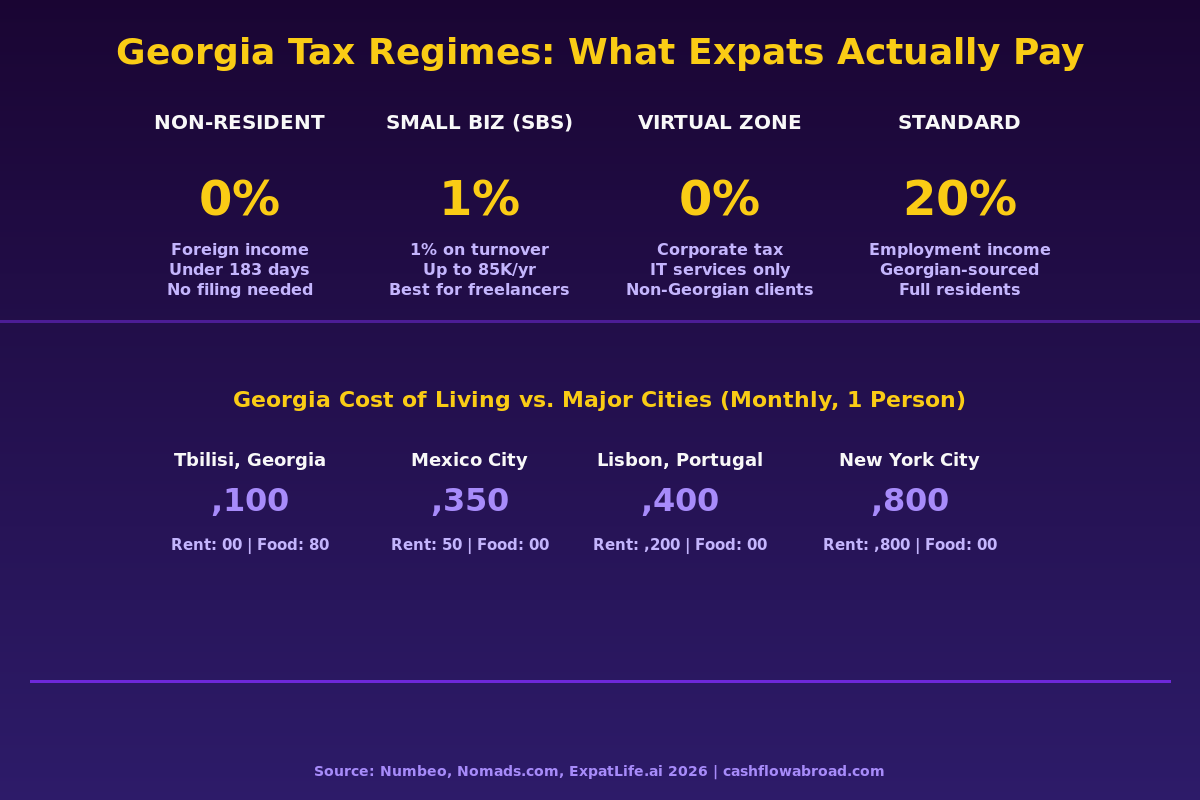
Tbilisi is no longer the $600/month city some 2019 blog posts describe. Rents in popular expat neighborhoods — Vera, Vake, Saburtalo — have risen 20-40% since 2022, driven partly by the influx of Russian and Ukrainian professionals who relocated after the invasion. A one-bedroom in a central neighborhood runs $400-600; you can find $250-350 if you're willing to be 15-20 minutes from the main expat hubs.
| Expense | Tbilisi | Mexico City | Lisbon | New York |
|---|---|---|---|---|
| 1BR Central Rent | $450–600 | $650–900 | $1,100–1,500 | $2,500–3,500 |
| Groceries (monthly) | $150–200 | $180–250 | $280–350 | $450–600 |
| Restaurant meal | $5–9 | $6–12 | $14–22 | $18–35 |
| Mobile data (unlimited) | $10–15 | $15–20 | $20–30 | $50–80 |
| Coworking desk | $80–150 | $100–200 | $200–350 | $400–600 |
| Total (comfortable) | $1,100–1,400 | $1,300–1,700 | $2,200–2,800 | $4,500–5,500 |
The food situation is genuinely exceptional. Georgian cuisine — khinkali dumplings, khachapuri cheese bread, churchkhela, mtsvadi — is one of the great underrated food traditions, and a filling meal at a neighborhood restaurant rarely costs more than 25 GEL ($9). Groceries are cheap because Georgia grows most of its own produce and dairy. Internet is fast: 100-200 Mbps fiber is standard in most apartments and costs $10-20/month.
The combination — $1,100-1,400/month in living costs, 1% tax on income — means a freelancer earning $80,000/year in Tbilisi keeps significantly more than the same person earning $80,000 in almost any Western city. See the full geographic arbitrage country comparison for how Tbilisi stacks up against 10 other relocation destinations.

Visa and Residency Basics
Citizens of 95+ countries — including the US, EU, and UK — can enter Georgia visa-free and stay for up to 365 days without any paperwork, income requirements, or registration. You just show up. This makes Georgia uniquely accessible for testing a relocation before committing to formal residency.
For longer-term stays or to open a local bank account, you'll want residency documentation. The most common path for self-employed expats is registering as an Individual Entrepreneur (required for SBS anyway) and using that business registration as your legal basis for continued presence. Many expats cycle out every 365 days — a quick trip to Armenia or Turkey resets the clock — though formal IE registration is cleaner for anyone serious about Georgia long-term.
If you want a formal residence permit, Georgia offers investment-based residency starting at $100,000 in real estate or business investment. The real estate market in Tbilisi is notable: prices in central districts run $800-1,500 per square meter, and rental yields of 6-10% are common. Several expats buy a small apartment, live in part of the year, and rent it out short-term when traveling — the short-term rental market remains active despite tighter regulations since 2023.
Practical Setup Checklist
Here's the operational sequence for a US freelancer or consultant planning a Tbilisi move:
- FEIE qualification: Confirm you'll hit 330 qualifying days outside the US. Track days carefully. See the US expat banking and tax guide for what "qualifying day" means in practice.
- Register as Individual Entrepreneur: Done at any House of Justice location. Takes 1-2 hours, costs 30-50 GEL (~$11-18). Bring your passport.
- Apply for Small Business Status: Done online at eservices.rs.ge immediately after IE registration. Approval is typically same-day or next-day.
- Open a Georgian bank account: TBC Bank and Bank of Georgia are the most expat-friendly. TBC allows account opening with a passport and IE registration.
- Maintain your US banking: Keep your Schwab International account active. Receive client payments in USD, convert what you need to GEL for local expenses.
- US mailing address: The IRS requires a US mailing address. A Traveling Mailbox virtual address gives you a real street address in a domicile-friendly state — mail scanned and viewable online within hours. Critical for maintaining US banking, brokerage accounts, and IRS correspondence while abroad.
- Health insurance: SafetyWing Nomad Insurance covers most remote workers for $56.28/month and works across Georgia and neighboring countries. Georgian hospitals are excellent for basic and emergency care at a fraction of Western prices — a specialist visit runs $15-40. See the expat health insurance guide for a full comparison.
- Connectivity: Pick up a local SIM at Tbilisi airport (Magti or Geocell). If you need data on arrival before finding a SIM, Saily eSIM covers Georgia with instant activation.
- International transfers: Use Remitly for moving money from your US account to your Georgian account or back. Transfer fees are transparent and usually under 1%.
Who Georgia Works For — And Who It Doesn't
The 1% SBS path is optimal for active income earners: freelancers, consultants, contractors, remote workers. If you're billing clients for your time or expertise, SBS makes Tbilisi one of the most tax-efficient places on earth for that work. The combination of the FEIE (zeroing out US federal income tax) and SBS (1% Georgian rate) means your total tax bill on the first $132,900 in earned income is roughly $1,329 — equivalent to a 0.1% effective rate against the 22-24% you'd pay in the US on the same income.
Georgia is less compelling for pure passive investors. If you're living off dividends and capital gains from a US brokerage, those are genuinely foreign-sourced and Georgia doesn't tax them — but neither does Panama, Paraguay, or several other territorial-tax countries with arguably better infrastructure or legal protections. The Georgian advantage is most pronounced for people who are actively working.
W-2 employees working for a US company as employees can't use SBS — you'd need to restructure as a contractor or through an Employer of Record arrangement. If your employer offers remote-friendly contractor status, the tax math becomes very different and worth exploring.
One practical note: keep investment assets in USD or EUR, not GEL. The Lari has been relatively stable in recent years, but it's not a reserve currency and lacks the institutional depth of major currencies. Hold earning and investment accounts in hard currency; convert to GEL only what you need for monthly expenses.
Bottom Line
Georgia's tax system is genuinely one of the most favorable in the world for location-independent earners — but the mechanism isn't the "0% on foreign income" pitch you'll see in most relocation content. The real structure is the Small Business Status, which taxes your total turnover at 1% with a $185,000 annual ceiling, combined with the FEIE to eliminate US federal income tax on the same income. The result is a legal, documented, Revenue Service-approved arrangement that cuts your total income tax bill on $100,000 of freelance income to roughly $1,000 — and leaves you living in a city where $1,200/month covers a good apartment, excellent food, and 200 Mbps fiber.
The trade-off is administrative overhead: monthly tax filings, a local bank account, IE registration, and proper FEIE compliance on the US side. It's more paperwork than staying in the US. It's also significantly less than most people expect from an international relocation. For anyone earning $60,000+ remotely and spending $1,100-1,400/month in living costs, the math is decisive.
This post is for informational purposes only and does not constitute tax, legal, or financial advice. Tax laws in Georgia and the United States change; consult a qualified international tax advisor before restructuring your affairs. Exchange rates and cost-of-living figures are approximate and based on publicly available 2026 data.
This guide is general information, not personalized tax, legal, or investment advice. Rules change; verify current thresholds with official sources or a qualified professional before acting.
Related guides
 Geographic ArbitrageAugust 31, 2026
Hungary White Card: The €3,000 Subsistence Test
Prove €3,000 net for six months, pay €110, and model Hungary's 15% PIT. The White Card is a two-year Budapest permit, not a path to settle.
 Geographic ArbitrageJuly 19, 2026
Sofia Remote Work Budget Under $2,000
Price rent, transit, utilities, insurance, and visa caveats before using Sofia, Bulgaria as a lower-cost EU base for remote work.
 Geographic ArbitrageJune 30, 2026
Moving Abroad with Kids: School Costs and Family Budget
International school fees change the whole geographic arbitrage math for families. Compare real costs in Medellín, Chiang Mai, Mexico, and Lisbon for