Bali's $130K Visa and the Tax Trap Most Nomads Miss
Indonesia Second Home Visa requires a $130K deposit — but the real surprise is the 183-day tax trap that turns your Bali dream into a worldwide income tax obligation.
Indonesia's $130K Second Home Visa sounds ideal — but the 183-day tax rule could expose your worldwide income. Here's what nomads need to know.
Disclosure: this article contains affiliate links. If you open an account through one of them, Cashflow Abroad may earn a referral commission at no extra cost to you.
Around 80,000 foreigners live in Bali on any given month. Most are there on a tourist visa, doing border runs to Singapore or Kuala Lumpur every 60 days to reset their clock. Indonesia noticed. So they launched a fix: a prestige-tier visa that lets you stay for up to a decade without ever leaving. The catch? It costs $130,000 just to qualify — and if you actually use it, you could be handing the Indonesian tax authority a claim on your worldwide income. Most glossy relocation guides skip that part entirely.
What the Indonesia Second Home Visa Actually Is
The Second Home Visa (VITAS B-211E) is a long-stay residency visa that grants up to five years of continuous legal residency, renewable for another five. That's a decade of uninterrupted access to Bali, Lombok, Jakarta, or anywhere else in the archipelago without a single border run.
What trips people up: the $130,000 requirement is not a fee. It's a financial deposit — specifically IDR 2 billion — that must sit in an Indonesian bank account in your name. You keep the money. You earn interest on it. The government just wants proof you have the assets. The actual visa application fee is roughly $130 (IDR 21 million). So the out-of-pocket cost to obtain this visa is $130 total. The $130,000 stays in your account the entire time.
That changes the math considerably for anyone with liquid assets already sitting in a brokerage or savings account. You're not spending $130,000. You're parking it in Indonesia, where it can earn 3–5% annually in a bank term deposit or Indonesian government bond. You're essentially converting idle US savings into a residence permit and an interest-bearing deposit in the world's fourth most populous country.
Additional features worth knowing:
- No employment restrictions — you can run a foreign-source remote business or freelance freely
- Can sponsor a spouse and up to two dependents for dependent visas
- The KITAS (temporary stay permit) converts from the visa on arrival and grants access to a local ID card (KTP)
- Can serve as a path toward Indonesian permanent residency (KITAP) after five years of continuous residence
That all sounds excellent. Now for the part the relocation blogs skip.
The 183-Day Trigger Nobody Tells You About
Indonesia determines tax residency through two tests: a physical presence test and an intent test.
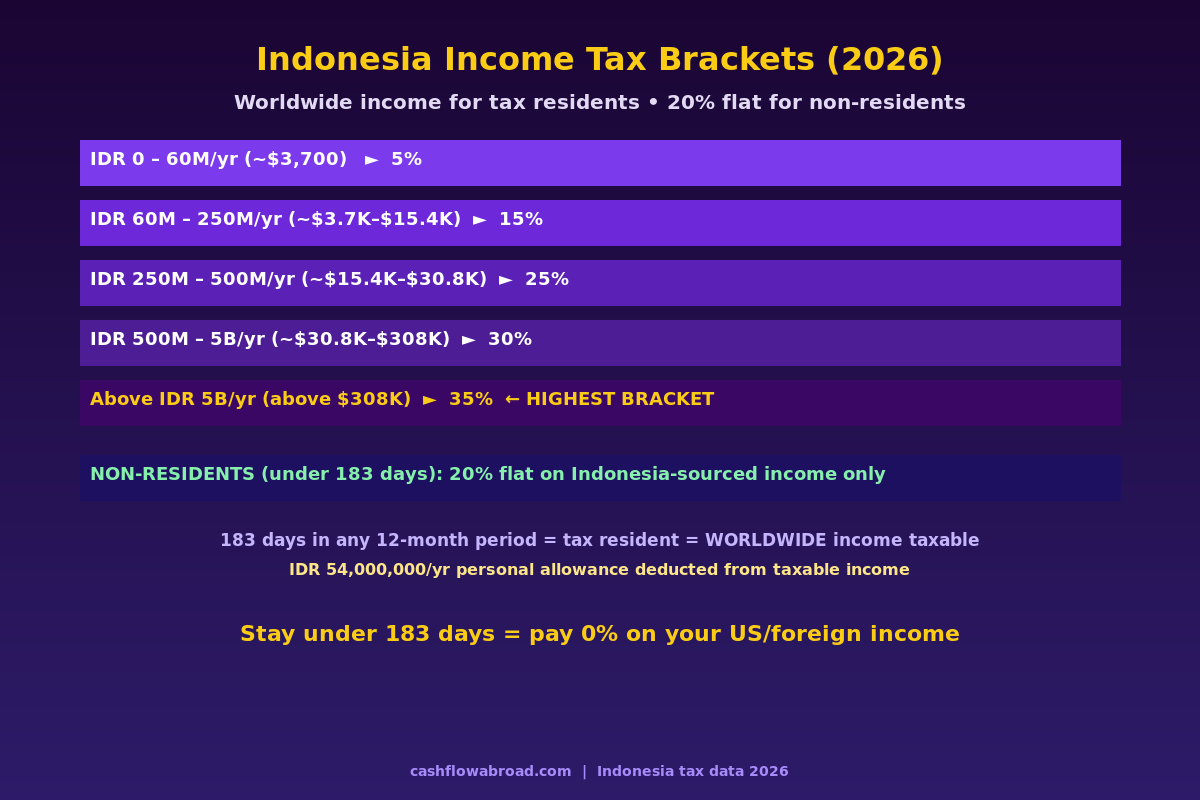
Physical presence test: If you are physically present in Indonesia for 183 or more days within any 12-month period, you become an Indonesian tax resident. From that point, Indonesia taxes your worldwide income at progressive rates reaching 35%. There is no grace period.
Intent test: Even if you stay fewer than 183 days, holding a long-term residency permit like the Second Home Visa KITAS can be interpreted as demonstrating an intent to reside in Indonesia permanently. Indonesian tax authorities have explicitly flagged this. The law is ambiguous enough that possessing a KITAS creates legal exposure even for those who carefully count their physical days.
Starting in 2026, Indonesia's new Coretax Administration System is integrated directly with the immigration database. When you apply to extend your KITAS, the system automatically checks whether you have filed your Annual Tax Return (SPT Tahunan). Miss a filing? Your visa extension may not go through.
The contrast with tourist-visa life is stark. A perpetual visa runner on a 60-day tourist entry has zero Indonesian tax exposure on foreign income. A Second Home Visa KITAS holder who spends 200 days a year in Canggu potentially owes Indonesian tax on every dollar earned from US clients. Different document, completely different tax universe.
Indonesia's Tax Rates: What You'd Actually Owe
Once you cross into tax resident territory, Indonesia applies progressive Pajak Penghasilan (PPh) rates to your net worldwide income after a personal allowance deduction of IDR 54,000,000 (approximately $3,300) per year.
| Annual Taxable Income (IDR) | Approx. USD | Tax Rate |
|---|---|---|
| Up to 60,000,000 | Up to ~$3,700 | 5% |
| 60,000,001 – 250,000,000 | ~$3.7K – $15.4K | 15% |
| 250,000,001 – 500,000,000 | ~$15.4K – $30.8K | 25% |
| 500,000,001 – 5,000,000,000 | ~$30.8K – $308K | 30% |
| Above 5,000,000,000 | Above ~$308K | 35% |
If you earn $80,000 per year from remote work and become an Indonesian tax resident, you're looking at roughly $19,000–$22,000 in Indonesian personal income tax before any treaty reductions. For non-residents — those who stay under 183 days and avoid the intent test — the rate is a flat 20%, but only on Indonesian-sourced income. A US freelancer whose clients are entirely American has zero Indonesian-sourced income as a non-resident. Their Indonesian tax bill is $0.
The US Expat Overlay: Paying Two Governments
American citizens living abroad don't escape US taxes by relocating. You still file with the IRS each year and report worldwide income. Two tools keep this manageable:
Foreign Earned Income Exclusion (FEIE): In 2026, the FEIE allows you to exclude up to approximately $130,000 of foreign-earned income from US federal tax — provided you pass either the Physical Presence Test (330 days outside the US in a 12-month period) or the Bona Fide Residence Test. If you're spending 183+ days in Bali and meeting FEIE requirements, your US federal income tax on earned income could be zero. The full mechanics are covered in our FEIE guide.
Foreign Tax Credit (FTC): If you're paying Indonesian income tax, you can claim a credit against your US tax liability dollar-for-dollar on income taxed by both countries. The US and Indonesia have a bilateral tax treaty in force. The treaty's "saving clause" preserves most US taxing rights on US citizens, but the FTC mechanism prevents genuine double-taxation on income already taxed by Indonesia.
In practice, most Americans in this scenario owe Indonesian tax on their worldwide income, get a US FTC for what they paid Indonesia, and use the FEIE to minimize additional US federal liability. The total tax burden often ends up similar to what a US resident would pay domestically — but you're living in Bali. The problem isn't the absolute tax number. It's that you expected an escape and got a lateral move instead.
For pure tax efficiency, zero-territorial-tax destinations like the UAE, Paraguay, or Georgia still rank higher. For how those stack up, see our ranked digital nomad visa guide.
The 4-Year Exemption Almost Nobody Knows About
Here is the provision that very few Second Home Visa guides mention: Indonesia has a 4-year exemption from worldwide income taxation available to new foreign tax residents. Under Indonesian tax law, a foreigner who newly becomes an Indonesian tax resident may elect to be taxed only on Indonesian-sourced income during their first four years of residency.
If you qualify and make this election, years one through four as a formal Indonesian tax resident mean paying 0% on your foreign freelance income, investment income from US accounts, or any other non-Indonesian-source earnings. Only income generated within Indonesia would be taxable during that window. In year five, worldwide taxation kicks in like any other resident.
This provision is not automatic. You must register and make the election actively, and the qualifying conditions are specific. Indonesian tax law is also subject to change — consult a qualified Konsultan Pajak before assuming this applies to your situation. But if it does apply, the 4-year window dramatically changes the cost-benefit analysis for someone genuinely committed to Bali long-term.
The Split-Stay Strategy: Engineering Your Days
The cleanest approach for most nomads who want Bali without the tax complexity is deliberate day-counting. Stay under 183 days per rolling 12-month period, remain a non-resident, and your foreign income is untouched by Indonesia. This is the standard playbook across Southeast Asia's nomad circuit.
A common pattern: five months in Bali (October through February, avoiding monsoon season), three months in Thailand or Malaysia, two months split between other destinations. That puts you around 150 days in Indonesia — comfortably inside the threshold with a reasonable buffer against any retroactive 12-month window calculations.
The complication: if you hold a KITAS from the Second Home Visa while doing this, you need explicit legal advice about whether the intent test overrides your day count. Multiple practitioners report that Indonesian enforcement focuses on physical day counts in practice, but the statute creates ambiguity. The conservative position is to not hold a KITAS unless you're prepared to engage the tax residency question head-on.
For most under-183-day Bali residents, the tourist visa or the E33G Digital Nomad Visa is a more rational choice than the Second Home Visa anyway. The E33G — introduced in 2024 — is a 60-day single-entry visa with no $130,000 deposit requirement, designed explicitly for remote workers. It doesn't grant the long-term rights of the Second Home Visa, but it also doesn't put you anywhere near KITAS territory.
What Bali Actually Costs: The Case Still Holds
Even factoring in Indonesian income tax, Bali's cost-of-living case is real and material. Here's a realistic monthly budget for a single person living well in Canggu or Seminyak versus equivalent quality of life in a US city:
| Expense | Bali (Canggu) | Austin, TX (equivalent) |
|---|---|---|
| 1BR Apartment (modern, furnished) | $500–$900/mo | $1,800–$2,500/mo |
| Groceries + Eating Out | $300–$500/mo | $800–$1,200/mo |
| Scooter rental + petrol | $80–$120/mo | $600–$900/mo (car) |
| Health Insurance | $60–$150/mo (expat plan) | $400–$700/mo |
| Coworking space | $100–$200/mo | $300–$500/mo |
| Total (comfortable) | $1,200–$2,000/mo | $4,000–$6,000/mo |
Even paying 25–30% Indonesian income tax on a $60,000 annual salary, you would still net more purchasing power in Bali than you would on $120,000 in San Francisco after US taxes and local cost of living. The geographic arbitrage doesn't disappear when you factor in Indonesian taxes — it shrinks, but it doesn't close.
For health coverage, SafetyWing's Nomad Insurance starts at around $56/month and covers Indonesia including emergency medical evacuation. It pairs well with Bali's quality private hospitals — BIMC Kuta and Siloam are legitimately excellent and cost a fraction of US facilities for procedures that would bankrupt you stateside. For a full breakdown of expat health options across Southeast Asia, see our expat health insurance guide.
Banking and Money: Setting Up Your Bali Infrastructure
The practical setup for a Bali-based expat involves keeping your US banking infrastructure intact while layering local access on top.
Maintain a US bank account with zero foreign ATM fees. Charles Schwab's international checking account reimburses all ATM fees worldwide — including Indonesian ATMs, which charge $2–$5 per withdrawal in tourist areas. It costs nothing to open and it's one of the most reliably useful tools in the expat toolkit. For more on the full expat banking stack, see our US expat banking and tax guide.
For international transfers — whether funding your IDR 2 billion deposit or moving money between accounts — Remitly offers competitive USD-to-IDR rates with transparent fees. We break down the full comparison in our international transfer guide.
If you're maintaining a US address for banking, IRS correspondence, or state domicile purposes, a virtual mailbox like Traveling Mailbox gives you a real US street address in 50+ cities at $15/month with mail scanning and check deposits. It's essential infrastructure for maintaining your US financial footprint while abroad. More in our virtual mailbox guide.
Indonesia's government periodically blocks social media and finance platforms. A reliable VPN like NordVPN is standard infrastructure in Bali, not optional. For your first few days before getting a local SIM card, an eSIM like Saily keeps you connected from the moment you land.
Who Should and Shouldn't Get This Visa
Strong fit for the Second Home Visa:
- Retirees or semi-retirees with pension or investment income who want permanent Bali residency and have $130K in liquid assets they're comfortable parking in an Indonesian bank
- Entrepreneurs who intend to make Indonesia their primary tax base, have done the math with a real cross-border tax advisor, and want legal certainty over their status
- Couples or families who want long-term stability without the ongoing stress of visa runs and border hopping
- Anyone using the 4-year foreign income exemption window strategically during an initial establishment phase
Not the right tool for:
- Freelancers or nomads who move between countries and aren't ready to tie $130K to a single country's banking system
- Anyone who wants to maintain strict under-183-day stays — the KITAS creates intent-test exposure that the tourist visa doesn't
- Income earners above $80K who want maximum tax efficiency — there are more optimized jurisdictions covered in our geographic arbitrage playbook and expat investing guide
The Bottom Line
Indonesia's Second Home Visa is a legitimately good product for a specific kind of expat: asset-rich, Bali-committed, and willing to engage with the country's tax system rather than dodge it. The $130,000 deposit is not the barrier it appears to be on first read — it's a deposit that earns interest, not a visa fee. The real variable is understanding that accepting a KITAS means entering Indonesia's tax system, not escaping the world's.
For the majority of digital nomads currently living in Bali on tourist entries, the E33G Nomad Visa or a carefully managed tourist visa + border-run strategy remains the cleaner path. Stay under 183 days, keep your income foreign-sourced, and Indonesia has no claim on it. The Second Home Visa is for people who have genuinely decided to live there — and who've run the tax numbers with a real advisor, not a Reddit thread.
Financial disclaimer: This article is for informational and educational purposes only and does not constitute tax, legal, or financial advice. Indonesian tax law is complex and subject to change. Consult a qualified Indonesian tax advisor (Konsultan Pajak) and a US expat CPA before making any decisions regarding visa status, tax residency, or financial planning. The author and cashflowabroad.com are not responsible for outcomes resulting from reliance on this content.
This guide is general information, not personalized tax, legal, or investment advice. Rules change; verify current thresholds with official sources or a qualified professional before acting.
Related guides
 Expat Tax & FinanceMay 31, 2026
The 183-Day Tax Rule: What Expats Get Wrong
Most expats misunderstand the 183-day tax rule. Learn how it actually works country by country and why it is irrelevant for US citizens abroad.
 Geographic ArbitrageJune 29, 2026
Bali for US Expats: Monthly Costs and Permit Guide
How much Bali costs, which Indonesian stay permit suits long-term stays, and what US citizens owe the IRS while living there in 2025.
Geographic ArbitrageJune 6, 2026
Indonesia Expat Guide: KITAS, Banking, and Real Costs
Indonesia's E33G KITAS requires $60K income and is employees-only. Costs by city, Indonesian tax brackets, and the critical 2025 rule change.