Greece's €100K Flat Tax: The Non-Dom Deal Most Expats Miss
Greece wants you to pay €100,000 in taxes. And depending on your income, that might be the best financial deal available to you in the EU right now.

Greece wants you to pay €100,000 in taxes. And depending on your income, that might be the best financial deal available to you in the EU right now.
The country's Non-Dom Tax Regime for high-net-worth investors caps your entire foreign tax liability at €100,000 per year — flat, regardless of whether you earned €300,000 or €5 million offshore. For 15 years. And you don't even have to live there full-time.
Most expat tax coverage focuses on the zero-tax destinations: Dubai, Paraguay, Georgia. Greece rarely makes that list because people see "EU country" and assume European tax rates. That assumption is costing high earners hundreds of thousands of dollars.
Three Non-Dom Regimes, Three Different Audiences
Greece actually runs three distinct non-domicile programs, each targeting a different expat profile. Understanding which one applies to you is the first step.
1. Investor Non-Dom: The €100K Flat Tax
This is the headline program. Pay a flat annual tax of €100,000 on all your foreign-sourced income — dividends, interest, capital gains, rental income, business profits, everything — and that's your total Greek tax bill on offshore earnings. The regime lasts up to 15 fiscal years and requires an investment of at least €500,000 in the Greek economy within three years of application.
Family members can join for €20,000 per year each. A couple with two adult children could lock in flat tax treatment for the entire family for €160,000/year — and if the family's foreign income exceeds €750,000, they're already saving money compared to standard rates.
The eligibility bar: you must not have been a Greek tax resident for 7 of the previous 8 years. Applications must be submitted to Greece's Independent Authority for Public Revenue (AADE) by March 31 of the relevant fiscal year. Approval typically takes around 10 months.
2. Pensioner Non-Dom: 7% Flat on Foreign Income
For retirees drawing foreign pensions or investment income, Greece offers a 7% flat tax on all foreign-sourced income — a direct competitor to Italy's famous 7% program but with fewer restrictions on where you live within the country. No minimum investment required. The tradeoff: you must spend at least 183 days per year in Greece.
This regime runs for 15 years and requires the same 7-of-8 non-residency history. For a retiree collecting €80,000/year in foreign pension income, the Greek bill is €5,600 annually. Under progressive rates, that same income would generate roughly €28,000 in Greek tax. The Italy comparison is instructive: Italy's 7% requires moving to specific qualifying southern towns with populations under 20,000. Greece's pensioner non-dom has no geographic restriction — you can live in Athens, Thessaloniki, or Crete.
3. Employee Non-Dom: 50% Income Tax Exemption
Targeted at remote workers and employees relocated to Greece by foreign companies. If you've been a non-Greek tax resident for 5 of the past 6 years and you work for a foreign employer or conduct business outside Greece, you qualify for a 50% reduction on your Greek employment income tax for 7 years.
No investment required. This pairs naturally with the digital nomad visa, which allows non-EU citizens earning at least €3,500/month to live and work remotely in Greece for one year (renewable). Stay more than 183 days and you establish Greek tax residency — at which point you can apply for the employee non-dom 50% exemption.
The Math That Makes €100K Look Like a Bargain
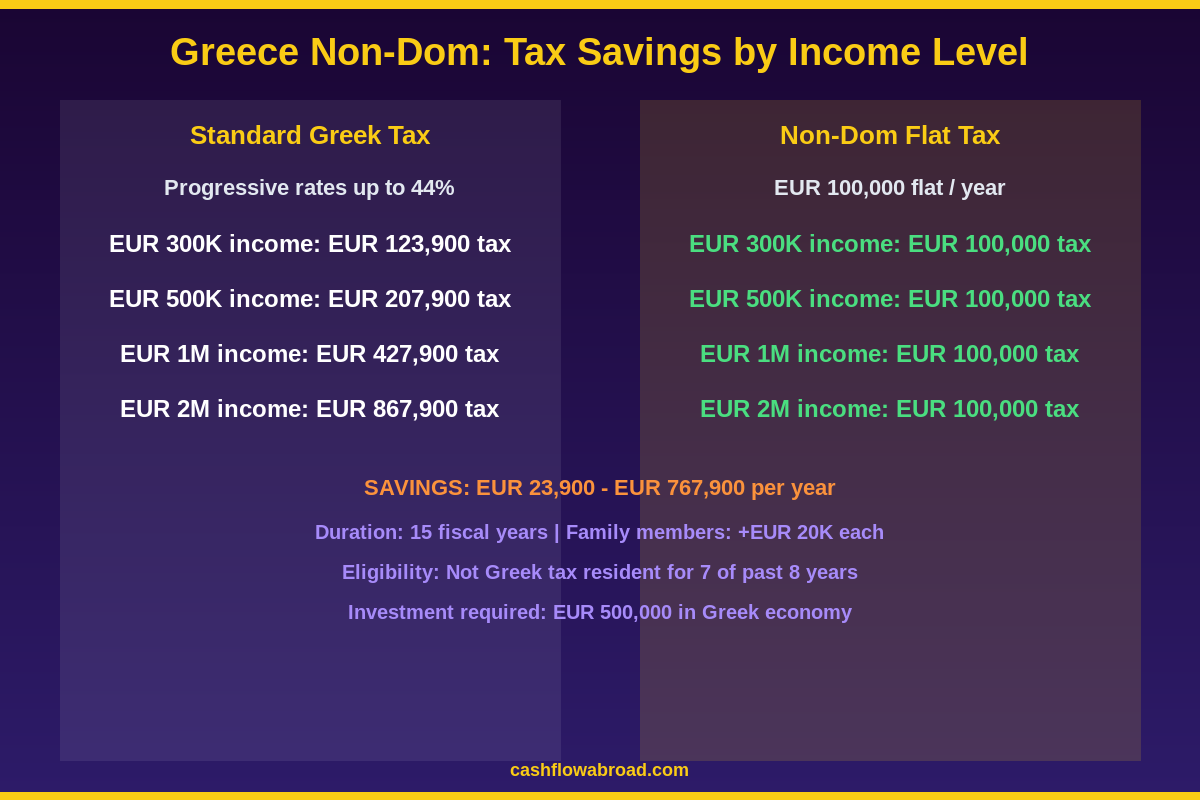
Greece's standard income tax uses progressive brackets that top out at 44% on income above €40,000. Here's how the investor non-dom compares at various income levels:
| Annual Foreign Income | Standard Greek Tax | Non-Dom Flat Tax | Annual Savings |
|---|---|---|---|
| €200,000 | €78,500 | €100,000 | –€21,500 (not worth it) |
| €300,000 | €123,900 | €100,000 | €23,900 |
| €500,000 | €207,900 | €100,000 | €107,900 |
| €1,000,000 | €427,900 | €100,000 | €327,900 |
| €2,000,000 | €867,900 | €100,000 | €767,900 |
| €5,000,000 | €2,187,900 | €100,000 | €2,087,900 |
The breakeven point is approximately €230,000 in annual foreign income. Below that, you pay more under the flat rate. Above it, savings compound dramatically. Over the 15-year window, an investor earning €1 million annually could save over €4.9 million in taxes — after accounting for the €100,000 annual flat payment and the €500,000 initial investment.
The €500,000 Investment: What It Actually Buys
The investment requirement isn't a fee paid to a government and forgotten — it's an asset you own. Eligible options:
- Greek real estate: The most popular choice. Athens property prices average €2,200–€4,500/sqm in prime central neighborhoods. €500,000 buys a significant apartment or small portfolio of rental units. Greek residential prices rose roughly 12% in 2023 and continued climbing in 2024, recovering substantially from the 2010s crisis lows.
- Greek government bonds: Three-year minimum maturity. Greece regained investment-grade status in 2023 for the first time in over a decade; its 10-year yield has tightened toward core EU rates.
- Shares in Greek companies: Positions in Athens Stock Exchange-listed companies or private Greek entities qualify.
- Fixed-term bank deposits: €500,000 in a Greek bank account satisfies the threshold — the lowest-effort option, though it requires navigating Greek bank KYC requirements.
If you're buying Greek real estate regardless — and many expats are, given prices relative to Western Europe — the investment requirement costs you nothing extra. You're redirecting capital into an asset you'd have purchased anyway.
A note on the Greece Golden Visa: the property investment threshold for residency permits is separate and higher (€400,000–€800,000 depending on area, as of 2024 changes). The non-dom tax regime's €500,000 threshold and the Golden Visa threshold can overlap if you invest in qualifying real estate, but they're distinct programs with separate applications.
What US Expats Need to Know
American passport holders face a layer of complexity that EU nationals don't. The IRS taxes US citizens on worldwide income regardless of where they live, which means Greece's non-dom regime doesn't eliminate your US tax obligation — it only addresses what Greece charges you.
That said, the combination creates significant planning opportunities:
FEIE still applies. The Foreign Earned Income Exclusion lets you exclude approximately $130,000 (2026 figure, indexed annually) in foreign earned income from US tax. If your €100,000 flat tax payment to Greece covers passive income — dividends, interest, capital gains — and your earned income is excluded via FEIE, your effective global rate on total income can be far lower than staying in the US. For the mechanics, see our FEIE deep dive.
Foreign Tax Credit stacking. The €100,000 you pay to Greece can potentially be credited against your US tax bill on the same foreign-source income under the US-Greece tax treaty (signed 1952, still in force). The treaty is old and has gaps — consult a dual-qualified CPA before assuming full FTC treatment. The IRS PFIC rules for foreign investment holdings also apply regardless of where you live.
FBAR and FATCA remain mandatory. Any Greek bank account with an aggregate balance exceeding $10,000 at any point during the year goes on your FBAR. Greek accounts at Alpha Bank, Piraeus Bank, Eurobank, or National Bank of Greece are foreign financial accounts. There is no exemption for EU country accounts.
Greek AFM (tax number) is required first. Before opening a bank account, purchasing property, or applying for the non-dom regime, you need a Greek tax registration number (Αριθμός Φορολογικού Μητρώου / AFM). Obtainable at any AADE office with a valid passport and proof of address.
For the expat banking stack that survives international moves and account closures, Charles Schwab International remains the most practical option — unlimited ATM fee reimbursement worldwide and no account closures based on foreign residency, unlike Fidelity and Vanguard. If you're maintaining US ties from Greece, a Traveling Mailbox virtual US address ($15/month) handles IRS correspondence, state domicile mail, and US banking statements.
How to Apply: Step-by-Step
The process runs through AADE and takes roughly 10 months from application to approval. Here's the sequence:
- Get your AFM (tax number): Obtainable same-day at AADE offices. You'll need a valid passport, a local address (rental contract or hotel confirmation), and proof of purpose.
- Open a Greek bank account: Required for the investment and for paying the flat tax. Major banks include Alpha Bank, Piraeus, Eurobank, and National Bank of Greece. Bring complete documentation — Greek banks run intensive KYC checks.
- Prepare the investment documentation: Property purchase agreement, bond certificates, share registry documentation, or bank deposit certificate demonstrating the €500,000 commitment.
- Submit to AADE by March 31: The application requires proof of non-Greek tax residency for 7 of the past 8 years (foreign tax returns or residency certificates), the AFM, investment documentation, and a declaration of intent to become a Greek tax resident.
- Pay the first-year flat tax: Once approved, €100,000 is due annually by the Greek tax filing deadline (typically July 31 for the prior calendar year).
Professional fees for the full process run €5,000–€15,000 depending on attorney and complexity. Add notary and property transfer costs if buying real estate (typically 3–4% of property value in stamp duty and legal fees).
Living in Greece: What Your Money Actually Buys

The tax benefit doesn't exist in isolation — it comes with one of Europe's most compelling quality-of-life propositions. Greece has a lower cost of living than France, Germany, Spain, or Italy, with dramatically better weather than all of them.
| City | 1BR Apartment (City Center) | Monthly Expenses (excl. rent) | Comfortable Total Budget |
|---|---|---|---|
| Athens (Kolonaki/Glyfada) | €700–€1,100/mo | €860/mo | €1,800–€2,200/mo |
| Thessaloniki | €450–€700/mo | €750/mo | €1,300–€1,600/mo |
| Crete (Heraklion/Chania) | €400–€600/mo | €870/mo | €1,400–€1,600/mo |
| Corfu | €400–€700/mo | €800/mo | €1,300–€1,600/mo |
An investor earning €1 million per year who pays the €100,000 flat tax and lives in Athens on €2,000/month spends €124,000 annually and retains €876,000. Compared to staying in France (where that income triggers 45%+ rates, generating a €450,000+ tax bill), the non-dom regime doesn't just save money — it changes the trajectory of wealth accumulation over a decade.
Athens has direct flights to most major European cities (London is 3.5 hours, Frankfurt 3 hours) and is a short island-hop to Mykonos, Santorini, Rhodes, and dozens of less-touristed islands. English proficiency among professionals is high. The internet infrastructure in Athens and major cities supports remote work without difficulty.
For international health insurance, SafetyWing Remote Health covers expats living abroad with comprehensive hospital and specialist coverage — useful for non-doms who aren't triggering Greek public health system access through full residency.
Greece vs. Italy vs. Cyprus: A Direct Comparison
Since we've covered both Italy's 7% pensioner regime and Cyprus's non-dom dividend exemption, a side-by-side is useful:
| Feature | Greece (Investor) | Italy (Pensioner) | Cyprus Non-Dom |
|---|---|---|---|
| Annual foreign income tax | €100,000 flat | 7% of all foreign income | 0% dividends/interest + €4,770 GHS cap |
| Best income level | €230,000+ per year | €50K–€500K (retirees) | Any level with passive income |
| Minimum stay required | None (investor) | 183+ days/year | 60 days/year |
| Investment required | €500,000 | None (retirees) | None |
| Duration | 15 years | 10 years | 17 years |
| Family extension | €20K/member/year | Not available | Spouse qualifies separately |
| Capital gains treatment | Covered by flat tax | 26% in Italy | 0% on securities (all residents) |
Cyprus wins on dividend and passive income at any income level — €4,770 maximum regardless of earnings. Greece wins for high earners with diverse income types who want EU residency without minimum-stay commitments. Italy wins for retirees with modest foreign income who want to live in the Italian countryside full-time. None of them perfectly solves the US citizen's double-taxation problem, but all three reduce the total bill significantly.
Bottom Line: Who Should Actually Look at This
The investor non-dom program is purpose-built for a specific profile: individuals with €230,000+ in annual foreign income who want EU residency, don't need to park there for 183 days a year, and have €500,000 to deploy into an asset anyway.
It's not for digital nomads or remote workers earning average salaries — the pensioner or employee non-dom regimes are better fits. And it's not a pure tax haven like Dubai or Paraguay, where your foreign income faces no local tax at all. It's a structured arrangement where Greece trades significant tax revenue for attracting wealthy international residents, with the €500,000 investment ensuring real economic benefit flows to the Greek economy.
For anyone mapping out the geographic arbitrage playbook, Greece belongs in any serious analysis of EU options. The country that most people associate with debt crisis and austerity has quietly built one of the most competitive high-net-worth tax regimes on the continent. The €100,000 price tag is the first number you hear. The number that matters is everything above it that you keep.
Financial Disclaimer: This article is for informational purposes only and does not constitute tax, legal, or financial advice. Greek non-dom tax rules and US international tax law are complex and change regularly. Specific figures, rates, and eligibility requirements may have been updated after publication. US citizens should consult a tax professional with expertise in both US international tax law (FBAR, FATCA, FEIE, Foreign Tax Credit) and Greek tax law before making any residency or tax planning decisions. Nothing here constitutes a recommendation to restructure assets or establish residency in any jurisdiction.
Guias relacionadas
 Expat Tax & FinanceJune 2, 2026
FBAR vs Form 8938: The $10,000 Expat Filing Trap
US expats with foreign accounts must file both FBAR and Form 8938. Learn the exact thresholds, account types, and penalties before you miss a
 Expat Tax & FinanceJune 1, 2026
Airbnb Hosting Abroad: The US Tax Guide You Actually Need
FEIE won't cover Airbnb income. Learn how expat hosts use Schedule E, depreciation, and the Foreign Tax Credit to legally cut their US tax bill.
 Expat Tax & FinanceJune 1, 2026
State Income Tax Trap Most Expats Don't See Coming
California taxes expats at 13.3% even abroad. Learn how to legally sever domicile before moving overseas and eliminate state income tax.