How to Pay Zero Federal Tax (Legally) as a US Expat
Every year, thousands of US expats legally pay $0 in federal income tax on up to $130,000+ of earned income. The IRS can and will audit this.
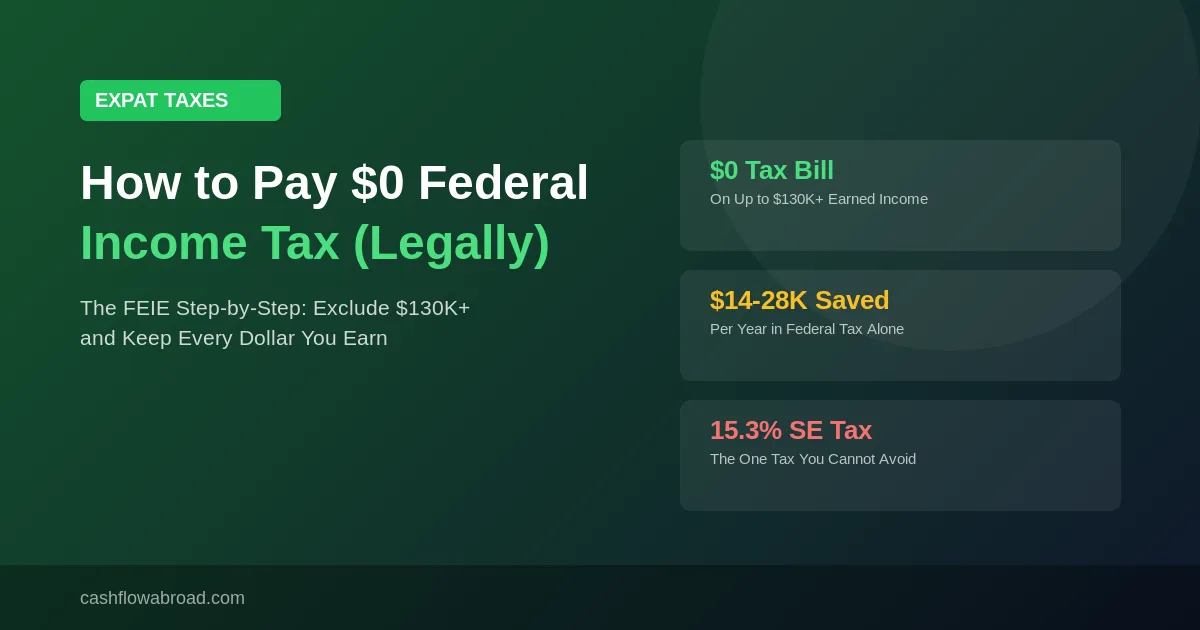
Every year, thousands of US expats legally pay $0 in federal income tax on up to $130,000+ of earned income. It's not a loophole, a hack, or a gray area — it's the Foreign Earned Income Exclusion (FEIE), codified in IRC Section 911, and it's been available to qualifying Americans abroad for decades.
Yet most expats either don't know about it, don't use it correctly, or make simple mistakes that cost them tens of thousands of dollars. This is the step-by-step guide to legally eliminating your federal income tax bill.
Paying $0 federal income tax isn't complicated — it just requires living abroad, tracking your days, and filing the right forms. The FEIE saves the average qualifying expat $10,000-25,000/year. Combined with geographic arbitrage savings, you're building wealth at an extraordinary rate. Don't forget health coverage — SafetyWing provides global health insurance from ~$120/month, a fraction of what US plans cost and fully compatible with the nomad lifestyle. Disclaimer: This is not tax advice. Consult a qualified tax professional for your specific situation. Tax laws change; verify current thresholds before filing.
The FEIE: Your $0 Tax Tool
The Foreign Earned Income Exclusion allows qualifying US citizens and residents living abroad to exclude up to:- 2025: $130,000
- 2026: $132,900
Related: self-employment tax trap guide
How to Qualify: Two Tests
You must pass one of two tests:Physical Presence Test (Most Common)
- Be physically present in a foreign country for 330 full days during any 12-consecutive-month period
- Days do NOT need to be consecutive
- The 12-month period does NOT need to align with the calendar year
- Travel between foreign countries counts; US days do not
- You get 35 days in the US — use them wisely (holidays, family visits, business trips)
Bona Fide Residence Test
- Must be a bona fide resident of a foreign country for an entire calendar year (January 1 - December 31)
- Must be a US citizen (Green Card holders generally can't use this)
- The IRS looks at intent: lease agreements, local bank accounts, community ties, visa type
Real Tax Savings Scenarios
| Income | US Tax (Single, Standard) | With FEIE | Annual Savings |
|---|---|---|---|
| $60,000 | ~$6,300 | $0 | $6,300 |
| $80,000 | ~$10,100 | $0 | $10,100 |
| $100,000 | ~$14,300 | $0 | $14,300 |
| $130,000 | ~$21,500 | $0 | $21,500 |
| $150,000 | ~$26,000 | ~$2,600 | $23,400 |
Above $130K? The Housing Exclusion Adds More
On top of the FEIE, the Foreign Housing Exclusion lets you exclude additional amounts for qualifying housing costs:- Standard cap (2025): additional $18,200 above the base amount
- High-cost cities get more: Hong Kong ($114,300), Geneva ($102,600), Singapore ($82,900)
Related: five-flag strategy guide
The One Tax You CANNOT Avoid: Self-Employment Tax
Here's the critical caveat: the FEIE does not reduce self-employment tax. If you're self-employed (freelancer, LLC owner, consultant), you still owe:- 12.4% Social Security (on earnings up to $176,100 in 2025)
- 2.9% Medicare (no cap)
- Total: 15.3%
State Tax: The Hidden Trap
You can owe $0 federal tax and still owe state tax. California, Virginia, and New Mexico are notorious for continuing to tax residents who move abroad. Most states don't recognize the FEIE. The solution: Establish domicile in a no-income-tax state (Florida, Texas, Nevada, Wyoming, etc.) before moving abroad. I detail the complete strategy in the state tax section of my expat tax guide.Related: Roth IRA expat guide
Common Mistakes That Disqualify You
- Spending too many days in the US — Over 35 days and you fail the Physical Presence Test
- Not tracking days properly — Partial days count as US days if you're in the US at midnight
- Applying FEIE to passive income — It only covers earned income, not investments. Your trading gains are still taxed.
- Forgetting to file — You must file a US return and Form 2555 even if you owe $0
- Revoking the FEIE — If you revoke, you can't re-elect for 5 years without IRS approval
Step-by-Step: Your First Year
- Month 1-2: Establish domicile in a no-tax state if needed — use Traveling Mailbox for a real street address in your new domicile state (from $15/month) — and set up Mercury for business banking that works from anywhere
- Month 3: Move abroad, start your 12-month Physical Presence period
- Months 3-14: Spend at least 330 days outside the US
- April 15 (following year): Taxes owed are due (even with extensions)
- June 15: Automatic 2-month extension for expats (no form needed if tax home is abroad)
- October 15: Extended deadline (file Form 4868 before June 15)
- File Form 2555 with your return to claim the FEIE
- File FBAR separately if foreign accounts exceed $10,000
FEIE vs. Foreign Tax Credit: Quick Decision
- Low/no-tax country (UAE, Panama, Colombia under 183 days) → FEIE
- High-tax country (UK, Germany, Japan) → Foreign Tax Credit
- Above FEIE limit → FEIE on first $130K, FTC on the rest
Paying $0 federal income tax isn't complicated — it just requires living abroad, tracking your days, and filing the right forms. The FEIE saves the average qualifying expat $10,000-25,000/year. Combined with geographic arbitrage savings, you're building wealth at an extraordinary rate. Don't forget health coverage — SafetyWing provides global health insurance from ~$120/month, a fraction of what US plans cost and fully compatible with the nomad lifestyle. Disclaimer: This is not tax advice. Consult a qualified tax professional for your specific situation. Tax laws change; verify current thresholds before filing.
Guias relacionadas
 Expat Tax & FinanceMay 29, 2026
Moving Abroad Mid-Year: Maximize Your Tax Benefits
Moving in Q4 instead of Q1 costs you up to $30K in FEIE exclusions. Learn how pro-ration works, state tax traps, and FBAR obligations in year one.
 Expat Tax & FinanceMay 6, 2026
Capital Gains Tax: The FEIE Blind Spot Expats Pay For
The FEIE shields your salary but not your stock gains. Learn how NIIT, the stacking rule, and Section 865(g) affect US expat capital gains taxes.
 Expat Tax & FinanceMay 29, 2026
Self-Employment Tax: The Expat Freelancer’s Hidden Bill
FEIE zeroes your income tax abroad—but SE tax still applies. See the exact numbers and legal ways to reduce your bill as a US expat freelancer.