The $600 Visa That Buys Tax-Free Residency in Belize
The application fee for Belize's official residency program is $600. The minimum annual stay is 30 days. Here's everything you need to know.
The application fee for Belize's official residency program is $600. The minimum annual stay is 30 days. The Belize tax on your foreign retirement income, dividends, capital gains, and investment returns is exactly zero.
That's not a loophole or a gray area — it's the Qualified Retirement Program (QRP), a government-backed residency track that's been on the books since 1999 and remains one of the most underutilized expat plays in the Western Hemisphere. While thousands of Americans fight their way through Panama's paperwork trail or mourn Portugal's dead NHR program, Belize sits 90 minutes from Miami with an English-speaking population, a currency pegged to the US dollar since 1978, and a Caribbean coastline that belongs on a screensaver.
Here's everything you need to know.
What the QRP Actually Gives You
The Qualified Retirement Program is administered by the Belize Tourism Board and grants official resident status to qualifying applicants. The core benefits are specific and substantial:
- Zero Belize taxes on all foreign-sourced income — pension checks, Social Security, dividends, rental income, capital gains, interest payments
- Zero inheritance tax (Belize has none, full stop)
- Zero capital gains tax (also nonexistent in Belize)
- Duty-free import of all household goods and personal effects during your first year
- Duty-free import of one vehicle up to five years old
- Duty-free import of a boat or light aircraft — yes, that's real
- Permanent QRP status once approved — no periodic requalification
Belize operates a territorial tax system: only income earned inside Belize is subject to local taxation. A retiree drawing $5,000/month from US investment accounts has a Belize tax liability of $0 — not temporarily, not with caveats, permanently. Compare that to Thailand's 2024 pivot toward taxing foreign remittances, Spain's aggressive residency tests, or Malaysia's recent tightening of MM2H rules, and Belize's stability becomes a selling point of its own.
Who Qualifies
The requirements are deliberately accessible for Americans with modest retirement income:
- Age: 40 or older (lowered from 45 in 2023)
- Income: At least $2,000/month from sources outside Belize — pension, Social Security, investment income, rental income, or remote work income
- Application fee: $600 USD for the primary applicant; $75 per dependent
- Dependents: Spouse and children under 18 (up to age 23 if enrolled in university) can be included at minimal cost
- Background check: Clean criminal record and medical certificate
- Minimum presence: 30 consecutive days per year in Belize
The $2,000/month income floor is the primary bar. Your income must be deposited monthly into a Belizean bank account — a bureaucratic step, not a tax trap. You can transfer the money back out or use it locally as you choose.
Crucially, the income doesn't have to be retirement income. A 42-year-old remote software consultant earning $8,000/month from US clients qualifies just as well as a 65-year-old retiree drawing a pension. The program requires financial self-sufficiency from outside Belize, nothing more.
What Zero Belize Taxes Means — and Doesn't
Let's be precise, because this is where expat articles mislead people.
Belize will not tax your foreign income. A retired couple pulling $6,000/month from a US brokerage and Social Security owes Belize $0. A freelancer invoicing US clients from a beach house in Placencia owes Belize $0 on that income. These aren't gray areas — they're the explicit design of the territorial tax system, reinforced by QRP status.
The IRS will still tax you. US citizens owe US taxes on worldwide income regardless of where they live. Several tools reduce that bill, but none eliminate it entirely:
- The Foreign Earned Income Exclusion (FEIE) lets you exclude up to approximately $130,000 of earned income (wages, self-employment) from US federal tax. Passive income — dividends, interest, pensions, Social Security — is not covered. See our deep dive on FEIE strategy for the mechanics.
- The Foreign Tax Credit offsets US taxes with foreign taxes paid — but since Belize taxes nothing, there's no credit to claim here. This is pure geographic arbitrage: you're not getting a foreign tax offset, you're just avoiding a second layer of taxation entirely.
- There is no US–Belize tax treaty. That simplifies things: no treaty shopping, no complex tie-breaker rules, no treaty-specific limitations. Just US tax law applied to someone living in a zero-tax country.
The optimal structure for most QRP holders: maximize FEIE on earned income, hold investments in tax-advantaged US accounts (Roth IRA, 401k), and let Belize's territorial system ensure there's no local tax layered on top of whatever you owe the IRS.
Cost of Living by Region
Belize is not Central America's cheapest option — that's Guatemala or Nicaragua. But it's considerably cheaper than the US, English is the official first language, and the British common law legal system is far easier for Americans to navigate than civil-law countries. Costs vary substantially by where you settle:
| Location | 1BR Apt/mo | Groceries/mo | Utilities/mo | Couple Budget/mo |
|---|---|---|---|---|
| Ambergris Caye (San Pedro) | $1,100–$1,500 | $400–$600 | $150–$300 | $2,500–$3,500 |
| Placencia | $900–$1,400 | $350–$550 | $120–$280 | $2,200–$3,200 |
| Caye Caulker | $700–$1,100 | $300–$500 | $100–$200 | $1,800–$2,600 |
| Cayo District (San Ignacio) | $400–$700 | $250–$400 | $80–$150 | $1,200–$2,000 |
The one genuine cost shock is electricity. Belize charges roughly $0.22/kWh — about double the US average — and tropical air conditioning is non-negotiable for most Americans. Budget $200–$300/month if you're on the coast running AC regularly. Many property-owning expats install solar panels within a year or two and achieve near grid-independence.
Dining depends entirely on your choices. Local "cook shops" serve full rice-and-beans plates for $4–$7 USD. Beachfront tourist restaurants charge $15–$25 for a burger. Long-term expats typically land around $600–$900/month for food including a mix of local markets and occasional restaurants.
Internet quality has improved significantly in expat-heavy areas. Most coastal towns now offer 50–100 Mbps cable at $60–$90/month. Remote workers in Cayo or southern Belize increasingly run Starlink, which works well throughout the country.
The Duty-Free Import Benefit Is More Valuable Than It Looks
Belize normally charges 20–45% import duty on vehicles and significant tariffs on electronics and household goods. QRP approval exempts you from all of this during your first year, and the savings can be substantial:
- A $30,000 vehicle imported duty-free saves $6,000–$13,500 in tariffs
- A container of household goods worth $20,000 in furniture and appliances could otherwise face $4,000–$9,000 in duties
- A sailboat worth $50,000 enters duty-free — a benefit specifically listed in the program's terms
The $600 application fee looks different against that math. For anyone relocating with a vehicle, furniture, and household goods, the QRP pays for itself in import savings before you've spent a single night there.
Healthcare: Plan This Before You Move
Belize's public healthcare system is underfunded and understaffed — not a resource to rely on for anything beyond urgent stabilization care. This is the program's most significant practical limitation for Americans used to first-world medical infrastructure.
Private options exist and are affordable by US standards:
- Private clinic consultations: $35–$100 USD
- Blood panels and lab work: ~$50
- Ultrasounds and imaging: $100–$300
- Private hospital stays: $300–$600/day
Belize Medical Associates and Belize Healthcare Partners are the two main private hospitals in Belize City, with most major specialties represented. For complex procedures — cardiac surgery, oncology, advanced orthopedics — most expats fly to Cancún or Houston. Medical evacuation insurance is therefore not optional; it's foundational.
International health insurance runs $100–$300/month depending on age and deductible. Plans from Cigna Global, Aetna International, and SafetyWing's Remote Health all work in Belize and include emergency evacuation coverage. For a full comparison of expat health plan options and what each covers, see our expat health insurance guide.
Banking as a US Expat in Belize
Opening a Belizean bank account is required under the QRP — your $2,000/month qualifying income must be deposited there monthly. Atlantic Bank, Belize Bank, and Heritage Bank are the main domestic options. Account opening requires your passport, proof of address, QRP approval documents, and references. Budget 1–3 weeks and at least two visits. The process is slower than you'd expect, but it works.
For your primary US financial infrastructure, keep it intact. US banks and brokerages generally permit Belize as a country of residence without account closure. Belize is not on FATF blacklists and carries no high-risk designation. Charles Schwab International is the go-to for expat US banking and brokerage — free global ATM withdrawals, no foreign transaction fees, and no restrictions based on foreign address. Our US expat banking guide covers the full setup stack.
For transferring funds between your US accounts and your Belizean bank, Remitly handles USD-to-BZD transfers efficiently. The Belize dollar's fixed 2:1 peg makes conversion perfectly predictable — $1,000 USD is always $2,000 BZD, no surprises.
Before you move, set up a US virtual mailbox. You'll need a real US street address for IRS correspondence, state domicile, financial account maintenance, and mail that can't be forwarded internationally. Traveling Mailbox gives you a genuine US street address in 50+ cities, scans all incoming mail digitally, and handles check deposits — $15/month is cheap infrastructure insurance. We use it and recommend it specifically for this use case. See our full virtual mailbox guide for details.
QRP vs. Competing Retirement Programs
How does Belize compare to the other major expat residency tracks? Here's an honest comparison:
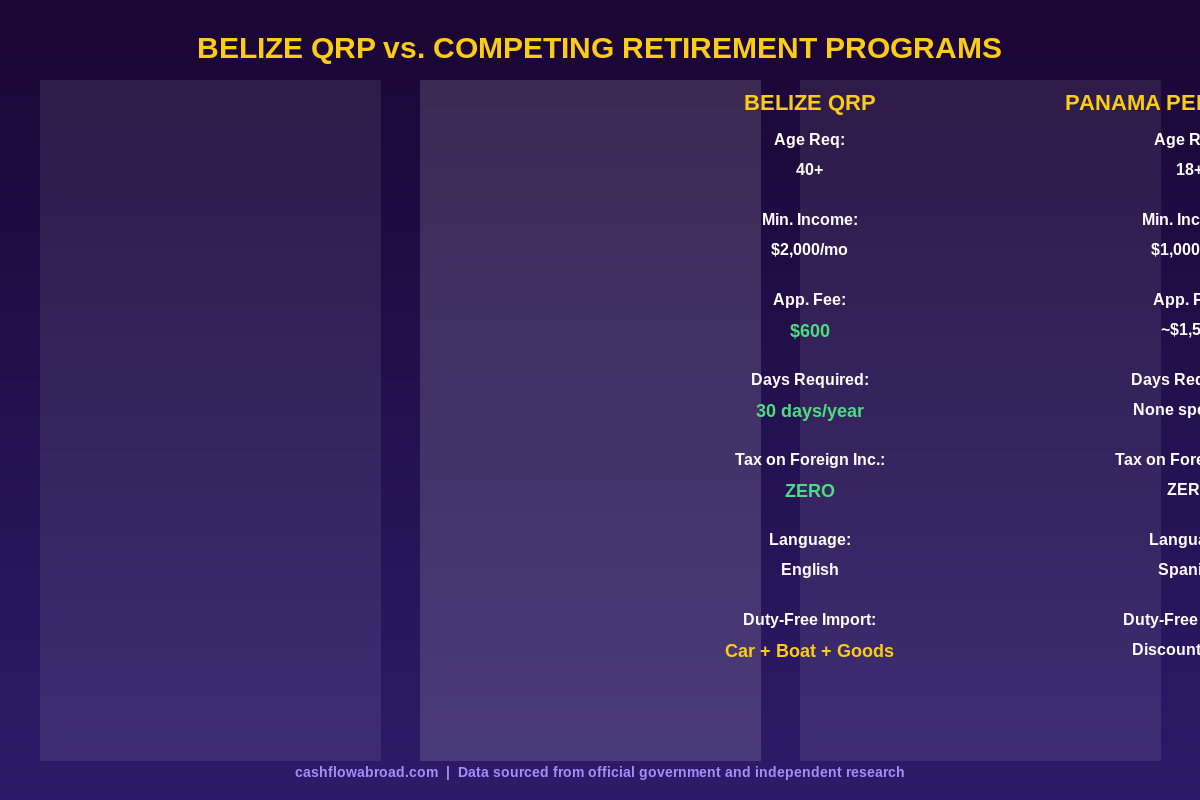
| Program | Min. Income | Min. Age | App. Fee | Days/Year | Language | Foreign Income Tax |
|---|---|---|---|---|---|---|
| Belize QRP | $2,000/mo | 40 | $600 | 30 days | English | Zero |
| Panama Pensionado | $1,000/mo (pension only) | None | ~$1,500 | None | Spanish | Zero |
| Costa Rica Rentista | $2,500/mo | None | ~$1,000 | 6 months/yr | Spanish | Zero on foreign inc. |
| Ecuador Jubilado | $800/mo (pension) | None | ~$500 | 6 months/yr | Spanish | Mixed |
| Malaysia MM2H | $9,000/mo offshore | 35 | ~$1,200 | 90 days/yr | Malay/English | Zero on foreign inc. |
Belize wins on three dimensions that specifically matter to Americans: language (the only English-first option in this table), application cost (by a wide margin), and proximity (1–2 hour direct flights from Houston, Miami, Atlanta, Dallas, and Los Angeles). Panama's Pensionado has a lower income threshold, but it requires pension income specifically — investment income or remote work income doesn't qualify for the core program. Belize accepts any foreign income source.
Costa Rica's 6-month physical presence requirement is a genuine constraint for people who want maximum flexibility. The QRP's 30-day minimum is easy to meet with a single month-long stay and gives you 10+ months of freedom to travel elsewhere, visit family, or split time between countries.
For a broader look at the geographic arbitrage landscape, see our 10-country geographic arbitrage playbook.
The Application Process, Step by Step
The QRP is more straightforward than Panama's or Portugal's processes, but Belizean bureaucracy is not fast. Expect 4–12 weeks from submission to approval.
- Gather documents. Certified copies of birth certificate and marriage certificate (if applicable); police clearance from every country you've lived in during the past 10 years; medical certificate from a licensed physician; proof of income (three months of bank statements, pension letters, brokerage statements, or employment contracts)
- Notarize and apostille. All documents must be certified through the appropriate US state authority. Your state Department of State office handles apostilles.
- Submit to the Belize Tourism Board in Belmopan along with the $600 fee. You can submit by mail or in person.
- Wait for approval. 4–12 weeks is typical. Missing or incorrectly formatted documents extend this.
- Receive your QRP card and duty exemption letter. The duty letter is critical for importing your vehicle and goods — treat it like a title document.
- Open your Belizean bank account and begin the monthly income deposits.
Many applicants use a local Belizean attorney for $500–$1,500 in fees to manage document handling and BTB communications. Not required, but it significantly reduces the back-and-forth that comes from document formatting issues and government office scheduling delays. If you're shipping a container of goods or a vehicle, coordinate timing carefully: the duty exemption must be active when your shipment clears customs.
What You Still Owe the IRS
Living in a zero-tax country doesn't change your US filing obligations:
- Form 1040: Annual filing required; expats get an automatic extension to June 15
- FBAR (FinCEN 114): Required if combined foreign account balances exceed $10,000 at any point during the year. Your required Belizean bank account triggers this from day one.
- Form 8938 (FATCA): Required if foreign financial assets exceed $200,000 for single filers abroad, or $400,000 for married filing jointly
- Self-employment tax: Remote workers and freelancers still owe 15.3% SE tax on the first ~$168,600 of net earnings — FEIE doesn't eliminate this
The practical reality for a typical QRP retiree: your Belize tax bill is zero, your US tax bill depends entirely on your income mix and deductions, and the net result is usually meaningfully better than equivalent US living costs. A couple drawing $5,000/month from Social Security and a brokerage account, living on $3,000/month in Placencia, is paying US federal tax on their worldwide income while spending far less on housing, food, and healthcare than they would stateside.
For how Social Security interacts with overseas living, see our post on why Social Security goes further abroad.
Is the QRP Right for You?
Be honest about which column applies to your situation:
| Good Fit for QRP | Not a Good Fit |
|---|---|
| Retirees with $2K–$5K/month passive income | People requiring frequent specialist medical care |
| Remote workers earning $24K+/year from US employers | Those who can't handle heat, humidity, or tropical infrastructure quirks |
| People wanting English-language daily life close to the US | Urban professionals who need major-city nightlife and culture |
| Divers, sailors, anglers, and ocean-focused lifestyles | Digital nomads who want zero minimum-stay obligations |
| Anyone importing a valuable vehicle or boat duty-free | People expecting US-quality roads, power stability, and internet everywhere |
| Families wanting English-medium schooling in a safe environment | High earners optimizing specifically for corporate tax structures |
Belize has real infrastructure gaps. Power outages are more common than in Panama or Costa Rica. Road quality outside main routes is rough. Amazon Prime doesn't deliver here (regional forwarding services exist but add cost and delay). These aren't dealbreakers for most retirees, but they're not trivial. The expats who thrive on the QRP tend to have come for the water — Belize sits on the second-largest barrier reef in the world — the English familiarity, and the 2-hour flight option when they need US healthcare or want to visit family.
Conclusion
Belize's QRP is the most underrated retirement residency program for Americans, and the reason it flies under the radar is precisely what makes it valuable: it doesn't have Panama's marketing budget, Portugal's prestige, or Dubai's glamour. What it has is a $600 application fee, a 30-day annual stay requirement, zero local taxes on foreign income, and a Caribbean lifestyle accessible on a direct flight from most major US cities.
For retirees drawing passive income and remote workers with stable US-source earnings, the structure is almost comically favorable: Belize taxes nothing, the cost of living is 40–60% below major US metros, the legal system speaks your language, and the dollar peg means no currency volatility to manage.
Get proper US expat tax guidance before you finalize your setup — FBAR, FATCA, and the interaction between FEIE and passive income require attention. But the Belize side of the equation is genuinely simple. Lock down your US virtual mailbox and your expat banking stack, get your documents apostilled, and send the BTB their $600.
Financial Disclaimer: This article is for informational purposes only and does not constitute tax, legal, or financial advice. Tax laws and program requirements change; individual circumstances vary significantly. Consult a qualified US expat CPA or international tax attorney and a Belizean attorney before making any residency or financial decisions. Information reflects conditions as of April 2026 and is subject to change. The author may receive compensation through affiliate links in this post.
Guias relacionadas
 Retirement AbroadMay 31, 2026
Social Security for Expats: Collect Full Benefits from Abroad
US expats can collect Social Security in 186+ countries. The 2025 WEP repeal restored hundreds per month for expats with foreign pensions.
 Retirement AbroadMay 31, 2026
Greece's 7% Flat Tax: Pay Less Than Your US State
Greece's 7% flat tax on all foreign pension income lasts 15 years. A California retiree earning $60K saves up to $15,000/year by moving.
 Retirement AbroadMay 8, 2026
Costa Rica Pensionado Visa: Retire on $1,000/Month Tax-Free
Costa Rica Pensionado visa: qualify on $1,000/month pension income, pay zero local tax on foreign income, and get CAJA healthcare for $70/month.