
Panama gets all the press. Costa Rica gets all the Americans — 70,000 to 120,000 of them, quietly living tax-free on retirement income that the IRS barely touches. The program making this possible has existed for decades, requires just $1,000/month in guaranteed pension income, and levies zero local tax on everything you earn outside the country. Yet most expat finance guides treat it as an afterthought behind Portugal and Thailand.
Here's what those guides miss: Costa Rica's Pensionado visa combines the lowest income floor of any major retirement residency program with a territorial tax system, genuine universal healthcare you can join for $70–$110/month, and property rights identical to those of Costa Rican citizens. If you have Social Security, a military pension, or any lifetime-guaranteed income stream hitting $1,000/month, you qualify today.
What Is the Pensionado Visa?
Costa Rica's Pensionado (pensioner) residency is a permanent residency category granted to retirees who can demonstrate a stable, guaranteed monthly income. The visa is issued initially for two years and is renewable indefinitely — with a path to permanent residency after three years and citizenship after seven.
The program is administered by DGME (Dirección General de Migración y Extranjería), Costa Rica's immigration authority. Unlike tourist-based arrangements that leave you technically overstaying, the Pensionado gives you full legal residency status: you can open bank accounts with full privileges, own property, access CAJA public healthcare, and drive with a Costa Rican license.
One application covers a spouse and children under 25 at no additional income threshold — meaning a couple can both gain legal residency on a single $1,000/month qualification.
The Income Requirement (And the Rules People Miss)
The $1,000/month floor is deceptively simple. The qualifying income must be:
- Guaranteed for life — not discretionary withdrawals
- Verifiable — documented by official statements from the paying institution
- Ongoing — not a lump sum or one-time disbursement
What qualifies: US Social Security benefits, federal or state government pensions, military retirement pay, and private company defined-benefit pension plans. What does not qualify: 401(k) or IRA withdrawals, rental income, freelance or business income, dividends, or any self-directed income stream — even if you pull exactly $1,000/month from your portfolio without fail.
The counterintuitive implication: you don't need to be old. A 42-year-old military veteran receiving $2,200/month in retirement pay from the DoD qualifies immediately. A federal worker who retired at 55 on a FERS pension qualifies. An early retiree drawing down a Roth IRA does not — no matter how wealthy they are.
If your guaranteed income falls slightly short, Costa Rica also offers a Rentista category requiring $2,500/month of verifiable income (broader definition) or a $60,000 deposit in a Costa Rican bank for five years. For pure retirees with Social Security, the Pensionado path is almost always cleaner.
The Tax Situation: What You Actually Owe
Costa Rica operates a territorial tax system — only income earned within the country is subject to local taxation. Your US Social Security income, foreign pension, dividend portfolio, rental properties in other countries, and international investment returns are entirely outside Costa Rican jurisdiction.
Costa Rica does impose taxes on locally-earned income: a 15% withholding on Costa Rican-source dividends and interest, and a progressive income tax on wages earned in the country (ranging from 10% to 25%). But for a retiree living on foreign pension income, the effective Costa Rican tax rate is zero.
The US side is less forgiving — Americans owe the IRS on worldwide income regardless of where they live, a function of citizenship-based taxation. The silver lining for retirees specifically:
- Social Security is taxable in the US, but only 0–85% of benefits are included in taxable income depending on your total income level. Many retirees with modest portfolios owe little to nothing on SS.
- The Foreign Earned Income Exclusion shelters up to ~$130,000 of earned income — less relevant for retirees, but powerful if you do consulting work from Costa Rica.
- The Foreign Tax Credit can offset US tax liability with any taxes paid to Costa Rica on local income.
Bottom line for a typical retiree: zero Costa Rican tax on foreign income, modest US federal tax on Social Security, and no state income tax if you've properly established domicile elsewhere before leaving. If you're still tied to a high-tax state, read the guide on state tax domicile traps before you book your one-way ticket.
Cost of Living Breakdown
Costa Rica's cost of living runs roughly 20% below the US average, with rent coming in about 44% cheaper according to Numbeo's 2025 data. But the country isn't monolithic — living in a San José suburb costs dramatically less than Nosara or the tourist-heavy Pacific beaches.
| Location | Monthly Budget (Couple) | 2BR Rent | Best For |
|---|---|---|---|
| San José / Central Valley | $1,600–$2,400 | $700–$1,200 | Urban amenities, infrastructure |
| Grecia / Atenas (mountain towns) | $1,400–$2,000 | $500–$900 | Ideal climate, low costs, expat community |
| Tamarindo (North Pacific) | $2,000–$3,000 | $900–$1,800 | Beach lifestyle, surf, English speakers |
| Manuel Antonio | $2,000–$3,200 | $1,000–$2,000 | National park access, tourist infrastructure |
| Nosara | $2,500–$4,000+ | $1,200–$3,000 | Wellness community, affluent expat scene |
Grocery costs for two people run $250–$400/month shopping at local markets (ferias). Eating at Costa Rican sodas (local diners) costs $4–$8 per meal. Imported goods — especially electronics and name-brand food — carry a premium, sometimes 30–60% above US prices. Utilities for a mid-range apartment including electricity, water, and internet average $80–$150/month in the Central Valley; air conditioning in coastal towns pushes that higher.
Healthcare: The CAJA Advantage Nobody Talks About
Costa Rica's public healthcare system — the Caja Costarricense de Seguro Social (CAJA) — is not a fallback for people who can't afford private insurance. It is a functioning national health system that covers hospital stays, specialist consultations, surgeries, prescriptions, and preventive care at no point-of-service cost.
Pensionado residents are required to enroll in CAJA. Contributions are calculated as 7–11% of your declared monthly income. At the $1,000 income threshold, that's $70–$110/month for comprehensive coverage. The tradeoffs: wait times for non-emergency specialist appointments can stretch to weeks, and the system's best facilities are concentrated in San José.
Many expats run a hybrid approach: CAJA for emergencies, hospitalizations, and prescriptions, plus a private supplemental plan from a provider like SafetyWing or a local insurer for faster access to private clinics. Full private coverage runs $100–$300/month depending on age, pushing total healthcare costs to $170–$410/month — still a fraction of US premiums.
Private hospitals like CIMA (affiliated with Baptist Health Miami) and Clínica Bíblica in San José deliver US-comparable care. A specialist consultation costs $60–$120 out of pocket. Hip replacements run $12,000–$18,000 versus $40,000+ in the US. Dental work is 50–70% cheaper.
How Pensionado Income Requirements Compare
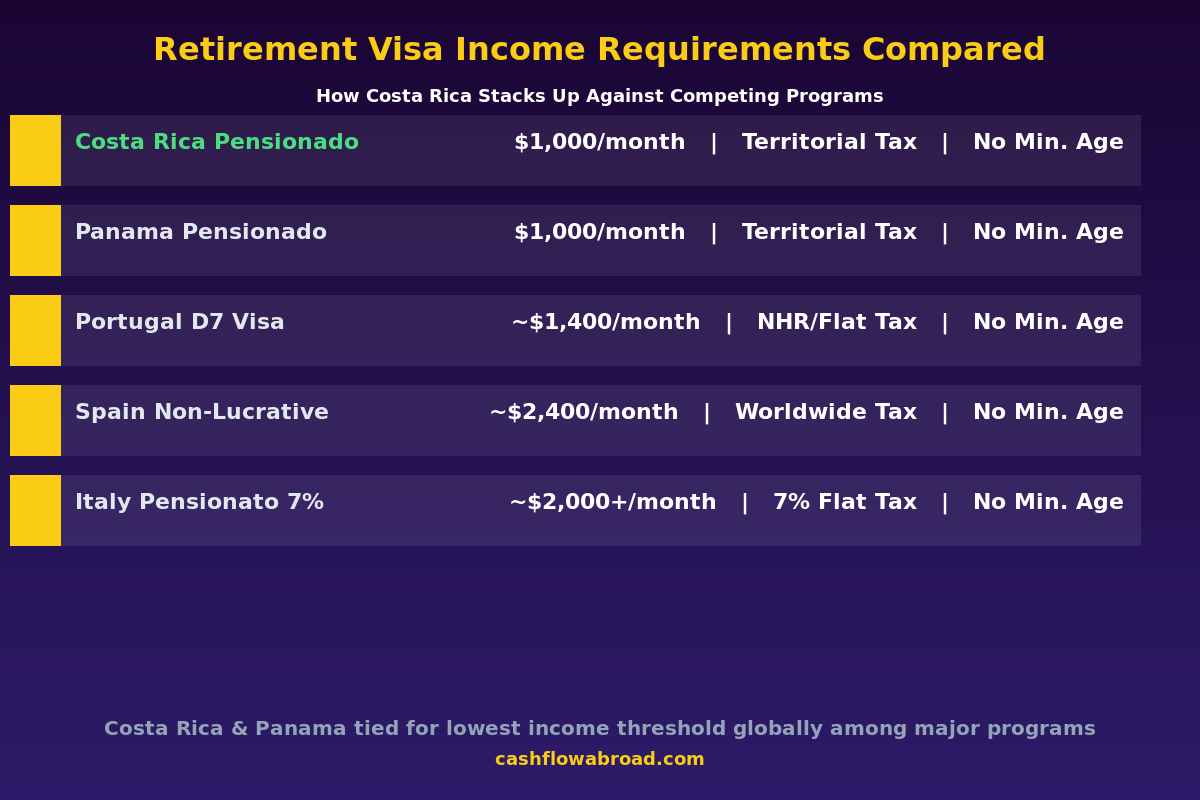
Costa Rica and Panama share the world's lowest income floor for major retirement residency programs — $1,000/month. Portugal's D7 requires roughly $1,400, Italy's 7% flat-tax pension visa requires $2,000+, and Spain's Non-Lucrative Visa demands around $2,400. The difference matters: a federal worker retiring at 57 on a pension just above the Social Security minimum has far more options than typical expat guides acknowledge.
Property Ownership for Foreigners
This is where Costa Rica genuinely surprises people. Unlike many popular expat destinations — where foreigners face restrictions, nominee structures, or 30-year lease maximums — Costa Rica grants foreigners identical property rights as citizens on titled land. You can buy, sell, inherit, and mortgage property in your own name with the same legal protections.
The critical exception is the Maritime Zone: land within 200 meters of the mean high-tide line falls under the Maritime Zone Law. The first 50 meters from the shoreline are public land and cannot be privately owned by anyone. The next 150 meters are "restricted zone" — available only via long-term municipal concessions (typically 5–20 years, renewable) and generally limited for foreigners who are not permanent residents. The condo 300 meters from the beach can be freehold titled and fully yours. The cabina directly on the sand usually cannot.
Purchase costs include a real estate transfer tax of 1.5%, a property registry fee, and legal/notary fees typically totaling 3–4% of purchase price. Annual property taxes run 0.25% of assessed value — on a $200,000 home, that's $500/year.
Banking and Your US Financial Stack
Banking as a non-resident in Costa Rica is difficult. Public banks like Banco Nacional and BCR technically accept non-residents but impose transaction caps ($1,200/month) and extensive anti-money-laundering documentation requirements — making full banking access impractical before residency.
Once you have Pensionado residency — and the DIMEX card (residency ID) that comes with it — banking opens up significantly. Required documents typically include your DIMEX, passport, proof of income, utility bill at your address, and enrollment in Costa Rica's tax registry (RTBF).
In the meantime, maintaining a robust US banking stack is essential. A Charles Schwab International checking account eliminates ATM fees worldwide and offers competitive interest — critical during the 6–18 months before residency is granted. For international transfers while your residency processes, Remitly consistently beats bank wire fees to Costa Rican recipients.
Maintaining a US mailing address is also non-negotiable for keeping your US banking relationships active and staying FBAR-compliant. Traveling Mailbox provides a real US street address in 50+ cities with mail scanning and check deposit capability — the site owner uses this personally. At $15/month, it's the cheapest insurance against losing your US financial infrastructure abroad.
Who Qualifies Right Now
| Income Source | Qualifies? | Notes |
|---|---|---|
| US Social Security | Yes | SSA award letter required; no minimum age |
| Military retirement pay | Yes | DFAS statement required; qualifies at any age |
| Federal/state FERS or CSRS pension | Yes | OPM or agency statement required |
| Private company defined-benefit pension | Yes | Letter from plan administrator confirming lifetime benefit |
| 401(k) / IRA withdrawals | No | Not guaranteed for life; consider Rentista category |
| Freelance / business income | No | Not guaranteed; Rentista with bank deposit may work |
| Rental income | No | Treated as variable; Rentista may apply |
| Dividends / investment portfolio income | No | Not guaranteed; Rentista with $60K deposit may qualify |
How to Apply
Applications are filed through DGME in San José. Most applicants hire a local Costa Rican immigration attorney ($500–$1,500) to navigate document requirements and submit on their behalf. Processing takes 6 to 18 months. Applicants typically enter on a tourist visa (90 days, extendable) and wait in-country or abroad while the application processes.
Required documents:
- Valid passport (plus color copies of all pages)
- FBI background check — apostilled, issued within 3 months of application submission
- Income certification letter (Social Security award letter, pension statement) — apostilled
- Birth certificate — apostilled
- If married: marriage certificate — apostilled
- Proof of health insurance enrollment or private coverage
- Immigration filing fee: approximately $50–$200
Apostilles for federal documents (FBI check, SSA letters) go through the US Department of State. State-issued documents are apostilled through the relevant state's secretary of state office. Give yourself 2–3 months to collect everything before filing.
Pensionado vs. Competing Programs
The closest competitor is Panama's Pensionado — same $1,000/month floor, same territorial tax system. Panama wins on banking (US-dollar economy, more international banks) and urban infrastructure. Costa Rica wins on natural diversity, healthcare quality, and lower monthly costs outside beach towns.
Against retiring abroad on Social Security generally: Costa Rica is one of a short list of countries where Social Security alone can cover your residency qualification and your monthly budget — especially in the Central Valley. Thailand's cost of living is comparable, but Americans there often exist in legal grey zones without a formal retirement visa unless they use the LTR or elite visa programs.
For those who don't qualify for Pensionado due to income source (not income level), the geographic arbitrage playbook covers countries where portfolio retirees can access formal residency without guaranteed pension income.
The Bottom Line
Costa Rica's Pensionado visa is the quiet achiever of global retirement options. The math is simple: $1,000/month of guaranteed pension income gets you legal residency, CAJA healthcare for under $110/month, zero local tax on foreign income, and a stable English-friendly country where couples live comfortably on $1,600–$2,400/month in the Central Valley. Property rights for foreigners equal those of citizens — a standard most popular expat destinations don't match.
The program's weakness is processing time and the strict definition of qualifying income. If you're a digital nomad, portfolio retiree, or freelancer without guaranteed pension income, the Pensionado category won't fit. But if Social Security, military pay, or a defined-benefit pension is in your income stack, this is one of the world's most accessible paths to a legal, low-tax retirement abroad — and it's been quietly available while everyone crowds into Lisbon and Playa del Carmen.
For the US tax obligations that follow you to Costa Rica, start with the complete expat banking and taxes guide and review how your 401(k) and IRA work while living abroad before your departure date.
Financial Disclaimer: This article is for informational and educational purposes only and does not constitute legal, tax, immigration, or financial advice. Immigration laws, income thresholds, and tax rules change; consult a licensed Costa Rican immigration attorney and a qualified US expat tax professional before making decisions based on this content. All figures are accurate to the best of our knowledge at time of publication and should be verified against current DGME guidelines.