Argentina Expat Guide: Live Well on $1,200/Month in Buenos Aires
Dollar-earning expats are discovering Buenos Aires costs 40-60% less than New York or London—even after Milei's stabilization. Here's the real cost breakdown.
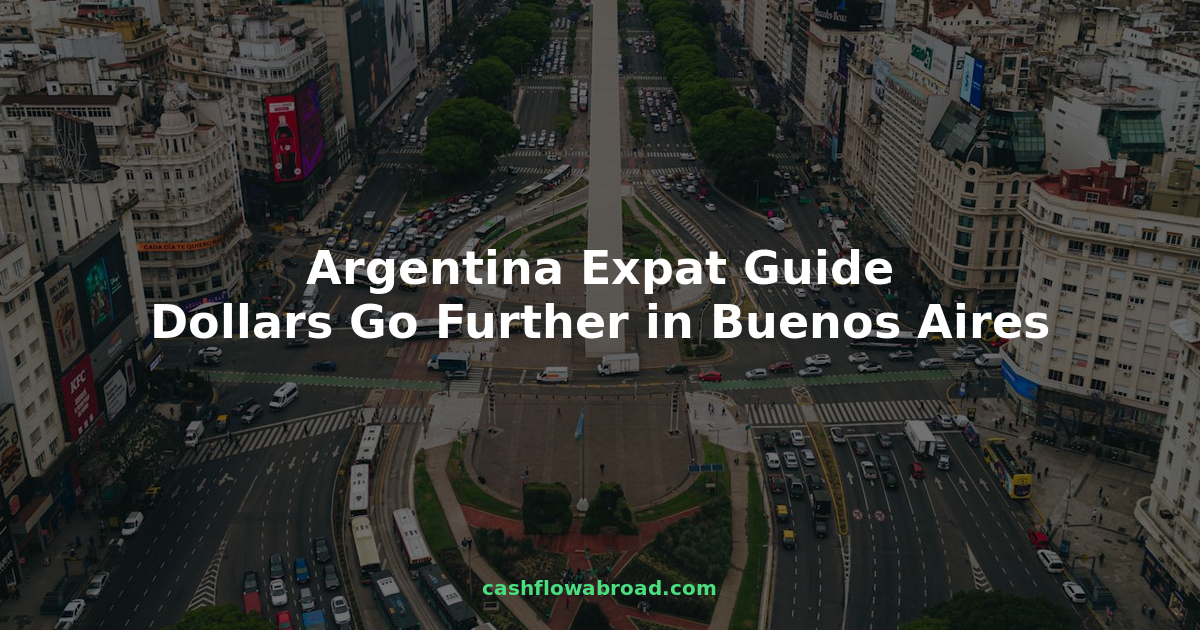
Argentina's annual inflation just printed at 32%. That sounds alarming until you realize it was 211% when Javier Milei took office — and topped 288% during the 2024 devaluation shock. For dollar-earning expats, that trajectory tells you everything: the chaos is fading, the affordability isn't.
The "blue dollar arbitrage" that made Buenos Aires famous on nomad forums — where the informal exchange rate ran 50–80% above official — officially collapsed in April 2025 when the government removed capital controls. The spread today? About 2–3%. That specific strategy is dead.
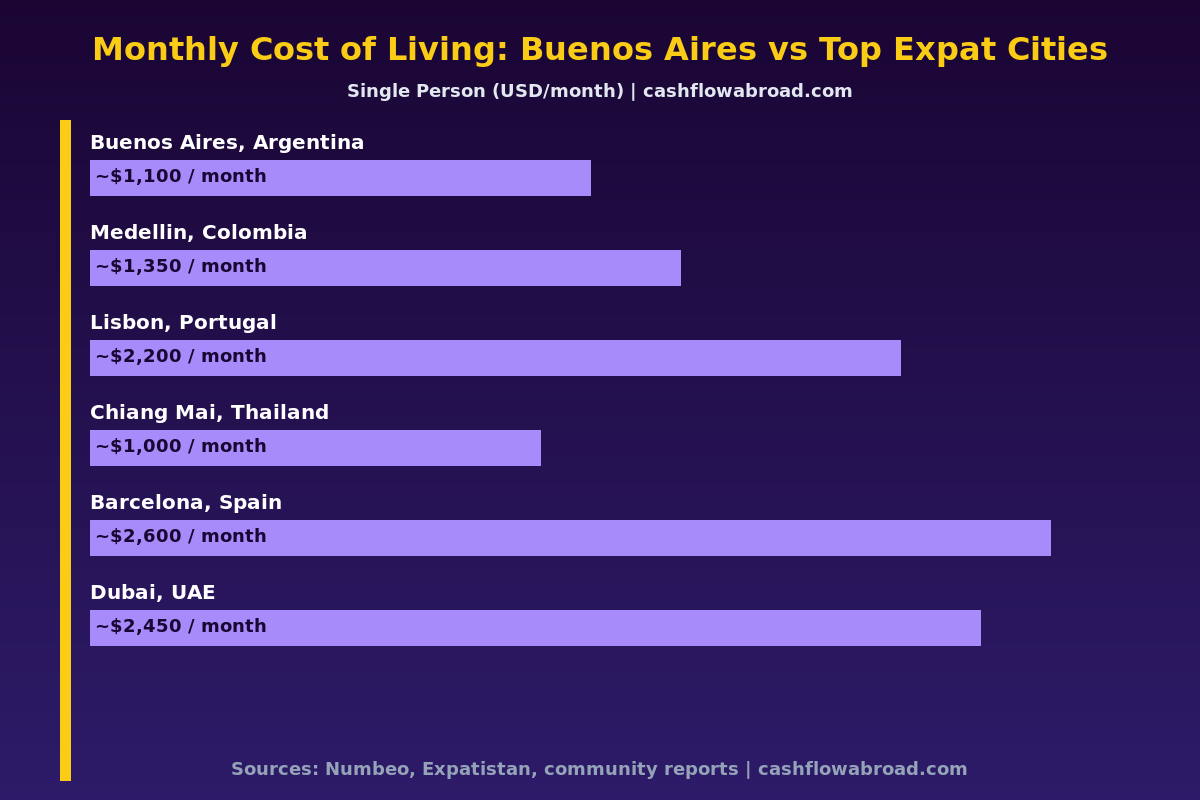
But Buenos Aires is still roughly 40–60% cheaper than comparable US metros. A comfortable single-person life costs $1,200–$1,800/month in a city with world-class steakhouses, functioning metro infrastructure, fast internet, and a cultural scene most European capitals envy. The arbitrage window has narrowed — the affordability window is wide open.
The New Argentina: What Milei's Reforms Actually Mean for Expats
Milei's first two years as president rewrote the economic rulebook. He slashed public spending by roughly 30%, eliminated dozens of state subsidies, removed all capital controls (April 2025), and secured a $20 billion IMF facility — including a $12 billion immediate disbursement — in April 2025. GDP growth ran nearly 5% in 2025, with 3.5–4% projected for 2026.
What does that mean practically for someone planning to move there?
- The peso is no longer in freefall. The USD/ARS rate sits around 1,450, and the IMF-backed currency band system has kept it stable for months.
- Prices have normalized. Buenos Aires isn't the absurdly cheap 2021–2022 version anymore. But it's also not Lisbon or Barcelona. It's somewhere in between — and at US income levels, that's still very favorable.
- Property prices in USD are historically low. A 2-bedroom apartment in Palermo can be bought for $120,000–$180,000. Rents are denominated in USD, which protects landlords against peso erosion and means you negotiate directly in your currency.
The instability risk hasn't vanished — Argentina has defaulted on sovereign debt nine times, and the political situation remains fluid. Anyone relocating here with significant capital should diversify storage: keep only spending money in pesos, and hold savings offshore in USD, stablecoins, or a brokerage like Charles Schwab, which offers free ATM withdrawals worldwide and functions as your anchor account.
Real Monthly Costs: What You'll Actually Spend
The figures below are based on current 2026 pricing in Buenos Aires, with rents denominated in USD (as is standard for longer-term leases).
| Expense | Budget ($) | Comfortable ($) | Expat Luxury ($) |
|---|---|---|---|
| Rent (1BR apartment) | 450–600 | 700–1,200 | 1,500–2,500 |
| Groceries | 150 | 250 | 450 |
| Restaurants & going out | 100 | 250 | 600 |
| Public transport (SUBE card) | 20 | 30 | 80 (Uber/taxi) |
| Private health insurance | 50 | 100 | 200 |
| Internet (100+ Mbps) | 18 | 18 | 40 (fiber) |
| Mobile SIM | 15 | 18 | 25 |
| Entertainment & activities | 80 | 200 | 500 |
| Monthly Total | ~$900 | ~$1,600 | $3,500+ |
The mid-tier budget of $1,500–$2,100/month gets you a furnished apartment in a good neighborhood, dinner out 3–4 times per week at restaurants that would cost $60–$80/head in New York, and a social life that feels genuinely abundant. A full asado dinner with Malbec at a mid-tier parrilla runs $10–$15 per person. Specialty coffee: $1.50.
Where to Live: Buenos Aires Neighborhood Guide
Buenos Aires is a city of neighborhoods — each with its own personality and price point. Here's the honest breakdown:
Palermo: The Expat Default
Palermo is where most English-speaking expats land first, and for good reason. It's walkable, packed with coworking spaces and specialty coffee shops, has multiple parks (including the massive Bosques de Palermo), and the nightlife runs until dawn. Sub-neighborhoods — Palermo Soho, Palermo Hollywood, Palermo Chico — each have their own vibe. One-bedroom rent: $700–$1,200/month. Expect to pay a premium for the convenience and social infrastructure.
Recoleta: Old Money, Still Affordable
Recoleta looks like Paris transplanted to South America — Belle Époque buildings, tree-lined boulevards, the famous cemetery where Eva Perón is buried. It skews older and quieter than Palermo. A one-bedroom here runs $700–$1,100/month for a nice furnished place. Great for anyone wanting a calmer pace with easy metro access to everywhere else in the city.
San Telmo: Character at a Discount
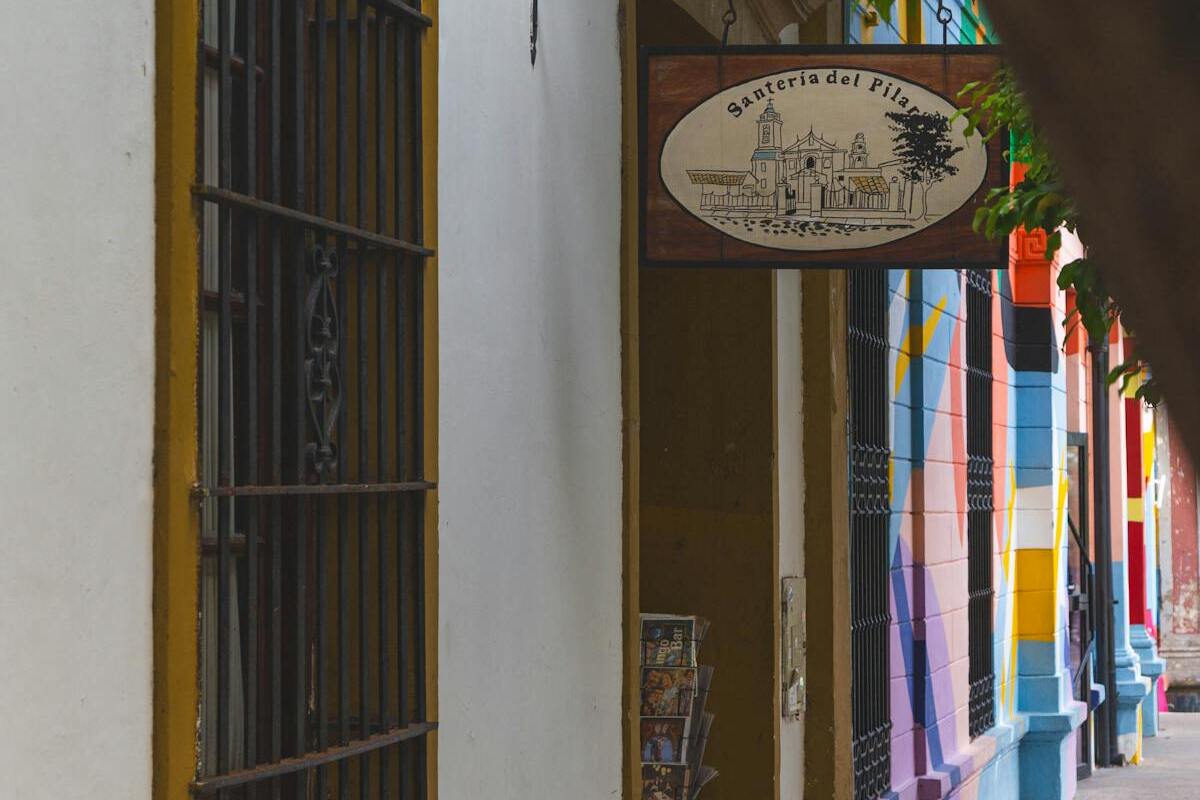
San Telmo is Buenos Aires's oldest neighborhood — cobblestone streets, antique markets, milonga tango clubs, and the most authentic porteño atmosphere in the city. It also has the best price-to-character ratio: a one-bedroom can be found for $500–$800/month. The Sunday street market on Defensa Street draws locals and tourists alike and never gets old.
Villa Crespo & Belgrano: For the Long Haul
Villa Crespo sits just west of Palermo and runs about 15–20% cheaper, with a younger, more artistic crowd. Belgrano, in the north, is family-friendly with excellent schools and quieter streets — good if you're relocating with kids. Both neighborhoods offer 1BR apartments for $550–$900/month.
The Exchange Rate in 2026: Stop Looking for Blue Dollars
The honest picture as of May 2026:
- Official rate: ~1,450 ARS/USD
- Blue dollar (cash parallel market): ~1,480–1,500 ARS — about 2–3% above official
- MEP rate (foreign Visa/Mastercard): ~1,460 ARS — this is what your card charges
The gaps between these three rates have essentially collapsed. Foreign Visa and Mastercard cards get the MEP rate automatically — and today that rate is nearly identical to the blue market. The days of finding an informal exchange house to double your purchasing power are over.
The crypto route still exists — using USDT or USDC to buy pesos through local P2P platforms yields about 3–5% above MEP — but for monthly spending under $5,000, the compliance complexity isn't worth the margin for most people. It's relevant for larger capital movements.
Practical approach: use a Charles Schwab debit card at ATMs (fee reimbursed globally) or a foreign Visa/Mastercard for card payments. For regular larger transfers into Argentina, Remitly offers competitive USD-to-ARS rates with same-day delivery to Argentine bank accounts — no elaborate cash strategy required.
Visa and Residency Options
Argentina offers more flexibility than most countries for getting in and staying legally.
Tourist Visa: The Easy Start
US citizens get 90 days visa-free on arrival — automatically. No application, no fee. You can extend once at the Buenos Aires immigration office (Dirección Nacional de Migraciones) for another 90 days for approximately $200. After 180 days, most expats do a border run to Colonia del Sacramento, Uruguay (a 1-hour ferry from Buenos Aires) and re-enter with a fresh 90 days.
Digital Nomad Visa: The 12-Month Path
Argentina's formal digital nomad visa (Residencia Transitoria para Trabajadores Remotos) provides an initial 180-day permit, renewable once for another 180 days. Key requirements:
- Proof of remote income from a foreign source (recommended: $2,500+/month, though no statutory minimum exists)
- Clean criminal background check with apostille
- Argentine address documentation (a rental contract works)
- Application fee: approximately $200 total (split between online application and consular fee)
Apply through the Argentine consulate in your home country or in person in Buenos Aires. Processing: 2–6 weeks. Holders don't owe Argentine income tax as long as their clients are foreign and they stay under the 183-day tax residency threshold.
Temporary and Permanent Residency
If you want roots, Argentina's rentista visa applies to those with consistent passive foreign income (roughly $1,500+/month). Standard permanent residency requires 2 years of legal residence. In July 2025, Milei signed Decree 524/2025 creating a citizenship-by-investment pathway — minimum roughly $500,000 in qualifying sectors (agribusiness, tech, renewables, tourism), with the standard residency wait waived. The program is new and details will evolve, but it signals Argentina's direction: actively courting foreign capital.
US Expat Taxes in Argentina
As a US citizen, you always file with the IRS regardless of where you live. Argentina's tax situation is relatively clean for expats:
| Scenario | Argentine Tax | US Obligation |
|---|---|---|
| Under 183 days/year in Argentina | None | Full US filing; FEIE up to $126,500 |
| Over 183 days, foreign-sourced income | Progressive 9–35%; US treaty applies | FEIE still claimable; Foreign Tax Credit for any overlap |
| Argentine bank account >$10K | N/A | FBAR (FinCEN 114) required annually |
| Investment/dividend income | Limited capital gains tax for non-residents | Taxable in US; Foreign Tax Credit may reduce liability |
The US–Argentina tax treaty prevents double taxation on most income categories. Most expats on the digital nomad visa staying under 183 days can use the FEIE to exclude up to $126,500 of earned income from US taxes — while owing nothing to Argentina. That's the optimal structure for the first year of any Buenos Aires stint.
Argentine bank and investment accounts over $10,000 at any point during the calendar year trigger FBAR reporting. For the full picture of expat tax compliance, see our US expat banking and taxes guide.
Healthcare: Private vs. Public
Argentina's universal public hospitals are functional for emergencies and free to access — but underfunded and chronically overextended. Every expat beyond tourist status should carry private coverage.
Options:
- Argentine private HMO (prepaga): Plans like OSDE, Swiss Medical, and Galeno accept private subscribers for $80–$200/month. These give access to Argentina's private hospital network — which is genuinely excellent. Buenos Aires has internationally accredited hospitals with well-trained physicians, often at a fraction of US private hospital costs.
- International nomad coverage: SafetyWing covers Argentina starting around $56/month and is ideal for the first 90 days while you settle. Once you have a rental contract and Argentine address, a local prepaga typically offers better local network coverage for the same or lower cost.
For a full breakdown of plans and what they cover internationally, see our expat health insurance guide.
Banking Stack for Buenos Aires
Opening a local Argentine bank account requires a DNI (national ID), which takes several months to obtain through the residency process. In the meantime, run on this stack:
- Charles Schwab International Account — the expat's best friend. No foreign transaction fees, unlimited ATM fee reimbursements worldwide, and US FDIC-insured. You get the MEP rate on every Argentine ATM withdrawal automatically.
- US virtual mailbox — critical for maintaining US banking access, IRS correspondence address, and state domicile while abroad. Traveling Mailbox gives you a real US street address (50+ cities, $15/month) with mail scanning and check deposit. Without a US address, most US banks will eventually close your accounts.
- Stablecoin float — holding USDC or USDT as a spending reserve lets you convert to pesos via local P2P platforms at the marginal 3–5% premium over MEP when the friction is worth it for larger conversions.
For a broader expat banking framework, see our geographic arbitrage playbook covering 10 countries and how to structure finances across borders.
Quality of Life: The Part the Spreadsheets Miss
Cost-of-living tables don't capture what makes Buenos Aires genuinely worth living in. The city punches well above its price class:
- Food and wine: World-class Malbec from Mendoza costs $5–$8 in a restaurant. A full asado dinner is $12–$18/person. The panadería croissant culture means breakfast is also a recurring highlight at $0.50–$1.50 per medialunas.
- Internet: Fiber at 100–500 Mbps runs $18–$40/month. Coworking spaces with private desks cost $100–$180/month. Reliable connectivity is not an issue.
- Language: Spanish-immersion accelerates fast in Buenos Aires. The local Rioplatense accent (Italian-influenced, with vos replacing tú) takes about 2 weeks to tune into. Fluency follows within 4–6 months for most disciplined learners.
- Culture: The Teatro Colón ranks among the world's top three opera houses. Live theatre, jazz clubs, milongas, and art museums are cheap and everywhere. Most events cost $5–$20 USD.
- Safety: Petty theft exists — pickpocketing in tourist zones, phone snatching in busy areas. Standard big-city precautions (Uber at night, valuables out of sight, aware posture) make it manageable. Violent crime targeting foreigners is rare relative to other major Latin American cities.
Who Argentina Works For (and Who It Doesn't)
Buenos Aires is exceptional value for dollar-earning expats who want high-stimulus, high-culture, low-cost city life. It's not the right base for everyone.
Strong fit:
- Remote workers or freelancers earning $3,000–$8,000+/month in USD who want to maximize their savings rate dramatically
- Writers, creatives, or anyone who needs cultural richness at low cost
- Retirees drawing Social Security or pensions in USD — the purchasing power advantage is substantial
- Spanish learners wanting full immersion in a European-quality city
Harder fit:
- Families needing English-language schooling — international schools exist but add $10,000–$20,000/year
- People with significant US-invested assets who need seamless tax coordination — Argentina adds complexity
- Anyone needing fast US travel access — Buenos Aires is 10–12 hours from Miami or JFK, with limited direct route options
For more country comparisons and how to choose a base, see our digital nomad visas ranked guide and the 10-country geographic arbitrage playbook.
The Verdict
The blue dollar era is over. What remains is something arguably more durable: a major world city — genuinely beautiful, intellectually alive, gastronomically remarkable — where a dollar-earner can build a comfortable life at roughly half the cost of any equivalent US metro, without giving up the things that make a city worth inhabiting.
Buenos Aires in 2026 is not the wild west it was in 2022. Milei's stabilization has meaningfully reduced the currency chaos without erasing the price advantage. That makes it, for the first time in years, a place you can actually plan around — not just opportunistically exploit. For the right person, that's a significant opportunity.
Financial disclaimer: This post is for informational and educational purposes only and does not constitute financial, tax, legal, or investment advice. Exchange rates, visa requirements, tax laws, and cost-of-living figures change frequently — verify current conditions with official Argentine government sources and consult a qualified international tax professional before making relocation or financial decisions. Affiliate links in this post may earn a commission at no cost to you.
Related guides
 Geographic ArbitrageJune 1, 2026
Argentina for US Expats: Costs, Visas, Banking
US dollar earners can live comfortably in Buenos Aires for $1,500/month. Complete guide to Argentina visas, banking, taxes, and healthcare for US
 Geographic ArbitrageMay 17, 2026
Argentina for Digital Nomads: Costs, Visa and Taxes
Live well in Buenos Aires for $1,400/month. The complete Argentina digital nomad visa guide: costs, taxes, neighborhoods, banking, and healthcare.
 Geographic ArbitrageApril 30, 2026
Argentina Expat Guide: Dollar Income, Peso Prices
Live comfortably in Buenos Aires for $1,500/month. Full guide to cost of living, tax rules, residency visas, and banking after Milei's 2025 reforms.