
Argentina's monthly inflation hit 25.5% in December 2023 — one of the worst in the world. Eighteen months later, it was 1.5%. President Javier Milei shredded the currency controls that made Argentine banking a bureaucratic nightmare, slashed government spending by 30%, and by April 2025 had done something no Argentine leader had managed in decades: let the peso float freely against the dollar. The chaos didn't disappear overnight, but for a US dollar earner willing to pay attention, what emerged on the other side is arguably the best geographic arbitrage play in the Western Hemisphere right now.
Buenos Aires has the food, culture, nightlife, and architecture of a European capital. It just costs a fraction of the price. A furnished one-bedroom in Palermo — BA's most sought-after expat neighborhood — runs $500–800/month. A restaurant dinner with wine lands under $12. Monthly grocery bills hover around $180. For someone earning even $3,000/month in USD, Argentina isn't budget travel. It's wealth.
Why Argentina, Why Now
The old Argentina story involved a dual exchange rate system — an official rate and the infamous dólar blue that could be 50–100% higher — and a labyrinthine set of capital controls ("cepo cambiario") that made moving money in or out a full-time job. That system is gone. In April 2025, Milei's government lifted the cepo, allowing individuals and businesses to buy and sell USD freely. The official exchange rate is now the only rate.
What does that mean practically? It means you can wire USD to an Argentine bank account, exchange at the real rate, and spend locally — no black market required, no risk of carrying cash through customs. The USD/ARS exchange rate in May 2026 sits around 1,395 pesos per dollar. That's not the obscene premium the blue market offered in 2022, but it's a legitimate rate in an economy that's stabilized enough to actually function.
Argentina's economy grew 4.4% in 2025, rebounding from the brutal 1.7% contraction Milei engineered in his first year of austerity. The IMF projects another 4% in 2026. Monthly inflation, while not yet fully tamed (2.9% month-on-month in early 2026), is a fraction of what it was. Annual inflation is projected to fall from ~41% in 2025 to ~18% in 2026 and single digits by 2028.
This matters for expats because it changes the calculus. When inflation is 25%/month, any peso-denominated savings evaporate instantly. At 2–3%/month, you're still not holding pesos as a savings vehicle, but your day-to-day expenses — rent, food, transport — are predictably priced in a way they weren't before. The country is volatile, but it's a manageable kind of volatile now.
The Argentina Digital Nomad Visa
Argentina launched its digital nomad visa in 2022, targeting remote workers and freelancers who earn income from outside the country. Here's what the program actually requires:
| Requirement | Details |
|---|---|
| Visa duration | 180 days, renewable for another 180 days |
| Application fee | ~$150 USD |
| Minimum income | ~$1,500–$2,500/month (no officially published hard figure) |
| Employer requirement | Must work for company or clients outside Argentina |
| Health insurance | Private coverage required for full stay duration |
| Criminal background | Clean record required |
| Processing time | Typically 15–30 days |
The visa is applied for online through Argentina's migration portal (Trámites a Distancia). You'll submit proof of income (bank statements, employment contract, or client invoices), proof of private health insurance, and a criminal background check from your home country. The process is bureaucratic — Argentina hasn't streamlined it — but it's workable.
On the health insurance requirement: this is non-negotiable and the application gets rejected without it. SafetyWing's Nomad Insurance covers Argentina and costs around $45–80/month depending on age — one of the most cost-effective ways to satisfy this requirement. For more thorough coverage comparisons, the expat health insurance guide covers the full landscape.
One important nuance: Argentina allows most nationalities to enter visa-free and stay as tourists for 90 days. Many nomads simply do a border run to Uruguay (a 1-hour ferry from Buenos Aires) to reset the clock. The digital nomad visa is better for anyone planning a longer or more structured stay — it gives you legal status to open a bank account and sign rental contracts.
Real Cost of Living in Buenos Aires
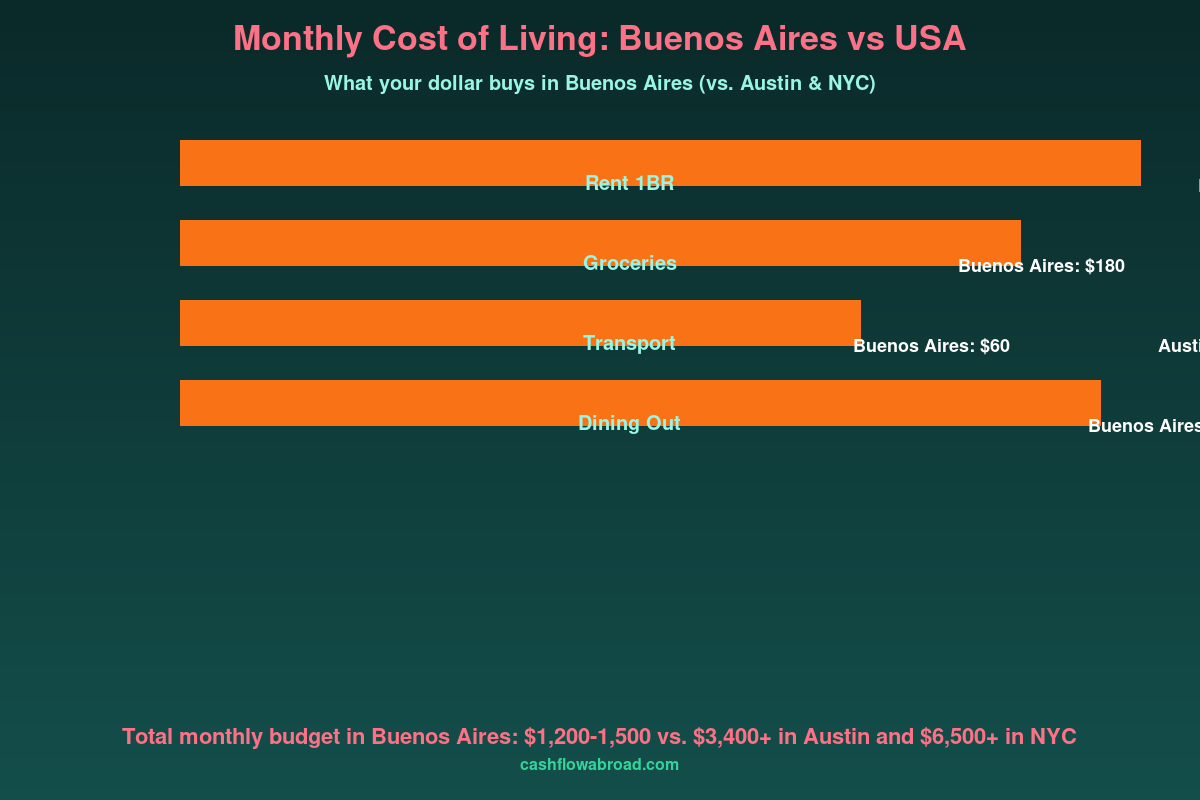
The headline number: the average monthly cost in Buenos Aires for a single person, excluding rent, is approximately $660 USD. Add a furnished one-bedroom and the total comes to $1,200–$1,500/month for a comfortable life in a top expat neighborhood. Compare that to $3,400+ in Austin or $6,500+ in Manhattan for an equivalent lifestyle. Numbeo data confirms that Buenos Aires rent is 68.5% cheaper than the US average and overall cost of living 39% lower.
| Expense Category | Buenos Aires (USD) | Austin, TX (USD) | New York City (USD) |
|---|---|---|---|
| 1BR Apartment, furnished | $400–$700 | $1,300–$1,800 | $2,800–$4,500 |
| Groceries (1 person/month) | $180 | $380 | $650 |
| Mid-range restaurant meal | $8–$15 | $20–$35 | $30–$60 |
| Public transport (monthly) | $20–$30 | $50–$80 | $132 |
| Co-working space (desk) | $80–$150 | $200–$350 | $400–$700 |
| Health insurance (nomad) | $45–$80 | $300–$600 | $400–$800 |
| Total monthly estimate | $1,200–$1,500 | $3,400–$4,500 | $6,000–$8,000 |
Rent figures deserve a closer look. In practice, a furnished studio in Palermo Soho runs $450–$650/month; a spacious one-bedroom with a balcony in Belgrano or Recoleta lands at $500–$800. These are dollar-denominated prices on the short-term rental market — landlords price in USD because peso-denominated rents erode with inflation. This is actually an advantage for dollar earners: your rental agreement is effectively inflation-protected and you know exactly what you're paying.
The steak situation is real. A proper parrilla dinner — salad, entrecote, Malbec, dessert — costs $15–$25 at a mid-tier restaurant. Mendoza wine costs $3–$7 a bottle at a grocery store. Argentine beef quality, by most rankings, rivals the finest cuts available in the US at a fraction of the price. If food is your thing, Buenos Aires has a legitimate claim to being the highest-value food city in the world for dollar earners.
Taxes: What You Owe and What You Don't
US citizens owe US taxes regardless of where they live — Argentina doesn't change that. The Foreign Earned Income Exclusion (FEIE) can shelter up to $130,000 of earned income from US tax, and the Foreign Tax Credit can offset dollar-for-dollar any Argentine taxes you pay against your US bill. The full framework is in the geographic arbitrage playbook.
Your Argentine tax exposure depends entirely on your residency status:
- Under 183 days/year: Argentina taxes only Argentine-source income. If your clients and employer are outside Argentina, you owe nothing to AFIP (Argentina's equivalent of the IRS).
- Over 183 days: You become an Argentine tax resident, subject to tax on worldwide income. Argentina's income tax rates range from 5% to 35% on a sliding scale.
For most digital nomads on the 180-day visa, the 183-day threshold is your practical ceiling. Stay under it and you have zero Argentine income tax exposure on foreign-source income. The visa's 180-day duration is conveniently calibrated to keep you just under this threshold.
If you're planning a longer stay and will cross into tax residency, get a bilingual CPA who works across the US-Argentina border. Argentina's tax code is complex and AFIP is modernizing its enforcement systems. The US-Argentina tax treaty does provide some relief, but it needs professional interpretation for your specific situation. See the full breakdown of how to structure this in the zero-tax FEIE guide.
Best Neighborhoods for Expats in Buenos Aires
Buenos Aires is enormous — nearly 3 million in the city proper, 15 million in greater Buenos Aires. Expats cluster in a handful of neighborhoods, each with a distinct character and price point.
Palermo: The default for most digital nomads. Palermo Soho has the cafes, co-working spaces, boutique gyms, and artisan food markets. Palermo Hollywood (the northern pocket) is quieter. Rent runs 15–20% above the BA average. Justified if you want walkability and social density in one package.
Recoleta: Buenos Aires' Upper East Side. Belle Époque architecture, the famous cemetery (Eva Perón's tomb), and some of the city's best restaurants. More residential, slightly older crowd. Comparable rent to Palermo with a more classic feel.
Belgrano: Quieter, more local feel, easier to find larger apartments at lower prices. Good transport connections. Popular with families and longer-term residents who want to live like a local rather than an expat.
San Telmo: The historic heart. Cobblestone streets, antique markets, tango bars. Edgier, slightly grittier, but the most "authentic" BA experience. Rents run 20–30% below Palermo.
Núñez / Villa Urquiza: Residential outer neighborhoods where locals actually live. If you're staying 6+ months and want a real neighborhood rather than an expat bubble, this cuts your rent by 30–40% versus Palermo without sacrificing safety or transit access.
Healthcare for Expats
Argentina has a three-tier health system: public hospitals (free, open to everyone including foreigners, but often overcrowded); prepaid private insurance ("prepagas"); and private clinics. The private system in Buenos Aires is genuinely world-class — the country trains excellent doctors, and hospitals like Hospital Alemán or Sanatorio Güemes rival anything in Western Europe.
A local prepaga plan for a healthy 30-something expat runs $100–$200/month, giving you access to private hospitals and specialist care. For shorter stays or digital nomad visa compliance, SafetyWing Nomad Insurance is the pragmatic choice — it satisfies the visa requirement, costs under $80/month, and covers emergency care including evacuation. SafetyWing does not cover elective care or pre-existing conditions, so if you have ongoing health needs, consider a local prepaga as a supplement.
One quirk: some Argentine doctors still prefer cash, and consultation fees at private practices run $15–$40. Even with insurance, paying out-of-pocket and getting reimbursed is common. Keep records of every medical expense.
Practical Setup: Banking, Internet, and Money
Banking: Opening an Argentine bank account as a foreigner requires a DNI (national ID), which you can apply for only after getting legal residency — out of reach on a 180-day visa for most people. The workaround: keep your US accounts and withdraw from ATMs or use USD cash. Charles Schwab International reimburses all ATM fees worldwide — essential in Argentina where ATM withdrawal limits are low and you may need multiple withdrawals per week.
For dollar access in Argentina specifically, ARQ Finance is worth knowing. It holds balances in USDC/EURc, lets you swap to local currencies including ARS, and carries a Mastercard with cashback — useful if you want to hold digital dollars and spend in pesos without touching a traditional bank. Available in Argentina, Mexico, Colombia, and Brazil.
Sending money: Remitly handles USD-to-ARS transfers at competitive rates. Now that the cepo is lifted, you're getting the real exchange rate rather than the old manipulated official rate — a meaningful improvement for anyone regularly moving money into the country.
Maintaining your US address: If you're staying in Argentina for months, you still need a valid US address for banking, the IRS, state domicile, and brokerage accounts. Traveling Mailbox provides a real US street address in 50+ cities, scans your mail digitally, and lets you deposit checks — about $15/month. Essential for not losing your US financial infrastructure while you're away. Full breakdown in the virtual mailbox guide.
Internet: Buenos Aires has solid connectivity — average fixed broadband speeds of 80–100 Mbps in modern apartments. Co-working spaces are abundant and well-equipped across Palermo and Microcentro. Expect to pay $80–$150/month for a dedicated desk. Budget co-working options run under $100; premium full-service spaces with meeting rooms and printing run up to $200.
SIM cards: Movistar, Claro, and Personal all sell tourist SIMs. Data is cheap — about $10–$20 USD for a month of usable data. Alternatively, an eSIM works for travel in and out of Argentina and avoids the hassle of a physical SIM.
Downsides Nobody Talks About
The Argentina pitch is compelling, but it comes with real friction points:
The peso math still matters: Even with controls lifted, inflation runs at 2–3%/month. Any pesos you hold lose value. The discipline is to hold USD (cash, a US account, or USDC) and convert to pesos only as needed for immediate spending. It's a habit you have to build and maintain.
Crime is not evenly distributed: Buenos Aires has a pickpocketing problem in tourist areas and on the Subte (subway). Palermo, Recoleta, and Belgrano are generally safe. Parts of the southern ring are not. Don't flash expensive gear. The same situational awareness you'd apply in any major Latin American city applies here.
Bureaucracy is a sport: Argentina's administrative systems — banks, immigration, utility hookups, internet contracts — are slow and often illogical. Budget extra time for any official process. A single transaction that should take 20 minutes routinely takes two hours and three different windows.
Political uncertainty hasn't disappeared: Milei's reforms are real but politically fragile. Argentina has had nine IMF programs since 1956. The current stabilization is the most promising in decades, but betting everything on Argentine policy remaining rational is not a strategy. Most expats treat it as a 3–12 month adventure rather than a permanent base, which is probably the right frame.
Dollar exposure cuts both ways: If your income is in USD and your expenses are in ARS, a strong dollar is great for you. A weakening dollar compresses your purchasing power. This isn't unique to Argentina, but the ARS has historically moved fast enough that short-term currency swings can meaningfully affect your monthly budget.
Who Should Seriously Consider Argentina
Argentina makes the most sense for:
- Digital nomads or remote workers earning $2,500–$5,000/month who want to maximize savings rate without sacrificing quality of life
- Freelancers in the 6–12 month stay range who want a Latin American base with genuinely European-quality culture
- Anyone who speaks Spanish (or wants to become fluent fast — Argentine Spanish is distinctive and immersive)
- People in creative, tech, or consulting industries who can operate without a physical US presence
It's a harder sell for: families with school-aged kids (international schools are expensive), people with complex ongoing health needs, or anyone who requires stable regulatory certainty for business operations that involve local contracting.
For a broader comparison of how Argentina stacks up against other geographic arbitrage destinations — Panama, Georgia, Colombia, Paraguay — the geographic arbitrage playbook covers 10 countries across tax, cost, and visa criteria. And for the visa-specific ranking across the region, see the digital nomad visa rankings.
The Bottom Line
Argentina is not the easiest country to live in as a foreigner. The paperwork is real, the peso management is a recurring task, and political risk is never zero. But for a dollar earner who wants to live genuinely well — not hostel-and-street-food well, but steak-and-Malbec-and-balcony-apartment well — at $1,400/month in a city with world-class food, culture, architecture, and nightlife, there is no comparable option in the Western Hemisphere right now. Milei removed the main structural barrier, the digital nomad visa provides a legitimate legal path, and the economy is growing again. That combination doesn't come together often. Argentina's window is open — the question is whether you want to walk through it.
This post is for informational purposes only and does not constitute tax, legal, or financial advice. US tax laws are complex and individual circumstances vary significantly. Consult a qualified CPA with international expertise before making any residency, visa, or financial decisions based on this content. Exchange rates, visa requirements, and tax regulations are subject to change.