Taiwan Gold Card: Asia's Overlooked Expat Tax Break
Taiwan's Gold Card grants 50% income tax exemption + tax-free overseas income for 5 years. Only 15,715 claimed since 2018. Here's how to apply.

How Taiwan’s Gold Card gives foreign professionals a 50% income tax cut + tax-free overseas income for 5 years. Step-by-step application guide.
Disclosure: this article contains affiliate links. If you open an account through one of them, Cashflow Abroad may earn a referral commission at no extra cost to you.
In the seven years since Taiwan launched its Employment Gold Card, just 15,715 foreign professionals have claimed one. That's fewer people than moved to Bali in a single year chasing the E33G visa. The Gold Card grants you a 50% income tax exemption, completely tax-free treatment of all overseas income, and a right to live and work freely in one of Asia's safest cities — and yet the expat community barely talks about it.
The reason is mostly optics. Taiwan sits between the flashier appeal of Singapore's lion-head marketing machine and the zero-tax allure of Dubai. Taipei doesn't have a PR department. What it has is a $1,800/month all-in cost of living, world-class public transit, and a tax deal that leaves most Southeast Asian expat programs in the dust.
What the Taiwan Gold Card Actually Is
The Taiwan Employment Gold Card is a four-in-one document: an open work permit, a residence visa, an Alien Resident Certificate (ARC), and re-entry permission — all on a single card. You don't need a Taiwanese employer sponsor. You don't need to form a company. You apply online, wait four to eight weeks, and arrive in Taiwan authorized to work for any employer (or yourself) in any field you choose.
The card runs one, two, or three years. A three-year card costs NT$10,000 (roughly $310 USD). Renewal is straightforward if you're still actively working in your field. It's the closest thing Asia has to a "just show up and work" visa for high earners.
As of January 2026, 8,318 Gold Cards are currently active, with 15,715 total approved since the program launched in 2018. For context: Portugal's NHR attracted roughly 10,000 applicants in its final year before the government killed it. Taiwan's program is quieter by orders of magnitude — which, from a queue-management standpoint, is a feature.
The Tax Math Nobody Explains Clearly
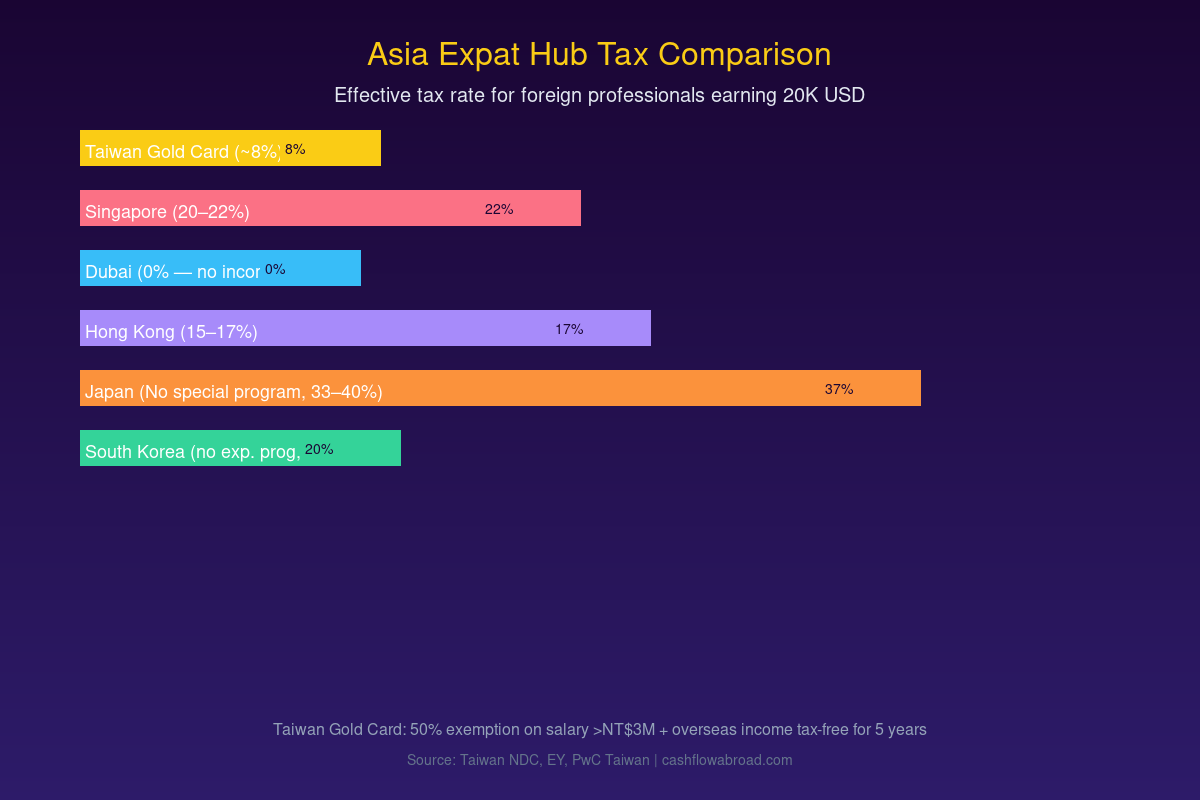
Taiwan's standard income tax is progressive: 5% on the first NT$560,000, scaling up to 40% on income above NT$4.72 million. Without any intervention, a high earner takes home less than they would in Singapore. The Gold Card changes that math entirely.
Here's exactly how the Gold Card tax benefit works:
- 50% salary exemption: For your first five years, you exclude 50% of any Taiwan salary income that exceeds NT$3 million (roughly $93,000 USD at ~32 TWD/USD) from your taxable income.
- Overseas income: fully exempt — for those same five years, any overseas-sourced income you receive is excluded from Taiwan's basic income tax calculation entirely.
Run the numbers on a $120,000 USD salary earned from a Taiwan-based employer:
- NT$3.84M total salary
- 50% exemption on NT$840K above the NT$3M threshold = NT$420K excluded
- Net taxable salary before standard deductions: NT$3.42M
- Minus standard deductions (~NT$416K total: personal exemption + standard deduction + salary special deduction)
- Net taxable income: ~NT$3.0M
- Taiwan tax owed: approximately NT$509,000 = ~$15,900 USD — a 13.3% effective rate
Now add $30,000 in overseas freelance income — say from a US client you kept after moving. Under the Gold Card benefit, that $30,000 doesn't appear in your Taiwan tax calculation at all. Your total Taiwan tax bill stays at $15,900 on combined $150K earnings.
How US Expats Stack FEIE on Top
There is no US–Taiwan tax treaty, which sounds alarming until you realize the Foreign Earned Income Exclusion (FEIE) does most of the same work. For 2025, the FEIE exclusion is $130,000. Physically present in Taiwan 330+ days? You can exclude up to $130K of earned income from US federal taxes.
Stack that against the taxes already paid in Taiwan (claimable as Foreign Tax Credits) and most US-citizen Gold Card holders end up with a combined global effective rate in the 13–18% range — on income earned in a stable East Asian democracy with universal healthcare access.
For comparison, a W-2 employee in California earning $150K pays roughly 37–42% combined federal and state. The difference is roughly $35,000–$40,000 per year in your favor — enough to cover your entire Taipei rent for two full years, every year you're there.
Do You Qualify?
There are twelve professional fields under the Gold Card program. You only need to qualify in one. The easiest route for most applicants is the salary track: document a monthly salary of at least NT$160,000 (~$5,000/month) sustained over the past six months, from any employer anywhere in the world. No Taiwan connection required.
| Qualification Route | Key Requirement | Best For |
|---|---|---|
| Salary Track | NT$160,000/month (~$60K/year) for 6 months | Remote workers, consultants, tech employees |
| Science & Technology | Patents, leadership at recognized firms, competition awards | Engineers, AI/ML researchers, product managers |
| Finance | Regulated credentials + senior roles (CFA, CPA, etc.) | Fund managers, bankers, financial analysts |
| Culture & Arts | Published works, international exhibitions, awards | Musicians, visual artists, filmmakers |
| Education | Academic publications, professor-level appointments | Researchers, PhDs, university faculty |
| Architecture | Licensed architect with significant design portfolio | Architects, urban planners |
The salary track is where most Americans land. NT$160,000/month is roughly $60,000 annually — achievable for mid-level tech, finance, or consulting professionals. You prove it with pay stubs, bank statements, or an employer letter. The online application takes about 15 minutes once documents are ready.
Self-employed? You can use average monthly earnings from freelance or consulting contracts. The National Development Council reviews self-employment income case by case, but regularly approves applications from developers, designers, and solo consultants with documented client contracts.
What $1,800/Month Gets You in Taipei
The tax break is only half the equation. Geographic arbitrage only works when the destination is actually livable.
| Expense | Monthly Cost (USD) | Notes |
|---|---|---|
| 1BR apartment, central Taipei | $875–$1,400 | Da'an or Zhongshan districts |
| Local restaurant meals | $120–$200 | $5–$8/meal at noodle shops and night markets |
| Groceries | $200–$350 | Mix of local markets and Western supermarkets |
| MRT unlimited pass | $40 | NT$1,280/month, covers the whole metro network |
| Utilities | $60–$90 | AC-heavy months push toward the top |
| National Health Insurance (NHI) | $28–$50 | Eligible after 6 months of continuous Gold Card residency |
| Home fiber internet | $15–$20 | 1 Gbps plans widely available, speeds are exceptional |
| Total (comfortable) | $1,600–$2,200 | Without extravagance or heavy travel |
A senior developer earning $150,000 who moves to Taipei can pocket $127,800 after $22,200 in living costs — versus netting perhaps $85,000 after taxes alone on the same US income. The annual spread is roughly $43,000 in your favor, every year, for five years of the Gold Card benefit window. That's $215,000 over the term.

Applying: What to Expect
The entire application runs through goldcard.nat.gov.tw. File under one field, one regulation. The process:
- Prep documents (1–2 days): Passport copy, 2-inch photo, six months of pay stubs or bank statements showing NT$160K+/month, proof of employment or self-employment contracts.
- Submit online (15 minutes): The form is available in English. Income-track applications are genuinely simple — no lawyer needed.
- Identity check by NIA (1–2 weeks): National Immigration Agency confirms basic details.
- Qualification review by relevant ministry (1–2 months): Tech goes through MOEA, finance through FSC, etc.
- Passport check at local Taiwan embassy (1 week): For overseas applicants only.
- Card printed and delivered (1–2 weeks): Arrives by courier to your address.
Total: four to eight weeks. Salary-track cases with clean documentation often clear in three to four weeks. Fees: NT$10,000 ($310) for a 3-year card, NT$8,000 ($250) for 2 years, NT$5,600 ($175) for 1 year.
Banking and Logistics Once You Arrive
Opening a Taiwan bank account requires your Gold Card plus a local address. Most landlords provide a rental contract that works. E.SUN Bank and Cathay United Bank both have English-speaking staff at Taipei branches in Da'an and Xinyi.
For maintaining your US financial infrastructure while abroad, a Traveling Mailbox virtual US address ($15/month) routes IRS correspondence, brokerage statements, and state domicile documentation to a real US street address. Your state of last domicile can still attempt to tax you without a clean paper trail proving you've established yourself elsewhere — this matters most for California and New York residents.
For US brokerage access, Charles Schwab International is one of the few US brokerages that actively serves Americans abroad without threatening account closure. Its debit card reimburses all ATM fees worldwide, which adds up quickly in cash-friendly Taipei.
On healthcare: Gold Card holders who maintain continuous Taiwan residency for six months become eligible for National Health Insurance. Monthly premiums run NT$900–1,600 (~$28–$50/month) depending on income bracket. Coverage is comprehensive and the quality of care in Taipei's major hospitals — particularly Taiwan University Hospital and Taipei Veterans General Hospital — is genuinely excellent. For the gap period before NHI eligibility, SafetyWing provides affordable international health coverage at around $45–$80/month.
For connectivity on arrival, an eSIM from Saily gets you online immediately — Taiwan has excellent 5G coverage, but local SIM contracts require an ARC you won't have until after arrival.
Who This Is (and Isn't) For
The Gold Card makes most sense for:
- Remote tech workers earning $80K–$200K who want an Asian base without Singapore's cost or Japan's residency opacity
- Finance professionals (traders, analysts, fund managers) with documented salary above the NT$160K threshold
- Consultants and freelancers with steady contract income who want one address they can defend to clients, banks, and the IRS
- Founders who can document salary from their company but don't need a CBI passport or offshore structure
It's probably not your move if your income is fully passive — the tax exemption applies to salary and overseas income, but Taiwan-source investment gains are a different calculation. Nor does it help much if you earn under NT$3M (~$93K) in Taiwan: the 50% exemption doesn't activate until you clear that threshold, and at lower incomes, Taiwan's regular brackets are already fairly low.
The Fine Print
The 183-day rule still applies. You only become a Taiwan tax resident — and thus eligible for the Gold Card benefits — if you spend 183 or more days in Taiwan in a tax year. Skipping around Southeast Asia for half the year won't qualify you. This is the same 183-day trap that catches nomads worldwide.
The five-year clock starts when you first meet all conditions — not when your card is issued. If your card starts in November but you don't hit 183 days that calendar year, year one of your benefit window doesn't begin until the following year.
Capital gains treatment is favorable: Taiwan eliminated capital gains tax on listed securities in 2016. Selling stocks on the Taiwan Stock Exchange generates no capital gains tax for individuals. US-listed ETFs in your Schwab account are taxed by the IRS, not Taiwan — and during your Gold Card window, those gains may qualify as exempt overseas income under Taiwan's basic income tax calculation.
Get a CPA who knows both systems. The interaction between the FEIE, the Gold Card exemption, and available foreign tax credits is genuinely layered. A US-Taiwan cross-border tax specialist typically charges $500–$1,200 for a combined return — money well spent on a $40K+/year tax saving.
The Bottom Line
The Taiwan Gold Card is one of the most practical, low-friction expat programs in Asia — possibly in the world. A $310 application, four to eight weeks of processing, and you have the legal right to live and work freely in Taiwan with 50% of your high-end salary exempted and your overseas income shielded entirely for five years.
Combined with Taipei's $1,800/month lifestyle and the FEIE for US citizens, the combined effective tax rate for a $150K earner lands around 13–16% globally. That's not a loophole — it's a published incentive that Taiwan's National Development Council designed explicitly to attract foreign talent. It works exactly as advertised.
The only question is why fewer than 16,000 people have taken it in seven years. Probably the same reason Taipei rarely makes the top of "best expat city" listicles: it doesn't market itself. The cities that do marketing get the crowds. The cities that don't get the upside.
For more context on how expat tax optimization stacks together, see the US expat banking and taxes guide and the full breakdown on using FEIE to reach zero federal income tax. If you're comparing Taiwan against other Asian options, the digital nomad visa rankings guide covers the broader landscape.
Financial disclaimer: This article is for informational and educational purposes only and does not constitute tax, legal, or financial advice. Tax laws in Taiwan and the United States change frequently, and individual circumstances vary significantly. Consult a qualified CPA or tax attorney familiar with US–Taiwan cross-border taxation before making any financial or residency decisions. Nothing in this article should be construed as a recommendation to engage in any specific financial or tax strategy.
This guide is general information, not personalized tax, legal, or investment advice. Rules change; verify current thresholds with official sources or a qualified professional before acting.
Related guides
 Expat Tax & FinanceMay 26, 2026
Portugal IFICI: Is the NHR Replacement Worth It?
NHR ended in 2025. Portugal's IFICI replacement gives tech workers and researchers a 20% flat tax for 10 years — but retirees and passive investors.
 Geographic ArbitrageJune 6, 2026
Vienna Expat Guide: RWR Card, Taxes, and Living Costs
Vienna ranks #1 in livability. Complete guide to Austria's Red-White-Red Card, the 30% expat tax deduction, income brackets, and real monthly living
 Geographic ArbitrageMay 28, 2026
Vietnam Expat Guide: $1,200/Month, Zero Foreign Tax
Vietnam costs ~$1,200/month for a comfortable expat life and taxes foreign income at 0% if you stay under 183 days. Complete guide for US expats.