
Here's a scenario playing out in dozens of expat forums right now: someone moves to Dubai, sets up a free zone company, pays zero local corporate tax, and assumes they've escaped the IRS for good. Then the accountant sends a bill for $12,600. That's the NCTI tax—and starting January 1, 2026, it just got more expensive.
The IRS renamed GILTI (Global Intangible Low-Taxed Income) to NCTI (Net CFC Tested Income) under the One Big Beautiful Bill Act. The rebrand came with a rate hike and the elimination of the one carve-out that protected tangible businesses. If you own 10% or more of any foreign corporation—anywhere in the world—this rule follows you across every border and taxes your company's annual profits whether you touch them or not.
What NCTI Actually Is (And Why It Exists)
NCTI is an anti-deferral mechanism. Congress created GILTI in 2017 specifically to stop multinationals from parking profits offshore indefinitely. The mechanism: any Controlled Foreign Corporation (CFC)—defined as a foreign company where US persons collectively own more than 50% of voting power or value—triggers annual US taxation for its American shareholders.
Own 10% or more of a foreign company? You're a "US shareholder" required to report and pay tax on your share of the company's profits every single year, on your personal US return, regardless of distributions.
For solo entrepreneurs, this means your consulting OÜ in Estonia, your agency LLC in Singapore, your tech company in Georgia (the country), or your Dubai free zone entity—if you're a US citizen and 100% owner—every dollar of annual profit is visible to the IRS before you touch it.
Most expats who set up foreign companies learn about this rule after their first penalty notice. The 2026 changes made it impossible to continue ignoring.
GILTI vs. NCTI: What the One Big Beautiful Bill Act Changed
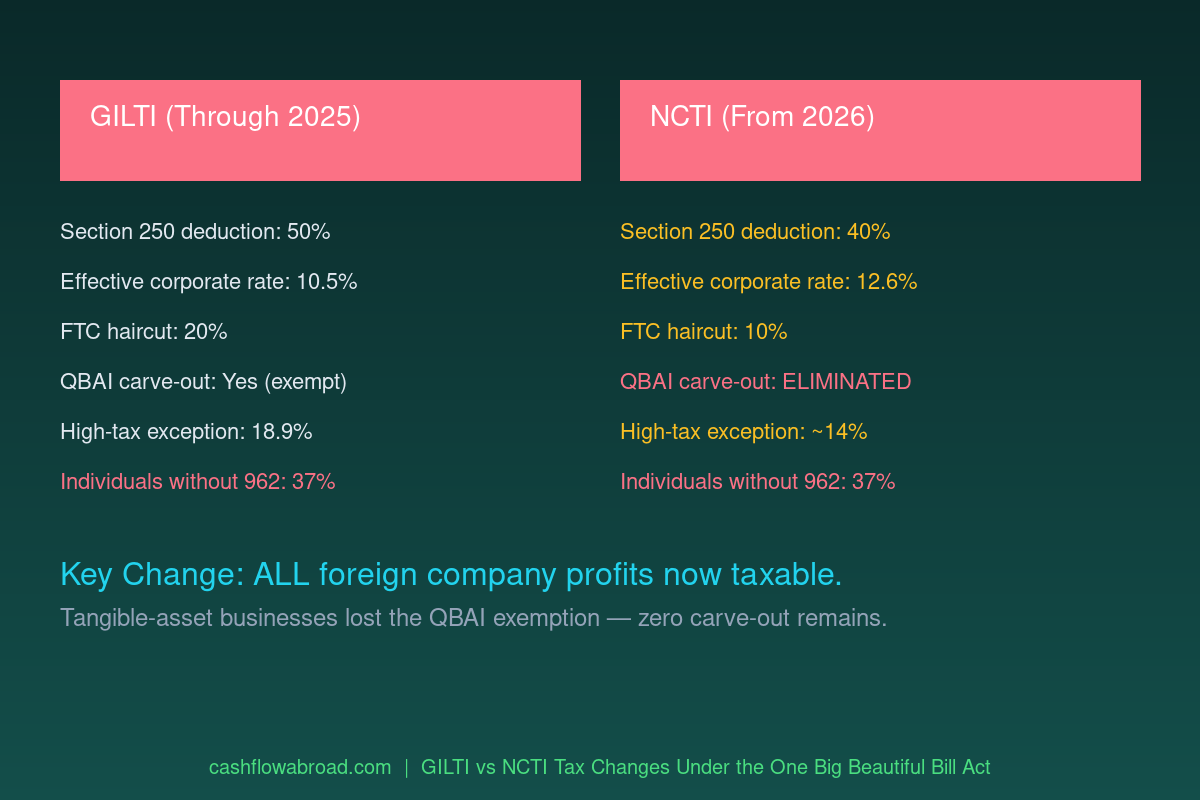
The OBBBA didn't just rebrand GILTI—it rewrote three of its mechanics. Two are bad news for expat business owners. One is slightly positive.
1. The Effective Rate Went Up
Under GILTI, C-corporations paid an effective rate of 10.5% on foreign company income (21% corporate rate, minus 50% Section 250 deduction). Under NCTI, the Section 250 deduction dropped from 50% to 40%, pushing the effective corporate rate to 12.6%. That's a 20% increase in the tax bill on income that was already taxed abroad.
2. The QBAI Carve-Out Is Eliminated
Under old GILTI rules, businesses with significant tangible assets—equipment, inventory, real property—received a deduction called the Qualified Business Asset Investment (QBAI) return. You could exclude an amount equal to 10% of your depreciable tangible assets from the GILTI calculation. If your foreign import business held $400,000 in equipment, $40,000 of profit was shielded each year.
The OBBBA eliminated QBAI entirely. Starting 2026, every dollar of CFC tested income enters the NCTI calculation with no asset-based reduction. Manufacturing companies, physical-goods exporters, and retail operations that had partial shelter are now fully exposed.
3. The Foreign Tax Credit Haircut Got Better
The one positive change: the FTC haircut dropped from 20% to 10%. Under GILTI, even if your foreign company paid 9% in local corporate taxes, you could only credit 80% of those foreign taxes against your US GILTI bill. Now you can credit 90%. That matters when stacking credits against a 12.6% effective rate.
| Metric | GILTI (Through 2025) | NCTI (From 2026) |
|---|---|---|
| Section 250 Deduction | 50% | 40% |
| Effective Corporate Rate | 10.5% | 12.6% |
| FTC Haircut | 20% disallowed | 10% disallowed |
| QBAI Carve-Out | Yes — 10% of tangible assets | Eliminated entirely |
| High-Tax Exception Threshold | 18.9% (90% of 21%) | ~14% (under new blended rate) |
| Individual Rate Without Election | Up to 37% (ordinary income) | Up to 37% (ordinary income) |
Who Gets Hit Hardest
Not all expat business owners face equal exposure. Four profiles carry the highest NCTI risk:
The zero-tax jurisdiction entrepreneur. You live in Dubai or Paraguay, your company pays little or no local corporate tax, and your FTC offset is minimal. For a company earning $200,000 annually, NCTI at 12.6% effective equals roughly $25,200 owed to the IRS before any other considerations—on income that already sits entirely outside the US.
The UAE free zone operator who loses QFZP status. UAE introduced its own 9% corporate tax in June 2023. Free zone businesses meeting the Qualifying Free Zone Person (QFZP) standard still get 0%—but the substance tests are strict. Non-qualifying revenue must stay below 5% of total revenue or AED 5 million. Fall out of QFZP status, and you pay UAE's 9%—but 9% still falls below the NCTI threshold, so US liability doesn't disappear, it only shrinks slightly due to creditable foreign taxes.
The tangible-goods exporter. With QBAI gone, a US expat running a physical products business in Vietnam or Thailand gets zero asset-based relief. Previously, $300,000 in equipment shielded $30,000 of annual profit. That protection no longer exists.
Individuals who haven't made the Section 962 election. This is the most expensive mistake in expat business taxation. Corporate shareholders access the 12.6% effective rate. Individual shareholders—the default for most solo expat founders—are taxed at ordinary income rates on NCTI. That's up to 37%, with no Section 250 deduction and no indirect foreign tax credits.
The Individual Taxpayer Trap

Most expat business owners are individuals, not C-corporations. They are the 100% sole shareholders of their Estonian OÜ or Georgian LLC. Under NCTI default rules, individual US shareholders owe ordinary income rates—potentially 37%—on their CFC's tested income, with no access to the 40% Section 250 deduction and no indirect foreign tax credit.
The Section 962 election fixes this. By attaching a §962 election to your Form 1040, you elect to be treated as a domestic corporation for NCTI purposes. This unlocks:
- The 40% Section 250 deduction (dropping effective rate to 12.6%)
- Access to indirect foreign tax credits against the NCTI bill
- Eligibility for the high-tax exception election
The election must be made annually. Miss one year and you revert to full ordinary income rates for that tax year. It's filed as an attachment to your return—your expat tax professional needs to know it exists and to apply it proactively. Not all of them do.
The High-Tax Exception: Your Escape Valve
If your foreign company pays a sufficiently high local effective tax rate, you can exclude that income from NCTI entirely. Under 2026 rules, the threshold sits at approximately 14% (90% of the new blended rate). When your CFC's income is subject to a foreign effective rate above 14%, you can elect to exclude it from the NCTI calculation on Form 8992.
Countries where this exclusion typically applies: France, Germany, Australia, UK, Canada, Netherlands, and most Western European nations. Any jurisdiction with effective corporate rates above 14% makes you a candidate for a full NCTI exclusion on that income stream.
The election is annual, applied consistently across a "tested unit," and country-by-country. Income from a high-tax jurisdiction can be excluded even if you have other CFCs in low-tax places—the elections don't bleed across.
| Country (CFC Location) | Local Corp Rate | NCTI Exposure | Notes |
|---|---|---|---|
| UAE (QFZP qualifying) | 0% | High — full 12.6% | No local offset; NCTI bites hardest here |
| Georgia (country) | 0% on foreign-source income | High | Virtual Zone / Small Business Status; NCTI still triggered |
| Paraguay | 10% | Medium | Below high-tax exception threshold; partial FTC offset |
| Singapore | 17% | Low-Medium | FTCs offset most NCTI; high-tax exception may apply |
| Estonia | 20% on distribution | Complex | Retained earnings create timing complexity with NCTI |
| UK | 25% | Very Low | High-tax exception likely; minimal residual NCTI |
| Germany | ~30% | Minimal | Fully excluded under high-tax exception |
Strategies That Actually Reduce Your NCTI Bill
There is no magic structure that eliminates NCTI entirely for US citizens in low-tax jurisdictions—but the following approaches materially reduce it when applied correctly.
Make the Section 962 Election Every Year
This is the single highest-ROI action for individual US shareholders of CFCs. Get your preparer to confirm it appears on your return each year. The cost is zero; the difference between paying 37% at ordinary income rates versus a 12.6% effective corporate rate can mean tens of thousands of dollars annually. For how this election stacks with your overall foreign investment picture, the expat investing playbook covers interaction with PFIC rules and other CFC regimes.
Apply the High-Tax Exception
If your CFC is in a country with effective corporate rates above ~14%, make the annual election to exclude that income on Form 8992. For CFCs in medium-to-high-tax jurisdictions, this election can reduce NCTI taxable income to zero. It must be applied consistently—you cannot cherry-pick years—but the payoff is a full annual exclusion rather than a net rate of 12.6%.
Pay Yourself a Market-Rate Salary from the CFC
Income paid to you as salary from your foreign company reduces the CFC's tested income—and that salary, when earned in a foreign country and meeting the physical presence or bona fide residence test, qualifies for the Foreign Earned Income Exclusion (up to $132,900 in 2026). This structure converts what would be NCTI-taxed retained earnings into FEIE-excludable personal income. See our guide to zero federal income tax via FEIE for the mechanics.
Track Your Previously Taxed Income Account
Every dollar of NCTI you pay tax on creates a Previously Taxed Income (PTI) balance inside your CFC. When you eventually distribute profits, those distributions come out of the PTI account tax-free—no second layer of US tax. Failing to document PTI correctly leads to double taxation when you take distributions or sell the company. This bookkeeping detail has caught expat founders off-guard on exits worth hundreds of thousands.
Consider the §954(b)(4) High-Tax Kickout
Even without a formal high-tax exception election, income subject to a high foreign tax rate may be "kicked out" of Subpart F or NCTI under specific circumstances. A US international tax attorney can model whether a deliberate increase in local effective tax rate—through salary payments, accelerated depreciation, or deductible local expenses—pushes income above the 14% threshold, triggering exclusion and producing a net tax saving.
What You're Required to File
Owning a CFC generates a compliance stack most expats encounter only after they're already delinquent:
- Form 5471: Annual information return for each CFC you own. Penalty for failure to file: $10,000 per form per year, escalating to $50,000 if not filed after IRS notification. Zero de minimis exception.
- Form 8992: Calculates NCTI inclusion. Required whenever you have NCTI to report.
- Form 1118: Foreign tax credit computation. Required to claim foreign tax offsets against NCTI.
- FinCEN Form 114 (FBAR): If your CFC has foreign bank accounts where you have signature authority and the aggregate balance exceeds $10,000 at any point during the year.
- Form 8938 (FATCA): Required if your specified foreign financial assets exceed $200,000 abroad (or $50,000 in the US). A CFC can trigger this requirement even with modest balances.
The Form 5471 penalty alone has cost expat business owners who simply didn't know they were required to file it. The IRS has ramped up enforcement on this form since 2023, and the CARF data-sharing framework makes foreign company ownership visible to the IRS in ways it simply wasn't five years ago. If you're behind on any of these forms, a Streamlined Filing Compliance Procedure is available—but only until the IRS contacts you first.
Banking and Paper Trail for CFC Owners
Clear financial separation between your personal accounts and the CFC's corporate accounts isn't just good business hygiene—it's a compliance requirement that the IRS will examine during an audit of your NCTI position. A US-based account at Mercury works well as the receiving account for distributions from your CFC back to the US, and the transaction records become part of your PTI documentation trail.
If you're abroad full-time and need a stable US address for IRS correspondence, state domicile, and registered-agent notices, a Traveling Mailbox virtual address ($15/month) handles all incoming IRS notices and state tax mail without needing a physical US presence. IRS penalty notices have strict response windows—missing them at a forwarding address that's weeks behind creates compounding problems. See our virtual mailbox guide for the full setup.
NCTI Within the Broader Anti-Deferral Picture
NCTI is one of four major US anti-deferral regimes that affect expat business owners. Missing any one of them creates a gap the IRS eventually finds:
- Subpart F: Taxes passive income (dividends, interest, rents, royalties) and certain related-party sales income from CFCs currently—no deferral, regardless of distribution
- PFIC rules: Apply to foreign passive investment companies (foreign mutual funds, foreign ETFs). Penalties can push effective tax rates above 50%. See the PFIC guide.
- NCTI / Subpart F overlap: The two regimes interact when CFC income is both passive and intangible. Income can't be taxed twice, but the calculation order matters significantly for FTC utilization.
For expats running active businesses through foreign companies, the combination of Subpart F and NCTI covers most income scenarios. The offshore company tax trap guide covers Subpart F and the full CFC regime; read both before concluding your structure is clean.
For the practical application of how all this stacks up when operating a business from abroad, the guide to running a US business from Colombia walks through totalization agreements and territorial tax structures at the operational level.
Bottom Line
NCTI is not theoretical. It's a real annual tax bill that thousands of expat entrepreneurs are currently either paying correctly, underpaying accidentally, or avoiding through good structural planning. The 2026 changes made it more expensive (12.6% vs 10.5%), more comprehensive (QBAI gone), and harder to ignore (CARF data sharing).
Three things to do before your next tax filing:
- Confirm your accountant is filing Form 5471 for every foreign company you own 10% or more of
- Ask whether a Section 962 election is on your return if you're an individual shareholder
- Model whether the high-tax exception applies to any of your CFCs given updated 2026 thresholds
The cost of a consultation with a US international tax CPA—typically $300–$600—is a fraction of the $10,000 Form 5471 penalty for a single missed filing. Run the numbers before year-end, not after.
Financial Disclaimer: This article is for informational and educational purposes only and does not constitute tax, legal, or financial advice. Tax laws are complex, change frequently, and vary significantly based on individual circumstances, treaty elections, and jurisdiction-specific rules. The One Big Beautiful Bill Act provisions referenced here reflect available public guidance as of publication; consult the IRS and qualified US international tax professionals for binding guidance. Always work with a CPA or tax attorney before making decisions about foreign company structure, CFC elections, or NCTI compliance. The author and cashflowabroad.com are not liable for actions taken based on this content.