Expat State Domicile: Florida, South Dakota, or Wyoming?
Most US expats pick Florida by default. It's warm, it has no income tax, and everyone knows it. Getting it wrong is expensive.
Most US expats pick Florida by default. It's warm, it has no income tax, and everyone knows it. Getting it wrong is expensive.
Disclosure: this article contains affiliate links. If you open an account through one of them, Cashflow Abroad may earn a referral commission at no extra cost to you.
Most US expats pick Florida by default. It's warm, it has no income tax, and everyone knows it. But here's what the default crowd misses: South Dakota lets you establish legal domicile in a single afternoon for under $75 — and Wyoming's asset-protection laws can shield multi-million-dollar trusts from creditors in ways that Florida's legal framework simply can't match. Your choice of home state follows you around the world for your entire expat life, showing up on your taxes, your FBAR filings, your banking relationships, and your estate plan. Getting it wrong is expensive. Getting it right is free — if you do it before you board the plane.
Why State Domicile Is Not Optional
The US taxes citizens on worldwide income regardless of where they live. But state taxes? Those depend entirely on where you're considered a legal resident. Nine states impose no individual income tax: Alaska, Florida, Nevada, New Hampshire, South Dakota, Tennessee, Texas, Washington (temporarily), and Wyoming. If you're domiciled in California when you move abroad, the Franchise Tax Board expects its cut — even when you're earning every dollar in Medellín or Chiang Mai.
Domicile is the legal concept of your permanent home — the place you intend to return to, not just where you sleep most nights. Courts and tax authorities look at objective evidence: driver's license, voter registration, where your bank accounts are held, where your children go to school, where your professional memberships are registered. A California FTB auditor doesn't care that you haven't spent a night in San Francisco since 2022. If your address is still there, your obligations are still there.
Beyond taxes, domicile determines:
- FBAR and FATCA filings — state requirements vary on reporting thresholds
- Voting eligibility — UOCAVA lets overseas voters use their last US address for federal elections
- Business registration — LLC and corporate filings tie to your state of domicile
- Estate planning — probate, trust law, and inheritance taxes all follow domicile state rules
- US banking access — many banks require a valid US address; your mailbox state provides this
If you haven't locked down your federal filing strategy yet, the US expat banking and taxes guide covers FBAR, FATCA, and FEIE compliance in full.
The Short List: Only Five States Work for Expats
Of the nine no-income-tax states, several immediately disqualify themselves for expats. Washington requires annual physical presence for business purposes. New Hampshire taxes dividends and interest (though this is phasing out). Tennessee's process is bureaucratically cumbersome. Alaska is geographically isolated with minimal nomad infrastructure.
That leaves five realistic options: Florida, Nevada, South Dakota, Texas, and Wyoming. Nevada requires a vehicle smog check in-state — a dealbreaker if your car is parked overseas. Texas has no restrictions but also no standout structural advantages. Florida, South Dakota, and Wyoming are the three worth comparing in depth.
Florida: The Crowd Favorite (For Good Reason)
Florida is the default choice because it genuinely earns that title for many expats. The state's mature infrastructure for non-permanent residents — mail services, registered agents, and expat-friendly banks — makes the process straightforward. Its legal track record defending domicile changes from aggressive auditing states is the strongest of any no-tax state.
What makes Florida work:
- No state income tax, no estate tax, no inheritance tax
- Homestead exemption — Florida's homestead laws can shield your primary residence from most creditors, a protection no other no-tax state matches
- Major international airports (Miami, Orlando, Tampa) making brief return visits easy to document
- Declaration of Domicile filing (available at any county courthouse) creates a clean legal record
- Established case-law history successfully defending FL domicile against CA and NY audits
The friction points:
- A PMB (personal mailbox) alone is insufficient — you need a service providing a real street address
- Driver's license requires a physical DMV visit; appointments can run 2–4 hours
- Vehicle registration requires the vehicle to be physically present in state
- Mailbox services cost $150–$300/year for a Florida address
Florida is the right call if you own or plan to buy property in the US, have family there, or are retiring abroad and want a US landing pad. Retirees especially benefit from the homestead creditor protection, which can shield a Florida condo entirely from judgment creditors.
South Dakota: The Digital Nomad Sweet Spot
South Dakota has built an entire industry around helping nomads and expats establish domicile quickly. The process is genuinely the simplest in the country, and for people with no plans to maintain any permanent US property, it wins on cost and flexibility.
The South Dakota process (as of 2026):
- Sign up with a registered SD mail-forwarding service — DakotaPost, Americas Mailbox, and MyDakotaAddress all specialize in this. Cost: $100–$150/year.
- Book one night at a Sioux Falls or Rapid City hotel — the receipt serves as proof of physical presence.
- Visit the DMV with your hotel receipt, mailbox confirmation, and out-of-state license — SD license issued same day.
- Register to vote at your SD address.
- Total out-of-pocket: $75–$200 including the overnight stay.
Structural advantages that make South Dakota stand out:
- No state income tax, no estate tax
- Remote vehicle registration — unlike Florida and Wyoming, you don't need to bring your car to the state, so this entire step can be handled by mail
- Dynasty trusts running up to 365 years — the most favorable trust duration in any US state, making it attractive for multigenerational wealth planning
- Single-member LLC charging order protection (Florida only protects multi-member LLCs)
- Lowest total setup cost of any viable expat domicile state
Important 2023 changes still in effect: SD tightened its rules. Personal mailbox addresses can no longer be used for payroll tax purposes — unemployment taxes go to the state where your employer is headquartered or where work was performed. If you run a US business and pay yourself a salary, this requires a separate analysis. Voting residency requirements for new registrants were also tightened under SB 175.
South Dakota is the right choice for FEIE-eligible freelancers and remote workers who want a cheap, clean US address and don't own US property.
Wyoming: The Asset Protection Heavyweight
Wyoming gets less attention in expat circles than it deserves. For anyone with significant investment portfolios, US-based businesses, or complex estate planning needs, Wyoming's legal framework is the most powerful in the country — and for $60/year in LLC fees, it's not expensive.
Wyoming's structural advantages:
- No state income tax, no estate tax, no inheritance tax
- Strongest LLC charging order protection in the US — single and multi-member LLCs are both protected; creditors cannot seize LLC assets or force a distribution or dissolution
- Domestic Asset Protection Trust (DAPT) — Wyoming allows self-settled spendthrift trusts, meaning you can create a trust for your own benefit and still receive creditor protection. Florida explicitly prohibits self-settled trusts as against public policy.
- Blind trusts permitted with no public registration requirement — Wyoming does not require trust disclosure to the state or federal government
- LLC annual fees of $60 — roughly $290/year less than Nevada's equivalent structure
- No residency required to form a Wyoming LLC or trust — you can hold Wyoming entities as a non-resident, though domicile and entity jurisdiction matching maximizes the protections
Practical requirements:
- One physical visit to obtain a Wyoming driver's license
- Vehicle registration requires the vehicle in-state (same as Florida)
- Mail service required for a Wyoming address — several Cheyenne-based providers specialize in this; cost similar to Florida ($150–$250/year)
The critical caveat: if you're domiciled in Florida but create a Wyoming trust, Florida courts may apply Florida law — which voids self-settled trust protections. The Wyoming DAPT works best when your domicile and trust jurisdiction are both Wyoming. High-net-worth expats building serious structures should domicile in Wyoming to maximize the protections, not just entity-shop from another state.
For the full picture of building a cross-border asset structure, the expat estate planning guide covers offshore and domestic options in depth.
Side-by-Side: Florida vs South Dakota vs Wyoming
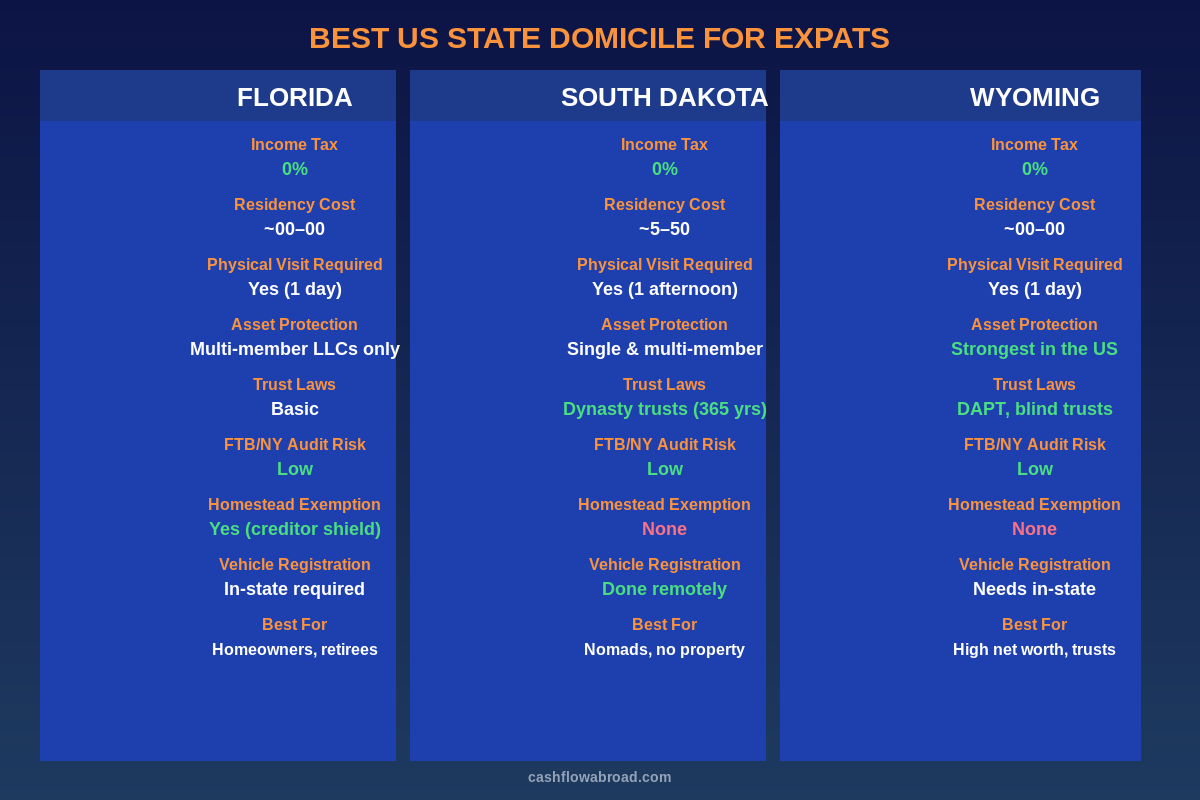
| Factor | Florida | South Dakota | Wyoming |
|---|---|---|---|
| State income tax | 0% | 0% | 0% |
| Estate / inheritance tax | None | None | None |
| Setup cost (est.) | $300–$500 | $75–$200 | $100–$250 |
| Annual mailbox cost | $150–$300 | $100–$150 | $150–$250 |
| Physical visit required | Yes | Yes (1 afternoon) | Yes |
| Vehicle in-state required | Yes | No — remote OK | Yes |
| Single-member LLC protection | No | Yes | Yes (strongest) |
| Homestead creditor exemption | Yes (full home value) | None | None |
| Self-settled trust (DAPT) | No — prohibited | Yes | Yes |
| Dynasty trust duration | 360 years | 365 years | 1,000 years |
| LLC annual fee | $138.75 | $50 | $60 |
| Best for | Homeowners, retirees | Nomads, clean break | High net worth, trust planning |
Escaping California and New York: What It Actually Takes
If you're currently domiciled in California or New York, the domicile change is not a formality — both states pursue former residents aggressively. The California Franchise Tax Board completed 520 residency audits in 2023, and New York maintains over 300 dedicated residency auditors specifically targeting high-income taxpayers who claim to have moved.
California FTB audit triggers:
- Income above $200K combined with a move to a zero-tax state
- Keeping California property after claiming non-residency
- Maintaining a California driver's license or voter registration
- Spending 45+ days in California after claiming to have moved
- California mailing address on W-2s, 1099s, or bank accounts
- Owning a California-based LLC or business
- Immediate family members remaining in California
California's only bright-line safe harbor is 546 consecutive days outside the state. Everything else is a facts-and-circumstances analysis. New York uses the "statutory residence" test: if you maintain a permanent place of abode in NY AND spend 183+ days there, you're taxed as a NY resident regardless of claimed domicile elsewhere.
The practical implication: sell or lease out your CA/NY property before leaving, cancel all accounts that show those addresses, and get your new state driver's license and voter registration done on the same trip. An auditor's first three questions are always about your license, voter card, and where your bank statements are addressed. If those three align with your claimed domicile, you've won 80% of the audit before it starts.
The 10-Step Domicile Change Checklist
Do these in order, and complete them before you move abroad. Partial completion creates ambiguity — and ambiguity is what auditors use to keep you on the hook.
- Set up a US mail address in your chosen state. For expats who'll be abroad long-term, a virtual mailbox service with a real street address is the foundation. Traveling Mailbox provides real street addresses in 50+ US cities — they scan mail, forward packages, and deposit checks. From $15/month. It solves the address problem for banking, IRS filings, and state domicile simultaneously. See also: the full virtual mailbox guide for expats.
- Get the new state's driver's license — visit the DMV physically and surrender your old license. This is the single most important signal of domicile change.
- Register to vote in the new state and actively cancel the old registration.
- File a Declaration of Domicile (required in Florida; recommended in all states).
- Update your federal tax returns to show the new state address — this is what the IRS and state agencies use as the primary record.
- Transfer bank and brokerage accounts to your new address. A Mercury business account or Charles Schwab international checking both accept a virtual mailbox address as your US address of record.
- Update all financial accounts: IRA, 401(k), life insurance, credit cards, investment accounts.
- Cancel or transfer professional licenses and memberships from the old state.
- File a final part-year or non-resident return in your departure state for the year of the move.
- Remove remaining old-state ties: sell or rent your property, cancel gym memberships, transfer medical records and safe deposit boxes, resign from local clubs or associations.
South Dakota: The Nomad Standard
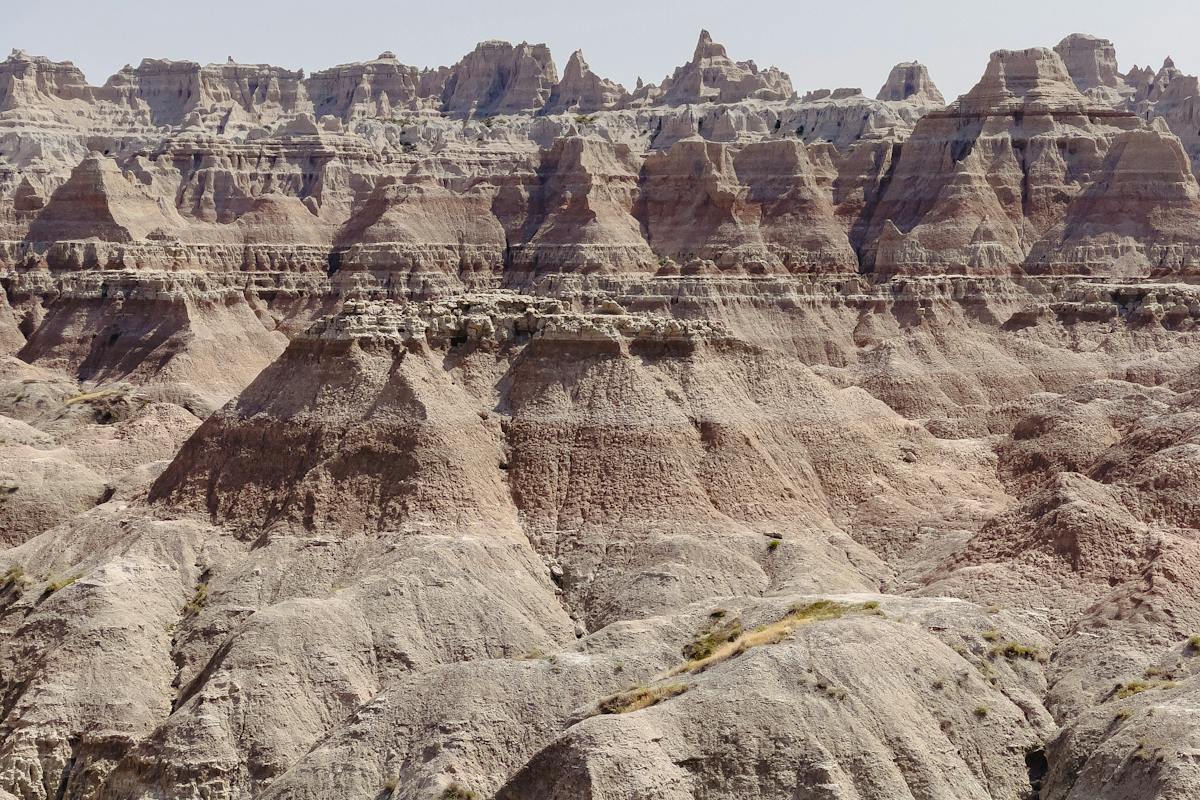
Fewer than a million people live in South Dakota, but tens of thousands of full-time nomads and expats claim it as their legal home. The state's Badlands, prairies, and wide-open political culture made it the first state to actively court the nomad community — and the infrastructure built around that decision makes it the easiest state in the union to call home when you don't actually live anywhere in particular.
Decision Guide: Which State Fits Your Situation
Pick Florida if: You own or plan to own US residential property. You're retiring abroad but want a US condo as a landing pad. You value the homestead exemption as a creditor shield. You want the most litigation-tested track record against FTB and NY audits.
Pick South Dakota if: You own zero US property and want the simplest, cheapest setup. You're a full-time nomad or will be abroad indefinitely. You want to handle vehicle registration by mail. You're exploring dynasty trust structures for multigenerational wealth transfer.
Pick Wyoming if: You have substantial business assets in a US LLC. Your net worth justifies setting up a DAPT or blind trust. You want charging order protection on a single-member LLC. You need privacy — Wyoming requires no public disclosure of LLC membership.
For most digital nomads and remote workers with no US property, South Dakota is the practical winner on cost, simplicity, and flexibility. For retirees with a US property footprint, Florida wins. For entrepreneurs with significant assets who want the strongest legal protections available anywhere in the US, Wyoming is worth the extra step.
Whatever you choose: do it before you leave. Changing state domicile from abroad is far more complicated than doing it in person, and every month of delay is a month your former state can argue you never really changed your home base at all.
Bottom Line
Florida is popular for good reasons. But the default choice isn't always the right one. South Dakota cost $75 and an afternoon to set up, handles vehicle registration by mail, and has dynasty trust law that rivals any jurisdiction in the country. Wyoming has the most powerful asset protection framework in the US — charging order protection, DAPTs, blind trusts, and $60/year LLC fees that make Nevada look overpriced.
The correct answer depends on what you own, how much you earn, and how seriously you want to structure your legal and financial life. None of the three charge income tax. The difference is in the details — and those details can be worth a significant amount of money over a full expat career.
This post is for informational purposes only and does not constitute legal or tax advice. State residency, domicile law, and LLC statutes vary and change frequently. Consult a qualified CPA or attorney before making any state domicile decisions, especially if you are currently domiciled in California, New York, or another state with aggressive non-residency audit programs.
This guide is general information, not personalized tax, legal, or investment advice. Rules change; verify current thresholds with official sources or a qualified professional before acting.
Related guides
 Expat Tax & FinanceOctober 19, 2026
Foreign Tax Credit Carryover: How Many Years?
Carry unused foreign tax back 1 year and forward 10 years. Learn which income basket keeps the credit and what makes the balance expire.
 Expat Tax & FinanceOctober 15, 2026
Can You Claim FEIE and the Standard Deduction?
Yes, claim the foreign earned income exclusion and the standard deduction. A $16,100 single deduction still cuts tax on wages the exclusion left
 Expat Tax & FinanceOctober 11, 2026
Do You Pay US Taxes If You Live Abroad?
Check the $15,750 single filing line, why excluded foreign wages still count, and the $400 self-employment rule before you skip a US return.