Brazil Digital Nomad Visa: Full Cost & Tax Guide
Brazil VITEM XIV visa requires just $1,500/month income — the lowest bar of any G-20 nomad program. Real costs for 4 cities, plus the 183-day tax trap US expats must avoid.
Brazil VITEM XIV visa needs just $1,500/mo income. Real cost-of-living figures for 4 cities, the 183-day tax trap, and full US expat tax breakdown.
Disclosure: this article contains affiliate links. If you open an account through one of them, Cashflow Abroad may earn a referral commission at no extra cost to you.
Most Americans skip Brazil because they assume it's expensive — and they're right, if you're earning in reais. But if your income is in dollars, the math looks completely different. The Brazilian real has lost nearly 40% of its value against the USD over the past decade, meaning a $3,000/month remote salary buys roughly what $5,000 did in 2015. A furnished beachside apartment in Florianópolis that rents for R$3,000/month costs you just $590 at today's exchange rate. Brazil's VITEM XIV digital nomad visa quietly became one of the most underrated programs in South America — with the lowest income bar of any G-20 country's nomad program and processing times that dropped from 8 weeks to 15–30 days in 2025.
Here's everything you need to know: requirements, real monthly costs, the tax trap that ends most stays at 183 days, and how to structure your setup as a US citizen.
What Is the VITEM XIV Visa?
Brazil's digital nomad visa — officially issued under Resolution 45 of the National Immigration Council, stamped as VITEM XIV — was designed specifically for remote workers who earn income from outside Brazil. It is not a tourist extension. It is not a freelancer permit. It is a formal temporary residency category with its own legal framework, separate from tourist or student visa tracks.
The key restriction: you cannot work for Brazilian clients or companies on this visa. Your income must come exclusively from foreign sources — a US employer, international clients, or your own business incorporated outside Brazil. Violating this condition voids the visa and can complicate future entry.
One significant 2025 update worth knowing: Brazil now allows in-country status changes. If you entered on a tourist visa (90 days, extendable to 180), you can convert to VITEM XIV without leaving the country. Previously, applicants had to apply from abroad or make a border run to a Brazilian consulate. That friction is gone.
Requirements and Fees
The VITEM XIV sets some of the most accessible bars of any remote work visa globally:
- Income: $1,500/month minimum — verifiable via bank statements, pay stubs, or client contracts — OR $18,000 in accessible savings
- Health insurance: International coverage valid for the duration of your stay (mandatory, not optional)
- Criminal background check: From your home country, apostilled and typically translated to Portuguese
- Valid passport: Must cover the full visa duration
- CPF number: Brazil's taxpayer ID, required for everything from opening a bank account to signing a lease; obtainable at Banco do Brasil or the Federal Revenue Office, usually free or minimal cost
Visa fee for US citizens: approximately $290. This is higher than most nationalities due to Brazil's reciprocity fee system — the US charges Brazilians for tourist visas, so Brazil charges Americans in kind.
Processing time as of 2025: 15–30 days, down from a previous 4–8 week window. The Ministry of Justice processed over 3,800 VITEM XIV applications in Q3 2025 alone — a 47% increase quarter-over-quarter — a sign that Brazil is actively investing in processing capacity and expects demand to keep growing.
The visa is initially granted for one year, renewable once for another year. After two years, holders may be eligible to apply for permanent residency through standard channels.
Cost of Living: City-by-City Breakdown
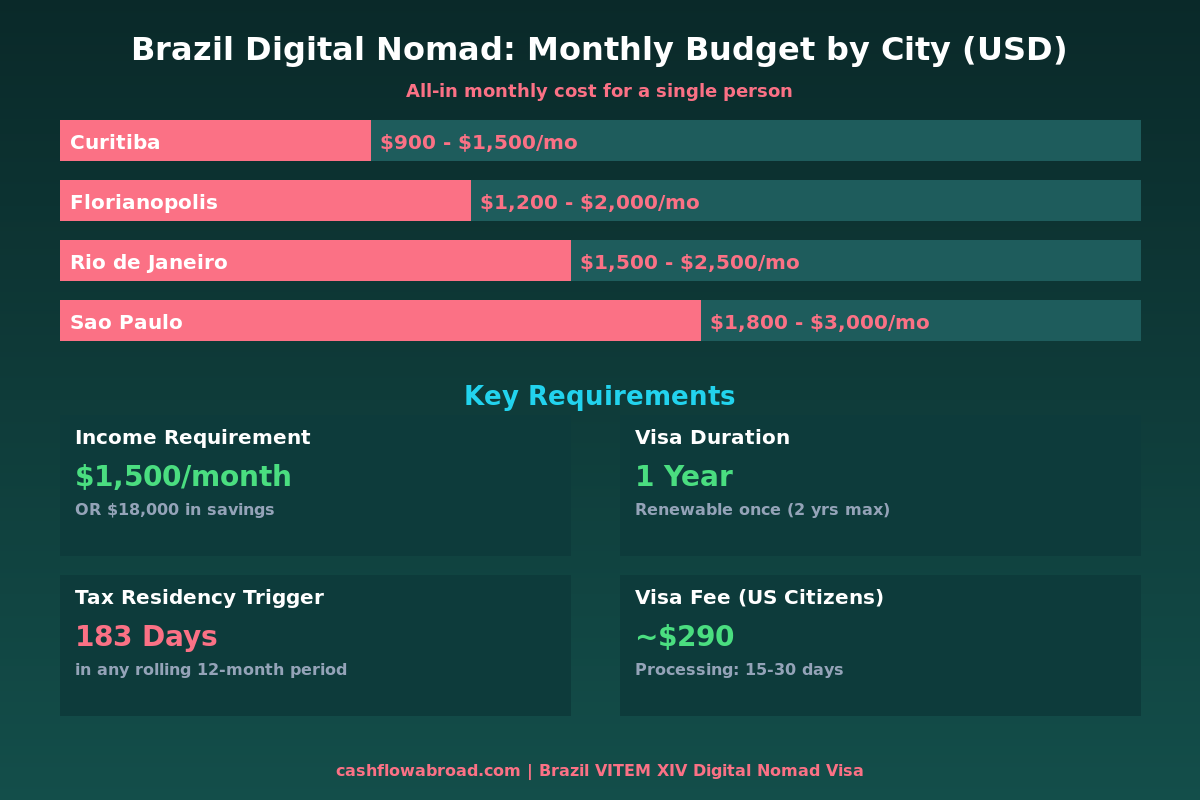
Brazil is not one market. São Paulo costs roughly twice what Curitiba costs. Florianópolis sits between them with a lifestyle that punches well above its price point. All figures below use the current USD/BRL rate of approximately 5.0:
| City | Monthly Budget (Single) | 1-BR Rent (Center) | Safety | Nomad Community |
|---|---|---|---|---|
| Curitiba | $900–$1,500 | $400–$800 | High | Small but growing |
| Florianópolis | $1,200–$2,000 | $600–$1,000 | High | Large & active |
| Rio de Janeiro | $1,500–$2,500 | $700–$1,400 | Moderate (neighborhood-dependent) | Medium |
| São Paulo | $1,800–$3,000 | $800–$1,500 | Moderate | Largest in Brazil |
Internet is reliable and fast across all four cities — a 60 Mbps fiber connection runs about $15/month. Coworking spaces in Florianópolis and Curitiba typically charge $100–$200/month for a dedicated desk; São Paulo coworking (WeWork, Spaces, and local operators) runs $150–$300+.
Food is where the real arbitrage lives. A full restaurant lunch in Florianópolis — a prato feito (plate of the day with protein, rice, beans, and salad) — costs R$20–40, or roughly $4–8 at current rates. Groceries and daily staples run well under half of US equivalent costs in most cities.
Why Florianópolis Is the Top Pick
Floripa is an island city with 40+ beaches, a growing tech sector (the highest density of tech firms anywhere in Brazil), and a safety profile that stands well apart from Rio and São Paulo. It regularly ranks as one of Brazil's most livable cities. The tradeoff: more expensive than Curitiba, and less English spoken than São Paulo. For lifestyle-focused nomads willing to invest in some Portuguese, it delivers the most compelling combination of beach access, infrastructure, and expat community density in the country.
Budget realistically: $1,400–$1,800/month for a furnished apartment, groceries, coworking, local transport, and dining out 3–4 times per week. That's not scraping by. That's a comfortable life with ocean access.
Curitiba: The Value Play Most Nomads Ignore
Brazil's most livable large city by most metrics costs about 11% less than Rio for an equivalent lifestyle. It has European-influenced urban planning, strong infrastructure, genuinely low crime, and a growing tech scene. It won't give you beaches, but $900–$1,200/month all-in is hard to beat for a South American base with first-world infrastructure. For nomads who want serious productivity over beach time, Curitiba is underrated in nearly every nomad ranking.
The 183-Day Tax Trap: Read This Before Booking
This is the most important section in this guide.
Brazil determines tax residency using a rolling 12-month window. Stay 183 or more cumulative days in any 12-month period, and Brazil considers you a tax resident — obligating you to declare and pay tax on your worldwide income. Brazil counts both arrival and departure days. It does not reset on January 1st.
Brazil's income tax rates are progressive:
| Annual Income (BRL) | Approx. USD (at 5.0 rate) | Tax Rate |
|---|---|---|
| Up to R$28,559 | Up to ~$5,700 | 0% |
| R$28,560–R$33,919 | ~$5,700–$6,800 | 7.5% |
| R$33,920–R$45,012 | ~$6,800–$9,000 | 15% |
| R$45,013–R$55,976 | ~$9,000–$11,200 | 22.5% |
| Above R$55,976 | Above ~$11,200 | 27.5% |
The critical wrinkle: the US and Brazil have no bilateral income tax treaty. This is not a minor footnote. It means there's no diplomatic framework to prevent double taxation. If you trigger Brazilian tax residency, both countries can tax the same income, and you're left relying on the US Foreign Tax Credit (Form 1116) to avoid paying twice — workable, but administratively heavy and dependent on annual CPA support. For most US nomads, the simplest path is staying under 183 days per year.
The 183-day cap is easy to manage with intentional regional travel. Uruguay, Argentina, Colombia, and Chile are all within a short flight. Many experienced nomads spend 4–5 months in Brazil, then rotate to another South American base before returning. See the full strategy in our guide to the 183-day rule and how digital nomads navigate it.
US Tax Side: FEIE, Physical Presence, and SE Tax
As a US citizen, you file US taxes regardless of where you live. Brazil doesn't change that obligation. What changes is how you offset it.
The Foreign Earned Income Exclusion (FEIE) for the 2025 tax year lets you exclude up to $130,000 of foreign-earned income from US taxable income. The Physical Presence Test — the most practical qualifying route for nomads — requires being outside the US for at least 330 full days in any 12-month period. It doesn't require establishing a home anywhere specific.
The FEIE does not eliminate self-employment tax (15.3%) for freelancers and independent contractors. There is no US-Brazil totalization agreement, so SE tax is fully due regardless of where you live. If you're self-employed, model the SE tax into your income planning before committing to Brazil as a base. Full breakdown in our FEIE vs. Foreign Tax Credit comparison.
If you do cross the 183-day threshold and become a Brazilian tax resident, the Foreign Tax Credit offsets your US liability dollar-for-dollar up to what you'd owe the US on that same income. At Brazil's 27.5% top rate, you often end up owing little or nothing extra to the IRS — but expect $500–$2,000/year in cross-border CPA fees to file correctly in both systems. See how the full zero-tax strategy works for US expats at our FEIE guide.
Banking and Moving Money
Getting paid internationally into a Brazilian account is possible but requires a CPF number first. Once you have a CPF, Nubank — Brazil's digital bank and one of the largest fintechs in Latin America — accepts foreigners without the bureaucratic weight of legacy banks like Itaú or Bradesco. For most nomads, keeping US banking active and using a fee-free international card is the simpler parallel track.
Charles Schwab's international debit card reimburses all ATM fees worldwide and converts at the mid-market rate — useful when withdrawing reais from local ATMs throughout Brazil. Keep your US mailing address active with a virtual mailbox service to maintain your banking correspondence address and IRS-registered address while abroad.

For international transfers, Remitly offers competitive USD-to-BRL rates with low flat fees. On transfers of $2,000+, the difference between a bank wire and a specialized service can easily save $40–80 per transaction.
If you work with clients across Latin America or want to hold dollar-denominated balances without the complexity of moving money through multiple banking layers, ARQ Finance supports BRL as one of its local currencies. You can hold USDC/USDT and swap to reais as needed — a useful hedge against real-world BRL volatility, particularly given the currency's 40% depreciation over the past decade.
Health Insurance: Mandatory and What It Actually Costs
International health insurance is a visa requirement — you cannot submit a VITEM XIV application without proof of coverage. Beyond the visa requirement, Brazil's public healthcare system (SUS) is technically available to legal residents but is widely considered inadequate for expats: chronic underfunding, long wait times, and limited English-speaking staff in most cities outside São Paulo.
For most nomads staying under six months, an international plan covering emergency hospitalization, evacuation, and outpatient visits is sufficient. SafetyWing starts around $45–50/month for nomads under 40 and covers hospital and emergency care in Brazil with relatively low deductibles — and satisfies the visa requirement.
For longer stays: a local Brazilian plano de saúde provides access to the country's private healthcare network, which is genuinely strong in major cities. Entry-level local plans for a healthy 30-year-old start around R$200–400/month (~$40–80) — dramatically cheaper than comparable US private coverage. Full breakdown of options in our expat health insurance guide.
Digital Nomad Setup: Connectivity and Tools
Brazil's cellular infrastructure is solid nationwide. Vivo, TIM, and Claro all offer prepaid SIMs with reasonable data packages — a 20GB monthly plan runs about R$50–70 (~$10–14). For your first few days before getting a local SIM, an international eSIM keeps you connected from the moment you land without hunting for a carrier store with English support.
One thing that surprises many arrivals: certain ISPs and regions throttle or geo-restrict specific services. A reliable VPN is worth running consistently, especially on coworking connections and when accessing US-based streaming services or financial platforms that flag foreign IP addresses.
The Language Reality
Unlike Colombia or Mexico, Brazil is not a country where functional English gets you far outside tourist zones and major business districts. Portuguese is the operating language in government offices, hospitals, banks, and everyday commerce. The good news: Brazilian Portuguese is widely considered the most melodic and accessible Portuguese variant for language learners, with strong content resources and a large native-speaker tutoring market on platforms like iTalki.
This isn't a dealbreaker — hundreds of thousands of expats navigate Brazil with developing Portuguese skills. But expect the language gap to add friction to bureaucratic processes (visa applications, CPF registration, opening a bank account) and plan to invest in at least basic conversational ability before you arrive. Google Translate handles day-to-day navigation reasonably well, but won't save you in a government office conversation.
Who Should Do This (And Who Should Look Elsewhere)
Brazil's VITEM XIV makes the most sense for US nomads who:
- Earn $4,000+/month in USD — below that threshold, Brazil is affordable but the visa overhead and compliance complexity erodes the arbitrage meaningfully
- Plan to rotate through multiple countries and want 4–5 months of Brazilian base time per cycle, staying comfortably under the 183-day trigger
- Are drawn to the beach + tech + infrastructure combination — specifically, the Floripa value proposition
- Want South America without the political instability of Argentina or the altitude adjustment of Bogotá and Quito
- Are genuinely interested in Portuguese — the language investment pays dividends well beyond the stay
Brazil is not ideal if you want minimal language friction, maximum tax simplicity from day one, or a lower-cost base in the $700–$1,000/month range. For those priorities, Colombia (run a US business from Colombia), Mexico, or Southeast Asian bases may serve you better. The full comparison of 10 countries is in our geographic arbitrage playbook.
Bottom Line
The VITEM XIV sets a low bar: $1,500/month income, health insurance, a background check, and $290 in fees. Processing is now 2–4 weeks. The real exchange rate makes your dollars go further than at any point in the past decade. The 183-day tax trigger — worldwidetaxation with no treaty protection — is manageable with intentional itinerary planning. Most nomads cap their Brazil stays at 150 days and use regional travel to stay compliant.
The four cities tell different stories. Curitiba for European infrastructure and maximum affordability. Florianópolis for beach life and tech community in one package. São Paulo for professional networking and urban scale. Rio for culture and energy, with the neighborhood due-diligence that comes with it.
For a US earner with a remote income stream, Brazil in 2026 is a high-upside, manageable-risk destination that most of the expat internet is still sleeping on. The currency math, the low visa bar, and the Q3 2025 application surge all point the same direction: this window will not stay this wide forever.
Financial Disclaimer: This post is for informational purposes only and does not constitute tax, legal, or financial advice. Tax rules for US expats are complex and change frequently. Consult a qualified cross-border CPA — expect $500–$2,000/year for dual-country US-Brazil filing — and a licensed Brazilian immigration attorney before making decisions based on this content. Exchange rates, visa fees, and cost of living figures reflect conditions as of the research date and will change.
This guide is general information, not personalized tax, legal, or investment advice. Rules change; verify current thresholds with official sources or a qualified professional before acting.
Related guides
 Digital Nomad & Visa GuidesMay 15, 2026
Taiwan Gold Card: Asia's Overlooked Expat Tax Break
How Taiwan’s Gold Card gives foreign professionals a 50% income tax cut + tax-free overseas income for 5 years. Step-by-step application guide.
 Digital Nomad & Visa GuidesMay 3, 2026
Mexico Temporary Residency: The Legal Fix for Expat Americans
The Residente Temporal visa costs under $1,700 and is the legal path for 1.6M Americans living in Mexico. Step-by-step process, 2026 fees, and city
 Digital Nomad & Visa GuidesOctober 17, 2026
Costa Rica Nomad Visa Income Rules
Prove $3,000 a month, or $4,000 with family, for Costa Rica's nomad stay, then see the US tax that still applies to that pay.