How to keep your US business phone-ready while living abroad
You moved abroad. Your US business kept running. The phone kept ringing. By Tuesday Eastern, callers stopped trying. Here is how to fix the timezone tax.

You moved abroad, but your US business is still ringing at 2pm Eastern. Here is the timezone-tax math and the deployment that actually fixes it.
Disclosure: this article contains affiliate links. If you open an account through one of them, Cashflow Abroad may earn a referral commission at no extra cost to you.
You moved abroad. Your US business kept running. The phone kept ringing. And by Tuesday afternoon Eastern, you noticed something: that number you used to recognize stopped trying. They hired the next person who picked up.
This is the timezone tax on US-owned, expat-run service businesses, and it is quietly more expensive than every line item on your geographic arbitrage spreadsheet.
The actual cost of the timezone gap
Some numbers, sourced and specific:
- 62% of inbound calls to small businesses go unanswered. Average across industries.
- 85% of business voicemails get hung up on without a message left.
- Of the 15% who DO leave a voicemail, ~70% never get a callback fast enough to convert. Effective lost rate per missed call: 95%+.
- Lead-to-contact under 5 minutes converts at 21%. Over 30 minutes: 4%. A 5x revenue gap on the exact same lead.
Now layer the timezone math on top.
If your US business is in Eastern Time and you are in Colombia (also Eastern), you are fine. If you are in Lisbon (5 hours ahead), every Eastern morning rush is your evening. If you are in Bali (12 hours ahead), every Eastern business hour is your night. The phone-coverage gap is not theoretical, it is hours-per-day where US customers are calling your business and nobody is picking up.
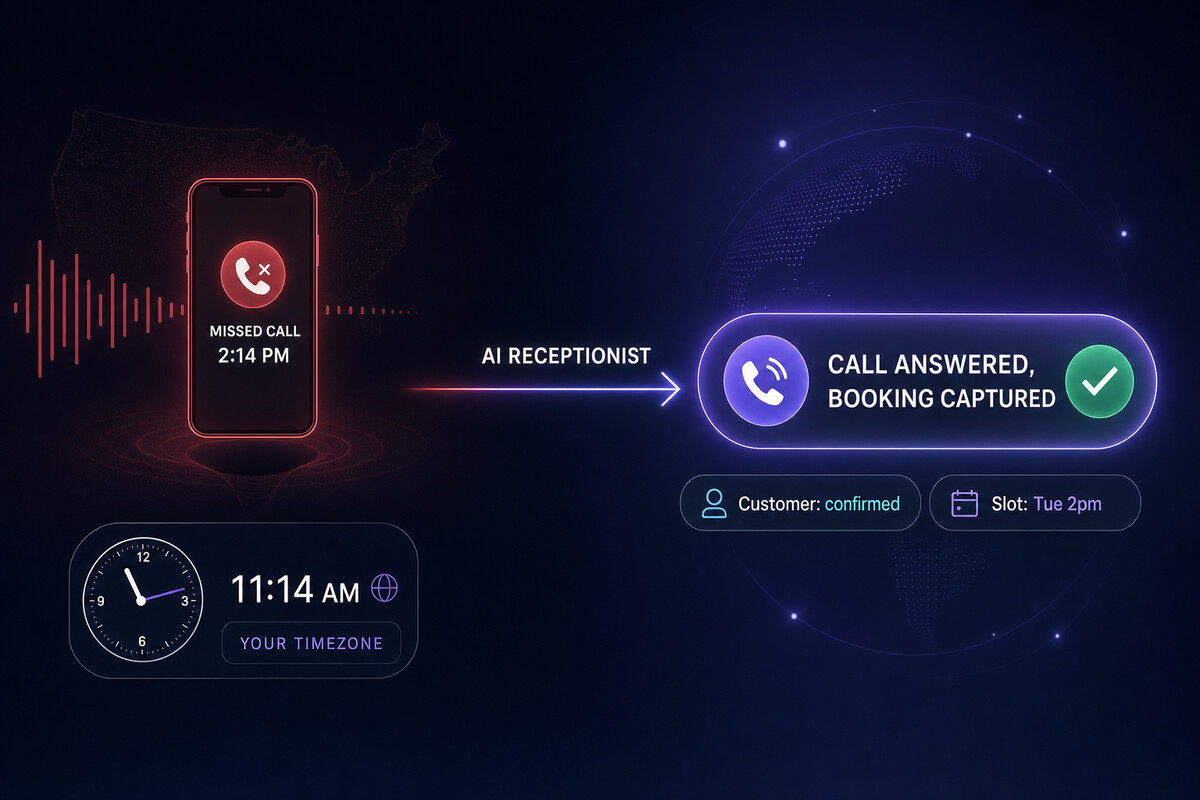
For a contractor missing 3 calls a day at $400 average ticket, that is $36k of leaked revenue per year. For a salon missing 5 calls a day at $85 average service, $13k per year. For a med spa where the average consult value is $1,200 and the 12-month patient LTV runs $2,500–8,000, missing one consult a week costs $62k–416k in year-one revenue.
This is the bill the timezone gap is quietly running against your business.
Why most fixes don't actually fix it
Expats running US businesses usually try one of three things. The first two have known failure modes. The third actually works.
Trap 1: "I'll just check messages later"
You set up call forwarding to your cell. Or you check voicemail twice a day. Or you sign up for a virtual receptionist service that takes messages.
The math has already been done above. Voicemail is a 95%+ lost-rate channel. Twice-a-day callbacks miss the under-5-minute window where conversion happens. Virtual receptionists who take messages without booking are the same problem with extra steps. The customer wanted to book a service, and at no point did anyone actually book the service.
Trap 2: Hire a US-based front desk worker
You hire a part-time front desk in your old city. They cost $35–45k base, plus 25% in benefits and taxes, total $44–56k year one. You're managing a US employee from another timezone. You handle the W-2, the workers comp, the pay-when-they-don't-show, and the ramp time (90 days to fully productive, ~$11k of salary before they're earning their seat).
This works. It is also the most expensive way to do it, and you'll wake up at 7am your local time to fire someone for ghosting their shift.
Trap 3: Slap a SaaS receptionist on top
Tools like CallBird AI, AgentZap, and Rosie run $49–499/month depending on call volume. You sign up, configure the conversation flow against their template, integrate with their supported booking systems, and forget about it.
This is a real category and it works for the right business. The trade-offs: their voice not yours, their integration list not yours (your booking software might or might not be supported), their roadmap not yours, and you're paying $600–6,000/year forever to rent something you could own.
For an expat business owner who already has the upfront capital from the US business, SaaS is usually the wrong end of the math. You are cash-rich and management-light by definition (you are abroad). You should own infrastructure, not rent it.
What actually works in 2026
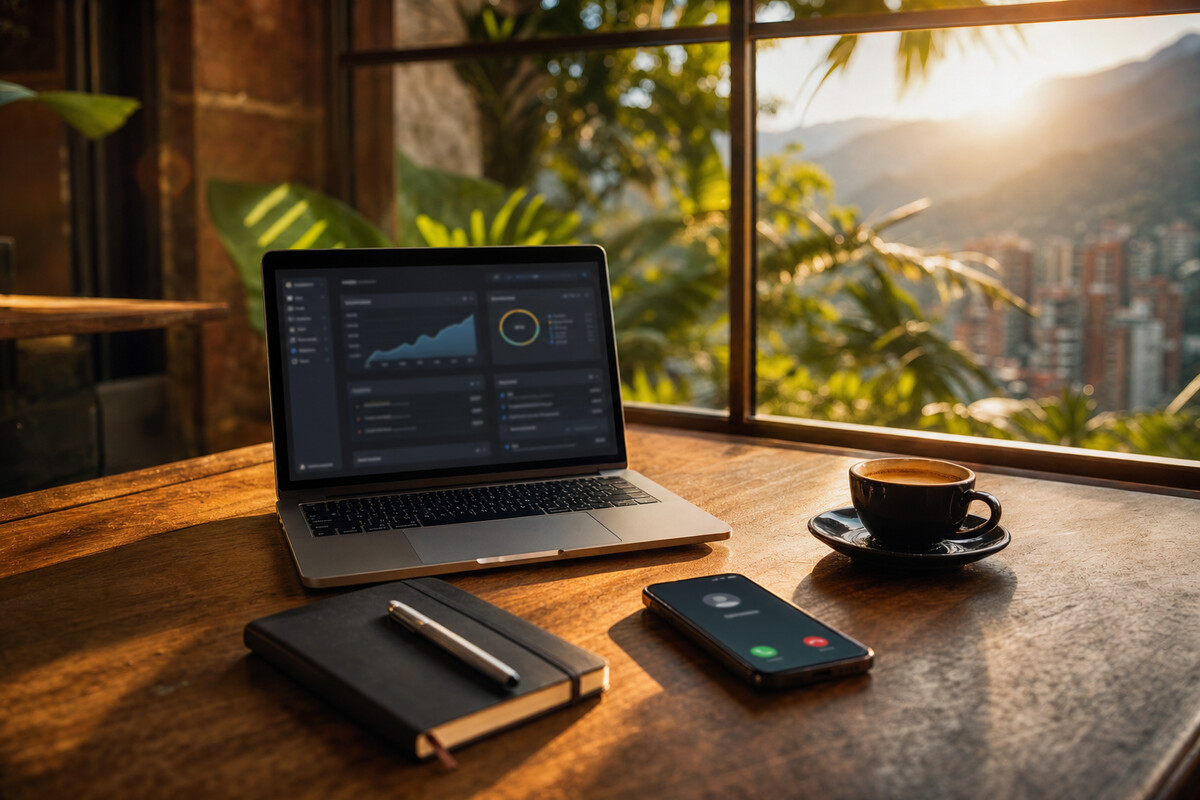
The deployment that fits the expat owner is a hand-deployed AI receptionist on infrastructure you own:
- Runs on your stack (Cloudflare Workers, Twilio, your booking software's API)
- Customized to your specific service menu, pricing, and intake flow
- Available 24/7 regardless of your timezone
- Handles booking, rescheduling, FAQs, message capture, emergency routing
- One-time deployment cost (~$8k for an AI receptionist), no recurring SaaS rent
- You own the code and the data
The math is straightforward. Year one: $8k upfront vs $44–56k for a US hire. Year two: nothing recurring vs another $44–56k. The savings compound and fund the next deployment, or just sit on your P&L.
The operator running this site actually deploys this category for service businesses through michaelheredia.com. Hand-deployed AI receptionists, Telegram bots, Discord agents, Slack enterprise builds. Same shape, no SaaS subscription, you own everything afterward. It's the same deployment that runs his own US business while he lives in Colombia.
What an AI receptionist actually does (the workflow)
Specifically, for a US service business with an expat owner:
| Step | What happens |
|---|---|
| 1 | Inbound call rings to your US business number (Twilio routes it) |
| 2 | AI agent answers within 1–2 rings, says your business name, asks how it can help |
| 3 | Agent qualifies the caller: what service, when works, any specific provider preference |
| 4 | Agent checks live calendar (Vagaro, Boulevard, Aesthetic Record, whatever your booking system is) |
| 5 | Agent books the appointment, sends a confirmation SMS, drops the booking into your system |
| 6 | For anything outside scope (emergency, complaint, unusual request), agent captures the message and texts you a summary |
| 7 | You wake up to a full calendar instead of a stack of voicemails |
What it handles well: booking, rescheduling, cancellations, FAQ (hours, pricing, services), confirmation and reminder flows, message capture, basic emergency triage.
What it does not handle (and shouldn't): sensitive medical or legal first-touch advice, high-emotion customer complaints, anything that genuinely requires you specifically to be in the conversation.
The rest of the expat-owner US-business stack
The receptionist solves the phone problem. Three other things have to be in place to run a US service business from abroad without things slowly falling apart:
A real US street address. Not a PO box. Not your friend's house. The IRS, your state of business registration, your bank, your insurance carrier, and your customers all need a physical US address they trust. Traveling Mailbox handles this with a real US street address in 50+ cities, mail scanning, check deposits, IRS-acceptable. The site owner uses this personally; it's the fix every long-term expat with a US business eventually lands on.
US business banking that doesn't lock you out for international logins. Most traditional US banks will flag and freeze your account the first time you log in from a non-US IP. Mercury is built for the use case: online-first, modern interface, international logins are not a fraud trigger, free business checking with no minimum.
Health coverage that follows you. Your US-based business pays you, your geographic location moves. SafetyWing handles the global-coverage piece without the enrollment-period games of US ACA marketplaces.
For the broader playbook of running a US business while living abroad (payroll, contractors, state nexus, tax filings), see running a US business while living in Colombia and building a $100k online business from anywhere.
When this isn't the right move yet
Don't deploy if:
- Your US business is sub-10 inbound calls per week. The receptionist is overbuilt for that volume. Your problem is not response speed, it is lead generation.
- Your booking system has no API. Some legacy industry-specific systems make integration painful. Vagaro, Boulevard, GlossGenius, Square Appointments, Fresha, Aesthetic Record, Symplast, Mangomint, and PatientNow are all fine. Some older boutique systems are not.
- You aren't actually running the business, your manager is. Then your manager should make this call, not you. AI receptionists work when there is clarity on who owns the workflow.
- You're considering selling the US business within 12 months. Don't deploy infrastructure right before a sale; the buyer may want their own stack.
The bottom line
The geographic arbitrage math people obsess over (rent in Medellin vs rent in Brooklyn, etc.) is real but it is mostly a few thousand dollars a month. The timezone tax on a US service business an expat is still running is often bigger than that, single-digit thousands per month leaked from missed calls and slow response times.
The fix exists. It is a hand-deployed AI receptionist on infrastructure you own, deployed once, runs forever. The math pays back in 60–90 days for most service businesses. The infrastructure pieces around it (US street address, US banking that doesn't lock you out, global health coverage) are the boring backbone that lets you actually live abroad without the US business slowly bleeding out behind you.
If you want to scope what this would look like for your specific business (service menu, booking system, current call volume), michaelheredia.com runs a free workflow audit that returns a written recommendation within 48 hours, including "don't deploy yet, here's why" if that's the honest answer.
For broader Colombia-specific context if you're considering Latin America as your base, the sister site has more on moving to Colombia as an American.
Disclaimer: This article is for informational purposes only and does not constitute tax, legal, or financial advice. Consult a qualified professional for guidance specific to your situation.
This guide is general information, not personalized tax, legal, or investment advice. Rules change; verify current thresholds with official sources or a qualified professional before acting.
Related guides
 Expat Business & Remote WorkSeptember 3, 2026
Expat Personal Loans: Borrow While Living Abroad
Compare five US personal loan paths for expats: military credit unions, co-signers, secured loans, and what SoFi requires when you live overseas.
 Expat Business & Remote WorkSeptember 1, 2026
Portugal 4× RMMG: The €3,680 AIMA Floor
Hit Portugal’s €3,680 4× RMMG test, file the art. 61-B consular sticker, then convert it at AIMA without mixing a D7 file.
 Expat Business & Remote WorkAugust 31, 2026
Spain Telework Permit: The €2,849 SMI Bar
Hit Spain 2026 telework SMI bar of €2,849, file the UGE 3-year route, and keep US tax plus Beckham Law on a separate clock.