
As of April 30, 2026, exactly 9,704 people have been approved for Thailand's Long-Term Resident (LTR) visa. In a world of roughly 66 million expats and digital nomads, that number is tiny — and it might represent one of the most underutilized tax-advantaged residency programs on the planet. Work-from-Thailand Professionals under the LTR pay 0% Thai personal income tax on their foreign-sourced earnings, live in one of Asia's most affordable major cities, and get a 10-year, multiple-entry visa for a one-time $1,400 fee. Meanwhile, everyone's talking about Dubai.
This guide breaks down what the LTR visa actually is, who qualifies, what the tax math looks like in practice, and why it quietly outcompetes programs that get ten times the press coverage.
What Is the Thailand LTR Visa?
Launched in September 2022 and managed by Thailand's Board of Investment (BOI), the LTR visa is a 10-year residency permit — granted in two 5-year tranches — designed to attract high-value foreign residents. It's not a tourist visa, not a retirement visa, and not the same as the newer Destination Thailand Visa (DTV). The LTR is in a different league entirely.
Key structural features:
- Duration: 10 years (5-year initial + 5-year renewal), multiple-entry
- Immigration reporting: Once per year (standard Thailand visa holders report every 90 days)
- Included: Digital Work Permit — legal authorization to work remotely from Thailand, with no Thai employer sponsorship required
- No 4:1 ratio: Exempt from Thailand's requirement that employers hire 4 Thai workers per foreign employee
- One-time visa fee: 50,000 THB (~$1,400)
The Four LTR Categories — And What Each Requires
The LTR is split into four categories with different income thresholds and tax treatments. Understanding which bucket you fall into determines what your actual tax exposure looks like.
| Category | Income / Net Worth Requirement | Thai Tax on Foreign Income | Share of Approvals |
|---|---|---|---|
| Work-from-Thailand Professionals | $80,000+/yr from an overseas employer (past 2 years) | 0% — fully exempt | ~37% |
| Wealthy Global Citizens | $1M+ assets, $80,000+/yr income, $500k invested in Thailand | 0% on foreign income | ~35% |
| Wealthy Pensioners | $40,000+/yr pension or passive income, 50+ years old | 0% on foreign income | ~18% |
| Highly Skilled Professionals | $80,000+/yr, working for a Thai entity in targeted industry | 17% flat rate on Thai employment income (vs. 35% standard top rate) | ~10% |
The Work-from-Thailand Professional category is the most relevant for remote workers: you need to earn at least $80,000 annually from a well-established foreign company for the past two years, carry health insurance with at least $50,000 coverage, and have your employer provide a supporting letter. That's it. No Thai job offer. No capital investment. Your client or employer just needs to be outside Thailand.
The Tax Math: Where It Gets Interesting
Thailand's standard personal income tax is progressive, running from 5% up to 35% on income above ~136,000 USD. But LTR Work-from-Thailand Professionals are completely exempt from Thai personal income tax on foreign-sourced income — regardless of when or whether they remit it to Thailand. This is a codified, BOI-backed exemption, not a gray-area interpretation.
How does this compare to the competition?
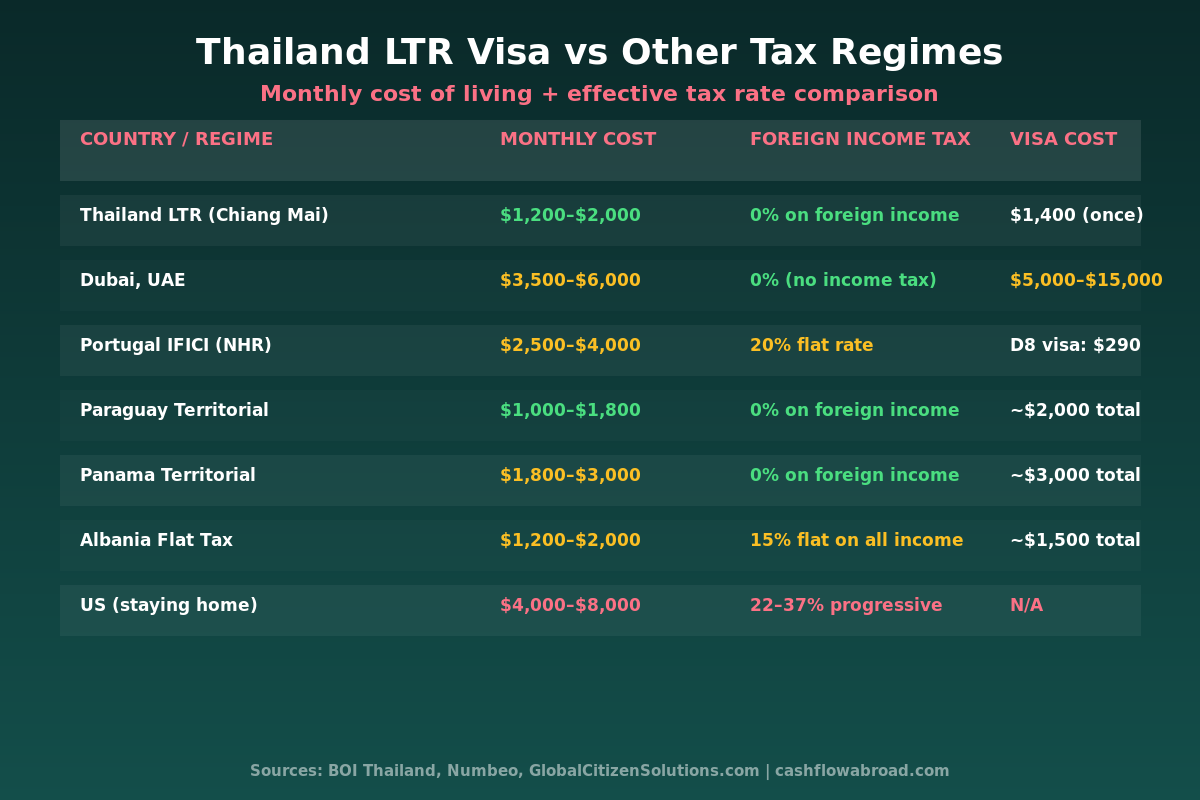
Dubai gets enormous marketing attention as a zero-tax destination. And it's true — the UAE has no personal income tax. But Dubai's cost of living runs $3,500–$6,000+/month for a comfortable expat lifestyle, and initial visa setup costs (Emirates ID, residency, company formation if self-employed) often run $5,000–$15,000. Thailand's LTR costs $1,400 total for 10 years of legal residency, and Chiang Mai runs $1,200–$2,000/month for a genuinely comfortable lifestyle.
Over five years, a remote worker earning $120,000/year who chooses Chiang Mai over Dubai saves approximately $120,000–$180,000 in living costs alone — before touching the tax equation.
The US Citizen Angle: Stacking LTR With FEIE
Here's where it gets layered. US citizens owe federal taxes on worldwide income regardless of where they live — that's not changing anytime soon. But the Foreign Earned Income Exclusion (FEIE) lets qualifying expats exclude a substantial chunk of foreign earned income from US taxes, provided they meet the physical presence or bona fide residence tests.
With LTR residency status in Thailand:
- Thailand taxes you 0% on your foreign-source employment income
- The US FEIE shields your first $120,000+ of earned income from federal income tax
- Income above the FEIE threshold may be eligible for the Foreign Tax Credit — but since Thailand collected nothing, you'd owe US rates on the excess
The practical takeaway: a US remote worker earning $100,000 from a US employer while living in Thailand under the LTR can potentially owe zero Thai income tax and near-zero US federal income tax on that income — legally, with full documentation. That's the stack that makes this visa worth understanding.
For context on maintaining your US banking and financial infrastructure while doing this, a virtual US mailbox keeps your US bank accounts, IRS address, and state domicile intact while you're based in Thailand. It's the piece most people forget until their bank account gets closed for having a foreign address on file. Read our full guide on why expats need a virtual mailbox.
For investment and brokerage access as a US expat, Charles Schwab International remains one of the few major US brokerages that actually serves expats — with free worldwide ATM withdrawals as a bonus.
What $2,000/Month Actually Buys You in Thailand
Cost of living numbers get thrown around loosely. Here's what $2,000/month actually means in the two most popular LTR destinations:
| Expense | Chiang Mai (Budget) | Chiang Mai (Comfortable) | Bangkok (Comfortable) |
|---|---|---|---|
| 1BR apartment (central) | $250–$350/mo | $400–$600/mo | $600–$900/mo |
| Food (local + restaurants) | $200–$300/mo | $350–$500/mo | $400–$600/mo |
| Transport (motorbike/taxi) | $60–$100/mo | $80–$150/mo | $100–$200/mo |
| Coworking space | $60–$120/mo | $80–$150/mo | $100–$200/mo |
| Health insurance (required) | $80–$150/mo | $100–$200/mo | $100–$200/mo |
| Entertainment + misc | $100–$200/mo | $200–$400/mo | $250–$500/mo |
| Total | $750–$1,170 | $1,210–$2,000 | $1,550–$2,600 |
Chiang Mai is roughly 30–40% cheaper than Bangkok, and it has a mature digital nomad infrastructure: fast fiber internet, dozens of coworking spaces, an international airport, and a large expat medical community. Bangkok offers more options for nightlife, international dining, and direct long-haul flights — at a 40% cost premium.
Note on health insurance: the LTR program mandates at least $50,000 in coverage. SafetyWing offers remote-worker-specific health plans that satisfy this requirement starting around $60–$100/month depending on your age and coverage tier. Our full expat health insurance guide walks through what to look for in a qualifying plan.

What the LTR Visa Doesn't Cover
Be clear-eyed about the limits before applying.
You must source income from outside Thailand. The Work-from-Thailand Professional category requires employment or contract income from a foreign company. If your income shifts to Thai sources — Thai clients, Thai employer — you lose the exemption and fall under standard Thai PIT rates.
The $80,000 income threshold is hard. Unlike some other visa programs that set low-bar minimums (Paraguay's territorial tax requires almost nothing in terms of income proof), the LTR Work-from-Thailand category requires $80,000/year in documented income for two consecutive years. Freelancers with volatile income may struggle to qualify.
US citizens still file with the IRS. The LTR exempts you from Thai tax. It does nothing for your US filing obligations. You need to maintain FEIE eligibility (183+ days out of the US, or bona fide residence status), file FBARs if holding over $10,000 in foreign accounts, and stay on top of FATCA penalties. The IRS doesn't care where you live.
Annual reporting still required. The once-per-year immigration check-in is much better than the standard 90-day report, but it's not zero. You need to appear in person or via authorized agent at an immigration office annually.
Health insurance is mandatory, not optional. The $50,000 minimum coverage is a hard requirement for visa maintenance. If your policy lapses, your LTR status is at risk.
How to Apply: The Actual Process
Thailand's BOI manages applications through its online portal at ltr.boi.go.th. The process is more organized than most Southeast Asian visa applications.
- Gather documents: 2 years of employment letters and income proof, health insurance certificate ($50k minimum), passport copy, professional credentials if applying as Highly Skilled Professional
- Submit online: Upload via the BOI portal. Initial application has no fee — you only pay if approved
- Wait for BOI review: Typically 4–8 weeks for Work-from-Thailand Professional applications
- Receive approval letter: BOI issues a letter of endorsement
- Apply at Thai consulate or immigration: Present the endorsement to get your actual LTR visa stamp
- Pay 50,000 THB (~$1,400): One-time fee at visa issuance
- Collect Digital Work Permit: Included with the visa — no separate application needed
You can apply from outside Thailand through a Thai consulate in your home country, or convert from within Thailand if you're already on another visa. The BOI has immigration offices in Bangkok (Chamchuri Square) that process LTR applications directly.
If you want connectivity sorted before you arrive, a Saily eSIM gives you instant data coverage in Thailand without needing a local SIM swap at the airport — useful for the initial landing and getting your documents uploaded. For international money transfers, Remitly offers competitive rates for THB-to-USD transfers with low fees and fast processing.
LTR vs. the Geographic Arbitrage Alternatives
The full geographic arbitrage comparison covers more ground, but for the specific 0%-foreign-income-tax bracket, Thailand LTR sits alongside Paraguay, Panama, and Georgia (the country) as legitimate zero-tax options for remote workers. Here's what differentiates Thailand:
- Infrastructure: Thailand's internet, coworking scene, and healthcare quality are meaningfully better than Paraguay or Georgia for most nomads
- Cost: Similar or lower than Panama's territorial tax options; cheaper than Dubai by a factor of 2–3x
- Stability: BOI backing means the LTR exemption is structural, not a revenue department opinion that could flip on a policy memo
- Visa duration: 10 years beats Paraguay's temporary residency path (3 years to permanent) and Panama's similarly structured process
The main advantage Paraguay and Panama hold: lower income requirements to qualify. If you're earning $50,000–$75,000/year, the LTR Work-from-Thailand bracket is out of reach, and those options remain more accessible. For a complete breakdown of all the main options, the digital nomad visa ranking guide compares the major programs side by side.
Is the LTR Visa Right for You?
It is if:
- You earn $80,000+ from a foreign employer and have 2 years of tax returns to prove it
- You want a Southeast Asian base with legal work authorization for a decade
- You want 0% Thai tax on your foreign income without Dubai's cost of living or European schemes' complexity
- You're comfortable doing one annual immigration check-in
It probably isn't if:
- You earn under $80,000/year (look at Thailand's DTV instead — 180-day validity, no income minimum, around $220 fee)
- Your income is project-based or highly variable and hard to document over two consecutive years
- You need to work for Thai clients or Thai entities regularly
- You're not willing to carry qualifying health insurance year-round
Final Word
The Thailand LTR visa isn't new — it's been available since late 2022. What it still is, in mid-2026, is dramatically underutilized. Fewer than 10,000 people have been approved. The paperwork is manageable, the cost is low, the tax benefit is real and legally backed by the BOI, and the cost-of-living math works out better than most high-profile alternatives. If you clear the $80,000 income bar and want a stable, low-tax Southeast Asian base with actual infrastructure, there's no real reason to stay uninformed while paying full US rates from home.
The full US expat banking and tax guide covers the IRS-side maintenance required while holding residency abroad, including FBAR, FATCA, and banking setup that doesn't collapse the moment you update your address.
Financial Disclaimer: This article is for informational purposes only and does not constitute tax, legal, or financial advice. Tax laws change frequently and vary by individual circumstance. Consult a qualified tax professional or attorney before making any decisions about international residency, visa status, or tax strategy. US citizens living abroad remain subject to IRS filing obligations regardless of foreign residency status.