

Most US expats spend months obsessing over the Foreign Earned Income Exclusion — eliminating up to $130,000 of federal tax — then move abroad and never think about their home state again. That's the trap. California, New York, Oregon, and a handful of other states operate their own tax collection machines, and those machines don't care that you're sitting in Lisbon or Medellín. If you haven't legally severed ties, the bill keeps coming.
California's top rate is 13.3%. New York's is 10.9%. The FEIE eliminates exactly zero dollars of that. An expat making $120,000/year who assumes moving abroad means zero US tax burden — and skips the state step — could owe $12,000–$16,000 annually to a state they haven't lived in for years.
Domicile vs. Residency: The Two Traps
States use two different hooks to keep taxing you after you leave.
Domicile is where you intend to return. It's your permanent home base in a legal sense — and it doesn't change just because you got on a plane. Courts have ruled that someone can maintain California domicile while living in Southeast Asia for five years if their intent to "return someday" remains. Domicile is yours until you affirmatively abandon it and establish a new one elsewhere.
Statutory residency is the day-count trap. Several states treat you as a full resident — regardless of domicile — if you maintain a permanent place of abode in the state AND spend more than 183 days there during the year. New York uses this test aggressively. If you kept your Manhattan apartment and visited family for a summer, you might trigger it without ever intending to.
You need to beat both tests to truly escape. Many expats beat the day-count test easily (they're abroad) but ignore domicile — and that's where the audit notices come from.
The Sticky States: California and New York Lead the List
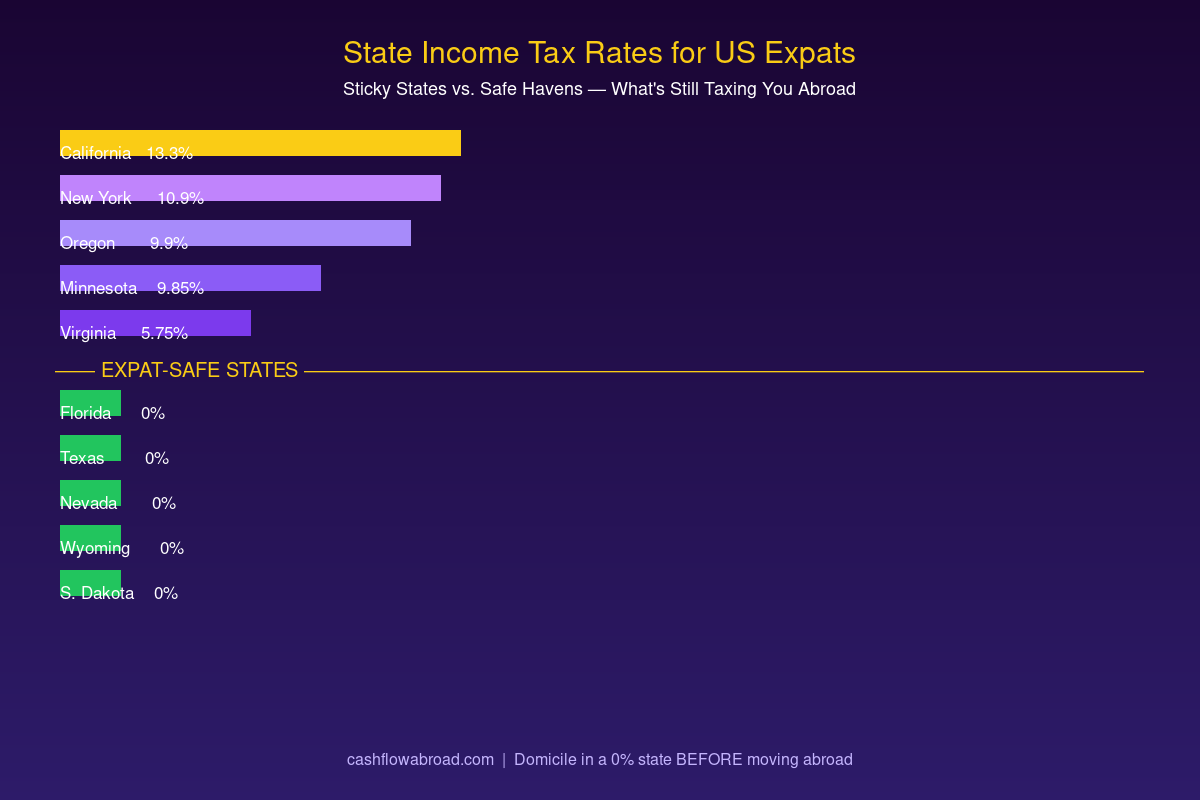
Not all states are equally aggressive. Here's how the main players break down:
| State | Top Rate | Honors FEIE? | Difficulty to Exit | Notes |
|---|---|---|---|---|
| California | 13.3% | No | Very Hard | 546-day safe harbor only for employment contract holders |
| New York | 10.9% | No | Very Hard | 548-day safe harbor; aggressive audit unit; spousal rules tightened in 2025 |
| Oregon | 9.9% | No | Hard | Domicile-based; requires clear establishment elsewhere |
| Virginia | 5.75% | No | Moderate | Cleaner exit rules; domicile change documentation usually sufficient |
| South Carolina | 6.2% | No | Moderate | Aggressive with pension and retirement income |
| Florida | 0% | N/A | Easy exit | No income tax; ideal pre-departure domicile state |
| Texas | 0% | N/A | Easy exit | No income tax; no domicile trap |
| Nevada | 0% | N/A | Easy exit | No income tax; popular choice for western expats |
| Wyoming | 0% | N/A | Easy exit | No income tax; lowest overall tax burden in the US |
| South Dakota | 0% | N/A | Easy exit | No income tax; popular for perpetual travelers |
California: The 546-Day Safe Harbor (And Who It Excludes)
California's Franchise Tax Board (FTB) is widely considered the most aggressive state tax authority in the country. The FTB audits high-income departures — generally earners over $200,000 — at elevated rates. If you file a final California return claiming you moved to Florida or abroad, assume they'll look twice.
California does offer a 546-day safe harbor that treats you as a nonresident even if you maintain California domicile. But it comes with four strict conditions that exclude most expats:
- You must be outside California for at least 546 consecutive days
- You must be abroad under a written employment contract tying you to a foreign location
- You can spend no more than 45 days per year in California
- Your intangible income cannot exceed $200,000 annually (stock options, dividends, interest)
Self-employed expats, digital nomads, retirees, and anyone without an employment contract are completely excluded from the safe harbor. The FTB will still consider you a California resident and tax your worldwide income — including income California treats as California-source (exercised stock options, rental income, capital gains on California property).
The math is brutal: a digital nomad in Medellín making $150,000 in consulting income who never broke California domicile owes roughly $19,950 to the FTB on that income alone. The FEIE doesn't reduce that by a cent. See our complete FEIE guide for why federal and state tax obligations operate entirely independently.
New York: The Audit Machine (Now with 2025 Spousal Rules)
New York's Department of Taxation and Finance operates a dedicated residency audit unit specifically focused on high-income departures. If you earned over $300,000 in New York and then filed a nonresident return or no return at all, the probability of an audit notice within 3–5 years is significant.
New York offers a 548-day foreign safe harbor. To qualify, you must:
- Be present in a foreign country for at least 450 of any 548 consecutive days
- Your spouse and minor children cannot spend more than 90 days in New York during that period
- Your own New York presence must not exceed a formula limit during that window
The 2025 ruling in Matter of Lynch significantly tightened the spousal requirement. Prior to this decision, some taxpayers argued that informal separation from a spouse who remained in New York satisfied the requirement. The court rejected that interpretation: legal separation is required, or the spouse must genuinely not be in New York. Informal "we're living apart" arrangements no longer protect the taxpayer.
In an audit, New York investigators will subpoena cell phone tower data, E-ZPass toll records, credit card purchase locations, boarding passes, and hotel records. They reconstruct a day-by-day presence calendar. The burden of proof is on you, the taxpayer, to demonstrate you were not a New York resident — not on them to prove you were.
What State Auditors Actually Look For
State tax auditors use a consistent checklist of "domicile factors." The more of these you left behind in the sticky state, the stronger their argument that you never truly left.
| Domicile Factor | What Counts Against You | What Protects You |
|---|---|---|
| Home | Owning a home, keeping it vacant or renting seasonally | Selling or establishing a long-term rental; address in new domicile state |
| Business ties | Continuing to operate a business registered in the state | Severing business connections; operating entirely from abroad |
| Near and dear items | Leaving family heirlooms, art, jewelry behind | Taking or relocating valued personal property |
| Family | Spouse or children remaining in the state | Full family relocation or legal separation |
| Social ties | Club memberships, religious affiliations still active | Established community connections in new domicile |
| Voter registration | Still registered in the old state | Re-registered in new domicile state; all IDs updated |
| Driver's license | Still licensed in the old state | New state license; or valid foreign driver's license |
| Banking | Primary accounts still at local state branches | US accounts at national institutions with no state nexus |
California and New York auditors weight the "home" factor most heavily. A vacant house sitting in San Francisco "just in case" is a domicile anchor the FTB will use against you. If you can't sell, rent it under a formal long-term lease with a property manager — it transforms the asset from a domicile indicator into income-producing property.
The Fix: Domicile Hop Before You Leave
The cleanest solution for anyone leaving a sticky state is to establish domicile in a no-income-tax state before departing the country. This isn't about shuffling paper — you need to genuinely move there, even briefly.
The five go-to states for expat domicile are Florida, Texas, Nevada, Wyoming, and South Dakota. All have zero state income tax. South Dakota is especially popular among perpetual travelers because you can establish valid residency with just a few days in-state — and a network of mail forwarding services and RV communities has built entire industries around it.
Work through this checklist before you get on the plane:
- Get a real physical address in the new state. A virtual mailbox with a real street address — not a PO box — works for banking, IRS, and most legal purposes. Traveling Mailbox provides real US street addresses in 50+ cities starting at $15/month, with mail scanning and check deposit. It's what the site owner personally uses to maintain a valid Texas domicile while living abroad.
- Get a driver's license in the new state. Visit in person, pass the test, get the card. This is one of the most powerful domicile indicators and is hard for states to argue around.
- Register to vote in the new state. Update your voter registration before departure.
- Update all financial accounts. Banks, brokerage accounts, IRS records (Form 8822), and Social Security should all reflect your new address. Charles Schwab International is the default expat banking choice — no foreign transaction fees, free ATM withdrawals worldwide, and no branch dependency. Mercury works well for business accounts.
- File a final part-year return with the sticky state. Make the break official on paper. Don't just stop filing.
- If you own property in the sticky state, sell or formally rent it. A vacant home is the single biggest domicile anchor you can leave behind.
Our virtual mailbox guide goes deep on how to set up a real US address in a tax-free state that satisfies banking, IRS, and state domicile requirements simultaneously.
Digital Nomads Have Extra Exposure
Employees working for a foreign company get at least a path to the 546-day safe harbor (if California-based) and generally have cleaner documentation. Self-employed expats — freelancers, consultants, agency owners, content creators — face the most risk because:
- California's 546-day safe harbor explicitly excludes them (no employment contract)
- Their income often has no foreign-employer documentation to satisfy safe harbor requirements
- They're more likely to maintain US business registrations, bank accounts, and client relationships in their home state
- They tend to return to the US more frequently, accumulating days
A self-employed Californian making $200,000 in consulting income while living abroad — who never broke California domicile — faces $26,600 in California state tax annually. Meanwhile, the same person who spent one week in Nevada getting a driver's license and updating their bank address before departure owes $0 to any state. The difference is a long weekend and some paperwork.
See our US expat banking and taxes guide for the full federal picture alongside state strategy — and our geographic arbitrage playbook for the countries that provide the most compelling cost-of-living reductions once the state tax question is settled.
If You Already Left Without Doing This
Don't panic, but don't wait either. The statute of limitations for state income tax audits is typically 4 years from the filing date — or 6 years if the state believes you underreported by 25% or more. California and New York can audit any year where you failed to file entirely, with no statute of limitations on those years.
If you're already abroad and still technically domiciled in a sticky state, you have options:
- Establish domicile in a no-income-tax state now. Future years are cleanly protected regardless of historical exposure.
- File any missed returns voluntarily. Voluntary filing is always better than the state finding you through IRS data-sharing programs or employer reporting. States increasingly receive copies of federal tax filings automatically.
- Document your whereabouts retroactively. Gather bank records, travel records, boarding passes, and any other evidence of time outside the state for years that might be audited.
- Consult a state tax attorney if the exposure is significant. If you're looking at multiple years of unreported California or New York income at high earnings, a specialist is worth the fee. Residency audit defense typically costs $10,000–$30,000 — significantly less than a six-figure tax assessment plus penalties and interest.
The State Tax Bill Nobody Talks About
Federal tax planning dominates the conversation in expat finance — and for good reason, since the FEIE and foreign tax credit can eliminate tens of thousands of dollars in federal liability. But the state layer is where most people get blindsided, because it doesn't come up until the audit notice arrives years later.
California and New York have dedicated units whose job is to identify high-income departures and collect. They're funded by the tax they recover. They're good at this. The fix is straightforward: domicile-hop to a no-income-tax state, document it thoroughly, and file clean final returns before you board your flight abroad. Done right, this step alone can save $10,000–$30,000+ per year — sometimes more than the cost-of-living savings between countries that got you excited about moving in the first place.
Financial Disclaimer: This article is for educational and informational purposes only and does not constitute tax, legal, or financial advice. Tax laws vary by state and individual circumstances. Consult a qualified expat tax professional or state tax attorney before making decisions about state domicile, residency, or tax filing obligations. Safe harbor rules and state tax codes change; verify current requirements with official state sources and a qualified professional before acting.