South Africa for US Expats: Taxes, Visas & the $1,200/Month Life
The average American spends $5,500 a month just to live in New York City. Yet almost nobody talks about it as a serious expat destination.
The average American spends $5,500 a month just to live in New York City. Yet almost nobody talks about it as a serious expat destination.
Disclosure: this article contains affiliate links. If you open an account through one of them, Cashflow Abroad may earn a referral commission at no extra cost to you.
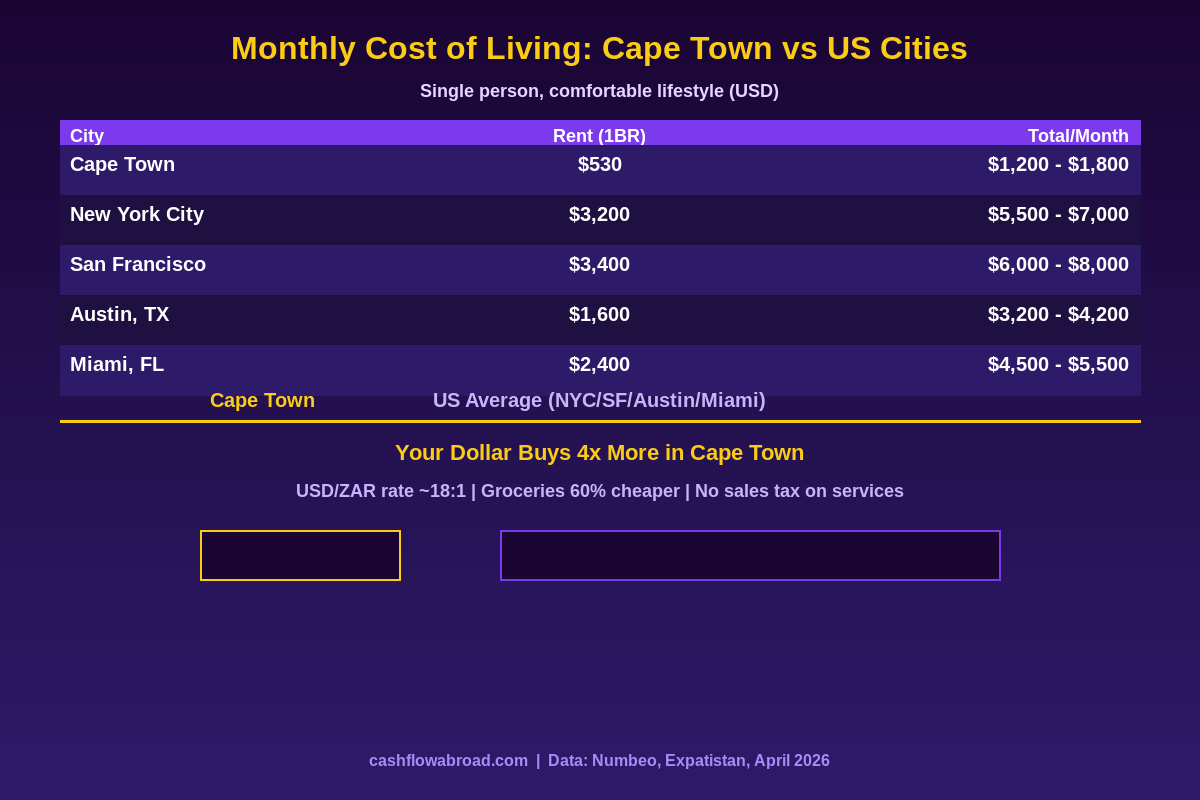
The average American spends $5,500 a month just to live in New York City. Move to Cape Town, and that same lifestyle costs closer to $1,800 — with a mountain backdrop, world-class wine, and year-round sunshine thrown in. South Africa's USD/ZAR exchange rate hovers around 18:1, which means every dollar you earn abroad buys nearly four times what it does at home. Yet almost nobody talks about it as a serious expat destination.
That gap is closing fast. South Africa launched its Digital Nomad Visa in March 2025, making it official: the country wants remote workers. Cape Town is already one of the most livable cities in the Southern Hemisphere. And the US-South Africa tax treaty means you won't get crushed by double taxation. Here's the full picture — visas, taxes, costs, banking, and the risks nobody glosses over.
Visa Options for Americans in South Africa
The US gets 90 days visa-free in South Africa, which is a fine starting point but not enough for a real move. Here are the three routes worth knowing:
Digital Nomad Visa (Remote Work Visa)
Launched in March 2025, South Africa's Digital Nomad Visa is valid for 12 months and renewable annually up to three years total. The income floor is ZAR 650,976 per year — roughly $38,500 at current rates. You must be employed by or contracted to a company headquartered outside South Africa.
Required documents:
- Valid passport (plus two blank pages)
- Proof of remote employment with a foreign company
- Income proof exceeding R650,976/year
- Comprehensive health insurance for the full stay
- Police clearance certificate from every country you've lived in for 12+ months in the past 5 years
- Medical certificate
Processing takes 4–8 weeks through a South African consulate. The big tax wrinkle: stay under 183 days in a 36-month period and you owe South Africa nothing. Exceed that and SARS (South African Revenue Service) considers you a tax resident. Plan your exit timing if you're using this visa purely for cost-of-living arbitrage.
Retired Person's Visa
No minimum age. South Africa's Retired Person's Visa requires you to prove a minimum monthly income of ZAR 37,000 (roughly $2,050 at current rates) from pension funds, annuities, rental income, or investment dividends. Salary income from active work doesn't count.
The visa is valid for four years and renewable, with a path to permanent residency. For retirees with Social Security plus an IRA distribution, this threshold is easily cleared.
Critical Skills Work Visa
If you have a skill on South Africa's Critical Skills list — which includes software engineers, data scientists, financial analysts, and several healthcare professions — you can obtain a work visa with employer sponsorship. Processing is notoriously slow (6–12 months is common), but the pathway to permanent residency is more direct.
How US-South Africa Taxes Actually Work
Two tax systems apply to you simultaneously, which sounds terrifying until you understand the treaty.
Your IRS Obligations Don't Go Away
The US taxes citizens on worldwide income regardless of where you live. That means filing Form 1040 every year plus FBAR if you hold over $10,000 in foreign accounts. The US Expat Banking & Taxes guide covers the full compliance stack.
The Foreign Earned Income Exclusion (FEIE) lets you exclude up to $126,500 (2024 threshold, adjusted for inflation annually) of foreign-earned income if you meet either the Bona Fide Residence test or the Physical Presence test (330 days outside the US in 12 months). Learn the full FEIE mechanics at the FEIE guide.
South Africa's Tax System
South Africa taxes residents on worldwide income using a progressive rate structure:
| Taxable Income (ZAR) | USD Equivalent (~18:1) | Marginal Rate |
|---|---|---|
| R0 – R237,100 | $0 – $13,170 | 18% |
| R237,101 – R370,500 | $13,170 – $20,580 | 26% |
| R370,501 – R512,800 | $20,580 – $28,490 | 31% |
| R512,801 – R673,000 | $28,490 – $37,390 | 36% |
| R673,001 – R857,900 | $37,390 – $47,660 | 39% |
| R857,901 – R1,817,000 | $47,660 – $100,940 | 41% |
| R1,817,001+ | $100,940+ | 45% |
South Africa's primary rebate for the 2025/26 tax year is R17,235, which effectively means no income tax is owed on the first ~R95,750 (~$5,320) of income. Dividends from South African companies face a 20% withholding tax at source.
The US-South Africa Tax Treaty
The bilateral tax treaty means you can generally take a Foreign Tax Credit on your US return for taxes paid to SARS — preventing dollar-for-dollar double taxation. For most remote workers earning in USD and spending in ZAR, the FEIE typically delivers a better outcome than the FTC. Run both scenarios before filing.
One planning angle: digital nomads who stay under 183 days in a 36-month period avoid SARS taxation entirely. Six months per year in South Africa, the rest elsewhere, zero South African tax liability — while living cheaply on the rand's weakness.
What Your Dollar Actually Buys in South Africa
The numbers here are genuinely striking. The USD/ZAR rate currently sits around 18:1. At that rate, a $5,000/month remote income translates to R90,000 — firmly upper-middle-class by South African standards.
Cape Town: The Premium Option
Cape Town is South Africa's most popular expat hub. It's also the priciest — though "priciest" is relative:
| Expense | Monthly Cost (ZAR) | Monthly Cost (USD @ 18:1) |
|---|---|---|
| 1-BR apartment (city center) | R9,000 – R13,000 | $500 – $720 |
| 1-BR apartment (suburbs) | R6,500 – R9,000 | $360 – $500 |
| Groceries (single person) | R3,000 – R5,000 | $165 – $280 |
| Eating out (local restaurants) | R1,500 – R2,500 | $85 – $140 |
| Private health insurance | R2,500 – R5,000 | $140 – $280 |
| Transport (Uber/Bolt) | R800 – R1,500 | $45 – $85 |
| Internet (fiber, 100Mbps) | R700 – R1,000 | $40 – $55 |
| Utilities (electric, water) | R1,200 – R2,000 | $65 – $110 |
| Total (comfortable) | R22,000 – R35,000 | $1,200 – $1,950 |
Johannesburg and Stellenbosch: The Alternatives
Jo'burg is South Africa's financial capital. Rents run 15–20% below Cape Town — a central 1-BR goes for R7,000–R10,500/month. The coworking infrastructure is more developed and the business networking scene is active. Stellenbosch, 45 minutes from Cape Town in the Cape Winelands, delivers a university-town atmosphere with excellent restaurants and a 1-BR at R6,000–R8,500/month ($330–$470).
Healthcare: The Best News for Expats
South Africa's public healthcare system is strained. The private system is a different story. Cape Town's private hospitals — Netcare, Life Healthcare, Mediclinic — deliver care comparable to Western Europe. Specialists are world-class; medical tourism from neighboring African countries is common precisely because South African private medicine is so far ahead regionally.
A GP consultation runs R600–R900 ($33–$50). A specialist visit costs R1,200–R2,500 ($67–$140). Local private medical aid (Discovery Health, Bonitas, Momentum) can be purchased by visa holders; monthly premiums for a quality plan start around R2,500–R4,000 ($140–$220).
International coverage via SafetyWing is valid in South Africa starting at $45/month — workable for healthy 20–40 year olds who want flexibility without committing to a local medical aid scheme.

Banking and Moving Money
Opening a South African Bank Account
As a visa holder, you can open a non-resident account at FNB (First National Bank), Standard Bank, or Absa with your passport and visa documentation. FNB's Easy Account is the most foreigner-friendly entry point. You'll need proof of address (a lease works), your visa, and source-of-funds documentation.
Important: SARS and the South African Reserve Bank (SARB) tightened capital controls in late 2025. Sending large sums out of South Africa now requires a Tax Compliance Status (TCS) PIN from SARS. Don't let large balances accumulate in a South African account if you plan to repatriate them.
Keeping Your US Banking Intact
Don't close your US accounts before you leave. Charles Schwab International remains the gold standard for expats — no foreign transaction fees, reimbursed ATM fees worldwide, and a brokerage that won't close your account when you update your address to Cape Town. The geographic arbitrage playbook covers the full expat banking stack in detail.
Transferring Money to South Africa
For regular transfers from your US account, Remitly offers competitive USD-to-ZAR rates with transfers completing in minutes. On a $3,000 transfer, even a 0.5% rate improvement saves you R270 — real money when you're doing this monthly. Always compare against the mid-market rate before sending.
Maintaining a US Address
Keeping a valid US address is non-negotiable for maintaining bank accounts, brokerage access, and IRS compliance. A Traveling Mailbox gives you a real US street address in 50+ cities for $15/month — mail gets scanned and forwarded digitally, checks can be deposited remotely. See the virtual mailbox guide for expats for the full setup.
Safety: The Honest Picture
South Africa has a serious crime problem. Don't sanitize it. The murder rate nationally is roughly 45 per 100,000 — among the highest globally. Cape Town's crime is heavily concentrated in the Cape Flats townships, which most expats never visit. The Atlantic Seaboard (Sea Point, Green Point, Camps Bay, Clifton), City Bowl, V&A Waterfront, and Southern Suburbs (Constantia, Newlands, Claremont) are generally safe with reasonable precautions.
The practical rules expats live by:
- Never display phones, cameras, or jewelry in public unnecessarily
- Drive with windows up and doors locked in traffic
- Avoid walking alone after dark in unfamiliar areas
- Use Bolt or Uber rather than street taxis
- Choose gated residential estates or security-managed buildings
The US State Department maintains a Level 2 advisory (Exercise Increased Caution) for South Africa — the same rating as France, Germany, and Italy. Expats who do their homework on neighborhood selection consistently report feeling safe in their daily routines.
Why Expats Keep Coming Back
Cape Town consistently ranks among the most beautiful cities on earth. Table Mountain frames the skyline from every neighborhood. The Cape Winelands produce Chenin Blancs that compete with Burgundy at a tenth of the price — a bottle of quality Stellenbosch Pinotage runs R80–R150 ($4.50–$8.50). A serious restaurant meal with wine rarely exceeds R400 ($22) per person.
Fiber internet from Vumatel or Openserve covers most Cape Town neighborhoods at 100Mbps for R600/month ($33). Coworking spaces like Workshop17 and The Workspace are professional grade. The UTC+2 time zone overlaps with US Eastern mornings, which matters if you're on calls with US clients.
The Geographic Arbitrage Math
A US remote worker earning $6,000/month and living in Cape Town:
| Scenario | Monthly Expenses | Monthly Savings | Annual Savings |
|---|---|---|---|
| Living in NYC on $6K/month | $5,500 – $6,500 | $0 – $500 | $0 – $6,000 |
| Living in Cape Town on $6K/month | $1,400 – $1,900 | $4,100 – $4,600 | $49,200 – $55,200 |
| Difference | — | +$4,100/month | +$50,000/year |
That $50,000 annual surplus — invested at 7% for 10 years — compounds to approximately $690,000. The geographic arbitrage playbook covers exactly this math, comparing 10 countries side by side. South Africa's combination of manageable safety risks, excellent quality of life, and extraordinary dollar purchasing power makes it one of the most underrated plays in the expat world.
Investing While Living in South Africa
Keep your investment accounts US-based. South African investment products available to foreigners are subject to PFIC rules and foreign tax reporting complexity that makes them a nightmare for Americans. Index funds through a US brokerage accessed remotely is the clean path. The expat investor's playbook explains why PFIC traps cost expats 37%+ in taxes if they buy the wrong foreign products.
Bottom Line
South Africa's geographic arbitrage case is one of the strongest available right now: an ~18:1 exchange rate, a functioning Digital Nomad Visa, a US tax treaty, and a private healthcare system that delivers Western-quality care at developing-world prices. The trade-offs — crime requiring neighborhood awareness, slow immigration bureaucracy, and SARB capital controls — are real but manageable with preparation.
For a structured comparison of how South Africa stacks up against other geographic arbitrage destinations, see the full geographic arbitrage playbook covering 10 countries. For the tax compliance side, the US expat banking and taxes guide covers every IRS filing requirement you'll need to stay current.
Disclaimer: This post is for informational purposes only and does not constitute tax, legal, or financial advice. Tax laws change frequently; consult a qualified expat tax professional before making any filing decisions. Exchange rates fluctuate — verify current rates before making any financial moves.
This guide is general information, not personalized tax, legal, or investment advice. Rules change; verify current thresholds with official sources or a qualified professional before acting.
Related guides
 Geographic ArbitrageOctober 25, 2026
Italy Nomad Visa Income Requirements
Italy's nomad visa income test is €25,500 on 2026 sheets. See the $133.60 Washington fee and the US return you still file.
 Geographic ArbitrageOctober 4, 2026
Greece Nomad Visa: The €3,500 Monthly Test
See whether your pay clears Greece's digital nomad visa: €3,500 net a month, or €4,200 with a spouse, before you apply now.
 Geographic ArbitrageSeptember 21, 2026
Korea F-1-D Workation Income Rules for Expats
As of June 2026, Korea’s F-1-D visa starts at ₩52.4M outside Seoul for ages 18–34. Map income tiers, US FEIE, and where you park the paycheck.