Solo 401(k) Abroad: Self-Employed Expats Save $72k
Self-employed expats can shelter up to $72,000/year in a Solo 401(k)—but the FEIE interaction is a landmine most miss. Here's exactly how to do it right.
Self-employed expats can contribute up to $72,000/year to a Solo 401(k). But the FEIE trap can wipe out your eligibility. Here's how to navigate it.
Disclosure: this article contains affiliate links. If you open an account through one of them, Cashflow Abroad may earn a referral commission at no extra cost to you.
Most self-employed Americans abroad assume retirement accounts are a US-only privilege — a perk that vanishes when you board the one-way flight. They're wrong. A properly structured Solo 401(k) lets a self-employed expat shelter up to $72,000 per year in 2026, all while sitting in a café in Lisbon, Medellín, or Chiang Mai. That's more than a W-2 employee at a Fortune 500 company can contribute through a standard 401(k) plan.
The catch — and there is always a catch — is the interaction with the Foreign Earned Income Exclusion (FEIE). Get it wrong and you've made excess contributions that trigger a 6% annual penalty until corrected. Get it right and you're building a tax-sheltered nest egg that most of your expat peers don't even know exists.
What Is a Solo 401(k)?
A Solo 401(k) — also called an Individual 401(k) or one-participant 401(k) — is a retirement plan designed for self-employed individuals with no full-time employees other than a spouse. Freelancers, consultants, online business owners, coaches, developers-for-hire: if you're generating self-employment income and you have no W-2 employees, you qualify.
Unlike a SEP-IRA (which limits you to 25% of compensation in employer contributions only), a Solo 401(k) has a dual contribution structure. You contribute twice: once as the "employee" and once as the "employer" of your own business. This dual structure is why the Solo 401(k) lets most self-employed expats contribute significantly more than a SEP-IRA at the same income level.
2026 Contribution Limits: The Full Picture
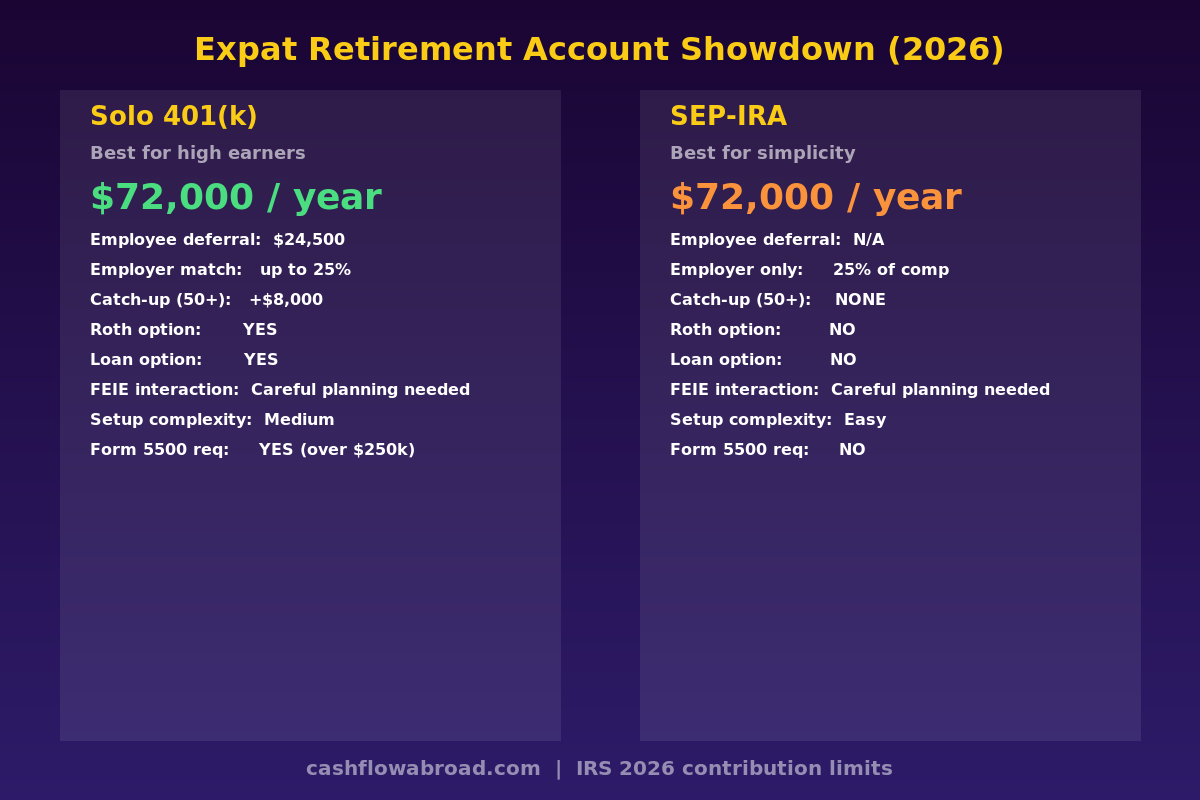
For the 2026 tax year, the IRS caps total Solo 401(k) contributions at $72,000. Here's how the math breaks down:
| Contribution Type | 2026 Limit | Notes |
|---|---|---|
| Employee salary deferral | Up to $24,500 | Or 100% of eligible compensation, whichever is less |
| Employer profit-sharing | Up to 25% of net compensation | Based on net self-employment income after SE tax deduction |
| Combined maximum (under 50) | $72,000 | Employee + employer combined |
| Catch-up contribution (age 50–59 or 64+) | +$8,000 | Total: $80,000 |
| Enhanced catch-up (ages 60–63, SECURE 2.0) | +$11,250 | Total: $83,250 |
For comparison: a standard W-2 employee at a large company can defer a maximum of $24,500 in 2026 — plus whatever employer match their company offers. A solo operator running their own business can do more than double that if they earn enough.
The FEIE Trap That Wipes Out Your Contributions
Here's where expats get into trouble. The Foreign Earned Income Exclusion (FEIE) lets you exclude up to $132,900 of foreign-sourced earned income from US income tax in 2026. Sounds like a dream. For retirement contributions, it's a landmine.
The IRS is explicit: excluded income cannot serve as the basis for retirement plan contributions. Your eligible compensation for Solo 401(k) purposes is your net self-employment income that remains taxable — after FEIE exclusion, after the self-employment tax deduction.
The practical consequence: if you earn $120,000 abroad and exclude all of it using the FEIE, you have zero eligible compensation for Solo 401(k) contributions. Any contributions you make would be excess contributions subject to a 6% annual excise tax until withdrawn.
There is one crucial nuance: the FEIE does not eliminate self-employment tax. That 15.3% tax on your net SE income still applies regardless of the FEIE. This matters because your Solo 401(k) contribution calculation starts from your net SE earnings (before FEIE), then you subtract the contribution itself, then apply FEIE. But income must still be taxable income — not excluded income — to count as eligible compensation.
Real Example: $160,000 Earner
| Scenario | Gross Income | FEIE Excluded | Taxable Income Left | Max Solo 401(k) |
|---|---|---|---|---|
| FEIE only (full exclusion) | $132,900 | $132,900 | $0 | $0 — no contributions allowed |
| FEIE + income above threshold | $160,000 | $132,900 | $27,100 | ~$24,500 employee deferral + some employer match |
| Foreign Tax Credit (no FEIE) | $160,000 | $0 | $160,000 | Up to $72,000 (full limits apply) |
The third row is the strategy most high-earning expat freelancers miss. If you live in a country with meaningful income taxes — Portugal, Germany, Australia — those foreign taxes likely exceed your US tax liability. Using the Foreign Tax Credit (FTC) instead of the FEIE means your income remains fully eligible for Solo 401(k) contributions while the FTC offsets the US tax due. In many cases, after maxing the Solo 401(k), your US taxable income drops to near zero anyway.
This is a calculation your expat CPA should run every year. The optimal choice depends on your country of residence's tax rates, your income level, and the interplay with self-employment tax. See our deep-dive: FEIE vs. Foreign Tax Credit: Which One Saves More?
Solo 401(k) vs SEP-IRA: Which Wins for Expats?
Both accounts have the same $72,000 total limit in 2026, but they behave very differently at different income levels.
At $80,000 net self-employment income, a SEP-IRA caps you at 25% of compensation — roughly $18,600 after the SE tax deduction math. A Solo 401(k) lets you contribute that same $18,600 employer piece plus $24,500 in employee salary deferrals, reaching over $43,000 total. That gap compounds enormously over time.
The SEP-IRA wins on simplicity. No Form 5500-EZ to file, no plan document to maintain. You can open and fund one up until your tax filing deadline (including extensions) for the prior year. Solo 401(k) plans must be established by December 31 of the tax year to make employee deferrals.
SEP-IRA has no Roth option and no loan provision. Solo 401(k) plans — through providers like Charles Schwab or Fidelity — allow Roth deferrals within the employee contribution portion and allow plan loans of up to $50,000. That Roth optionality matters enormously for expats, as we'll see next.
The Roth Conversion Window Expats Keep Missing
Here's a scenario that plays out more often than most expat advisors discuss: you're using the FEIE, earning $90,000, and excluding all of it. Your US taxable income is essentially zero. You have no contribution room for new retirement accounts this year.
But you have an opportunity many expats don't see: convert existing pre-tax retirement balances (traditional IRA, old 401(k)) to Roth — potentially at a 0% US federal rate.
When your FEIE exclusion zeros out your taxable income and your standard deduction ($15,000 for single filers in 2026) further reduces any remaining amount, you can convert that exact gap to Roth with no US federal tax. A single filer excluding $90,000 with a $15,000 standard deduction could convert up to $15,000 to Roth and owe nothing federally. Repeat this for five or ten years of expat life and you've built a substantial tax-free pool.
Note: the FEIE does inflate your Modified Adjusted Gross Income (MAGI) for Roth IRA contribution purposes. An expat excluding $132,900 of income and earning another $30,000 in investment income has a MAGI of $162,900 — above the single-filer Roth contribution phase-out of $153,000 in 2026 — even though their taxable income is just $30,000. This is a separate issue from conversions (conversions have no income limit post-2010), but it does mean many FEIE users can't make new direct Roth contributions. More in our guide: Roth IRA for US Expats: FEIE, Backdoor & Conversion Strategy.

Setting Up a Solo 401(k) From Abroad
The mechanics are straightforward. You don't need a US address to maintain an existing Solo 401(k), though some brokerages ask you to have one — your virtual mailbox address works perfectly. Traveling Mailbox provides a real US street address in 50+ cities starting at $15/month, which handles brokerage address requirements, IRS correspondence, and state domicile documentation simultaneously.
Opening a new Solo 401(k) from abroad takes three steps:
- Establish the plan document. Most major brokerages (Fidelity, Schwab, Vanguard) have pre-approved prototype plan documents. This must be done by December 31 for employee deferrals to count in that tax year.
- Get an EIN for the plan itself. You'll need a plan-level Employer Identification Number, separate from your business EIN or personal SSN. Apply online via IRS Form SS-4.
- Fund before the deadline. Employee deferrals should be deposited monthly; employer profit-sharing contributions can wait until the tax filing deadline plus extensions.
Charles Schwab is the most widely recommended brokerage for expats. Their Individual 401(k) includes Roth deferral options, and their international banking arm offers free ATM withdrawals worldwide — making Schwab a logical one-stop institution for banking, brokerage, and retirement from abroad.
The Form 5500-EZ Threshold
When your Solo 401(k) plan assets exceed $250,000, you're required to file Form 5500-EZ annually. This isn't a tax return — no money is owed — but it's a disclosure requirement with a $250/day late-filing penalty. Set a calendar reminder. Many expats hit this threshold without realizing it, then face IRS notices years later.
What Can You Invest In?
A Solo 401(k) at a major US brokerage gives access to the full investment universe: stocks, bonds, ETFs, mutual funds, REITs. One caveat for expats with European addresses: US mutual funds may be closed to new purchases in EU countries under MiFID II product distribution rules. ETFs — which trade on exchanges rather than through fund companies — are typically unaffected. This is one reason some expats maintain a US virtual mailbox address for their brokerage.
Self-directed Solo 401(k) plans allow alternative investments: real estate, private equity, certain crypto assets. The administrative complexity and IRS scrutiny are substantially higher. For most self-employed expats, a standard plan in broad-market ETFs is cleaner and safer. If you do hold crypto assets and need help tracking US tax reporting across multiple account types, CoinTracking handles multi-account and multi-exchange reporting.
The Full Expat Retirement Stack
A Solo 401(k) rarely operates alone. High-income self-employed expats often layer multiple strategies depending on their income structure and country of residence:
- Solo 401(k) — Primary retirement vehicle for high earners using FTC or with income above FEIE limit
- SEP-IRA — Simpler fallback for expats who consistently earn below the FEIE threshold and occasionally have taxable income
- Roth conversions — Exploits low-taxable-income years when FEIE pushes taxable income near zero
- Taxable brokerage — Overflows after tax-advantaged limits; best for expats using FTC with foreign tax offsets
For the full picture on how these interact with PFIC rules (a separate landmine for expats holding foreign funds), see our Expat Investing Playbook & PFIC Guide.
Quick-Reference Checklist
- Confirm net SE income is not fully excluded under FEIE before contributing
- Run FEIE vs FTC comparison annually with a qualified expat CPA
- Establish the plan by December 31 to make employee deferrals for that year
- Secure a US address via virtual mailbox if your brokerage requires one
- File Form 5500-EZ once plan assets exceed $250,000
- Model Roth conversion opportunities in FEIE years when taxable income is near zero
- Keep separate EINs for your business and the Solo 401(k) plan
Bottom Line
The Solo 401(k) is the most powerful retirement savings tool available to self-employed Americans abroad — when used correctly. The $72,000 annual limit dwarfs what most W-2 employees can save, and the dual contribution structure creates more headroom at lower income levels than any other self-employed option. The critical variable is your FEIE strategy: high earners above the exclusion threshold should model FEIE versus FTC every single year, and expats in low-taxable-income years shouldn't miss the Roth conversion window.
Get the structure right once and you're building a six-figure tax shelter that works just as well from Bangkok as it does from Boston. Most of your expat peers are leaving this on the table entirely.
Financial Disclaimer: This article is for informational and educational purposes only and does not constitute tax, legal, or investment advice. IRS rules governing Solo 401(k) contributions, FEIE interaction, and self-employment tax are complex and subject to change. Individual circumstances vary significantly. Consult a licensed tax professional or CPA with expertise in US expat taxation before making retirement contribution decisions.
This guide is general information, not personalized tax, legal, or investment advice. Rules change; verify current thresholds with official sources or a qualified professional before acting.
Related guides
 Expat Tax & FinanceMay 3, 2026
The FEIE Retirement Trap: Why Your Tax Break Costs More
Claiming the FEIE can zero out your Solo 401(k) and IRA contribution limits. Learn how the 5-year lock-in affects self-employed expats.
 Expat Tax & FinanceMay 16, 2026
The FEIE-Roth IRA Trap Costing Expats $500K at Retirement
The FEIE excludes income from U.S. tax — but blocks Roth IRA contributions. Learn the 5-year trap and preserve retirement savings abroad.
 Expat Tax & FinanceSeptember 6, 2026
Why 330 Days Abroad Can Still Fail FEIE
Pass the IRS tax home and abode tests before you file Form 2555. A 330-day count without a foreign tax home can wipe out the $130,000 FEIE.