Silver & Commodity Trading from Abroad: An Expat's Guide
Silver is the most electrically conductive element on Earth. And yet — silver is still trading below its all-time high from 1980 .
Key Takeaways
Silver is the most electrically conductive element on Earth. And yet — silver is still trading below its all-time high from 1980 .
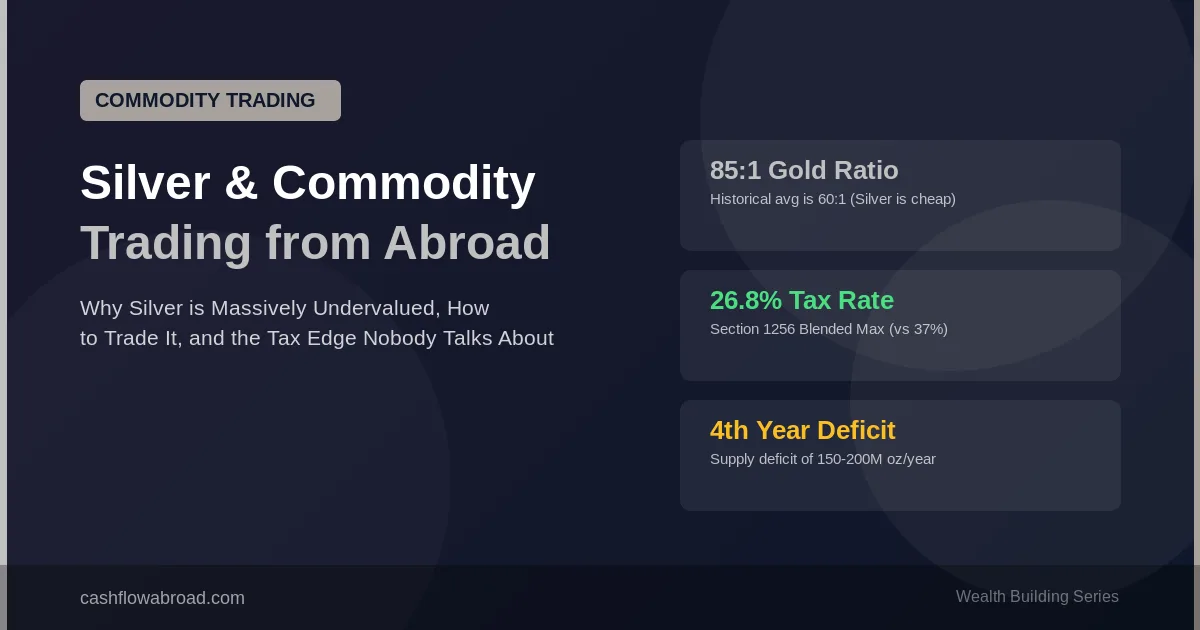
Silver is the most electrically conductive element on Earth. It's in every solar panel, every electric vehicle, every 5G tower, and every AI data center being built right now. Global demand has exceeded supply for four consecutive years, with a shortfall of 150-200 million ounces annually. And yet — silver is still trading below its all-time high from 1980.
Adjusted for inflation, that 1980 peak would be roughly $180/oz in today's dollars. Silver currently trades around $30-35/oz.
I trade silver and other commodities from my apartment in Medellín, Colombia using tastytrade — and thanks to a little-known IRS provision called Section 1256, my maximum blended tax rate on futures gains is just 26.8%, regardless of how long I hold the position.
This is the complete guide to commodity trading from abroad — why silver is the opportunity of the decade, how to trade it, and the tax advantages that make it even better.
No assignment fees, no platform fees, no inactivity fees. The $0-to-close on equity options is a standout feature.
The bottom line: Silver's fundamentals are the strongest they've been in decades. Solar panels, EVs, AI data centers, and 5G are creating unprecedented industrial demand against a structurally constrained supply. The gold-to-silver ratio suggests massive undervaluation. And Section 1256 gives commodity traders a tax rate that stock day-traders can only dream of. From a café in Medellín, I can trade COMEX silver on tastytrade during peak US market hours, pay a blended 26.8% max rate on my gains, and reinvest the difference into an asset I believe has a generational bull case. That's geographic arbitrage meets financial arbitrage — and it's the kind of stacking that builds real wealth. Ready to get your financial house in order before you start trading from abroad? Start with our complete US expat banking and taxes guide, then check out how I run a US business from Colombia for the full geographic arbitrage playbook. And if you're planning your move to Colombia, ColombiaMove.com has the most comprehensive relocation guides online. Disclaimer: This article is for informational purposes only and does not constitute investment, tax, or financial advice. Commodity trading involves substantial risk of loss and is not suitable for all investors. Past performance is not indicative of future results. Some links in this post are affiliate links. Consult a qualified financial advisor and tax professional before trading.
The Bull Case for Silver: Why Now
Here's the situation: silver sits at one of the most compelling risk/reward setups I've seen in any asset class. Let me break down why.The Gold-to-Silver Ratio Is Screaming "Buy"
The gold-to-silver ratio currently sits around 85-90:1. That means it takes 85-90 ounces of silver to buy one ounce of gold. For context:- Historical average: ~60:1
- Ancient civilizations: 12-15:1
- Natural mining ratio: ~8:1 (there's about 8x more silver in the Earth's crust than gold)
- 2011 peak: The ratio compressed to ~32:1
Four Consecutive Years of Supply Deficit
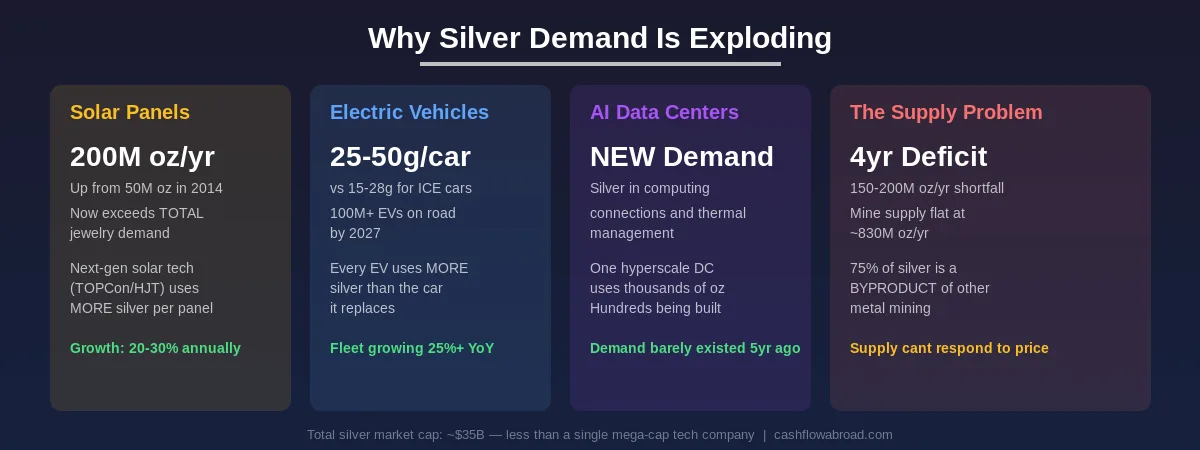
The Silver Institute has documented a structural supply deficit since 2021, with demand exceeding mine supply by 150-200 million ounces every year. Total global demand runs approximately 1.2-1.3 billion ounces annually. Where does the supply come from?- Mine supply: ~830 million ounces (flat — and here's the kicker)
- Recycling: ~150-180 million ounces
- The gap: Being filled by drawing down above-ground inventories — COMEX and LBMA vaults have seen persistent drawdowns
The Market Cap Argument
The entire investable silver market is worth approximately $30-40 billion. For perspective:- Apple's market cap alone is roughly 100x the total value of all investable silver
- The S&P 500 is worth ~$50 trillion — 1,400x the silver market
- Gold's market cap is ~$15+ trillion — 400x silver's
Related: expat investing playbook
The Demand Explosion Nobody's Talking About
Silver isn't just a monetary metal — it's the most critical industrial metal of the clean energy transition. And the numbers are staggering.
Solar Panels: The Biggest Story
Solar PV demand for silver has surged to approximately 200 million ounces per year in 2024 — up from just 50-60 million ounces in 2014. That's a 4x increase in a decade. Here's the stat that should stop you in your tracks: solar panels now consume more silver annually than the entire global jewelry industry (~150-160 million ounces for jewelry). And it's getting worse (for supply, better for bulls): next-generation solar cell technologies — TOPCon and HJT — actually use MORE silver per panel than the older PERC technology. Even as manufacturers try to reduce silver content per cell, total installations are growing at 20-30% annually, overwhelming any efficiency gains.Electric Vehicles
An EV uses approximately 25-50 grams of silver (0.8-1.6 oz), compared to 15-28 grams for a traditional internal combustion engine vehicle. Silver goes into electrical contacts, battery connections, power electronics, charging infrastructure, and autonomous driving sensors. The global EV fleet is projected to exceed 100 million vehicles by 2027. Every single one uses more silver than the car it replaces.AI Data Centers: The New Wild Card
This demand source barely existed five years ago. Silver is used in high-performance computing connections, server contacts, and thermal management. A single hyperscale data center can use several thousand ounces of silver in its electrical connections and components. With hundreds of new data centers being built globally for AI workloads, this is a meaningful and growing demand driver that most analysts haven't fully priced in.5G Infrastructure
Silver is used in RF filters, connectors, and antenna components of 5G base stations. As global 5G deployment scales with millions of small cell installations, this adds an estimated 10-20+ million ounces of annual demand.Ways to Trade Silver (And Which Are Best for Expats)
Not all silver exposure is created equal — especially when you factor in tax treatment and accessibility from abroad.Futures (COMEX Silver)
This is how I primarily trade silver. COMEX silver futures trade on CME Globex nearly 24 hours a day, Sunday through Friday.- Full contract (SI): 5,000 troy ounces (~$150,000 notional at $30/oz)
- Micro silver (SIL): 1,000 ounces (~$30,000 notional) — better for most accounts
- Margin: ~$8,000-12,000 for a full contract (15-20:1 leverage)
- Tax treatment: Section 1256 — 26.8% blended max rate
- Trading hours: Nearly 24/7 — ideal for any time zone
Options on Futures
My bread and butter. Selling premium on silver futures options lets me profit from time decay while maintaining defined risk. This is what tastytrade was literally built for — their probability tools make options analysis intuitive.- Defined risk: As a buyer, your max loss is the premium paid
- Strategic flexibility: Spreads, strangles, covered strategies
- Tax treatment: Also Section 1256 — same favorable 60/40 rate
Silver ETFs
- SLV (iShares Silver Trust): Largest silver ETF, 0.50% expense ratio. Stores physical silver in London vaults.
- SIVR (abrdn Physical Silver Shares): Lower cost at 0.30% expense ratio.
- PSLV (Sprott Physical Silver Trust): 0.62% expense ratio, stored at the Royal Canadian Mint, allows physical redemption.
Mining Stocks
Silver miners offer leveraged exposure to the metal — when silver moves 10%, miners can move 20-30%:- First Majestic Silver (AG) — pure play silver miner
- Pan American Silver (PAAS) — diversified precious metals
- Wheaton Precious Metals (WPM) — streaming/royalty model with lower operational risk
- SIL ETF: Global X Silver Miners ETF (0.65% expense ratio)
CFDs: Hard No
CFDs are prohibited for US persons regardless of where you live. The CFTC and SEC ban US persons from trading CFDs. Even from abroad, you remain subject to US regulation. Don't go there.Why I Use tastytrade for Commodity Trading Abroad
I've used several brokers over the years. tastytrade is what I've stuck with, and it's particularly well-suited for commodity trading from abroad. Here's why:Built for Options Traders
tastytrade was founded by Tom Sosnoff — the same guy who built thinkorswim (sold to TD Ameritrade for $606 million). The platform was designed from the ground up for options analysis:- Probability of profit displayed on every trade before execution
- Curve analysis that visualizes options probabilities and expected moves
- Quick Roll — one-click rolling of options positions to the next expiration
- Follow feed — social trading features where you can see other traders' positions
Competitive Commissions
| Product | Commission |
|---|---|
| Stocks/ETFs | $0 |
| Equity options | $1.00/contract to open, $0 to close |
| Futures | $1.25/contract/side |
| Micro futures | $0.85/contract/side |
| Options on futures | $2.50/contract/side |
Full Mobile Capability
This is critical for trading abroad. tastytrade's mobile app is functionally equivalent to the desktop platform — not a watered-down companion app. Full futures and options chains, real-time streaming, position management, push notifications for fills and alerts. I manage my entire portfolio from my phone when I'm at a café in Laureles. Seriously.Commodity Access
Full access to CME, CBOT, NYMEX, and COMEX products: silver, gold, crude oil, natural gas, corn, soybeans — the works. With the 23-hour trading session on Globex, I can trade from any time zone.Built-in Education
tastytrade runs hours of daily live trading content through their media network. When you're an expat, potentially isolated from other traders, this community aspect is surprisingly valuable. It's like having a trading desk in your living room.Expat Considerations
tastytrade generally allows US citizens living abroad to maintain accounts. You'll typically need a US address on file — most expats use a family member's address or a US mail forwarding service. Check their current country restrictions before applying. Open a tastytrade account here — I use it daily and it's the best platform I've found for options-focused commodity trading from abroad.Related: crypto tax guide for expats
Section 1256: The Tax Advantage Nobody Talks About
This is where commodity trading gets genuinely exciting from a tax perspective.
The 60/40 Rule
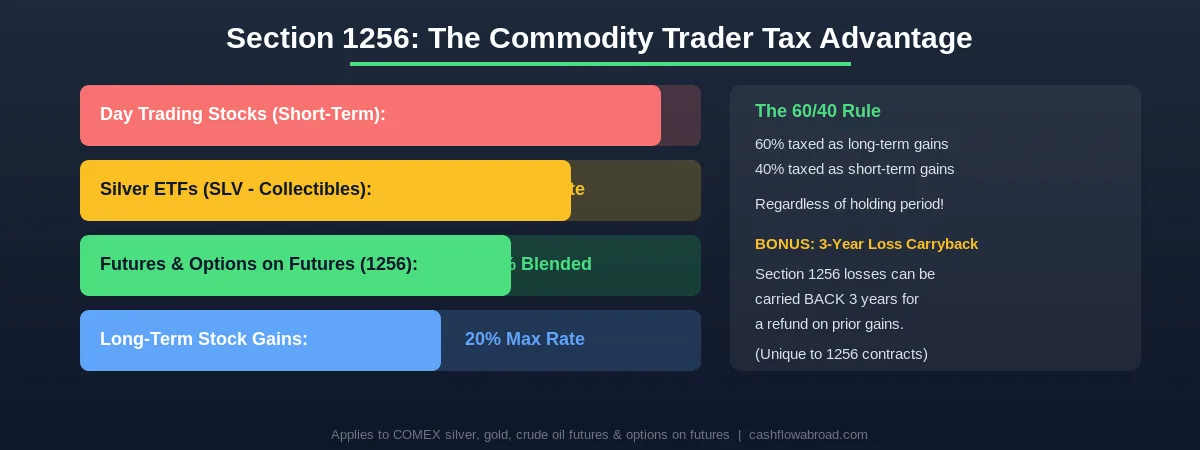
Regulated futures contracts — including COMEX silver, gold, crude oil, and options on these futures — are classified as Section 1256 contracts by the IRS. The benefit: regardless of how long you hold the position, gains and losses are treated as:- 60% long-term capital gains (max 20% rate)
- 40% short-term capital gains (max 37% rate)
- Day trading stocks: up to 37% (short-term)
- Silver ETFs (SLV/SIVR): up to 28% (collectibles rate)
- Section 1256 futures/options: 26.8% max
The 3-Year Loss Carryback
Here's the bonus that almost nobody knows about: Section 1256 losses can be carried back three years against prior Section 1256 gains. Regular capital losses can only carry forward — 1256 is unique. Made $50,000 in commodity futures profits in 2024, then lost $30,000 in 2025? You can amend your 2024 return and get a refund on those previously taxed gains. Try doing that with stock losses.Mark-to-Market
All open Section 1256 positions are treated as if sold at fair market value on December 31st. Unrealized gains and losses are reportable. Filed on Form 6781. This simplifies holding period tracking (there is none — everything gets the 60/40 treatment), but be aware of the tax liability on unrealized gains at year-end.Expat Tax Considerations for Traders
If you've read my complete guide to US expat banking and taxes, you know the FEIE can exclude up to $130,000+ of earned income. But here's the critical distinction: The FEIE does NOT apply to investment or trading income. Capital gains, dividends, interest, and commodity trading profits are not earned income. Even if you pay zero income tax on your salary using the FEIE, you still owe US tax on every dollar of trading profit. This is the single most important tax fact for expat traders, and it catches people off guard constantly. I cover the FEIE vs. FTC decision in depth in my expat tax guide.What You Can Do
- Use Section 1256 to get the best available tax rate (26.8% blended vs. 37% short-term)
- Foreign Tax Credit — if your host country also taxes capital gains, claim FTC (Form 1116) to avoid double taxation
- Roth IRA — if you're eligible, trade commodity ETFs inside a Roth for tax-free gains
- Hold miners for 12+ months to qualify for the 15/20% long-term capital gains rate
- Loss carryback — use the Section 1256 three-year carryback to recover taxes from prior profitable years
Net Investment Income Tax (NIIT)
Don't forget the 3.8% NIIT surtax on net investment income for AGI above $200,000 (single) / $250,000 (MFJ). This applies on top of regular capital gains rates, even for expats. Trading profits are subject to NIIT.FBAR and FATCA
Trading accounts at US brokerages like tastytrade don't trigger FBAR — they're US accounts. But any foreign bank accounts you use to fund them do. If your foreign accounts exceed $10,000 aggregate at any point during the year, file your FBAR.Beyond Silver: Other Commodities Worth Trading
Silver is my primary focus, but diversification across the commodity complex makes sense:Gold (COMEX, ticker: GC)
- Full contract: 100 oz (~$300,000+ at $3,000/oz); Micro (MGC): 10 oz
- More liquid than silver, tighter spreads, less volatile
- Central banks bought 1,000+ tons in both 2023 and 2024 — highest levels in decades
- Section 1256 treatment applies
Copper (COMEX, ticker: HG)
- "Dr. Copper" — barometer of global economic health
- EVs use 3-4x more copper than traditional vehicles (130-180 lbs per EV)
- Major new mines take 10-15 years from discovery to production — supply is structurally constrained
Crude Oil (NYMEX, ticker: CL)
- Most actively traded commodity future in the world
- Full contract: 1,000 barrels; Micro (MCL): 100 barrels
- Very liquid with tight spreads — good for active trading
Uranium
- No liquid futures — best accessed through stocks: Cameco (CCJ), URA ETF, URNM ETF
- Global supply covers only ~75-80% of reactor demand
- Nuclear power being re-embraced globally for clean baseload energy
Related: passive income guide
Risk Management: Don't Blow Up Your Account
Commodity futures will destroy your account if you don't manage risk. Full stop. Approximately 70-80% of retail futures traders lose money, primarily due to overleveraging.The 2% Rule
Never risk more than 2% of total account equity on any single trade. For a $50,000 account, your maximum risk per trade is $1,000. With a full silver contract (5,000 oz), a mere $0.20/oz move is $1,000. Silver can easily move $0.50-1.00 in a single session. Do the math — most accounts are too small for full-size contracts. This is why micro contracts exist. Micro silver (1,000 oz) at $30/oz is $30,000 notional with ~$2,000 margin. Much more manageable for accounts under $100K.Expat-Specific Risks
- Internet reliability: If you're in a developing country, have backup internet (mobile hotspot). A lost connection during a leveraged futures position can be catastrophic. When I'm in Colombia, I keep a Claro mobile hotspot as backup — I've needed it twice during heavy rainstorms in Medellín.
- Currency risk: Your living expenses are in local currency, but trading profits are in USD. If the dollar weakens, your local cost of living may increase.
- Time zone liquidity: Silver futures liquidity is thinnest during Asian hours. Colombia's UTC-5 alignment with US markets means I trade during peak liquidity — another advantage of basing yourself in Colombia.
Hedging Strategies
- Options as insurance: Buy puts on silver futures to protect long positions — the premium is a known, limited cost
- Spread trading: Trade the gold-silver ratio, or calendar spreads within silver, to reduce directional risk
- Position sizing: Start with micro contracts and scale up only as your account and experience grow
Physical vs. Paper Silver: The Expat Perspective
The "real silver vs. paper silver" debate is fierce in precious metals communities. Here's my practical take as an expat:The Case for Physical
- Zero counterparty risk — you own the metal
- Hedge against systemic financial risk
- Premiums over spot: typically $2-4/oz for bars/rounds, $4-7 for government coins (American Silver Eagles)
The Problem for Expats
Physical silver is heavy (a 100 oz bar weighs ~6.8 lbs), expensive to ship internationally, and creates storage headaches. Are you going to keep silver bars in your apartment in Medellín? Probably not.The Practical Solution
- Core holding: Store physical silver in a US vault (SD Bullion vault, Delaware Depository) — costs 0.3-0.5% of value annually
- Active trading: Futures and options on tastytrade for speculative positions (better tax treatment, no storage hassle)
- International storage: Singapore (BullionStar) and Switzerland (PAMP) for non-US jurisdiction diversification
- Always choose allocated storage — specific bars with serial numbers assigned to you. Unallocated means you're an unsecured creditor if the custodian goes bankrupt.
Getting Started: Your Commodity Trading Playbook
Step 1: Set Up Your Foundation
- Open a tastytrade account — apply for futures trading approval during signup
- Fund with at least $5,000-10,000 for micro futures, $25,000+ for full-size contracts
- Use a US address — family member or mail forwarding service
- Ensure your banking setup is solid — if you haven't yet, read my US expat banking guide to get the right accounts in place
Step 2: Start Small
- Paper trade first — tastytrade offers simulated trading
- Begin with micro silver futures (1,000 oz = ~$30,000 notional)
- Never risk more than 2% per trade
- Focus on one market before diversifying
Step 3: Learn the Options Game
- Watch tastytrade's daily content — their approach to high-probability options selling is excellent for commodity markets
- Start with defined-risk strategies (vertical spreads) before selling naked options
- Use the probability tools — tastytrade shows you the math before you place every trade
Step 4: Tax Prep
- Understand that trading gains are NOT covered by the FEIE — you will owe US taxes on profits
- Trade futures/options on futures to get Section 1256 treatment (26.8% blended max vs. 37% short-term)
- File Form 6781 for Section 1256 gains/losses
- Use an expat tax specialist — I recommend the services listed in my expat tax guide
- Track everything — tastytrade provides 1099-B and year-end statements that make this easier
The bottom line: Silver's fundamentals are the strongest they've been in decades. Solar panels, EVs, AI data centers, and 5G are creating unprecedented industrial demand against a structurally constrained supply. The gold-to-silver ratio suggests massive undervaluation. And Section 1256 gives commodity traders a tax rate that stock day-traders can only dream of. From a café in Medellín, I can trade COMEX silver on tastytrade during peak US market hours, pay a blended 26.8% max rate on my gains, and reinvest the difference into an asset I believe has a generational bull case. That's geographic arbitrage meets financial arbitrage — and it's the kind of stacking that builds real wealth. Ready to get your financial house in order before you start trading from abroad? Start with our complete US expat banking and taxes guide, then check out how I run a US business from Colombia for the full geographic arbitrage playbook. And if you're planning your move to Colombia, ColombiaMove.com has the most comprehensive relocation guides online. Disclaimer: This article is for informational purposes only and does not constitute investment, tax, or financial advice. Commodity trading involves substantial risk of loss and is not suitable for all investors. Past performance is not indicative of future results. Some links in this post are affiliate links. Consult a qualified financial advisor and tax professional before trading.
This guide is general information, not personalized tax, legal, or investment advice. Rules change; verify current thresholds with official sources or a qualified professional before acting.
Related guides