Serbia: 10% Flat Tax, $1,600/Month, and 6-Year Citizenship
Serbia offers a 10% flat tax, comfortable living from $1,400/month in Belgrade, free public transit, and a 6-year citizenship path. The underrated European hub for US expats.
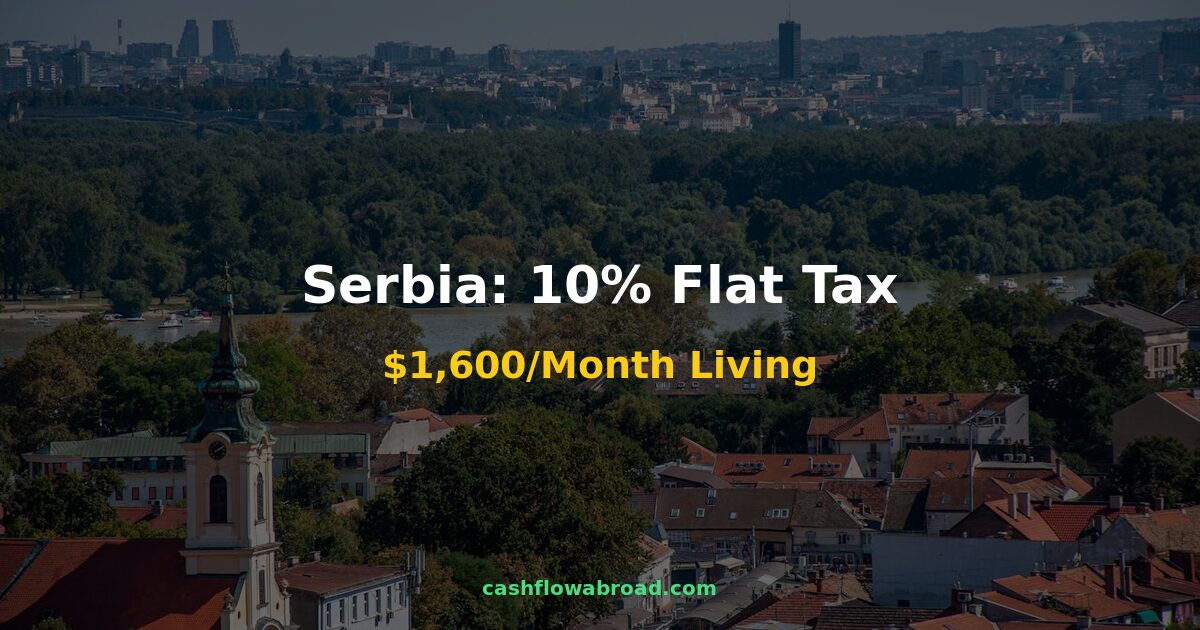
Serbia offers a 10% flat tax, comfortable living from $1,400/month in Belgrade, free public transit, and a 6-year citizenship path.
Disclosure: this article contains affiliate links. If you open an account through one of them, Cashflow Abroad may earn a referral commission at no extra cost to you.
Belgrade's public transport has been free since January 2025. Not subsidized, not discounted — completely free. Trams, buses, trolleybuses, the works. That one detail says everything about where Serbia sits right now: a functional European capital making deliberate quality-of-life moves that countries charging €3,000/month in rent haven't bothered to try.
While the usual suspects — Georgia, Albania, Portugal — dominate the expat relocation conversation, Serbia has been quietly building its case. Flat 10% income tax. Sub-$2,000/month all-in living costs. A naturalization timeline of just 6 years. SEPA euro transfers since May 2025. And a growing tech ecosystem that means your Zoom calls won't cut out during a client presentation.
This isn't a hidden-gem pitch. Belgrade has a metro area of 1.7 million people. But as a tax-optimized, cost-arbitraged home base for US expats and digital nomads? It remains dramatically underrated relative to the package it actually offers.
Serbia's 10% Flat Tax: What It Actually Means
Serbia taxes residents on worldwide income. That's the critical first point — this is not a territorial system like Georgia or Malaysia where foreign income simply isn't taxable. Serbian tax residents owe Serbian tax on everything they earn globally.
The rate is a flat 10% on income up to approximately €42,000/year (~$46,000 USD). Cross that threshold and the rate jumps to 20% on the excess, plus social contributions that can add another 10–20% depending on your employment structure.
For freelancers and self-employed workers earning $50,000–$120,000/year, the math still often beats Western Europe — and by a lot:
| Income Level (Annual) | Serbian Tax (Flat 10%) | US Tax Est. (Single, Federal Only) | Potential Savings |
|---|---|---|---|
| $40,000 | ~$4,000 | ~$4,500 | Roughly even |
| $75,000 | ~$7,500 | ~$13,000 | ~$5,500/year |
| $120,000 | ~$12,000–15,600 | ~$22,000+ | ~$6,400–10,000/year |
| $200,000 | ~$27,600 (blended + contributions) | ~$46,000+ | ~$18,000+/year |
The catch for US citizens: You still owe US taxes. Serbia's flat 10% doesn't exempt you from the IRS. However, you can use the Foreign Earned Income Exclusion (FEIE) to exclude up to $126,500 (2024 limit) of foreign earned income from your US taxable income, or use the Foreign Tax Credit to offset dollar-for-dollar. For most earners, the FEIE combined with partial FTC produces a very low effective combined rate. This is not a DIY situation — use a CPA who specializes in US expat returns.
One structuring note: many freelancers in Serbia register as a paušalno preduzetnik (lump-sum entrepreneur), a simplified regime where you pay a fixed monthly contribution — often €100–300/month total — regardless of income, up to a defined ceiling. It's exceptionally attractive for high-earners on short-to-medium stays. Work with a Serbian tax advisor to confirm eligibility and income caps before committing.
What $1,600/Month Actually Buys in Belgrade
Belgrade isn't a guesthouse town or a village with slow internet. The city has international hospitals, Michelin-noted restaurants, a concert and arts scene, and a nightlife reputation that draws visitors from across Europe specifically to its clubs. It also has all the standard expat infrastructure: coworking spaces, English-speaking services, international schools, reliable 4G/5G, and fiber broadband.
Living costs in 2026, per Numbeo and GlobalCitizenSolutions data:
| Expense | Budget | Comfortable | Upscale |
|---|---|---|---|
| 1BR apartment (city center) | €350/mo | €521/mo | €800–1,100/mo |
| Groceries (1 person) | €180/mo | €300/mo | €400/mo |
| Public transport | €0 (free since Jan 2025) | €0 | €0 |
| Utilities (85m² apt) | €120/mo | €171/mo | €220/mo |
| Dining out | €100/mo | €200/mo | €350/mo |
| Gym + entertainment | €30/mo | €80/mo | €150/mo |
| Monthly Total (est.) | ~€780 (~$860) | ~€1,272 (~$1,400) | ~€2,020 (~$2,220) |
The free transit figure deserves more attention than it usually gets. Belgrade eliminated fares citywide in January 2025, making it the largest European city to do so. For a car-free expat, that's €35–50/month in real savings per month. Across a year, it's a €420–600 line item that simply doesn't exist.
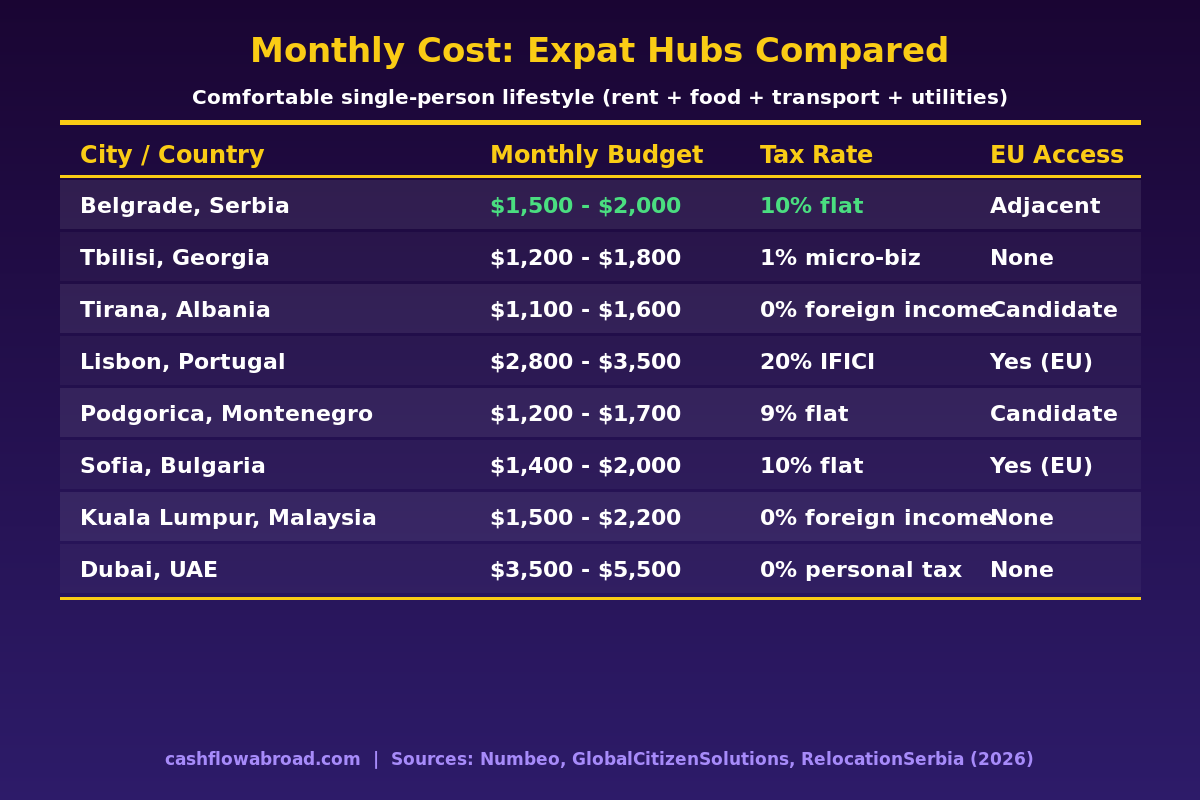
Compared to Lisbon ($2,800–3,500/month comfortable), Barcelona ($2,500+), or even Tbilisi — where 2022-era population influx pushed rents up 60–80% — Belgrade delivers a genuine European urban lifestyle at roughly half the price. A lifestyle that costs €4,000/month in London costs about €1,300 in Belgrade. That $2,700/month gap is what geographic arbitrage means in practice.
How to Get Serbian Residency
Serbian tax residency triggers at 183 days. Spend more than that in a calendar year and you're a tax resident, whether you hold a formal permit or not. For nomads wanting to pass through without triggering residency, Serbia offers 90 days visa-free to US citizens — easy travel without any commitment.
For those establishing formal residency, six permit pathways exist:
- Employment: Working for a Serbian company with a sponsored work permit
- Business: Registering a Serbian company — the most popular option for freelancers and founders
- Property ownership: Owning residential real estate in Serbia
- Family reunification: Joining a Serbian national or existing resident
- Education: Enrolled in a Serbian institution
- Freelance/remote work permit: For remote workers earning €3,500+/month with 6 months of income proof
The freelance permit is what most location-independent workers pursue. Requirements: 6 months of income proof at €3,500+/month, a Serbian address (rental contract works), and a clean criminal record. Permits are issued for 12 months and renewable. All pathways are processed within 15 business days under Serbia's unified residency system — genuinely fast compared to most EU countries where permit backlogs run 3–6 months.
Banking in Serbia as an Expat
Serbia joined SEPA in May 2025, with full bank-level operational integration reaching major institutions by early 2026. Euro transfers to and from the eurozone now clear in one business day at domestic-equivalent fees. For expats receiving EUR income from EU clients, this is a significant change — it removes the friction and correspondent banking fees that made Serbian accounts less practical before.
Top banks for expats in 2026:
- Banca Intesa Serbia: Largest retail presence (147 branches), non-resident accounts available, EUR/USD sub-accounts, American Express credit cards
- Raiffeisen Bank Serbia: Austrian-owned, reliable mobile banking, consistently recommended for EU-connected expats
- OTP Bank: Growing presence, competitive for multi-currency accounts
Account opening for non-residents is possible at most major banks with a passport, proof of address (even a temporary rental contract), and a Serbian tax ID. Personal accounts open in 1–2 days; business accounts in 1–2 weeks.
Maintain a US bank account before you leave. Charles Schwab International is the standard recommendation — they reimburse all ATM fees worldwide, which matters when you're withdrawing Serbian dinars from local machines at tourist-rate fees. Mercury works well for freelancers and founders receiving USD payments from US clients. A virtual US mailbox ($15/month) keeps a legitimate US address active for banking, IRS correspondence, and state domicile purposes while you're abroad — essential for not losing access to accounts that require a US address on file. More detail in our virtual mailbox guide.
For transferring money between USD and Serbian dinars, Remitly offers competitive USD-to-RSD rates with transfers typically landing within hours. For a breakdown of where transfer fees are hidden across providers, see the Expat Money Transfer Guide.

Serbia vs. The Other Cheap European Hubs
Serbia isn't the cheapest country in the region — Georgia and Albania can undercut it. And it's not the lowest tax — Montenegro's 9% flat rate beats it by a point, and Albania nominally exempts foreign income entirely. But Serbia's combination of factors makes it arguably the strongest all-around package when you score across all dimensions:
| Factor | Serbia | Georgia | Albania | Montenegro | Bulgaria |
|---|---|---|---|---|---|
| Personal income tax | 10% flat (to €42K) | 1% small biz; 20% standard | 0% on foreign income | 9% flat | 10% flat |
| Monthly budget (comfortable) | $1,400–2,000 | $1,200–1,800 | $1,100–1,600 | $1,200–1,700 | $1,400–2,000 |
| SEPA integration | Yes (2025) | No | No | Yes (uses EUR) | Yes (EU member) |
| EU membership | Candidate | Candidate | Candidate | Candidate | Full member |
| Citizenship timeline | 6 years | 10 years | 5–10 years | 10 years | 5 years (EU) |
| Dual citizenship | Yes | Yes (restricted) | Yes | Conditional | Yes |
| Free public transit | Yes (Belgrade) | No | No | No | No |
| Schengen visa-free | Yes | No | Yes | Yes | Yes (Schengen member) |
Albania has the tax edge with zero foreign income tax, but infrastructure, banking, and digital services lag considerably outside Tirana. Georgia's banking is famously easy and the 1% small business tax is legitimately good for low-to-mid earners — but the regime has caps, conditions, and mounting popularity has pushed Tbilisi rents up sharply since 2022. Montenegro is enticing but smaller, with a thinner expat ecosystem outside of coastal Budva and Tivat. Bulgaria has EU membership (giving you access to EU markets and a 5-year EU citizenship path) but the political environment has been unstable and the capital Sofia is culturally lower-energy than Belgrade.
Serbia wins clearly on infrastructure density, SEPA access, citizenship speed, and urban livability. Its main trade-offs are worldwide taxation (vs. Albania or Georgia's territorial approach) and EU membership still pending — expected before 2030 but overdue.
For a broader scorecard of which countries offer the best overall package for geographic arbitrage, the Geographic Arbitrage Playbook covers 10 destinations in depth.
The 6-Year Path to a Serbian Passport
Serbia's naturalization track is one of the faster ones available anywhere in Europe. The standard timeline:
- Years 1–3: Temporary residency (annual or multi-year renewable permits)
- Year 3: Apply for permanent residency after 3 continuous years of temporary residency
- Years 3–6: Hold permanent residency for an additional 3 years
- Year 6+: Apply for citizenship — processing takes 6–12 months
Total time from first permit to passport: approximately 7–7.5 years.
Serbian law generally permits dual nationality — you don't need to renounce your US passport. Language and cultural integration are required for naturalization (basic Serbian language test), but nothing onerous. The Serbian passport currently grants Schengen Area visa-free access (90/180 days), plus freedom of movement in roughly 130 additional countries.
The real long-game angle: Serbia is formally an EU accession candidate with an expected accession date before 2030. When Serbia joins the EU — and it's a when, not an if at this point — Serbian passport holders automatically gain full EU freedom of movement. You're not just locking in cheap living today; you're potentially acquiring EU residency rights in the next decade without paying the €250,000+ price tag attached to Portugal's or Malta's golden visa programs. A golden visa buys EU access upfront. Living in Serbia for 7 years builds toward the same destination while simultaneously saving $15,000–25,000/year in living costs.
What US Citizens Specifically Need to Know
The US taxes citizens on worldwide income regardless of residency. Moving to Serbia doesn't change your IRS obligations. What changes is the size of the bill. Two main tools:
Foreign Earned Income Exclusion (FEIE): Exclude up to $126,500 (2024 limit, indexed annually) of foreign earned income from US taxable income if Serbia is your bona fide residence. Works best for earners under ~$150K. Downside: excluded income doesn't qualify for Roth IRA contributions or Solo 401(k) contributions — a planning constraint for those prioritizing retirement accounts.
Foreign Tax Credit (FTC): Offset US tax dollar-for-dollar with Serbian taxes paid. Better for high earners or those wanting to preserve retirement contribution eligibility. Since Serbia's 10% is generally below the US effective rate for higher incomes, you may still owe a US residual — but far less than living stateside.
FBAR filing is required if your Serbian bank account ever holds $10,000+ equivalent in aggregate at any point during the year (FinCEN Form 114). FATCA reporting kicks in above $200,000 in foreign financial assets for bona fide foreign residents (Form 8938). Neither triggers extra tax — they're disclosure requirements. Missing them carries automatic penalties starting at $10,000 per form per year. The US Expat Banking & Taxes Guide covers these mechanics in full.
Health coverage is mandatory. Serbian public healthcare covers residents but wait times and language barriers make private insurance worth the cost. SafetyWing starts at roughly $45/month for nomads aged 18–39 and covers most of Europe including Serbia. For a full comparison of coverage tiers and what each plan actually pays, see the Expat Health Insurance Guide.
For connectivity during the move and while traveling within Europe, Saily eSIM covers Serbia and most of Europe without roaming charges. Once settled in Belgrade, a local SIM from Telekom Serbia or A1 runs roughly €10–15/month for unlimited domestic data.
The Practical Entry Path
Most expats follow this sequence:
- Enter visa-free — US citizens get 90 days without any permits. Use this time to apartment-hunt and evaluate neighborhoods.
- Find an apartment — Furnished short-term rentals run €600–900/month. Unfurnished long-term apartments on KupujemProdajem (Serbia's equivalent of Craigslist) are 30–40% cheaper. Savamala, Vracar, and Stari Grad are the most popular expat neighborhoods.
- Register your address (prijava boravka) — Required at the local police station within 24 hours of arriving at a new address. Your landlord typically handles this with you.
- Apply for your residency permit — Freelance permit, company registration, or property pathway depending on your situation. Timeline: 15 business days.
- Open a local bank account — Once you have your residency permit and address registration, most banks process accounts within 1–2 days.
- Get your JMBG (tax ID) — Issued automatically with your residency permit. Required for everything from mobile contracts to tax filings.
For broader visa comparison across European destinations, the Digital Nomad Visas Ranked guide scores programs across processing time, income requirements, and tax implications.
The Bottom Line
Serbia isn't a hack. It's a functioning European country that made deliberate decisions — low flat tax, SEPA integration, free transit, 15-day permit processing — that happen to align extremely well with what location-independent workers need. The 10% flat rate plus $1,400–2,000/month all-in living is a combination that beats most comparable alternatives when you factor in infrastructure quality, banking access, and EU trajectory.
The long-term case for Serbia is underrated because it requires thinking in decades rather than months. Every year you live there builds toward a Serbian passport. When Serbia joins the EU — the accession timeline is shorter today than it has been in years — that passport gets a significant upgrade without requiring any action on your part. You're building toward EU freedom of movement while paying 10% tax on a $1,600/month lifestyle, instead of paying €250,000 upfront for a golden visa that achieves roughly the same end state.
Not the right fit for everyone. But for the expat who wants a real city, real European infrastructure, and a credible long-term residency plan without paying Lisbon prices or navigating Tbilisi's increasingly crowded market — Serbia is the most undervalued option on the board right now.
Financial disclaimer: This article is for informational purposes only and does not constitute tax, legal, or financial advice. Tax laws are complex, change frequently, and vary significantly based on individual circumstances. Serbian tax rules and treaty positions require analysis by a qualified professional familiar with both US expatriate taxation and Serbian law. Consult a licensed CPA or tax attorney before making relocation or tax structure decisions. cashflowabroad.com is not liable for actions taken based on this content.
This guide is general information, not personalized tax, legal, or investment advice. Rules change; verify current thresholds with official sources or a qualified professional before acting.
Related guides
 Geographic ArbitrageJune 1, 2026
Argentina for US Expats: Costs, Visas, Banking
US dollar earners can live comfortably in Buenos Aires for $1,500/month. Complete guide to Argentina visas, banking, taxes, and healthcare for US
 Geographic ArbitrageMay 28, 2026
Vietnam Expat Guide: $1,200/Month, Zero Foreign Tax
Vietnam costs ~$1,200/month for a comfortable expat life and taxes foreign income at 0% if you stay under 183 days. Complete guide for US expats.
 Geographic ArbitrageMay 27, 2026
Cambodia Expat Guide: Dollar Economy, $800/Month, No Foreign Tax
Cambodia uses US dollars, costs under $1,200/month, and exempts foreign income from local tax. Full guide for US expats with real numbers and IRS