How to Buy a Second Passport: Every Program Ranked by Cost, Speed, and Tax Benefit
Key Takeaway: A second passport costs anywhere from $100,000 (Caribbean donation) to $2+ million (Malta). But there's a back door: naturalization in...
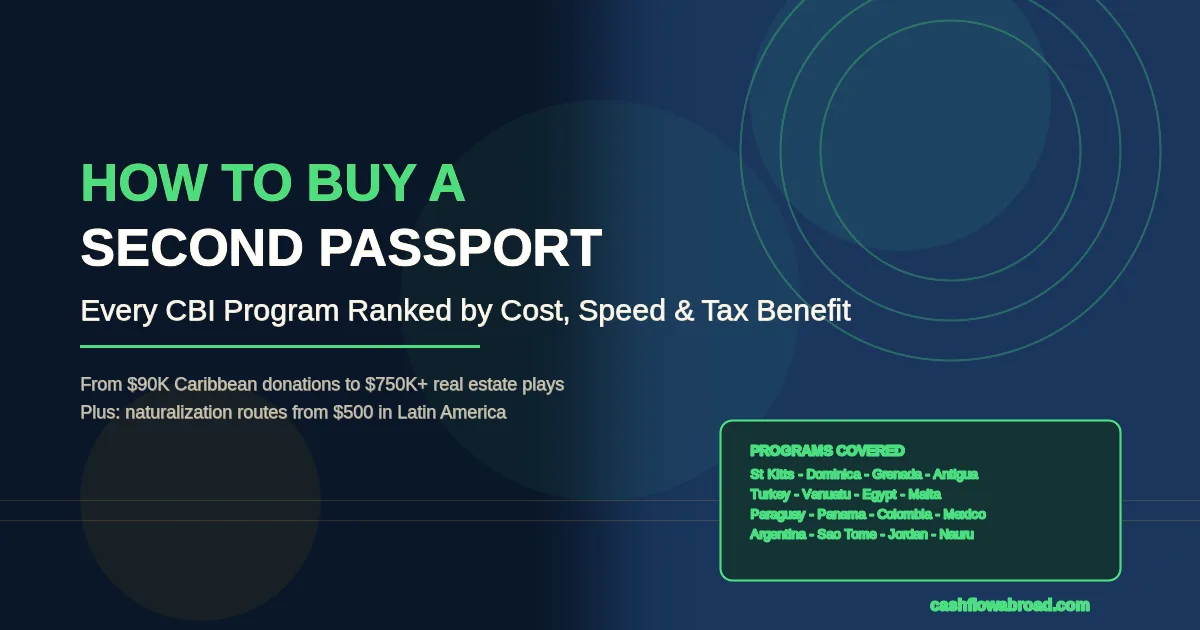
Key Takeaway: A second passport costs anywhere from $100,000 (Caribbean donation) to $2+ million (Malta). But there's a back door: naturalization in...
Key Takeaway:
A second passport costs anywhere from $100,000 (Caribbean donation) to $2+ million (Malta). But there's a back door: naturalization in countries like Paraguay, Argentina, or Colombia takes 2–5 years and costs almost nothing. This guide covers every route — fast and expensive, slow and cheap, and everything in between.
Why a Second Passport Matters More Than Ever
There's a stat that should keep every single-passport holder up at night: in the last decade, over 20 countries have introduced or tightened capital controls, travel restrictions, or emergency powers that affected their citizens' ability to move money or cross borders. From pandemic lockdowns to banking crises, from sanctions to tax policy overhauls — the countries that seemed "safe" weren't always.
Related: five-flag strategy guide
A second passport is the ultimate diversification. Not of your portfolio — of your optionality. It gives you:
- Travel freedom: Access countries your first passport can't reach (or reach them without a visa)
- Asset protection: Bank and invest in jurisdictions your home country can't easily reach
- Tax planning: Establish residency in low-tax countries with a legitimate legal basis
- Plan B: A literal escape hatch if things go sideways — politically, economically, or personally
- Generational wealth: Most citizenships pass to your children automatically
There are two ways to get one: buy it (citizenship by investment) or earn it (naturalization through residency). Let's cover both.
Citizenship by Investment (CBI) — Buy Your Way In
CBI programs grant you a passport in exchange for a financial contribution — typically a donation to a government fund or a real estate investment. Processing takes 2–6 months. No relocation required. These are the programs for people who value speed over savings.
Dominica — Best Value CBI
Dominica has consistently been ranked the world's best CBI program by the Financial Times' Professional Wealth Management publication. The reason: it's the cheapest legitimate program with a solid passport.
| Detail | Info |
|---|---|
| Government Donation | $100,000 (single applicant) | $175,000 (family of 4) |
| Real Estate Option | $200,000 (approved projects, held 3 years) |
| Due Diligence Fees | $7,500 per applicant |
| Processing Time | 3–4 months |
| Visa-Free Countries | 140+ (including UK, EU/Schengen, Singapore, Hong Kong) |
| Residency Requirement | None — no need to visit or live in Dominica |
Why choose Dominica: Lowest cost, solid due diligence (which means the passport maintains its reputation), and no physical residency requirement. You literally never have to step foot in the country.
St Lucia — The Newcomer
St Lucia launched its CBI in 2015 and has quickly become competitive. Same $100K donation minimum as Dominica, but with a slightly stronger passport (145+ visa-free countries) and a newer government bond option at $250K (fully refundable after 5 years).
| Detail | Info |
|---|---|
| Government Donation | $100,000 (single) | $150,000 (couple) | $175,000 (family of 4) |
| Government Bond Option | $250,000 (refundable after 5 years, plus $50K admin fee) |
| Processing Time | 3–5 months |
| Visa-Free Countries | 145+ |
Grenada — US Treaty Advantage
Grenada is the only Caribbean CBI country with an E-2 Treaty Investor Visa agreement with the United States. This means a Grenadian passport lets you apply for a US E-2 visa — live and work in the US based on a business investment. For non-Americans who want US access, this is massive. For Americans, it's less relevant — but Grenada's passport is still excellent.
| Detail | Info |
|---|---|
| Government Donation | $150,000 (single) | $200,000 (family of 4) |
| Real Estate Option | $220,000 (approved projects, held 5 years) |
| Processing Time | 4–6 months |
| Visa-Free Countries | 148+ (including China) |
Antigua & Barbuda
Antigua's program requires a $100K donation (single applicant, $130K for families up to 4) or $200K in real estate. Unique requirement: you must spend at least 5 days in Antigua during the first 5 years. That's it — 5 days total, not per year. The passport covers 150+ visa-free destinations.
St Kitts & Nevis — The Original
St Kitts launched the world's first CBI program in 1984. It has the strongest Caribbean passport (156+ visa-free countries) but also the highest price: $250,000 donation for a single applicant. St Kitts is the "Rolls Royce" option — premium price, premium reputation, and the most established due diligence process in the industry.
Malta — The EU Fast Track
Malta's MEIN program is the only legitimate path to EU citizenship by investment. It costs €750,000+ (after 36 months of residency) or €900,000+ (after 12 months), plus property purchase or rental and a €10,000 charitable donation. Total all-in cost: roughly €1–1.2 million. But the payoff is an EU passport — live, work, and bank anywhere in the 27-member EU. This is covered in detail in our golden visa guide.
Turkey — The Wildcard
Turkey offers citizenship through a $400,000 real estate investment (previously $250K before the threshold was raised). Processing takes 3–6 months. The Turkish passport gives visa-free access to 110+ countries — not as strong as Caribbean options, but Turkey offers something they don't: a huge, diverse country with a real economy, low cost of living, and a strategic location bridging Europe and Asia.
Related: territorial tax countries guide
| Detail | Info |
|---|---|
| Investment | $400,000 in real estate (held 3 years) |
| Processing Time | 3–6 months |
| Visa-Free Countries | 110+ |
Vanuatu — Fastest in the World
Vanuatu's Development Support Program grants citizenship in as little as 30–60 days — the fastest in the world. Cost: $130,000 donation (single applicant). The Vanuatu passport covers 96 visa-free countries and offers zero income tax, zero capital gains tax, and zero inheritance tax. It's not the strongest passport, but the speed and tax benefits make it attractive for those who need a quick Plan B.
Naturalization — The Budget Route
Don't have $100K+ to spare? You can earn citizenship the old-fashioned way: live in a country, meet the residency requirements, and apply for naturalization. It takes longer (2–10 years), but it costs almost nothing beyond living expenses and legal fees. Here are the fastest and easiest paths.
Paraguay — 3 Years, ~$5K Total
Paraguay may be the best-kept secret in second passport circles. Permanent residency costs about $5,000 in fees and legal costs. After just 3 years of permanent residency, you can apply for citizenship. The "residency requirement" is interpreted loosely — you need to enter the country at least once a year. Paraguay has a territorial tax system (foreign income untaxed) and no minimum stay requirement for maintaining residency.
Passport strength: 142 visa-free countries (including all of Europe/Schengen)
Argentina — 2 Years to Citizenship
Argentina has the fastest naturalization in the world: just 2 years of legal residency. Get a DNI (national ID), live in Argentina for 2 years, pass a basic Spanish/civics test, and you're an Argentine citizen. The Rentista visa requires proof of ~$2,500/month income. Argentina's passport covers 170+ visa-free countries and, because of EU immigration agreements, can facilitate Italian or Spanish citizenship claims for those with heritage.
Passport strength: 170+ visa-free countries
Colombia — 5 Years, Strong Passport
Colombia requires 5 years of residency for naturalization. The Digital Nomad Visa requires $3,000/month income and gives you 2 years. The investment visa (property worth ~$90K) gives you 3 years. After 5 years, apply for citizenship — Colombia allows dual citizenship, so you keep your US passport.
For the complete visa pathway breakdown, see ColombiaMove.com's visa guide.
Passport strength: 133 visa-free countries
Panama — 5 Years, Zero Tax
Panama's Friendly Nations Visa gives Americans permanent residency from day one ($5,000 bank deposit + company formation). After 5 years, apply for citizenship. Panama's territorial tax system means foreign income is completely untaxed. The country uses the US dollar, has world-class banking infrastructure, and Panama City is a modern, safe capital.
Passport strength: 142 visa-free countries
Related: digital nomad visa rankings
Mexico — 5 Years, Proximity
Mexico requires 5 years of legal residency (2 years temporary + 2 years permanent before applying). The advantage is proximity to the US — same time zones, cheap flights, land border crossings. The temporary resident visa requires $2,600+/month income. Mexico allows dual citizenship.
Passport strength: 158 visa-free countries
Portugal — 5 Years, EU Passport
The crown jewel of naturalization. Get any form of Portuguese residency (D7 visa requires just ~$850/month income), live there for 5 years, pass a basic Portuguese language test (A2 level), and you get an EU passport. Portuguese citizenship gives you the right to live and work in any of 27 EU countries. The passport covers 190+ visa-free destinations — one of the strongest in the world.
Passport strength: 190+ visa-free countries (one of the world's strongest)
CBI Programs Compared
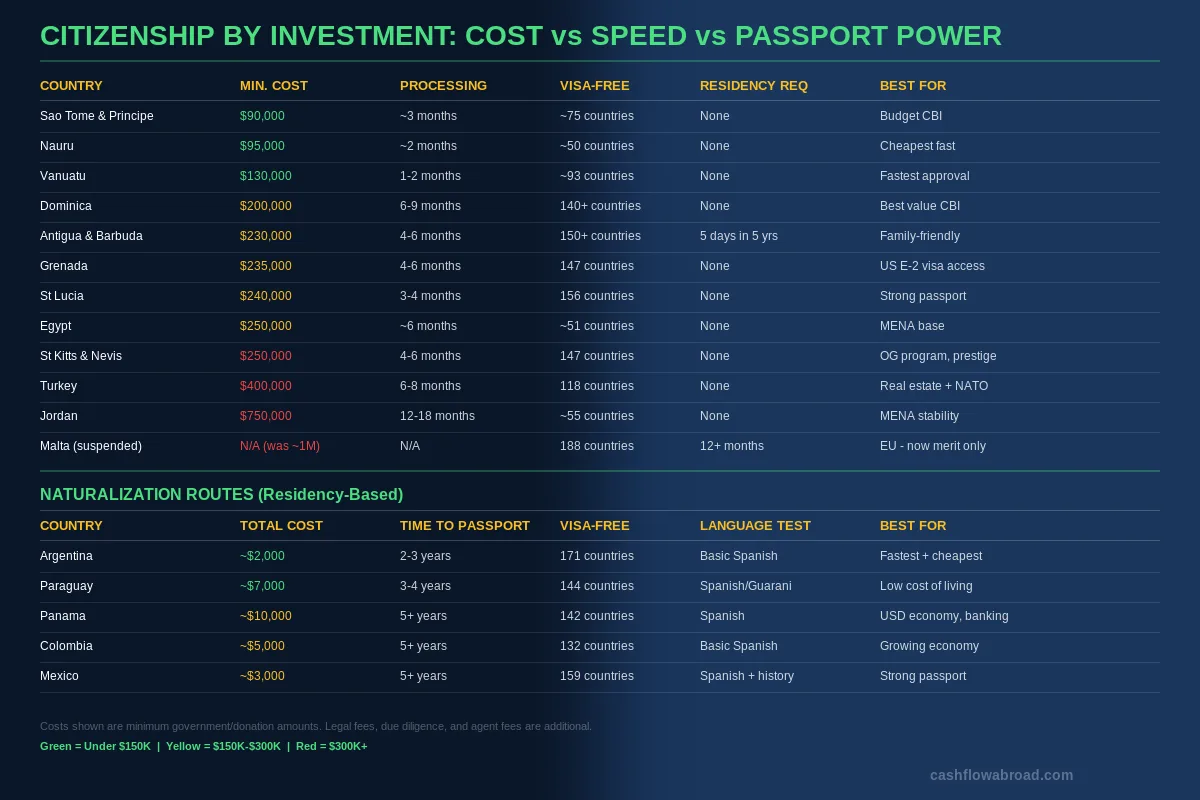
| Program | Min. Cost | Speed | Visa-Free | Must Visit? |
|---|---|---|---|---|
| Dominica | $100K | 3–4 mo | 140+ | No |
| St Lucia | $100K | 3–5 mo | 145+ | No |
| Antigua | $100K | 3–6 mo | 150+ | 5 days in 5 yrs |
| Vanuatu | $130K | 30–60 days | 96 | No |
| Grenada | $150K | 4–6 mo | 148+ | No |
| St Kitts | $250K | 2–4 mo | 156+ | No |
| Turkey | $400K | 3–6 mo | 110+ | Brief visit |
| Malta | €750K+ | 12–36 mo | 186+ | 12–36 mo stay |
US Tax Implications of a Second Passport
Getting a second passport does not change your US tax obligations. You're still required to file and pay US taxes on worldwide income as long as you remain a US citizen. However, a second passport creates options:
- Renunciation planning: If you ever consider giving up US citizenship to escape the worldwide tax net, you need another citizenship first. Without one, you'd be stateless. The exit tax applies to "covered expatriates" (net worth $2M+ or average annual tax liability $201K+). See our expat tax guide for the full breakdown.
- Banking diversification: A second passport lets you open bank accounts in countries that may refuse US-only citizens due to FATCA compliance burden.
- FBAR/FATCA reporting: Any foreign accounts opened under your second citizenship still need to be reported if they exceed $10,000.
Important: The US requires you to enter and leave the country on your US passport. You can use your second passport everywhere else. Having dual citizenship is 100% legal for Americans.
Which Route Is Right for You?
You have $100K+ and want speed: Caribbean CBI (Dominica or St Lucia). Passport in hand within 4 months.
You want an EU passport: Portugal naturalization (5 years, D7 visa, ~$850/month income requirement) or Malta CBI (€750K+, 1–3 years).
You're on a budget: Paraguay ($5K, 3 years) or Argentina ($0 beyond living costs, 2 years).
You want zero-tax residency + a passport: Panama (5 years, territorial tax) or Vanuatu (30 days, zero tax).
You want the strongest possible passport: Portugal (190+ countries) or Malta (186+ countries) via the naturalization/CBI routes.
You want to live somewhere great AND get citizenship: Colombia (5 years in Medellín), Mexico (5 years in CDMX), or Portugal (5 years in Lisbon/Porto).
Bottom Line
A second passport isn't paranoia — it's prudence. The wealthy have always held multiple citizenships. The difference now is that programs like Dominica ($100K), Paraguay ($5K over 3 years), and Portugal (D7 visa on modest income) make it accessible to anyone with a plan. Start the clock now — future you will be grateful.
This guide is general information, not personalized tax, legal, or investment advice. Rules change; verify current thresholds with official sources or a qualified professional before acting.