Saudi Arabia for US Expats: Zero Tax, High Pay, Real Traps
Saudi Arabia pays 0% local income tax — but US citizens still owe the IRS. Learn how FEIE, visas, salaries, and FBAR apply to the Gulf's biggest expat market.
Saudi Arabia has 0% local income tax but US citizens still owe the IRS. FEIE strategy, Iqama visa, expat salaries, and FBAR rules explained.
Disclosure: this article contains affiliate links. If you open an account through one of them, Cashflow Abroad may earn a referral commission at no extra cost to you.
A senior NEOM executive was earning $1.1 million per year, tax-free locally. He still owed the IRS over $300,000. Nobody told him that before he signed the contract.
Saudi Arabia is one of the most misunderstood destinations for US expats. The Kingdom levies zero personal income tax — your employer pays gross, you keep gross. That's legitimate and real. But "zero Saudi tax" does not mean "zero taxes." American citizens carry their tax liability with them everywhere on earth, and the Gulf is no exception. The question isn't whether you owe the IRS; it's how much you can legally reduce before writing the check.
Done right, a well-structured Saudi package with the Foreign Earned Income Exclusion and Foreign Housing Exclusion can drop your effective US tax rate to single digits on a $200,000 salary. Done wrong, you pay more in IRS bills than you ever saved — and potentially a $16,000+ FBAR penalty on top for forgetting to disclose your Saudi bank account.
Here's everything you actually need to know before accepting that offer.
Why Saudi Arabia Is Suddenly Worth Considering
Saudi Arabia has roughly 13 million foreign nationals living and working in the Kingdom — more than a third of the total population of 35 million. That is not an accident. The Kingdom is executing a $1 trillion-plus transformation agenda called Vision 2030, and it cannot execute it with domestic talent alone.
The flagship project, NEOM — a planned futuristic city-region in the northwest — carries a projected price tag of $500 billion and expects its workforce to exceed 200,000 people by end of 2025. The sector breakdown reads like a LinkedIn feed from 2035: technology, sustainability infrastructure, healthcare, urban planning, media, and finance. Pay packages run $130,000–$270,000 at mid-management and up to $1.1 million at the executive tier — all local-tax-free, often with employer-provided housing, annual business-class flights home, and company-covered health insurance included.
Beyond NEOM, Saudi Aramco, SABIC, Saudi Telecom, and dozens of government-affiliated entities are actively recruiting Americans with specialized skills. The Saudi government's new skill-based work permit system — launched July 2025 — classifies workers into three tiers (High-Skilled, Skilled, Basic) based on education, salary level, and experience, making the hiring process faster and more predictable for qualified professionals than the old opaque quota system.
Visa and Residency Options for US Citizens
Unlike the UAE, Saudi Arabia does not have a standalone digital nomad visa for independent remote workers. If you want to live and work in the Kingdom legally as an American, you generally need employer sponsorship through the Kafala system or significant personal capital for the Premium Residency route.
The Iqama (Residence Permit)
The standard path: your employer secures a block visa quota from the Ministry of Human Resources and Social Development, sponsors your work visa application, and applies for your Iqama within 90 days of your arrival. The Iqama functions as both your work permit and national ID — you need it to open a bank account, sign a lease, and access government services. Validity is typically one to two years, renewable tied to your employment contract.
Premium Residency Visa
Launched in 2019 and substantially expanded, the Premium Residency allows foreigners to live, work, own property, and operate businesses without a Saudi sponsor. The permanent version costs SAR 800,000 (~$213,000) as a one-time fee. A temporary annual version is available at SAR 100,000/year (~$26,700). This route suits high-net-worth individuals and entrepreneurs — not the average employment expat.
Temporary Work Visit Visa (TWVV)
Introduced in 2021, this multiple-entry visa is valid for 12 months and targets short-term specialized contractors. Employers purchase quota slots and sponsor workers for specific project engagements without a full-time employment contract — useful for consultants doing multi-month stints on Vision 2030 projects.
| Visa Type | Duration | Sponsor Required? | Best For |
|---|---|---|---|
| Iqama (Work Visa) | 1–2 years, renewable | Yes (employer) | Employed expats |
| Premium Residency (permanent) | Lifetime | No | Investors / entrepreneurs |
| Premium Residency (annual) | 1 year, renewable | No | Self-employed / business owners |
| Temporary Work Visit Visa | Up to 12 months | Yes (project sponsor) | Contractors / specialists |
What Expat Packages Actually Look Like
Saudi employers — especially government-affiliated companies and mega-projects — structure compensation differently from Western markets. The headline salary is only part of the picture. A typical mid-to-senior expat package includes:
- Base salary: SAR 25,000–80,000/month (~$6,700–$21,300) depending on role and sector
- Housing allowance: SAR 1,500–5,000/month, or full employer-provided compound housing
- Annual flight allowance: one to two return business-class tickets to home country per year
- Health insurance: mandatory for all foreign workers, employer-covered
- Iqama and work permit fees: almost always employer-paid
- End-of-service gratuity: one-third of final monthly salary for each year worked in the first five years, rising to half a month per year after five years — up to 24 months' total at separation
The highest-paying sectors for Americans: petroleum engineering (Aramco and its contractors), infrastructure and urban planning (NEOM), cybersecurity and defense technology, healthcare executive management, and international finance. If you bring a rare skill that's being imported specifically for Vision 2030, negotiating leverage is real.
The IRS Still Wants Its Cut — Here's the Actual Math
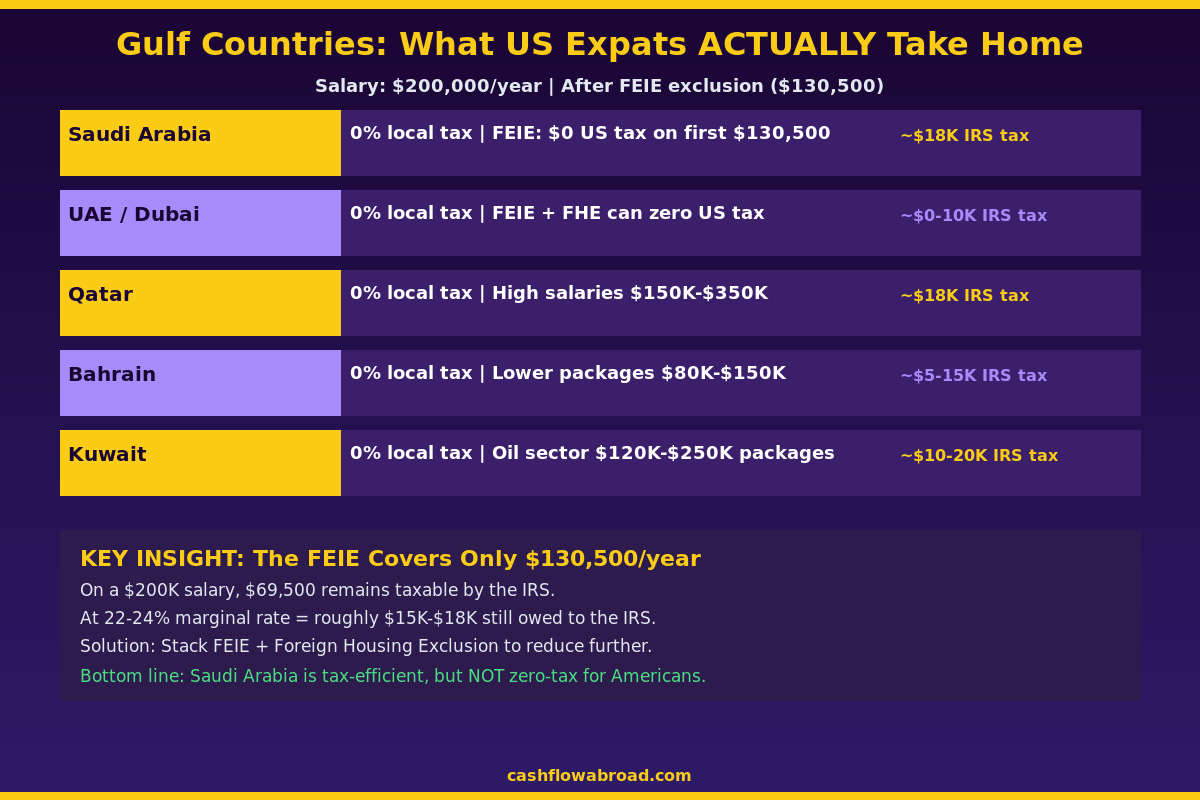
Saudi Arabia levies zero personal income tax on wages. But as a US citizen or green card holder, you file a US tax return regardless of where you live, and you pay US tax on worldwide income unless you use the right tools. Saudi Arabia offers no foreign tax credits (there are no local taxes to credit), so you're relying entirely on exclusions.
Foreign Earned Income Exclusion (FEIE)
The FEIE (Form 2555) excludes foreign earned income from US federal income tax up to the annual cap — $126,500 for 2024, approximately $130,500 for 2025 after inflation adjustment. To qualify, you meet either the Physical Presence Test (330 full days outside the US in any 12-month period) or the Bona Fide Residence Test (residing in a foreign country for a full tax year). Saudi Arabia employment on a full Iqama clears both tests without difficulty.
On a $200,000 salary, the FEIE covers roughly $130,500. The remaining ~$69,500 is still taxable at your US marginal rate — approximately $15,000–$18,000 in federal tax. Not zero. Substantially less than the $44,000+ you'd owe working stateside. Our FEIE deep-dive guide walks through the qualification rules in full.
Foreign Housing Exclusion (FHE)
Stacked on top of FEIE, the Foreign Housing Exclusion (also Form 2555) lets you deduct qualifying housing expenses above a base amount. For Saudi Arabia, where expat compounds routinely run $24,000–$37,000 annually and employer-provided housing is first added to your compensation, this exclusion can offset another $20,000–$40,000 of taxable income. Employer-provided housing counts — it gets added to your income first, then excluded through the FHE.
Why Foreign Tax Credits Don't Help Here
The Foreign Tax Credit (Form 1116) offsets US tax dollar-for-dollar against foreign taxes paid. Since Saudi Arabia levies zero personal income tax, there's nothing to credit. In high-tax countries like Germany or France, this dramatically reduces the US bill. In Saudi Arabia, you're starting from scratch and the FEIE plus FHE carry the full load.
| Salary | FEIE Exclusion | FHE Estimate | Remaining Taxable | Approx. US Tax Owed |
|---|---|---|---|---|
| $130,000 | $130,500 | $0 (fully covered) | $0 | ~$0 |
| $200,000 | $130,500 | $25,000 | ~$44,500 | ~$9,000–$12,000 |
| $350,000 | $130,500 | $35,000 | ~$184,500 | ~$50,000–$60,000 |
| $1,100,000 (NEOM exec) | $130,500 | $40,000 | ~$929,500 | ~$330,000–$380,000 |
The math turns painful at the executive tier. At $1 million-plus, the marginal rate on income above the FEIE exclusion approaches 37%. That NEOM executive earning $1.1 million faces a US tax bill north of $300,000 regardless of Saudi Arabia's zero-tax environment. Proper planning — maxed retirement contributions, timing of income, qualified deductions — can reduce this, but it doesn't disappear. Anyone accepting a package at this level should have a qualified expat CPA modeling the after-tax figure before signing.
FBAR and Reporting: The $16,000 Mistake Too Many Expats Make
Open a Saudi riyal account with Al Rajhi Bank or Saudi National Bank (both commonly required for Iqama-related payroll and transactions), and you've created a foreign account reportable to FinCEN. If the combined balance across your Saudi and any other foreign accounts exceeds $10,000 at any point during the calendar year, you must file an FBAR (FinCEN Form 114) by April 15, with an automatic extension to October 15.
The 2025 penalty for non-willful failures is up to $16,536 per form (inflation-adjusted). Willful violations — now including "reckless disregard" under a legal standard applied nearly universally across US jurisdictions — carry the greater of $165,353 or 50% of the account balance. Willful cases can trigger criminal prosecution with fines up to $250,000 and prison time up to five years.
Separately, FATCA Form 8938 is filed with your tax return. Living abroad as a single filer, the threshold is $200,000 at year-end or $300,000 at any point during the year. Married filing jointly abroad: $400,000 year-end or $600,000 at any time during the year. Non-filing penalties start at $10,000 and escalate to $50,000 for continued non-compliance after IRS notice.
The practical rule: every time you open a foreign bank account anywhere, flag it for your expat CPA that day. And maintaining a reliable US address is non-negotiable for IRS correspondence, state domicile, and banking purposes. A Traveling Mailbox ($15/month, real US street address in 50+ cities, digital mail scanning) handles this cleanly without requiring you to maintain a physical US location.
For sending money from Saudi Arabia back to the US or to family, Remitly consistently offers strong SAR-to-USD and SAR-to-other-currency exchange rates with same-day or next-day delivery on most routes.
Cost of Living: What Expats Actually Spend
A single expat living comfortably in Riyadh or Jeddah spends roughly 10,000–16,000 SAR per month ($2,700–$4,300), covering rent, food, transport, and entertainment. With an employer housing allowance or employer-provided compound, take-home spending drops significantly.
Key numbers as of 2025–2026:
- Apartment rent in Riyadh: SAR 2,500–7,000/month ($665–$1,865) for a standard apartment in a decent neighborhood
- Expat compound villa (3-bedroom): SAR 90,000–140,000/year ($24,000–$37,300) with Western-style amenities including pools and gyms
- Local neighborhood flats: SAR 25,000–60,000/year ($6,700–$16,000) for non-compound apartments
- Home internet: SAR ~100/month (~$27) for high-speed fiber
- International school fees: SAR 15,000–60,000/year ($4,000–$16,000) depending on curriculum and grade level
- Riyadh rent freeze: Since September 2025, landlords cannot raise rent on existing tenants' contracts until 2030 — a meaningful protection if you're planning a multi-year stay
Jeddah runs roughly 25% cheaper than Riyadh on housing. Dammam (Eastern Province, near Saudi Aramco's headquarters) sits between them. No alcohol is legally sold publicly in Saudi Arabia — a cultural reality that some expats find fine and others find difficult. It effectively eliminates one entertainment expense category entirely while requiring social life to be structured differently.
All Saudi employers are legally required to provide health insurance for foreign workers, but coverage quality ranges widely. For supplemental coverage or transitions between roles, SafetyWing offers international health coverage starting around $60/month with solid worldwide hospital access. Our full breakdown is in the expat health insurance guide.
Banking, Investing, and Moving Money
You'll need a Saudi bank account for salary deposits and local transactions — Al Rajhi, Saudi National Bank (SNB), and Riyad Bank are the main options. Opening requires your Iqama, passport, and an employment letter from your employer. Most major banks now offer English-language apps and support international SWIFT transfers.
For your US banking anchor, keep a Charles Schwab International account active. Schwab reimburses all ATM fees worldwide — useful when pulling local currency through Saudi ATMs or transiting through Dubai and Doha. More importantly, Schwab maintains brokerage accounts for Americans abroad, which is not universal: Fidelity and Vanguard routinely close accounts when they learn you're abroad. See our expat investing guide for the full account strategy.
For connectivity when traveling in and out of the Kingdom, a Saily eSIM covers 150+ countries and lets you swap data plans without fumbling with physical SIM cards — practical when you're transiting through multiple airports on the way home on annual leave.
The Nitaqat Risk Every Expat Should Understand
Saudi Vision 2030's Saudisation initiative (Nitaqat) requires companies to hire an increasing percentage of Saudi nationals across sectors. As quotas rise, the availability of roles for expats narrows — particularly in mid-tier administrative and management positions. Senior technical specialists, engineers, and senior executives remain in high demand and largely exempt from quota pressure. The mid-career expat job market, however, is tightening.
The July 2025 skill-tier classification system also affects visa renewability. Workers classified at the Skilled or Basic tier face more friction at renewal time. If your role sits in one of these lower tiers, plan for added bureaucracy and maintain a career development path toward the High-Skilled classification. Verifying your tier assignment upfront — before your first renewal — avoids a nasty surprise after two years of in-country investment.
Quality of Life: The Honest Picture
Saudi Arabia has changed faster in the last five years than in the previous three decades. Women drive, concerts happen, cinemas are open, and the entertainment economy — previously illegal — is now a government investment priority. There are limits: alcohol prohibition is enforced, cultural norms differ substantially from Western countries, and internet content is geo-filtered. Certain topics and platforms are blocked.
The expat community in Riyadh and Jeddah is large enough to find familiar groceries, international restaurants, and English-language social clubs. Compound life closely resembles a suburban American neighborhood with additional perimeter security. The cultural adjustment outside the compounds is real and shouldn't be minimized when you're evaluating whether Saudi Arabia fits your life, not just your spreadsheet.
VPN use is technically in a legal gray zone in Saudi Arabia, but extremely widespread among the expat community for keeping streaming services, social media, and VOIP calls accessible. A reliable VPN like NordVPN with servers optimized for the region keeps your connection encrypted on public networks and your content accessible.
Saudi Arabia vs. Other Gulf Destinations
If Saudi Arabia's lifestyle restrictions are a dealbreaker, the UAE offers a comparable zero-tax environment with substantially more cultural openness — see our Dubai expat tax guide. Bahrain has its own long-stay visa options and a noticeably more relaxed social environment. Oman offers quieter lifestyle with no personal income tax and a growing expat professional community.
For the purely financial calculation, Saudi Arabia wins on salary premium — especially in energy, infrastructure, and defense tech. For lifestyle flexibility and ease of daily life, Dubai wins decisively. The right choice depends on whether you're optimizing for maximum gross compensation or maximum quality of life per dollar of compensation.
Before You Sign the Contract: 7-Point Checklist
- Model your US tax bill first — calculate FEIE plus FHE coverage against your offered salary before accepting; the after-tax figure can differ substantially from gross
- Clarify housing treatment — employer-provided housing is added to your W-2 equivalent income first, then excluded via FHE; the calculation matters
- Confirm your visa tier classification — ensure your offer qualifies you for the High-Skilled tier under the July 2025 system before relying on long-term renewals
- Set an FBAR calendar alert — the day you open a Saudi bank account, set an annual reminder for the April 15 deadline
- Hire an expat CPA — Form 2555, Form 8938, FBAR, end-of-service gratuity taxation, and totalization agreement analysis all interact in ways standard tax software misses
- Set up a US virtual mailbox — you need a real US address for IRS correspondence, banking, state domicile, and brokerage maintenance
- Review your US brokerage accounts — many brokerages close expat accounts; transition to a expat-friendly brokerage like Schwab before you leave the country
Bottom Line
Saudi Arabia is a genuine financial opportunity for the right American — particularly in energy, infrastructure, and technology, where packages routinely clear $150,000–$300,000 with employer-covered housing and benefits. The Foreign Earned Income Exclusion and Foreign Housing Exclusion reduce but do not eliminate US tax liability, and the reporting obligations (FBAR, Form 8938) are non-negotiable regardless of how local-tax-efficient the environment is.
The professionals who make the most of a Saudi stint go in with the after-tax math already modeled, a maintained investment portfolio, and a clear timeline for what they're building. The ones who regret it assumed "zero Saudi tax" meant they'd finally escaped the IRS.
Financial Disclaimer: This article is for informational purposes only and does not constitute tax, legal, or financial advice. US expat tax law is complex and highly individual — consult a qualified expat CPA or tax attorney before making decisions based on this content. All tax figures, exclusion caps, and penalty amounts cited are based on publicly available IRS and FinCEN guidance and may change; verify all current thresholds for the applicable tax year with a qualified professional.
This guide is general information, not personalized tax, legal, or investment advice. Rules change; verify current thresholds with official sources or a qualified professional before acting.
Related guides
 Expat Tax & FinanceMay 29, 2026
Moving Abroad Mid-Year: Maximize Your Tax Benefits
Moving in Q4 instead of Q1 costs you up to $30K in FEIE exclusions. Learn how pro-ration works, state tax traps, and FBAR obligations in year one.
 Expat Tax & FinanceSeptember 6, 2026
Why 330 Days Abroad Can Still Fail FEIE
Pass the IRS tax home and abode tests before you file Form 2555. A 330-day count without a foreign tax home can wipe out the $130,000 FEIE.
 Expat Tax & FinanceAugust 26, 2026
Qualify Under the FEIE Bona Fide Residence Test
Qualify for the FEIE without counting 330 days. Use the IRS full-year test, avoid the tax-home trap, and file Form 2555 the right way.