Romania for US Expats: 10% Flat Tax and $900/Month Living
The internet is faster. The tax rate is 10% flat. And Romania has been a full EU member since 2007. Romania is no exception.

The internet is faster. The tax rate is 10% flat. And Romania has been a full EU member since 2007. Romania is no exception.
While thousands of American expats are crowding into Lisbon apartments at $2,200 a month and paying notaries in Madrid just to open a bank account, a 1-bedroom in Bucharest costs $650. The internet is faster. The tax rate is 10% flat. And Romania has been a full EU member since 2007.
Romania doesn't make most expat shortlists — that's exactly why it's worth looking at. Bulgaria gets the press for its 10% flat tax, Portugal gets the D7 visa coverage, Serbia gets the "cheap Belgrade" write-ups. Romania sits in the gap, offering the complete package: EU mobility, a low flat tax, fiber internet that rivals South Korea, and a cost of living that still makes your dollar feel like a superpower.
Here's everything a US expat needs to know before booking a one-way to Bucharest.
Visa Options: How to Stay Legally
Americans can enter Romania visa-free for up to 90 days within any 180-day period. Romania became a full Schengen member in March 2024 — which means that 90-day clock now runs across the entire Schengen zone, not just Romanian borders. If you're planning to base yourself in Bucharest while traveling through Europe, that Schengen math matters from day one.
If 90 days isn't enough, there are two primary paths for longer stays:
Digital Nomad Visa (Long-Stay D-type)
Romania's digital nomad visa grants a 1-year stay, renewable for an additional year. To qualify, you must:
- Work remotely for a company registered outside Romania, or own a foreign-incorporated company
- Show proof of income: at least 3x the average Romanian gross salary — currently approximately €3,700/month (~$4,000)
- Provide proof of private health insurance covering Romania
- Have a clean criminal record
The income threshold sounds steep relative to Romanian wages, but it's modest by US remote-worker standards. A freelancer billing $75/hour part-time clears it easily. Apply through the Romanian consulate in your home country before arrival; processing typically takes 4–6 weeks.
Temporary Residency Permit
Beyond the nomad visa's two-year cap, a standard temporary residency permit is the next step. It requires similar income documentation and is typically tied to employment, business registration in Romania, or studies. After 5 continuous years of legal residency, you can apply for permanent residency. Staying 8 years opens a path to Romanian citizenship and an EU passport.
Romanian Taxes: The 10% Flat Rate Explained
Romania's income tax is a straightforward 10% flat rate on taxable income — no brackets, no graduation, no surprises. This applies to employment income, freelance income, rental income, and most other categories once you become a Romanian tax resident.
Tax residency kicks in when you spend more than 183 days in Romania within a 12-month period. Before hitting that threshold, you're exempt from Romanian income tax and social contributions on foreign-sourced income — making the first six months essentially a tax holiday on your remote earnings.
Social Contributions: The Hidden Cost
Beyond the 10% income tax, Romanian tax residents pay social contributions:
| Contribution Type | Rate | Notes |
|---|---|---|
| Income Tax | 10% | Flat rate on all taxable income |
| Health Insurance (CASS) | 10% | Capped — calculated on a salary base, not total income |
| Social Security (CAS) | 25% | Applies to employees and self-employed; capped at ~24x min. salary |
The "10% flat tax" headline only tells part of the story. Self-employed workers and freelancers who become Romanian tax residents can face combined effective rates higher than 10% once social contributions are factored in — though both CASS and CAS are calculated on capped bases rather than your full income. If you earn $150,000 remotely, your Romanian social contributions are calculated on a base of approximately €24,000 annually, not your total earnings, which limits the exposure significantly.
The key lever: most Americans on a digital nomad visa who stay under 183 days pay zero Romanian tax on foreign income. Those who cross the threshold and establish tax residency use the Foreign Tax Credit on their US return to offset Romanian taxes paid.
US Tax Obligations in Romania
American citizenship means the IRS follows you everywhere. Romania is no exception. Here's what the picture looks like:
Foreign Earned Income Exclusion (FEIE)
If you qualify as a bona fide resident of Romania or pass the physical presence test (330+ days outside the US in a 12-month period), you can exclude up to approximately $130,000 of foreign earned income from US taxation in 2026. This is the core tool most American expats use to eliminate their US tax bill while living in low-tax countries. For the full breakdown of how FEIE works and when to pair it with the Foreign Tax Credit, see this guide.
Foreign Tax Credit (FTC)
If you owe Romanian taxes — because you've established residency and earn above the FEIE cap — you can use the Foreign Tax Credit dollar-for-dollar against your US tax liability. Since Romania's top rate (10%) is far below the US top marginal rate (37%), the FTC won't fully zero out a high-income earner's US bill on its own. Most expats layer FEIE and FTC together to minimize both bills simultaneously.
The Self-Employment Tax Gap: Read This Carefully
This is the piece most Romania guides omit. The US and Romania signed a totalization agreement in March 2023. Romania ratified it in January 2024. The US transmitted it to Congress in September 2024 — but as of early 2026, it has not yet entered into force.
What that means in practice: self-employed Americans who establish Romanian tax residency may owe both US self-employment tax (15.3%) on net self-employment income and Romanian social contributions. That's a genuine double-hit that doesn't affect employees of US companies working remotely (since the employee-side SE tax doesn't apply the same way). Before establishing Romanian residency as a freelancer or solo operator, consult a US expat tax specialist.
For the full framework of US reporting requirements — FBAR, FATCA, and FEIE — that apply regardless of where you live, see the Complete US Expat Banking & Taxes Guide.
Cost of Living: What $1,100/Month Actually Buys
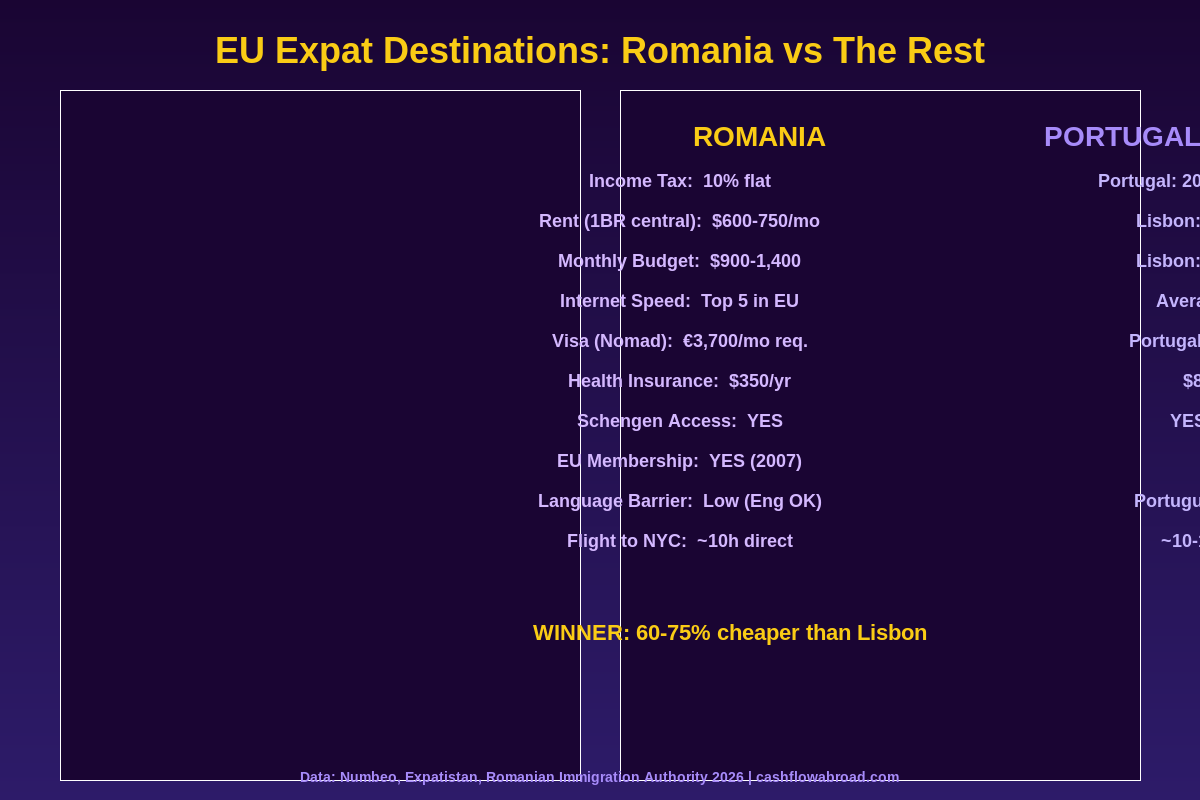
Bucharest is Romania's most expensive city — and it's still substantially cheaper than any Western European capital. Here's a realistic monthly budget for a single American expat living comfortably in a central neighborhood:
| Expense | Budget | Mid-Range | Comfortable |
|---|---|---|---|
| Rent (1BR central Bucharest) | $450 | $620 | $800 |
| Groceries | $180 | $240 | $320 |
| Restaurants (dining out 10x/mo) | $80 | $140 | $220 |
| Utilities (electric, water, gas) | $60 | $80 | $120 |
| Internet (fiber, 1 Gbps) | $12 | $14 | $15 |
| Mobile phone | $8 | $12 | $20 |
| Transport (metro + occasional taxi) | $30 | $50 | $80 |
| Private health insurance | $30 | $40 | $60 |
| Entertainment / gym / misc | $80 | $150 | $250 |
| Monthly Total | $930 | $1,346 | $1,885 |
For context: a comparable lifestyle in Lisbon runs $2,000–2,800/month, Barcelona is $2,200–3,200/month. Bucharest delivers the same EU legal framework and comparable cultural richness for roughly 40–50 cents on the Lisbon dollar.
Outside Bucharest, costs drop further. Cluj-Napoca — Romania's growing tech hub in Transylvania — offers 1BR apartments for $400–550/month and a thriving startup and expat community. Brasov and Sibiu are smaller mountain cities where $750–1,000/month covers everything comfortably with significantly better air quality and outdoor access than the capital.
This is the geographic arbitrage thesis in action: same income, drastically reduced burn rate, accelerated savings and investment timelines.
Best Neighborhoods for Expats in Bucharest

Bucharest's geography splits sharply north-south. The northern half is where most expats and the embassy community cluster; the southern districts require more local knowledge to navigate safely.
Northern Neighborhoods: Safest, Most Expat-Dense
Floreasca / Herăstrău: Built around Herăstrău Lake and the 187-hectare King Michael I Park, this is Bucharest's Upper West Side equivalent. High-rise apartments with Western fittings, international restaurants, a Carrefour large enough to solve any grocery problem, and a dense expat and embassy-staff population. Expect $700–1,000/month for a well-furnished 1BR.
Dorobanți / Primăverii: Embassy row. Leafy prewar streets, boutique coffee shops, and one of the lowest crime rates in the city. More residential and less nightlife-heavy than Floreasca. A 1BR runs $650–850/month.
Aviației / Băneasa: Further north, close to Henri Coandă International Airport. Quieter, greener, newer construction. Popular with younger professionals moving out of the center. More affordable: $500–700/month for a modern 1BR with good build quality.
Central Options
Piața Romană: The heart of Bucharest's creative and startup scene. Walkable, metro-connected, full of co-working cafés and independent restaurants. Mix of prewar architecture and modern inserts. $600–800/month for a 1BR.
Icoanei: Safe, architecturally distinctive, and more local than Floreasca. Good for expats who prefer living among Romanians over expat clusters. Harder to find fully furnished units; negotiate directly with landlords.
Avoid: Ferentari (southern suburb with documented crime and social deprivation), and exercise caution in parts of Militari and eastern Pantelimon, particularly at night.
Healthcare: What to Expect
Romania's public healthcare is universal and technically available to tax residents who contribute to CASS. In practice, the public system is chronically underfunded — long wait times, aging equipment in many hospitals outside Bucharest, and variable English proficiency make it a poor option for expats who need reliable care on a timeline.
Most expats use private clinics instead. Bucharest has several world-class private hospital networks — Regina Maria, MedLife, and Medicover — where a GP visit costs $20–40 and specialist appointments run $40–80. These facilities have English-speaking staff and modern diagnostics.
Private international health insurance is mandatory for the digital nomad visa application. Cost for basic plans: €300–600/year ($330–660) for a healthy adult under 45. The most practical options for US expats:
- SafetyWing Nomad Insurance — starts around $56/month for travelers under 40, covers Romania and travel within Europe, accepted for most digital nomad visa applications
- Cigna Global or AXA Global — more comprehensive plans from $120–300/month if you want full hospital coverage and no deductibles
For a detailed breakdown of how these compare, see the full Expat Health Insurance Guide.
Banking and Internet: Romania's Hidden Advantages
Internet: Genuinely World-Class
Romania consistently ranks in the top 5 countries in Europe and top 10 globally for fixed broadband speed. Average speeds exceed 200 Mbps on typical residential plans. 1 Gbps fiber connections cost $12–15/month. In practical terms: your Zoom calls will perform better from a Bucharest apartment than from most US cities, where 1 Gbps residential fiber is a $90/month premium add-on if it's available at all.
Mobile data matches — a 50GB 4G/5G plan from Digi, Orange, or Vodafone Romania runs $10–15/month. When you're traveling across Schengen on weekend trips, an international eSIM like Saily covers EU roaming without the surprise charges.
Banking Setup for American Expats
Opening a local Romanian bank account as a non-resident is bureaucratic — expect multiple branch visits, documents in Romanian, and patience. The major options are BCR (Banca Comerciala Romana, owned by Erste Group), BRD, and ING Romania. For day-to-day spending, a Romanian debit card is useful. For your primary financial life, keep it US-based.
Charles Schwab's international checking account remains the gold standard for expats: no foreign transaction fees, ATM fees refunded worldwide at month-end, no minimum balance requirement. Pull RON from any Romanian ATM at the interbank rate and Schwab reimburses whatever the ATM charged.
For large transfers — moving salary from a US entity, paying Romanian landlords, or repatriating savings — Remitly offers competitive USD-to-RON rates with upfront, transparent fees. Typically a fraction of what a wire through a Romanian bank costs you in spread and fees.
While abroad, maintain a real US street address for your banking, IRS correspondence, and state domicile. Traveling Mailbox provides a real US street address in 50+ cities, scans your mail on demand, and handles check deposits — $15/month and the cheapest insurance policy you'll own against account closures and missed IRS notices. See the full guide on why every US expat needs a virtual mailbox.
Is Romania the Right Base?
| Factor | Romania Verdict |
|---|---|
| Cost of living | Excellent — 50-60% cheaper than Western Europe |
| Income tax rate | Strong — 10% flat, but watch social contributions if self-employed |
| EU access | Full EU member since 2007, Schengen since 2024 |
| Internet speed | Top 5 in Europe, top 10 globally — exceptional for remote workers |
| Healthcare | Public system is poor; private clinics are affordable and solid |
| Language barrier | Low — English widely spoken in Bucharest's expat zones |
| Visa pathway | Good — digital nomad visa available with reasonable income threshold |
| Safety | Generally safe in northern and central neighborhoods |
| SE tax risk (US self-employed) | Elevated — totalization agreement not yet in force as of 2026 |
| Culture and nightlife | Excellent — Bucharest has one of Europe's best electronic music scenes |
Romania works best for American remote employees or business owners earning $4,000–15,000/month who want EU residency, Schengen travel access, and a genuine cost-of-living advantage over Western European competitors. It's a poor fit if your income is primarily self-employment and you're not ready to manage the social contribution complexity — in that case, a territorial tax country like Georgia or Paraguay may offer a structurally simpler setup at a comparable cost of living.
If you're planning the move and want a systematic relocation checklist covering finances, entity setup, banking, and legal paperwork, the Expat Relocation Kit is the resource most first-movers wish they had before year one.
Conclusion
Romania is the best-kept secret in European expat circles, and that's mostly because the loudest expat content channels are focused on Portugal and Spain. But the math is difficult to argue with: a flat 10% income tax, 1 Gbps fiber for $14/month, a comfortable single life for under $1,200/month, and full EU membership since 2007. Bucharest is no longer a backpacker city — it's a real metropolitan hub with international infrastructure, a growing tech scene, and a cost of living that makes $4,000/month feel like $10,000 in purchasing power.
The one genuine caveat is the self-employment tax gap created by the pending US-Romania totalization agreement. Until that agreement enters into force, self-employed Americans need a qualified expat CPA before establishing Romanian tax residency. For remote employees of US companies, the picture is considerably cleaner and more straightforward to plan around.
Do the math. Line up the paperwork. And don't wait for everyone else to discover it first — Bucharest rents have been rising as the word spreads, and the window of maximum arbitrage doesn't last forever.
Financial Disclaimer: This post is for informational purposes only and does not constitute tax, legal, or financial advice. Tax laws change frequently and individual circumstances vary significantly. Consult a qualified US expat tax professional and a Romanian tax advisor before making decisions about residency, tax filing, or financial structures abroad. Some links in this post are affiliate links; we may earn a commission at no additional cost to you.
This guide is general information, not personalized tax, legal, or investment advice. Rules change; verify current thresholds with official sources or a qualified professional before acting.
Related guides
 Geographic ArbitrageOctober 25, 2026
Italy Nomad Visa Income Requirements
Italy's nomad visa income test is €25,500 on 2026 sheets. See the $133.60 Washington fee and the US return you still file.
 Geographic ArbitrageOctober 4, 2026
Greece Nomad Visa: The €3,500 Monthly Test
See whether your pay clears Greece's digital nomad visa: €3,500 net a month, or €4,200 with a spouse, before you apply now.
 Geographic ArbitrageSeptember 21, 2026
Korea F-1-D Workation Income Rules for Expats
As of June 2026, Korea’s F-1-D visa starts at ₩52.4M outside Seoul for ages 18–34. Map income tiers, US FEIE, and where you park the paycheck.