Retire Early Abroad: FIRE on Half the Nest Egg
The $2M FIRE number is a US myth. Abroad, you can retire early on $360K–$840K. Here is the full ExpatFIRE playbook with country-by-country numbers.

Cut your FIRE number by 60-80% by retiring abroad. Country-by-country costs, visa options, tax rules, and portfolio math for ExpatFIRE.
Disclosure: this article contains affiliate links. If you open an account through one of them, Cashflow Abroad may earn a referral commission at no extra cost to you.
Here's the number financial planners rarely tell you: the $2 million FIRE target everyone obsesses over is almost entirely a product of US cost of living. Live somewhere else and that number can collapse to $400,000–$700,000 — sometimes less.
That's not wishful thinking. It's arithmetic. The 4% safe withdrawal rule says your portfolio can sustain roughly 4% annual withdrawals indefinitely. So if you need $80,000/year in the US, you need $2 million. But if you need $18,000/year in Medellín or $15,000/year in Chiang Mai, you need $450,000–$375,000. Same 4% rule. Radically different finish line.
This is ExpatFIRE — the strategy of combining Financial Independence / Retire Early principles with geographic arbitrage to cut your retirement number by 60–80% and retire years, sometimes decades, earlier than you'd otherwise manage.
How ExpatFIRE Changes Your Math
The Trinity Study, which popularized the 4% rule, analyzed US market returns from 1926–1992. The baseline assumption was a $40,000–$80,000 annual spend for a US-based retiree. That spend is the lever most people ignore.
If you're earning in USD (or any strong currency) but spending in Thai baht, Colombian pesos, or Vietnamese dong, you're exploiting a currency gap that makes your portfolio stretch in ways the original study never modeled. Your withdrawal rate doesn't change. Your spending does.
A quick example: A 40-year-old with $500,000 invested in a globally diversified index fund portfolio (think: a US brokerage like Charles Schwab, which keeps your account functional and fee-free abroad with worldwide ATM reimbursements) can withdraw $20,000/year at the 4% rate. That $20,000 is a tight budget in Denver. In Da Nang, it's an upper-middle-class life with room for annual flights home.
For longer retirements — 50 years for someone retiring at 40 — most researchers recommend pulling back to 3.5% to reduce sequence-of-returns risk. At 3.5%, $500,000 still yields $17,500/year. That comfortably funds a good life in half a dozen countries.
The ExpatFIRE Numbers by Country
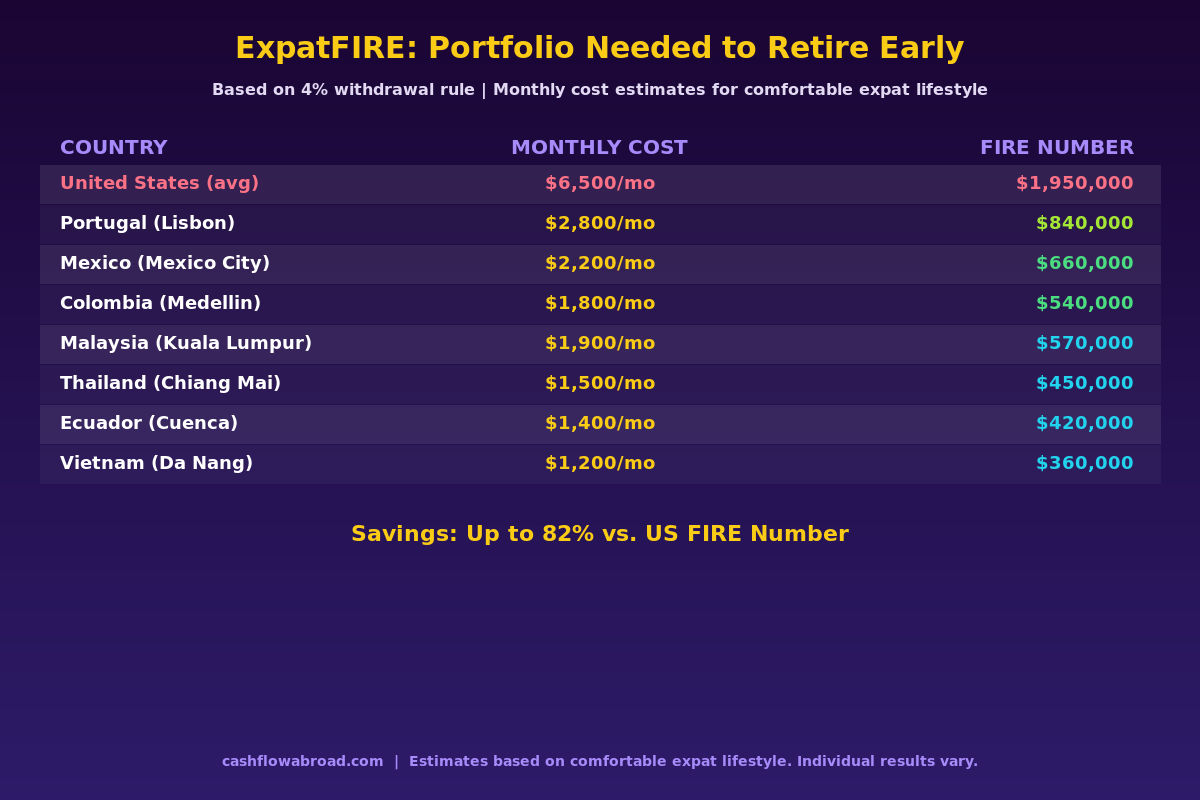
The table above uses conservative estimates for a comfortable (not luxury) single-person lifestyle. Couples can often share housing and fixed costs to reduce per-person spend by 30–40%.
| Country / City | Monthly Budget | Annual Spend | FIRE Number (4%) | Savings vs. US |
|---|---|---|---|---|
| United States (avg) | $6,500 | $78,000 | $1,950,000 | — |
| Portugal (Lisbon) | $2,800 | $33,600 | $840,000 | 57% less |
| Mexico (Mexico City) | $2,200 | $26,400 | $660,000 | 66% less |
| Colombia (Medellín) | $1,800 | $21,600 | $540,000 | 72% less |
| Malaysia (Kuala Lumpur) | $1,900 | $22,800 | $570,000 | 71% less |
| Thailand (Chiang Mai) | $1,500 | $18,000 | $450,000 | 77% less |
| Ecuador (Cuenca) | $1,400 | $16,800 | $420,000 | 78% less |
| Vietnam (Da Nang) | $1,200 | $14,400 | $360,000 | 82% less |
These budgets include rent for a nice 1-bedroom apartment in a good neighborhood, groceries, dining out regularly, internet, local transport, and incidentals. They do not include flights home or private health insurance — two expenses you need to budget separately (more on that below).
Top ExpatFIRE Destinations Ranked
Not every cheap country is a good place to actually live. Here's how the top destinations stack up across the dimensions that matter for a 30–50 year retirement:
Portugal — The EU Option
Portugal isn't the cheapest destination on this list, but it offers something the others don't: an EU base with world-class infrastructure, excellent public healthcare once you establish residency, and a growing expat community that makes integration relatively smooth. The D7 Passive Income Visa requires demonstrating roughly €760/month in passive income — modest by most FIRE standards. Lisbon runs $2,800–$3,200/month comfortably; smaller cities like Porto or Braga drop to $2,200–$2,500. FIRE number: roughly $840,000–$960,000. See our digital nomad visa guide for how the visa process compares across Europe.
Colombia — The Value Leader in the Americas
Medellín has transformed dramatically over the past decade and now hosts one of South America's largest expat communities. Monthly costs for a comfortable life — modern apartment in El Poblado or Laureles, regular restaurant meals, Uber everywhere — run $1,600–$2,000. The Pensionado Visa requires just $750/month in retirement income, one of the lowest thresholds in the Americas. The spring-like climate year-round eliminates heating/cooling costs that inflate budgets elsewhere. FIRE number at 4%: around $504,000–$600,000.
Thailand — The Southeast Asia Benchmark
Thailand remains the gold standard for Southeast Asian FIRE, particularly Chiang Mai with its large digital nomad community, walkable old city, excellent street food scene, and northern climate that's cooler than Bangkok. Monthly costs for a single person living well: $1,200–$1,800. Thailand's Retirement Visa (Non-OA) requires either 800,000 Thai baht (~$22,000) in a Thai bank account or proof of 65,000 THB/month (~$1,800) in income — both manageable for most FIRE portfolios. Private hospital care in Thailand costs roughly 20–40% of equivalent US prices.
Malaysia — English-Speaking Southeast Asia
Malaysia combines Southeast Asian cost advantages with widespread English fluency, a legacy of British colonial governance. Kuala Lumpur has world-class infrastructure, international food options, and excellent private hospitals. The Malaysia My Second Home (MM2H) visa has had fluctuating requirements in recent years — currently requiring a higher fixed deposit than historically, so verify current requirements before planning around it. Budget: $1,700–$2,200/month for a comfortable life.
Ecuador — The Dollar Economy Advantage
Ecuador uses the US dollar, which eliminates currency risk entirely — a meaningful factor in multi-decade retirement planning. Cuenca is the dominant expat destination: a UNESCO World Heritage colonial city at 2,500 meters elevation with mild climate year-round. Monthly costs run $1,200–$1,600. The Pensioner Visa requires roughly $1,410/month in pension or investment income. No currency conversion, no exchange rate anxiety. FIRE number: $360,000–$480,000.

The Three ExpatFIRE Risks Nobody Talks About
Enthusiast communities tend to undersell the friction. These are the real risks for a 40-year international retirement:
Healthcare: The Non-Negotiable
Medicare doesn't cover you abroad. Full stop. If you retire before 65, you have a gap of potentially 25+ years during which you need private coverage. Budget $150–$400/month for international health insurance depending on age and plan type.
SafetyWing's Nomad Insurance is a common entry point at around $45–$80/month for younger expats, though it has coverage caps and limitations. For a true long-term retirement, a comprehensive expat plan through providers like Cigna Global or Allianz Care runs $200–$400/month and provides coverage with real limits. Read our expat health insurance guide for a full breakdown. Many ExpatFIRE retirees use a hybrid: catastrophic coverage abroad plus occasional visits to home country for routine care. In countries with good public systems (Portugal, some Latin American countries), establishing residency eventually grants access to national health programs.
US Taxes: They Don't End When You Leave
The US taxes citizens on worldwide income regardless of where they live — one of only two countries in the world that does this (the other is Eritrea). Even in tax-free countries like Ecuador or Thailand, your investment income, capital gains, and retirement account distributions are potentially taxable to the IRS.
The good news: the Foreign Earned Income Exclusion (FEIE) excludes up to $126,500 in earned income (2024) if you pass the Bona Fide Residence or Physical Presence test. But FEIE applies to earned income — not investment returns, dividends, or IRA distributions. For most FIRE retirees drawing from a portfolio, the relevant tools are:
- Foreign Tax Credits: If your host country taxes your income, you can often use those payments to offset US tax dollar-for-dollar.
- Standard Deduction: Still applies. Single filer standard deduction in 2024 was $14,600, meaning your first $14,600 in income is tax-free regardless.
- Capital Gains Rates: Long-term capital gains at 0% for income up to $47,025 (2024, single filer). Many ExpatFIRE retirees with modest withdrawals pay zero federal capital gains tax.
The combination of standard deduction + 0% long-term capital gains rate means a single ExpatFIRE retiree withdrawing $30,000–$45,000/year from a brokerage account may owe zero US federal income tax. That changes the math dramatically.
Currency Risk and Sequence of Returns
A portfolio denominated in USD is vulnerable to two compounding risks abroad: a strong local currency that makes your spending more expensive, and a bad early-retirement sequence of returns that depletes capital before markets recover.
Practical mitigations: Keep 1–2 years of living expenses in cash or short-term bonds. Use a brokerage with no international fees — Charles Schwab International is the standard recommendation, offering free ATM withdrawals worldwide, no foreign transaction fees, and no account closure for living abroad. Dollar-cost average your withdrawals rather than pulling large sums. And pick countries with USD-pegged or USD-correlated currencies (Ecuador, Panama, El Salvador) if currency volatility is a concern. See our US expat banking guide for the full setup.
The ExpatFIRE Visa Toolkit
Getting into a country is easy. Staying legally for decades is the challenge. Here's the visa architecture for common ExpatFIRE destinations:
| Country | Visa Type | Income Requirement | Path to PR/Citizenship |
|---|---|---|---|
| Portugal | D7 Passive Income Visa | ~€760/mo passive income | 5 years to PR, 5 years to citizenship |
| Colombia | Rentista / Pensionado Visa | $750/mo pension or 10x min wage investment income | 5 years to PR |
| Mexico | Temporary Resident (Rentista) | ~$2,500/mo or $42,000 in savings | 4 years to PR, 5 years to citizenship |
| Thailand | Non-OA Retirement Visa (50+) | 800K THB in Thai bank (~$22K) or 65K THB/mo income | No permanent residency pathway (requires annual renewal) |
| Malaysia | MM2H (My Second Home) | Fixed deposit + income requirements (verify current rules) | No citizenship pathway; renewable long-term |
| Ecuador | Pensioner Visa | ~$1,410/mo (3x minimum wage) | 3 years to PR, 3 additional years to citizenship |
Thailand's lack of a permanent residency pathway is a real limitation — you're renewing annually and subject to policy changes. This is why many long-term ExpatFIRE retirees favor Latin America or Europe: there's a clear path from visa to permanent residency to eventual citizenship, providing real security. Our full retirement abroad guide covers each country's residency timeline in detail.
The Logistics Stack for ExpatFIRE
Early retirement abroad requires getting a handful of systems right before you move. Miss any of these and they become expensive problems later:
Keep a US Address
You need a US address for IRS correspondence, brokerage accounts, state domicile documentation, and any mail from financial institutions. Do not use a family member's address long-term — it creates state tax exposure. A virtual mailbox service like Traveling Mailbox gives you a real US street address in a no-income-tax state (they offer Florida, South Dakota, Wyoming, and others), scans your mail digitally, and can deposit checks — all for around $15/month. Essential infrastructure for anyone living abroad indefinitely.
Banking and Brokerage
Your existing US bank account can vanish. Some US banks close accounts when they discover the account holder is no longer a US resident. Charles Schwab is the gold standard for expats: they don't close accounts for living abroad, refund all ATM fees worldwide, charge no foreign transaction fees, and offer brokerage + banking in one account. Keep a second account as backup.
For business income or freelance projects that supplement your portfolio in early retirement years, Mercury provides US banking for online businesses with no monthly fees and good international transfer tools.
Healthcare Coverage
The layered approach most ExpatFIRE retirees use: a comprehensive international health plan from day one (budget $200–$400/month for ages 40–55), supplemented by local private insurance once you establish residency in countries with affordable private systems. In countries like Colombia, excellent private hospital networks charge $30–$80 for specialist visits without insurance — sometimes self-pay is cheaper than premiums for routine care.
Moving Money
When funding local accounts abroad, use a service like Remitly for regular international transfers. The spread on bank wire transfers alone — typically 2–4% above mid-market — can cost an ExpatFIRE retiree $500–$1,500/year on a $40,000 annual budget. Remitly's rates beat bank transfers significantly for most corridors.
How ExpatFIRE Also Accelerates Your Accumulation Phase
Most FIRE content treats moving abroad as a post-retirement strategy. But many ExpatFIRE practitioners use it during the accumulation phase too. If you can earn a US income remotely while living in Colombia or Thailand, your savings rate can jump from 30% to 70%+ of income. The math compounds aggressively.
Someone earning $80,000/year in the US, spending $55,000, and saving $25,000 reaches their $1M FIRE number in roughly 25 years at a 7% real return. The same person living in Medellín spending $22,000 — saving $58,000/year — reaches a $540,000 ExpatFIRE number in about 8 years. That's 17 fewer years of work bought by a change of address.
This is why geographic arbitrage is increasingly described as the most powerful lever available to anyone who can work remotely. You don't just lower the finish line — you simultaneously sprint faster toward it.
What ExpatFIRE Actually Looks Like
A few real patterns from within the ExpatFIRE community:
The Ecuador Lean FIRE: Single person, $350,000 portfolio, retires to Cuenca at 43. Withdraws 4% ($14,000/year). Supplements with $3,000–$5,000/year from occasional freelance writing. Total income: $17,000–$19,000. Monthly spend: $1,400. Works out to essentially zero stress on the portfolio. USD-based economy eliminates currency risk entirely.
The Portugal Couple: Two people, combined $900,000 portfolio, retire to Porto at 47. Withdraw 3.5% ($31,500/year). Monthly budget: $4,200 between two people. Access EU healthcare within 5 years of residency. Path to EU passport opens after 5 years — eventually grants full freedom of movement across 27 countries.
The Southeast Asia Nomadic Retiree: Single, $480,000 portfolio, splits time between Chiang Mai and Da Nang. No single country stay exceeds 180 days (managing tax residency carefully). Monthly spend fluctuates between $1,100 and $1,600. Annual withdrawal around $16,000 — well below even a 3.5% rate, meaning the portfolio actually continues growing in good years.
US Tax Filing Obligations Don't Disappear
Every US citizen living abroad must still file a US tax return if income exceeds the filing threshold ($14,600 for single filers in 2024). Brokerage dividends, capital gains, and retirement distributions all count. You must also file an FBAR (FinCEN 114) if your foreign bank accounts exceed $10,000 at any point during the year, and potentially FATCA Form 8938 above higher thresholds.
Many ExpatFIRE retirees with modest portfolio withdrawals end up owing little or no US tax — but the filing obligation never disappears. Hire a tax professional who specializes in expats. The cost ($400–$800/year for a straightforward expat return) is trivial compared to the consequences of non-filing.
Conclusion: The $2M Myth Has an Escape Hatch
ExpatFIRE isn't a compromise — for most people who try it, it's an upgrade. Smaller portfolio requirement, richer daily experience, better weather, lower stress, and more years of actual life lived instead of life deferred. The mechanics are well-understood at this point: apply the 4% rule to a dramatically reduced cost of living, pick a country with a livable visa path, build your banking and healthcare stack before you go, and keep filing your US taxes.
The $2 million finish line exists because $80,000/year costs $2 million to sustain forever. Change the denominator and everything changes. If $18,000/year buys the life you actually want — and in the right city it genuinely does — then $450,000 is the number you're chasing, not $2 million. For most people, that's the difference between retiring at 42 and retiring at 62.
Disclaimer: This article is for informational purposes only and does not constitute financial, tax, or legal advice. Investment returns are not guaranteed, and safe withdrawal rates are projections based on historical data. Consult a qualified financial planner and tax professional familiar with US expat law before making retirement or relocation decisions.
This guide is general information, not personalized tax, legal, or investment advice. Rules change; verify current thresholds with official sources or a qualified professional before acting.
Related guides
 Geographic ArbitrageMay 19, 2026
Panama for US Expats: Dollar Economy, Territorial Tax, Visa Reality
Panama uses the US dollar, taxes zero foreign income, and has 53 international banks. Full guide to visas, costs, and banking for US expats.
 Geographic ArbitrageAugust 31, 2026
Hungary White Card: The €3,000 Subsistence Test
Prove €3,000 net for six months, pay €110, and model Hungary's 15% PIT. The White Card is a two-year Budapest permit, not a path to settle.
 Geographic ArbitrageJuly 19, 2026
Sofia Remote Work Budget Under $2,000
Price rent, transit, utilities, insurance, and visa caveats before using Sofia, Bulgaria as a lower-cost EU base for remote work.