
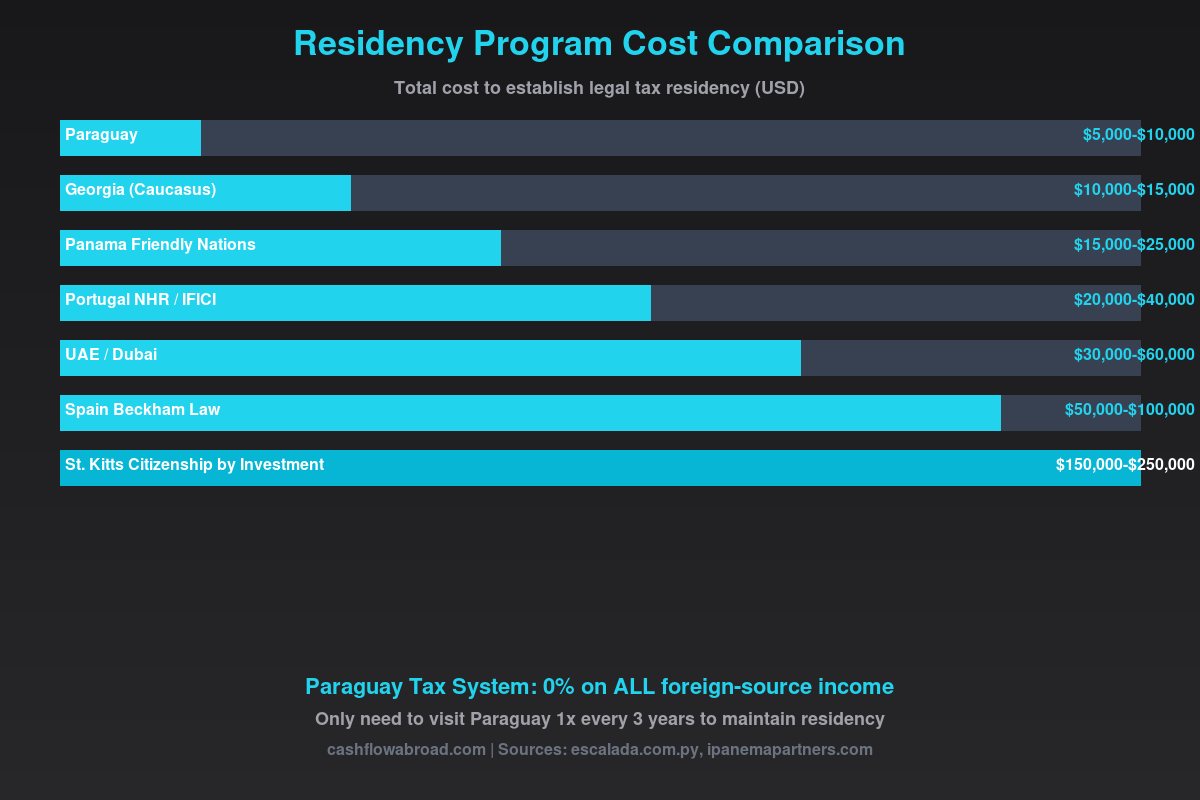
Most expats chasing tax optimization spend six figures doing it. A Henley & Partners citizenship-by-investment passport starts at $150,000 in St. Kitts. Dubai's popular 10-year Golden Visa requires $545,000 in real estate. Portugal's Golden Visa program demands $250,000 minimum. Meanwhile, Paraguay has been quietly offering a legally bulletproof 0% foreign income tax residency for under $10,000 total — and most of the expat internet has never heard of it.
That's not an accident. Paraguay doesn't have a marketing budget. It has no lobbying firm pitching to global wealth managers. What it does have: a pure territorial tax system, a path to citizenship in as little as 3 years, and a visit requirement that amounts to roughly one long weekend every three years. For anyone who earns remotely and wants legal tax optimization without the six-figure entry fee, this deserves a serious look.
What "Territorial Tax" Actually Means Here
Paraguay taxes income earned within Paraguay's borders. Income earned outside Paraguay — freelance work, investments, dividends, rental income from foreign properties, business revenue from non-Paraguayan clients — is taxed at exactly 0%. This isn't a loophole or a treaty trick. It's how Paraguay's tax code is written and has been for decades.
Paraguay-source income is taxed at a flat 10%, which applies to local salaries, rentals on Paraguayan real estate, and services provided to Paraguayan entities. For a remote worker, freelancer, or investor with no Paraguay-based income, that 10% rate is largely irrelevant.
Compare that to the EU average top income tax rate of 42%, the US federal rate of 37% (plus state taxes), or Australia's top marginal rate of 47%. Even the celebrated "low tax" destinations like Georgia (1% flat tax) or Serbia (10-15%) still tax income you earn. Paraguay doesn't.
The Actual Cost Breakdown
The headline number you'll see quoted most is a $5,000 refundable bank deposit in a Paraguayan bank — this is the standard financial solvency requirement for the Temporary Residency pathway. That money stays yours; it earns interest and can be withdrawn once you have permanent residency. It's closer to a security deposit than an investment.
Here's the actual itemized cost:
| Item | DIY Cost | With Attorney |
|---|---|---|
| Government application fees | ~$357 | ~$357 |
| Attorney fees (immigration lawyer) | $0 | $1,000–$1,500 |
| Document apostille + translation | $150–$300 | Often included |
| Flights + accommodation (Asunción) | $800–$1,500 | $800–$1,500 |
| Bank deposit (refundable) | $5,000 | $5,000 |
| Total out-of-pocket (non-refundable) | ~$1,300–$2,100 | ~$2,500–$3,700 |
Even at the high end with attorney fees and a round trip from North America, you're under $5,000 in permanent costs. Including the refundable deposit, total capital committed is still under $10,000 for most applicants. For context, one year of good health insurance in the US runs $8,000+.
What You Actually Have to Do
Paraguay's in-person requirement is not a burden. Here's the realistic timeline:
Initial trip: Plan for 3 to 7 business days in Asunción. You'll open a bank account, get fingerprinted, visit the immigration office (Dirección General de Migraciones), and submit your application. The in-person work is 2 to 5 days. You can continue traveling while the paperwork processes — approval typically comes in 2 to 4 months, and your lawyer or fixer can collect the documents and send them to you.
Maintenance: Paraguay requires you to visit once every 3 years to maintain temporary residency. That's it. No 183-day residency test, no proving your "center of life" is in Asunción, no spending any minimum number of nights per year. For anyone building a passport portfolio while living elsewhere, this is the lowest maintenance program in the Western Hemisphere.
Path to permanent residency: After 3 years of temporary residency, you become eligible for permanent residence — which never expires. Then after 3 more years as a permanent resident, you're eligible for citizenship. Paraguay is officially the fastest naturalization path in South America, beating Uruguay (3 years but stricter physical presence rules), Argentina (2 years residency requirement but much harder to maintain), and Brazil (4 years minimum).
Paraguay vs. Other Tax Residency Programs
| Destination | Tax on Foreign Income | Min. Investment | Physical Stay Required | Citizenship Path |
|---|---|---|---|---|
| Paraguay | 0% | ~$7,000 | 1 visit per 3 yrs | 6 years |
| Georgia (Caucasus) | 1% (small biz status) | ~$10,000 | 183 days/yr recommended | 10 years |
| Panama | 0% (territorial) | $5,000 deposit | Occasional visits | 5 years |
| Portugal IFICI/NHR 2.0 | Varies by treaty | $20,000–$50,000+ | 183 days/yr | 5 years |
| UAE / Dubai | 0% | $30,000–$60,000 | Frequent visits required | No citizenship path |
| St. Kitts CBI | 0% | $150,000+ | None | Immediate |
Panama is Paraguay's closest competitor on price and structure — both are territorial tax systems with low barriers. But Paraguay's citizenship path is faster, and the Paraguayan passport grants Mercosur free movement across Brazil, Argentina, Uruguay, and Bolivia. If you're building a second passport strategy, that's meaningful optionality from a sub-$10,000 investment. See our geographic arbitrage playbook for how Paraguay fits into a broader multi-country strategy.
The US Citizen Reality Check
The US taxes citizens on worldwide income regardless of where they live — it's one of only two countries globally that does this (Eritrea being the other). Establishing Paraguayan tax residency does not eliminate your US tax obligation.
What it does do:
- Give you a legitimate foreign tax residency to combine with the Foreign Earned Income Exclusion (FEIE), which lets you exclude up to $132,900 in earned income (2026 amount) from US federal tax
- Open the door to the Foreign Housing Exclusion, which can add $30,000+ depending on where you actually live
- Establish your tax domicile outside the US, which — combined with cutting ties to a high-tax state like California — can eliminate state income tax liability entirely
- Position you for Paraguay's 0% rate on investment income, dividends, and capital gains from non-Paraguayan sources
The FEIE applies only to earned income (freelance, salary, self-employment). Passive income — dividends from a US brokerage, rental income, capital gains — is still fully taxable by the IRS unless covered by a foreign tax credit. Paraguay's 0% rate means you'll owe no Paraguayan tax on that passive income, but you also get no foreign tax credit to offset the US bill. Review the expat investing playbook before restructuring investment accounts around a foreign residency.

Banking and Financial Setup
Paraguay has a stable banking sector. The Banco Central del Paraguay maintains solid reserves, and the major private banks — Banco Itaú Paraguay, Banco Regional, Banco Continental — are established regional institutions. Once your temporary residency is approved, opening a personal account is straightforward with your residency card and RUC (Paraguay's tax ID number).
The $5,000 deposit requirement is typically fulfilled at one of these banks. Most offer USD-denominated accounts alongside guaraní accounts. For international wire transfers, Remitly handles USD ↔ guaraní conversions at competitive rates. For maintaining a US account while abroad, Mercury offers fee-free US business banking that works from anywhere internationally.
One critical setup piece for US expats: you'll need a US address for IRS correspondence, brokerage accounts, and any remaining stateside accounts. A virtual mailbox like Traveling Mailbox gives you a real US street address with mail scanning for $15/month — the site owner personally uses this service — and it's essential when formally establishing Paraguay as your tax domicile while keeping an IRS-compliant US address. More on this setup in our virtual mailbox expat guide.
What Actually Living in Paraguay Costs
Most Paraguay residency applicants don't plan to live there full-time — but for those who want to spend extended time or run the numbers on longer stays:
| Expense Category | Budget | Comfortable | Western-Style |
|---|---|---|---|
| Rent (Asunción, 1BR) | $300–$450 | $500–$800 | $800–$1,400 |
| Groceries | $150–$250 | $250–$400 | $400–$600 |
| Eating out (local) | $100–$200 | $200–$350 | $350–$600 |
| Transportation | $30–$60 | $60–$120 | $120–$250 |
| Health insurance | $40–$80 | $80–$150 | $150–$300 |
| Utilities + internet | $60–$100 | $100–$150 | $150–$200 |
| Monthly total | $680–$1,140 | $1,190–$1,970 | $1,970–$3,350 |
Asunción's Carmelitas and Villa Morra neighborhoods have coworking spaces, international restaurants, and Uber. Apartment internet averages 50–100 Mbps at modern units. For health coverage during Paraguay stays, SafetyWing Nomad Insurance runs roughly $56–$80/month depending on age; local private health insurance is even cheaper. Read the full expat health insurance guide for a complete comparison.
Three Things That Trip People Up
1. Confusing residency with tax residency. Getting Paraguayan residency is the first step, not the whole step. To formally become a Paraguay tax resident, you need your RUC, a tax exit declaration in your home country, and severed ties that your home country uses to claim you as a tax resident. For Americans, that means choosing a no-income-tax domicile state before leaving — California (13.3%) and New York (10.9%) have notoriously aggressive rules about claiming ex-residents. The US expat banking and tax guide covers this in detail.
2. The guaraní currency risk on the deposit. Your $5,000 bank deposit earns interest in guaraníes, which fluctuates against the dollar. The currency has been relatively stable historically, but over a 3-year period, there's exposure. USD-denominated accounts at Paraguayan banks sidestep the currency issue, though at lower interest rates.
3. Using Paraguay as a standalone solution without exiting your home country's tax system. The Paraguay structure is legal and effective — but only if you've properly exited your current tax domicile. Getting a Paraguayan residency card while remaining a California resident doesn't eliminate California taxes. The territorial benefit flows to you in Paraguay, not through you to your home country. This is where a qualified international tax attorney earns their fee before you make the move.
The Passport Play: Why Some Expats Are Playing the Long Game
Six years of residency (3 temporary + 3 permanent, with minimal physical presence) opens access to a Paraguayan passport. That passport currently provides:
- Visa-free or visa-on-arrival access to 144 countries including Schengen/EU, UK, Japan, and most of Latin America
- Full Mercosur free movement rights — live, work, and operate in Brazil, Argentina, Uruguay, Bolivia, and Ecuador without a visa
- A second nationality for estate planning, asset protection, and travel optionality
- Paraguay allows dual citizenship, so US citizens keep their American passport
For someone who earns online and wants maximum optionality, spending $7,000–$9,000 in non-refundable costs over 6 years to acquire a second passport is one of the more efficient plays available — particularly when compared to citizenship-by-investment programs that charge $150,000+ for the same privilege.
Is Paraguay Right for You?
Paraguay makes sense if you check most of these boxes:
- You earn income from clients or investments outside Paraguay (remote work, freelance, online business, investment portfolio)
- You're willing to travel to Asunción once for setup and once every 3 years for maintenance
- You want a low-cost residency as part of a broader geographic arbitrage strategy, not a permanent relocation
- You've already addressed your home-country tax exit (or are willing to do so with professional help)
- You want a second passport as a long-term option
Paraguay doesn't make sense if: you need EU residency rights, you want a lifestyle destination (Asunción isn't comparable to Bangkok or Medellín in terms of infrastructure and expat ecosystem), or you're a US citizen who hasn't addressed state-level tax obligations — the federal savings are real, but incomplete planning creates exposure.
The Bottom Line
Paraguay's territorial tax system is one of the few remaining places where a modest investment unlocks genuine, legally straightforward 0% foreign income tax. The $5,000 refundable deposit plus $2,000–$3,500 in hard costs is a fraction of what most tax residency programs charge — and the once-every-three-years visit requirement means you're not giving up your lifestyle to access it.
The counterintuitive truth: the programs that get the most press (Dubai, Portugal, Malta) are often 5 to 20 times more expensive than necessary for anyone whose goal is purely tax optimization. Paraguay doesn't have a PR budget. It has a territorial tax code and a remarkably accessible residency program. Sometimes the best deal is the one nobody's talking about.
If you're serious about this, start by getting your US tax domicile exit right, then consult an immigration attorney in Asunción for the residency setup. The structure is straightforward — the execution just requires getting the sequencing right.
Financial disclaimer: This article is for informational and educational purposes only and does not constitute legal or tax advice. Tax laws change and vary significantly by individual situation. US citizens remain subject to worldwide income taxation regardless of foreign residency status. Consult a qualified international tax attorney and CPA before making any changes to your tax domicile, foreign bank accounts, or residency structure.