
Until late 2024, every guide to Paraguay residency opened with the same caveat: you'll need to park roughly $4,500–$5,000 in a Paraguayan bank account as a "deposit." That requirement was quietly eliminated. The actual out-of-pocket cost to obtain legal permanent residency in a territorial-tax country is now as low as $427 in government fees—or $750–$2,500 all-in if you use an attorney. For the entire process. For a residency that taxes your foreign income at zero percent.
Paraguay has been quietly sitting at the bottom of every "top territorial tax countries" listicle, overshadowed by Panama's skyline and Georgia's low flat tax. The people paying attention are quietly getting their residency done and moving on with their lives. Here's everything you actually need to know.
What "Territorial Tax" Actually Means in Paraguay
Paraguay's tax system is one of the simplest in the world. The entire principle: only income generated inside Paraguay gets taxed. Everything you earn from clients, employers, or investments outside Paraguay's borders is completely exempt from Paraguayan income tax.
In practice, here's how the rates break down for local income:
| Income Source | Tax Rate | Notes |
|---|---|---|
| Foreign-source income (remote work, freelance abroad, foreign dividends) | 0% | The big one |
| Local personal services income under ~$11,300/year | 0% | Exemption threshold |
| Local personal services income (progressive) | 8% / 9% / 10% | Capped at 10% |
| Local rental income | 8% | — |
| Capital gains on Paraguayan assets | 8% | Foreign assets: 0% |
| Local corporate profits (IRE) | 10% flat | No CFC rules |
There is no wealth tax. No inheritance tax. No gift tax. And critically, Paraguay has no Controlled Foreign Corporation (CFC) rules—meaning complex offshore corporate structures don't trigger automatic attribution of income to Paraguayan residents the way they might in Spain or Portugal.
For a digital nomad earning $8,000/month from US clients, Paraguayan tax liability: $0.
The Feature No Other Territorial Tax Country Offers
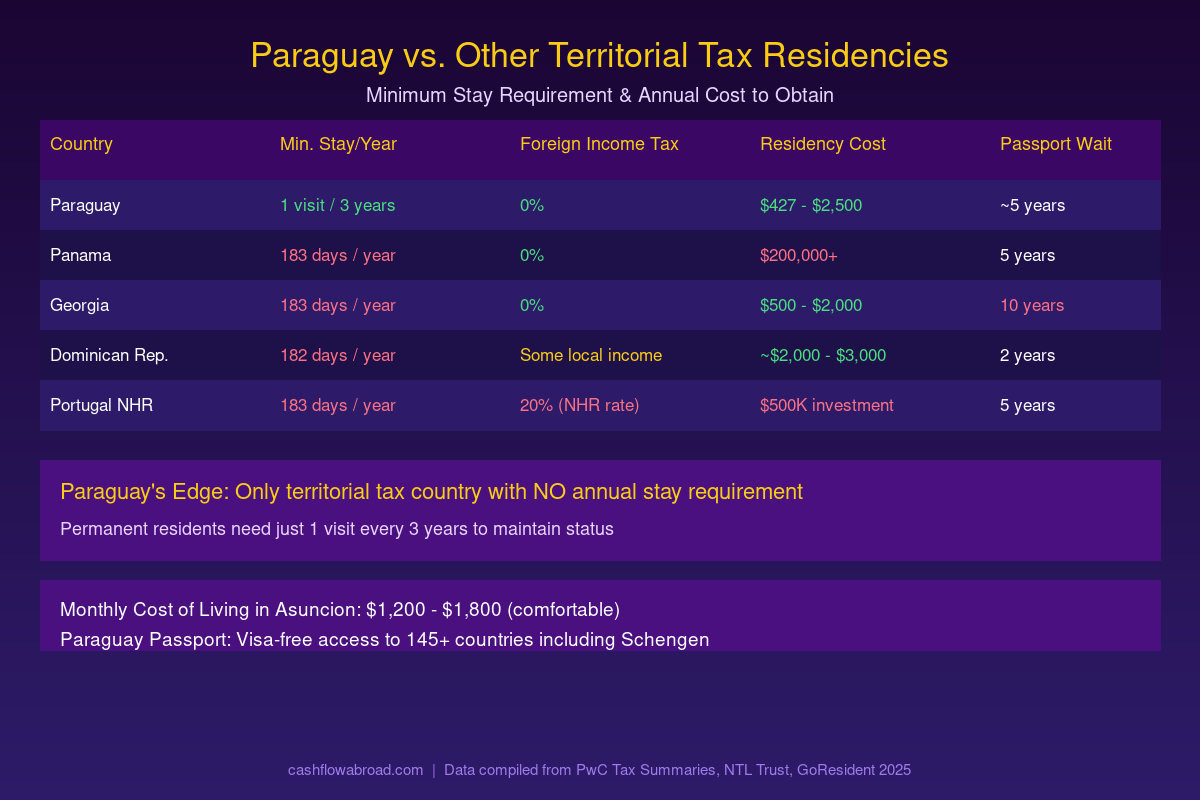
Every other major territorial tax jurisdiction couples its tax benefits with a physical presence requirement. Panama's tax residency requires 183 days per year. Georgia: 183 days. Dominican Republic: 182 days. If you want the tax benefit, you have to actually live there.
Paraguay has no equivalent rule. Tax residency is based on "center of economic and vital interests"—not a day count. And for legal residency status itself, the rules are equally minimal:
- Temporary residents: Must not be absent for more than 12 consecutive months. One visit, and the clock resets.
- Permanent residents: Must enter Paraguay at least once every three years. That is the entire stay requirement.
Read that again: permanent residency in a zero-foreign-income-tax country, maintained by a single visit every three years. This is not a loophole or a gray area—it is explicitly how the Paraguayan immigration framework works. No other major territorial tax jurisdiction comes close to this flexibility.
What Paraguay Residency Actually Costs
The $5,000 bank deposit that deterred people for years was eliminated in late 2024 as part of a broader streamlining of financial solvency requirements for the standard temporary residency pathway. Here's what you're actually paying now:
| Cost Component | Amount (USD) | Notes |
|---|---|---|
| Government application fee | ~$394 | Official rate (~2.78M PYG) |
| Certificate of Registration | ~$33 | Official rate |
| Bank deposit requirement | $0 (eliminated 2024) | Previously $4,500–$5,000 |
| DIY total (Spanish-fluent, 6–10 office visits) | ~$750 | Includes document costs |
| Budget attorney/agent service | ~$1,450 | All-inclusive packages |
| Full-service attorney | $2,000–$2,500 | Fees + government costs |
| SUACE investor fast-track | $70,000+ investment | Permanent residency in ~3 months |
The standard path takes you from arrival to temporary residency in 3–6 months, then to permanent residency after 21 months of legal temporary residency status. Total timeline from scratch to permanent: roughly two years. The SUACE investor path delivers permanent residency in about three months, but requires a minimum $70,000 investment into a qualifying business or asset.
The Document Process (Where Most People Get Tripped Up)
Paraguay's process is not complicated, but it is bureaucratic. The main requirements:
- Birth certificate — apostilled in your country of origin
- Criminal background check — apostilled, issued within 6 months of application
- Valid passport
- Proof of income or financial means (varies by pathway)
- All foreign documents translated into Spanish by a certified translator
The apostilled documents have a 6-month validity window from date of issue. Plan your application timeline accordingly—if you get your background check apostilled and then delay six months before traveling to Asunción, you start over.
As of September 2024, Paraguay moved to a new biometric cédula format with a microchip, electronic fingerprints, and digital signature. This must be done in person at a Paraguayan immigration office—the old process where some steps could be done at a Paraguayan embassy abroad is no longer available.
Banking Reality Check: The Cédula Bottleneck
Here's the thing almost no Paraguay residency guide tells you upfront: you cannot open a Paraguayan bank account until you have your cédula in hand. Your foreign passport alone won't do it at any serious bank. And since the cédula comes at the end of the residency process—2 to 4 months after you arrive—you're operating without local banking for that entire period.
Once you have your cédula, the main options expats use:
- Itaú Paraguay — Brazilian banking giant with excellent international wire capabilities. SWIFT transfers work reliably. Increasingly FATCA-compliant, which matters for US citizens.
- Banco Continental — Strong local presence, competitive deposit rates, USD accounts widely available.
USD accounts are common in Paraguay—this is a partially dollarized economy in practice, and holding dollar balances locally is normal. Initial accounts have a cap around $1,000 USD equivalent; full-functionality accounts require a RUC (tax ID) and six months of registered tax activity.
For moving money internationally during the waiting period, Remitly is a reliable option for transfers to and from Paraguay. For maintaining your US financial footprint while abroad, Charles Schwab's international account remains the gold standard for expats—no ATM fees worldwide and solid brokerage access.
If you're maintaining a US bank account, credit card, and IRS mailing address while living abroad, a virtual mailbox like Traveling Mailbox gives you a real US street address in 50+ cities for $15/month—essential for keeping US accounts and state domicile intact when you're outside the country.
Paraguay vs. The Alternatives
Here's the honest comparison of the major territorial tax residency options:
| Factor | Paraguay | Panama | Georgia | Dominican Republic |
|---|---|---|---|---|
| Foreign income tax | 0% | 0% | 0% (territorial) | 0% most foreign income |
| Min. stay for tax residency | None | 183 days/year | 183 days/year | 182 days/year |
| Residency cost | $427–$2,500 | $200,000+ | $500–$2,000 | $2,000–$3,000 |
| Citizenship timeline | ~5 years total | 5–20 years | 10 years (no dual) | 2 years |
| Monthly cost of living | $1,200–$1,800 | $2,500+ | $1,000–$1,500 | $1,500–$2,500 |
| CFC rules | None | None | None | None |
Panama used to be the default recommendation for territorial tax residency. Then Panama's Friendly Nations Visa—the easy pathway—was dramatically tightened in 2021. The straightforward routes now require $200,000+ in real estate investment. Panama City is also genuinely expensive by Latin American standards. Paraguay is cheaper to obtain, cheaper to live in, and has less stringent stay requirements.
Georgia is compelling for its Virtual Zone IT company structure (0% corporate tax on foreign-sourced revenue for qualifying tech companies) and its extremely low cost of living. But Georgian personal tax residency requires 183 days/year, Georgia doesn't allow dual citizenship, and the citizenship timeline is 10 years. For people who want to maintain flexibility and eventually obtain a second passport, Georgia is a weaker choice.
Dominican Republic offers a faster citizenship path (2 years), but tax residency requires 182 days, and the tax system is semi-territorial—some domestic income categories are taxed in ways that add complexity. Paraguay's pure territorial system is cleaner.
For more on structuring your life around geographic arbitrage, the geographic arbitrage playbook covers the broader framework across 10 countries.
The Critical Caveat for US Citizens
This section is not optional reading if you hold a US passport.
The United States taxes its citizens on worldwide income regardless of where they live. There is no US-Paraguay tax treaty and no totalization agreement. What this means in practice:
- Paraguay's 0% foreign income tax does not reduce your US tax liability by a single dollar.
- The Foreign Earned Income Exclusion (FEIE) can shelter up to approximately $126,500 (2024, indexed annually) of earned foreign income—but only if you qualify via the 330-day physical presence test or bona fide foreign residence test.
- Paraguay's minimal stay requirement means you can qualify for the FEIE while being a Paraguayan resident, but the FEIE is an IRS benefit, not a Paraguayan one.
- Without a totalization agreement, self-employed US expats may owe Social Security and Medicare taxes to both countries—though Paraguay doesn't currently levy equivalent taxes on remote workers, the US self-employment tax still applies to US citizens regardless of location.
- Paraguayan bank accounts over $10,000 trigger FBAR filing (FinCEN 114) annually. See the full expat banking and tax guide for compliance details.
For US citizens, Paraguay residency is primarily a lifestyle and optionality play: low cost of living, cheap and easy-to-maintain second residency, eventual path to a second passport (visa-free access to 145+ countries including Schengen), and a territorial tax base that reduces local tax to near-zero. It does not reduce the US tax bill.
For non-US citizens—Canadians, Brits, Australians, Europeans from high-tax countries—the calculus is different. If your home country uses residence-based taxation (most do), establishing genuine Paraguayan tax residency can dramatically reduce your global tax burden.
The Paraguay Passport: An Underrated End Goal
Paraguay's citizenship-by-naturalization timeline is competitive: three years of permanent residency, with physical presence of nine months per year during that citizenship period. The residence clock starts only after you have permanent residency (not temporary), so the total timeline from starting the process is roughly five years under the standard pathway.
A Paraguayan passport provides visa-free or visa-on-arrival access to over 145 countries, including the entire Schengen Area. Paraguay is also a founding member of Mercosur, which grants certain movement and business establishment privileges across Argentina, Brazil, Uruguay, and Paraguay. For a passport that starts at under $2,500 to obtain, this is significant optionality.
Who Should (and Shouldn't) Pursue Paraguay Residency
Strong fit:
- Non-US digital nomads and remote workers earning from foreign clients who want a legitimate zero-foreign-tax base with minimal physical commitment
- Online business owners and e-commerce operators who want a clean territorial tax jurisdiction without complex CFC exposure
- Perpetual travelers who want a legal residency base they can maintain with a brief annual or triennial visit
- Anyone seeking an affordable path to a South American passport and Schengen visa-free access
- Investors interested in early-mover opportunities in a stable, growing economy with no wealth or inheritance tax
Poor fit:
- US citizens hoping to reduce their US tax bill (it won't—see above)
- Anyone who needs immediate banking access from day one
- People who want immediate permanent residency without a $70,000+ investment
- Those who want the full citizenship path without spending 9 months/year in Paraguay for three years
For health coverage while living in Paraguay or as a location-independent resident, SafetyWing offers international health insurance plans designed for nomads and expats that work across borders without locking you into one country's healthcare system.
Bottom Line
Paraguay has a genuine structural advantage that no other territorial tax country offers: no meaningful stay requirement. The $5,000 bank deposit that used to create a barrier is gone. The government fees total under $500. The path to permanent residency is clear, if bureaucratic. And the territorial tax system is clean—no CFC rules, no wealth tax, no inheritance tax, pure source-based taxation.
It is not for everyone. Infrastructure in Asunción is less developed than Panama City or Tbilisi. The local expat community is smaller. Banking has a waiting period. And for US citizens specifically, the tax advantages accrue to the lifestyle column, not the tax bill column.
But for non-US citizens looking for the cheapest, most flexible territorial tax residency in the Western Hemisphere—one you can maintain with a single visit every three years—there is currently nothing better at this price point.
Financial Disclaimer: This article is for informational purposes only and does not constitute legal, tax, or financial advice. Tax laws, residency requirements, and immigration regulations change frequently and vary based on individual circumstances. Consult a qualified international tax attorney or immigration specialist before making decisions about residency, citizenship, or tax planning. US citizens should work with a US-licensed CPA experienced in expatriate taxation before establishing foreign residency.