Panama for US Expats: Dollar Economy, Territorial Tax, Visa Reality
Panama uses the US dollar, taxes zero foreign income, and has 53 international banks. But the visa just got 40x harder. Here's the real setup in 2026.
Panama uses the US dollar, taxes zero foreign income, and has 53 international banks. Full guide to visas, costs, and banking for US expats.
Disclosure: this article contains affiliate links. If you open an account through one of them, Cashflow Abroad may earn a referral commission at no extra cost to you.
Panama City has more international banks per square mile than any other city in Latin America — 53 licensed institutions, including HSBC, Citibank, and a dozen regional powerhouses you've never heard of. It uses the US dollar as its official currency, eliminating currency risk entirely. Its territorial tax system means the government takes zero cut of income you earn outside the country. Yet most expats researching a move abroad skip right past it, because they still picture the $5,000 Friendly Nations Visa that disappeared in 2021.
The visa got harder to get. Panama itself got more compelling. Here's what the actual setup looks like.
Why Panama Is Genuinely Different
Most expat destinations impose one immediate complication: your income is in dollars but your life runs on pesos, baht, or lempiras. Exchange rate swings eat into purchasing power unpredictably. Panama doesn't have that problem.
The Panamanian balboa has traded at exactly 1:1 with the US dollar since 1904. In practice, US dollar bills are the local currency — ATMs dispense dollars, prices are listed in dollars, your US debit card works identically to how it does in Florida. For American expats, the financial plumbing is as close to staying home as you can get while actually leaving.
The rest of the package compounds that advantage:
- 3 hours from Miami. Delta, American, and Copa fly direct from most major US hubs. A same-day round trip for emergencies is genuinely feasible.
- First-world infrastructure. Panama City has a modern metro system, reliable gigabit internet in expat neighborhoods, and hospitals accredited by Joint Commission International — the same US standard applied to American hospitals. Hospital Punta Pacífica is affiliated with Johns Hopkins Medicine.
- Latin America's banking hub. More foreign bank branches per capita here than anywhere else in the region. If you run an international business or want offshore diversification within full US regulatory compliance, Panama's banking sector is a legitimate tool.
The Tax Math for US Expats
Panama's territorial tax system is real and it works exactly as described — but not the way most people think it does for Americans.
What Panama taxes: Only income with a Panamanian source. If you work remotely for a US company, consult for European clients, or draw dividends from a US brokerage account, Panama collects nothing. Zero. Panama's top income tax rate is 25%, but that rate only applies to income generated within Panama.
What the IRS still wants: Everything. US citizens owe federal income tax on worldwide income regardless of where they live. Moving to Panama doesn't change that. What can change it significantly is the Foreign Earned Income Exclusion (FEIE), which lets qualifying expats exclude up to $126,500 in foreign earned income from US taxable income (2024 figure, adjusted annually). If your income is passive — dividends, interest, rental income — FEIE doesn't apply, but the Foreign Tax Credit may reduce your US bill to the extent Panama actually taxes you (which is typically nothing on foreign-source income).
The practical result for most US expats with remote income: your effective US tax rate stays similar to what it was at home, and Panama takes nothing. The benefit isn't tax elimination — it's that $70,000 gross income funds a dramatically better lifestyle in Panama City than the same $70,000 in Austin or Denver.
One thing to track carefully: Panama has signed FATCA agreements with the US. Panama's banks report US account holder data to the IRS. Any foreign account balance exceeding $10,000 at any point during the year triggers FBAR filing (FinCEN Form 114). Some expats arrive expecting "offshore privacy" and discover Panama's banking sector is fully transparent to US authorities. Your banking setup structure matters more than where you bank.
The Friendly Nations Visa: What It Actually Costs Now
Before 2021, the Panama Friendly Nations Visa was legendary for one reason: you could qualify by depositing $5,000 in a Panamanian bank account, opening a local company, or showing employment ties to Panama. Applications took 2–3 months and cost around $1,500 total in attorney and government fees.
That program is gone. The 2021 reforms tightened it substantially. As of 2026, the requirements are:
| Qualification Route | Requirement | Notes |
|---|---|---|
| Real estate investment | $200,000 USD property purchase | Funds must originate from abroad |
| Bank deposit | $200,000 USD fixed deposit | 3-year term at a Panamanian bank |
| Local employment | Work contract with a Panamanian company | Requires a Panamanian employer willing to sponsor |
Government fees run approximately $1,050 (split between the National Treasury and National Immigration Service). Attorney fees add $3,500–$5,500 depending on complexity. Document apostilles and translations cost another $400–$800. Total non-investment cost: $5,000–$7,000. Processing time: 4–6 months for provisional residency, permanent residency after 2 years, citizenship eligibility at 5 years.
US citizens are on the eligible countries list. The visa covers your spouse and dependent children under the same application.
Other Visa Paths That Actually Work
If $200,000 isn't on the table, Panama has several other entry points — one of which is arguably the best retirement visa in the Americas.
Pensionado Visa — The Underrated Gem
Qualifying requirement: $1,000/month in lifetime pension income — Social Security, a company pension, a disability payment, or an annuity. No capital investment required. Just demonstrable recurring income.
What you get is remarkable. The Pensionado visa comes with a permanent government-mandated discount package: 25% off airline tickets, 50% off hotels (weekdays), 25% off restaurant meals, 15% off hospital bills, and 10% off prescription drugs. These aren't nominal benefits — they're legally required discounts at all registered establishments. For a retiree living primarily in Panama, the compounding value of these discounts over 20–30 years is substantial.
A US retiree collecting $2,500/month in Social Security qualifies immediately. The entire application, including attorney fees, runs $2,500–$4,000. It's one of the most accessible quality-of-life upgrades available to American retirees abroad. Our retirement abroad guide compares this program to similar options in Ecuador, Mexico, and Costa Rica.
Qualified Investor Visa
Introduced as a higher-tier alternative, this starts at $300,000 invested in real estate, businesses, or government bonds. It's aimed at high-net-worth applicants who want fast, clean processing. Processing takes 30 days on average — significantly faster than the Friendly Nations route.
Tourist Entry: The 90-Day Test Drive
US citizens can stay 180 days on a tourist entry (30-day initial stay, renewable twice). Many prospective expats spend 3–6 months testing Panama before committing to residency. This also works for managing physical presence for FEIE eligibility — Panama as a base while bouncing to Costa Rica or Colombia resets the clock strategically.
Cost of Living: The Real Numbers
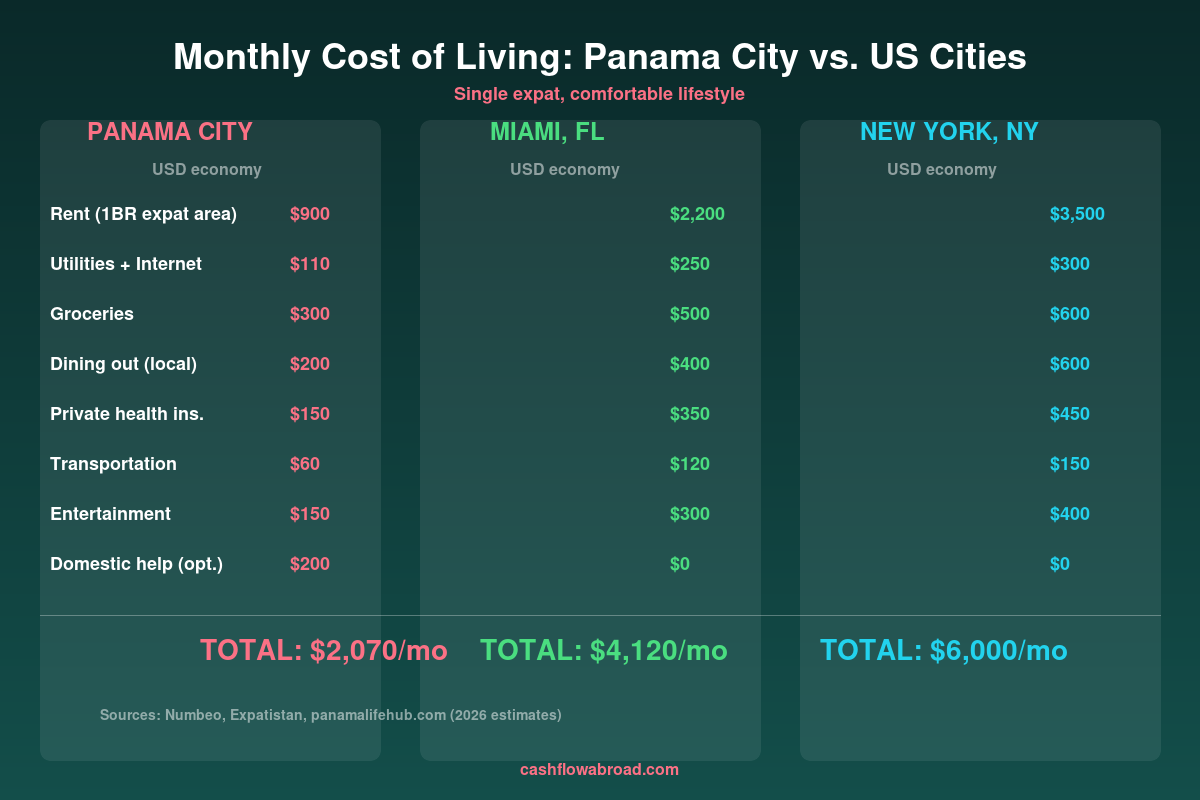
A comfortable single-expat life in Panama City runs $1,800–$2,500/month depending on neighborhood and lifestyle. A few callouts from the comparison above:
Rent: Panama City's rental market has distinct tiers. Marbella, El Cangrejo, and Bella Vista are mid-range expat neighborhoods where $900–$1,200/month gets a furnished 1-bedroom. Costa del Este and Punta Pacífica are premium — expect $1,500–$2,500+. Outside the capital (Boquete in the highlands, Coronado on the Pacific coast), quality 1-bedrooms go for $500–$800.
Food: Local "executive lunch menus" at fondeaderos run $5–$7 for a complete meal with protein, rice, and salad. Supermarkets like Rey and El Machetazo carry US brands at near-US prices. Farmers' markets and local wet markets run 40–60% cheaper for produce.
Transportation: Uber across Panama City typically costs $3–$6. The Metro covers most of the urban core for under $1 per ride. A car isn't necessary to live in Panama City, though many expats have one for weekend beach trips.
Healthcare: Specialist consultations run $50–$80 at JCI-accredited private hospitals. Full private health insurance for a healthy 40-year-old runs $100–$200/month through Panamanian carriers. Most US expats combine a local private plan with a global policy like SafetyWing for international coverage. Our expat health insurance guide covers the layered approach in full.
Banking in Panama as a US Expat
Panama's financial sector is a real differentiator — not in the "secret offshore account" sense that YouTube channels peddle, but in the legitimate sense of having more banking options, faster account opening for residents, and a genuinely international financial infrastructure.
The 53 licensed international banks operating in Panama include global institutions (HSBC, Citibank, Scotiabank), regional specialists, and private banks. For expats who run international businesses or need multi-currency functionality beyond what US banks offer, having a Panamanian banking relationship alongside your US accounts creates useful redundancy.
Opening a Panamanian bank account as a non-resident: Harder than it used to be. FATCA compliance costs have made Panamanian banks reluctant to take on non-resident US clients. Most require a local reference, proof of address, and a detailed source-of-funds letter. As a resident with a Pensionado or Friendly Nations visa, mid-tier banks like Multibank, Banistmo, or Global Bank will typically open a dollar account without drama. Budget 1–2 weeks for the paperwork cycle.
Keep your US accounts: A Panamanian account works for local expenses. For your primary investment accounts and brokerage, stay in the US. Charles Schwab's international account is the standard expat recommendation: no foreign transaction fees, worldwide ATM fee reimbursement, and brokerage access in the same login. Banks that close accounts when they detect foreign residence — which some US banks do — are a real risk. Schwab explicitly supports expat clients.
For regular transfers between your US and Panamanian accounts, Remitly consistently beats bank wire rates. The spread on US bank international wires typically runs 2–4% above mid-market — on a $3,000/month transfer that's $60–$120 in hidden costs monthly, or $720–$1,440/year.
One critical administrative item: get a Traveling Mailbox virtual US address before you leave. You need a real US street address for IRS correspondence, brokerage accounts that flag international logins, state domicile documentation, and any mail from US financial institutions. A virtual mailbox in a no-income-tax state (Florida, South Dakota, Wyoming) at $15/month is essential infrastructure for indefinite expat life.
Panama vs. the Alternatives
| Country | Official Currency | Foreign Income Tax | Min. Residency Visa | Flight to Miami |
|---|---|---|---|---|
| Panama | US Dollar | 0% (territorial) | $1K/mo pension (Pensionado) | ~3 hours |
| Paraguay | Guaraní (volatile) | 0% (territorial) | $5,500 bank deposit | ~8–9 hours |
| Costa Rica | Colón (variable) | 0% (territorial) | $2,500/mo or $150K deposit | ~3 hours |
| Ecuador | US Dollar | 0% on foreign income (effectively) | ~$1,410/mo pension income | ~5–6 hours |
| Georgia (country) | Lari (GEL) | 1% flat rate option | None required (180-day tourist) | ~12 hours |
Panama's uniqueness in this comparison is the combination of US dollar economy and territorial tax on foreign income in the same Latin American package, accessible by flight from most of the US in under 5 hours. Ecuador also uses the dollar, but Panama has significantly more developed financial infrastructure, a larger international expat community, and direct flights from more US cities. For a broader comparison of geographic arbitrage destinations, our geographic arbitrage playbook covers 10 countries across tax, visa, cost, and quality-of-life metrics.
Who Panama Works For (and Who It Doesn't)
Strong fits:
- Remote workers earning in USD. No currency exposure. No conversion math. Your paycheck funds a dramatically better lifestyle without any structural changes.
- Retirees with $1,000+/month in pension income. The Pensionado visa is one of the most accessible and well-structured retirement residency programs in the Western Hemisphere.
- International businesspeople. Panama's financial infrastructure — 53 banks, the Panama Canal, the Colón Free Trade Zone — is genuinely useful if your work involves Latin American distribution, maritime trade, or cross-border financial services.
- Geographic arbitrage seekers who want US-adjacent infrastructure. Three hours from Miami, fully dollarized, Joint Commission hospitals, first-world internet. This is as close to "living abroad without really leaving" as you'll find.
Poor fits:
- Minimum-budget expats. If you're optimizing for sub-$1,000/month living, Panama City isn't your city. Southeast Asia (Vietnam, Indonesia) or inland Ecuador offer lower floors. Panama competes on quality-to-price ratio, not absolute cheapness.
- People expecting tax elimination. Panama removes local tax on foreign income. The IRS still owns your worldwide income. If total US tax elimination is the goal, that requires more structural changes than a Panama address — see the five-flag strategy guide for what that actually entails.
- Heat-averse expats. Panama City averages 79–91°F year-round with humidity. The highland town of Boquete (5,000 ft elevation) offers high-60s to low-80s temperatures, but it's a very different lifestyle than the capital.
The First 90 Days: Practical Setup
Arrive before committing to a lease. Don't sign a long-term rental before you've lived in the city. Facebook groups (Panama Expats, Panama City Expats) have a constant stream of monthly furnished rentals. Spend 2–4 weeks testing neighborhoods — Marbella, El Cangrejo, and Bella Vista are the standard expat landing zones — before locking in a lease.
SIM card on arrival. Movistar and Claro prepaid SIMs are available at the airport for ~$15. Monthly plans with 10GB data run $20–$30. Many expats use a Saily eSIM for data connectivity immediately upon landing while waiting for a local SIM setup.
Hire an immigration attorney from day one. The Panamanian immigration system is paper-heavy and relationship-dependent. Attempting to navigate it alone is how applications get stuck for 12+ months. Budget $3,500–$5,500 for an attorney who handles Pensionado or Friendly Nations applications regularly. Ask for references from expat Facebook groups — quality varies significantly.
Set up US tax infrastructure before you leave. File IRS Form 2555 if claiming FEIE. FBAR (FinCEN 114) is due April 15 annually — covers any year where your foreign accounts exceeded $10,000 at any point. If you're new to expat tax filing, engaging a specialist (not a domestic CPA) from year one saves costly correction later.
Bottom Line
Panama isn't the push-a-button, $5,000-and-you're-in destination it was before 2021. The Friendly Nations Visa now requires a real capital commitment. But what Panama offers in return — a US dollar economy that eliminates currency risk, 53 international banks, zero local tax on foreign income, first-world healthcare at 20% of US cost, and a 3-hour flight home — is a package no other country in the Americas matches.
The Pensionado visa remains one of the most underused financial tools available to American retirees. If you're collecting more than $1,000/month from Social Security or a pension and want first-world infrastructure at Latin American prices, the math works immediately and the discount benefits compound for decades.
Panama rewards preparation. Run the numbers, hire an immigration attorney, keep your US financial accounts intact, file your FBAR, and arrive knowing which neighborhood you're testing first. The expats who struggle here are almost always the ones who showed up without a plan.
Disclaimer: This article is for informational purposes only and does not constitute legal, tax, or financial advice. US expat tax obligations are complex and individual circumstances vary significantly. Consult a qualified international tax professional and a licensed immigration attorney before making residency or relocation decisions. Visa requirements and investment thresholds may change; verify current requirements directly with Panamanian immigration authorities before applying.
This guide is general information, not personalized tax, legal, or investment advice. Rules change; verify current thresholds with official sources or a qualified professional before acting.
Related guides
 Geographic ArbitrageMay 28, 2026
Panama Residency: Live on $2,000/Month, Zero Local Tax
Panama taxes zero on foreign income and runs on the US dollar. Full guide to visas, costs, banking, and Pensionado discounts for expats.
 Geographic ArbitrageMay 24, 2026
Costa Rica Expat Guide: $2,100/Month, 0% Foreign Tax
Costa Rica taxes zero on foreign income. Live on $2,100/month and qualify with $1k/month SS. Complete visa, tax, banking, and cost of living guide.
 Geographic ArbitrageJune 1, 2026
Argentina for US Expats: Costs, Visas, Banking
US dollar earners can live comfortably in Buenos Aires for $1,500/month. Complete guide to Argentina visas, banking, taxes, and healthcare for US