Run a One-Person AI Business From Anywhere: The Full Stack
Danny Postma built HeadshotPro — an AI headshot generator — by himself, from his laptop. No employees. No office. Annual recurring revenue: $3.6 million.
Danny Postma built HeadshotPro — an AI headshot generator — by himself, from his laptop. No employees. No office. Annual recurring revenue: $3.6 million.
Disclosure: this article contains affiliate links. If you open an account through one of them, Cashflow Abroad may earn a referral commission at no extra cost to you.
Danny Postma built HeadshotPro — an AI headshot generator — by himself, from his laptop. No employees. No office. Annual recurring revenue: $3.6 million. His tool stack costs less than a monthly gym membership in New York.
That's the number nobody in the "build a startup" crowd wants to say out loud: the actual cost of building a real, revenue-generating software business has collapsed. What once required a $300,000 seed round and a 5-person team can now be built and shipped by one person with $150–$300 in monthly tool costs — and if that one person is living in Medellín or Chiang Mai instead of San Francisco, the math gets obscene.
This is the complete tech stack guide for expat solopreneurs who want to build one-person AI businesses from anywhere in the world — with real tools, real pricing, and the exact workflows that generate real revenue.
The Solopreneur Math Nobody Talks About
According to Founder Reports' 2026 data, 20% of solopreneurs now earn between $100,000 and $300,000 annually without a single employee. Stripe's Indie Founder Report found that 44% of profitable SaaS businesses today are run by solo founders, with AI handling what used to require a team.
The operating cost comparison is stark:
| What You Need | Traditional Team Cost | AI Solopreneur Cost |
|---|---|---|
| Senior developer (1 FTE) | $120,000/year | Cursor + Claude Code: $480/year |
| DevOps engineer | $130,000/year | Vercel + Supabase: $540/year |
| Marketing/content team | $80,000/year | Claude API + Make.com: $950/year |
| Operations/VA support | $50,000/year | n8n automation: $120/year |
| Total | $380,000+/year | $2,090/year (~$174/month) |
The 2025 Indie Hacker Trends Survey found that 1 in 3 indie SaaS founders now use AI for more than 70% of their development and marketing workflows. We've crossed the threshold where AI tools aren't a productivity supplement — they're the workforce.
Why Building Abroad Changes Everything
Here's where geographic arbitrage makes the numbers even more brutal in your favor. A US-based solopreneur needs $8,000–$12,000/month in personal income just to cover rent, healthcare, and basic expenses in a major city. That means your SaaS needs $15K+ MRR before you can stop worrying about money.
Building from Medellín, Colombia? You're comfortable on $1,500–$2,000/month. Chiang Mai? $1,200–$1,800/month. Tbilisi? Under $1,200/month. That means:
- $3,000 MRR covers your life completely in most LATAM or Southeast Asian cities. In San Francisco, $3,000 MRR is a rounding error.
- Your runway extends 5–8x further. A $10,000 savings account buys you 5 months of real focus in Colombia vs. less than 2 months in New York.
- You're not desperate-selling. Pricing from a position of financial security produces better products and better clients.
The geography unlock is the leverage multiplier. The AI stack is the engine. Put them together and you have a business model that wasn't mathematically possible 5 years ago.
If you're evaluating where to base yourself, the Geographic Arbitrage Playbook has cost-of-living breakdowns for the top 10 countries. And if running a US legal entity from abroad is part of your plan, this post on running a US business from Colombia covers the legal and banking setup in detail.
The 5 Layers of the AI Solopreneur Stack
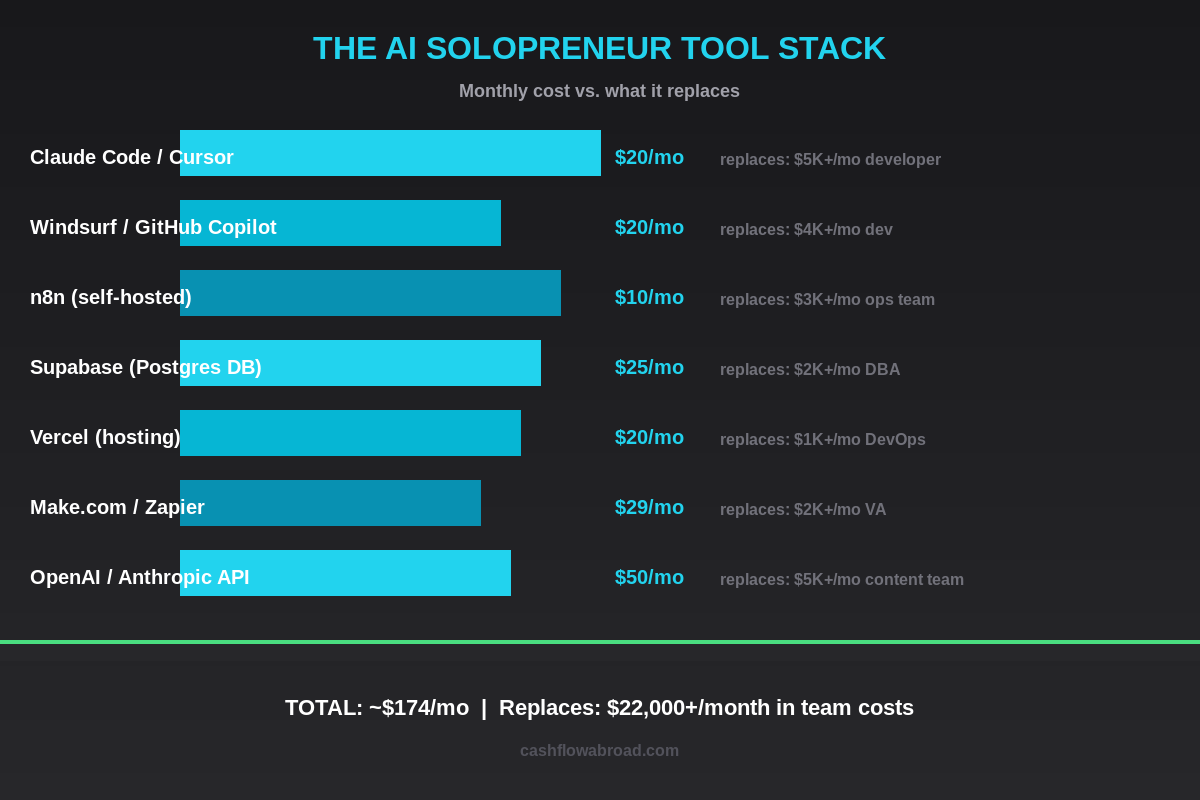
You don't need every tool in every category immediately. Start with one per layer and add as revenue grows. Here's what each layer does and what to use.
Layer 1 — AI Coding Intelligence (Your Virtual Developer)
This is the most impactful layer. AI coding tools have gone from "useful autocomplete" to "writes entire features from a description in plain English." Three tools dominate:
Cursor ($20/month Pro) — An AI-first fork of VS Code. Hit the Composer shortcut, describe the feature in English, and Cursor writes across multiple files simultaneously. It handles codebase-wide refactors, bug fixes, and new feature implementation. The Pro plan gives you unlimited Tab completions and $20/month in premium model credits (GPT-4o, Claude Sonnet). Most solopreneurs rate this as their single highest-ROI tool.
Windsurf ($20/month Pro as of 2026) — Windsurf's "Cascade" agent is particularly good at multi-file understanding and catching context that Cursor sometimes misses. Windsurf switched from credit-based to quota-based pricing in early 2026. At $20/month, it's a near-direct competitor to Cursor — many solopreneurs use both, switching based on the task.
Claude Code ($20–$100/month via API or Max plan) — Claude Code runs in your terminal rather than an IDE and excels at complex, multi-step agentic tasks: full feature builds, architecture decisions, debugging entire systems. The Max plan ($100/month) gives significantly expanded context and rate limits for heavy daily use. For autonomous agents and multi-turn coding workflows, Claude Code pulls ahead of IDE tools. Light users can stay on the API at $20–$40/month.
The practical workflow: use Cursor or Windsurf for in-IDE day-to-day coding, Claude Code for complex builds and architectural reasoning. Combined monthly cost: $40–$120.
Layer 2 — Backend Infrastructure (Database + Auth + Storage)
Supabase (Free tier → $25/month Pro) is the consensus choice for solo founders in 2026. It gives you a full PostgreSQL database, built-in user authentication (email, OAuth, magic links), real-time subscriptions, file storage, and edge functions — all through a clean dashboard and SDK. The free tier handles up to 500MB database and 5GB file storage, which is plenty for an MVP with hundreds of users. Scale to Pro ($25/month) when you need more.
What Supabase replaces: a database admin, a backend developer to wire up auth, and a DevOps engineer to manage PostgreSQL — conservatively $8,000–$15,000/month in contractor costs for a bootstrapped startup.
The modern solo stack for an AI SaaS product: Next.js 15 (frontend + API routes) + Supabase (database + auth) + Stripe (payments) + Vercel (hosting). This combination launches an authenticated, payment-enabled web app in days, not months.
Layer 3 — Deployment & Hosting
Vercel (Free → $20/month Pro) handles frontend hosting and serverless functions. Connect your GitHub repo and every push auto-deploys. Preview URLs for every branch. Built-in CDN across 100+ regions. For 95% of solopreneur AI products, the free tier covers launch. Pro at $20/month unlocks team collaboration, more serverless compute, and higher bandwidth limits.
For a VPS to run self-hosted tools like n8n or open-source models, DigitalOcean is the standard choice — a 2GB Droplet runs about $14/month and handles most n8n workloads easily. Their 1-click app marketplace makes deploying n8n or other tools a 5-minute job.
Layer 4 — Automation Orchestration
This layer is what most solopreneurs underinvest in — and it's the one that compounds hardest over time.
n8n (self-hosted: ~$10–14/month on a DigitalOcean Droplet) raised $180 million at a $2.5B valuation in 2025 and hit $40 million ARR with 10x year-over-year usage growth — which tells you how fast the automation-first model is spreading. It's open-source, you self-host it on a small VPS, and it connects 300+ services with visual workflow logic. Unlike Zapier, it supports complex branching, AI agent nodes (call Claude/OpenAI mid-workflow), code execution, and webhook handling — all without per-task pricing.
Make.com ($9–29/month) is the hosted alternative if you'd rather not manage a VPS. Slightly less powerful than n8n but has a polished UI and 1,500+ app connectors. A good starting point before you have the revenue to justify VPS overhead.
What you automate: lead capture → CRM entry → personalized follow-up email; new user signup → welcome sequence → usage analytics → churn alert; content generation → formatting → publish → social sharing. These workflows run 24/7 regardless of your timezone.
Layer 5 — AI APIs (The Brain of Your Product)
If you're building an AI-powered product, you need API access to a language model. Two options dominate:
Anthropic API (Claude Sonnet / Haiku) — Claude Sonnet 4.6 is the current workhorse: strong at reasoning, coding, and multi-turn conversations. Pricing: ~$3/million input tokens, ~$15/million output tokens for Sonnet. Claude Haiku is cheaper and faster for high-volume, simpler tasks (~$0.25/$1.25 per million tokens). Budget $30–$100/month for a product with active users. Prompt caching (built into the Anthropic SDK) reduces costs by 80–90% for repeated context — critical if you're serving many users with shared system prompts.
OpenAI API (GPT-4o / GPT-4o mini) — GPT-4o mini at $0.15/$0.60 per million tokens is the cheapest capable model for high-throughput applications. GPT-4o at $5/$15 per million tokens handles more complex reasoning. Most solopreneurs blend both: cheap mini for simple classifications and routing, a stronger model for generation and reasoning.
Open-source alternative: Ollama + Llama 3.3 lets you run models locally or on a $40/month GPU instance for zero API costs, but requires more engineering overhead to manage reliability at scale.
The Full Stack Cost Breakdown
| Tool | Monthly Cost | Free Tier? | What It Does |
|---|---|---|---|
| Cursor Pro | $20 | Yes (limited) | AI-first IDE, writes code from natural language descriptions |
| Claude Code (API/Max) | $20–$100 | Pay-as-you-go | Terminal-based AI coding agent for complex builds |
| Supabase | Free–$25 | Yes (generous) | PostgreSQL database, auth, storage, edge functions |
| Vercel | Free–$20 | Yes (excellent) | Frontend hosting, auto-deploy from GitHub |
| n8n (self-hosted on DO) | $10–$14 | Self-host free | Workflow automation, AI agent orchestration |
| Anthropic / OpenAI API | $30–$100 | Pay-as-you-go | Language model API — the core of your AI product |
| Stripe | 2.9% + $0.30/txn | No monthly fee | Payments, subscriptions, invoicing |
| Estimated total | $80–$259/month | Full product stack, MVP to $10K+ MRR |
Start at the bottom of that range. Use free tiers until you're generating revenue. Most profitable solopreneur products launch on under $100/month in tools and only scale costs as MRR grows.
Four Income Models That Work With This Stack

Model 1: Micro-SaaS ($500–$30K MRR)
A micro-SaaS is a narrow software product solving one specific problem for a defined audience, priced at $10–$99/month per user. The business model works for solopreneurs: monthly recurring revenue, no inventory, no shipping, 80–95% profit margins at scale.
Real examples: HeadshotPro ($3.6M ARR, one person), Bannerbear (AI image generation API, $2M+ ARR), Plausible Analytics ($2M+ ARR). None of these are unicorn ideas — they're focused tools that solve one problem extremely well.
Realistic first target: $3K–$10K MRR within 12 months. That covers your living expenses in most of Southeast Asia or LATAM with meaningful runway remaining. The stack above handles the entire technical implementation without hiring anyone.
Model 2: AI Automation Services ($3K–$15K/month)
Businesses pay $3,000–$10,000 for a custom n8n or Make.com workflow that automates a painful process — lead qualification, client onboarding, invoice processing, customer support triage. This is project revenue, not recurring, but it's cash-positive from day one and requires no product-market fit validation.
The niche plays best: real estate agencies automating lead-to-appointment pipelines; e-commerce stores automating customer support and review collection; professional services firms (law, accounting) automating client intake and document processing. Each workflow takes 20–40 hours to build and can be productized into a repeatable offer at the same price point for the same vertical.
Many solopreneurs start here — service revenue covers living costs while you build the SaaS product. It also surfaces product ideas from real client pain.
Model 3: Productized Digital Tools ($2K–$8K/month)
Not every AI product needs to be a subscription SaaS. Prompt packs, AI workflow templates, n8n template bundles, and automated content systems sell on Gumroad, LemonSqueezy, and direct via Stripe for one-time payments of $19–$197. Build once, sell repeatedly.
A well-positioned n8n template bundle for a specific vertical — say, "AI Customer Support Automation for E-commerce Stores" — can sell 50+ copies at $97 = $4,850 without a single line of custom code after the initial build. Gil Hildebrand pre-sold $20,000 in lifetime deals before writing a line of code by validating demand with a landing page first. That's the playbook: confirm people will pay, then build.
Model 4: AI-Assisted Freelancing ($5K–$20K/month)
If you already have a marketable skill — development, copywriting, design, video editing — AI tools let you execute at 3–5x your previous speed. That means either taking on more clients at the same rates or charging more while delivering faster.
AI-augmented developers on Toptal and Contra are commanding $120–$200/hour. An AI-assisted copywriter producing 4x the output can run $10K/month in retainer clients that previously required a team. The key: position around outputs and results, not hours. Deliver faster. Charge the same. Pocket the margin.
The 90-Day Launch Roadmap
Days 1–14: Stack setup and skill acquisition. Sign up for Cursor (free trial), Supabase (free), Vercel (free), and the Anthropic or OpenAI API. Build a simple CRUD app with authentication using Next.js + Supabase — just to feel the stack. The goal is one functioning prototype, not a polished product. A basic to-do list app with user accounts is enough.
Days 15–30: Find the problem. Spend 2 weeks in communities (Reddit niches, Indie Hackers, specific Slack/Discord groups) and identify a pain point someone is complaining about repeatedly. Don't pick a problem you invented — find one people describe in detail and in their own words. Validate with a waitlist landing page before writing product code. Aim for 50+ email signups before building anything.
Days 31–60: Build the MVP. Use Cursor and Claude Code to build the minimum version of your solution. Aim for 10 core features, not 50. Ship when it's "embarrassingly simple but actually solves the problem." Charge from day one — even $19/month. Free users give feedback; paying users give feedback that's worth acting on.
Days 61–90: Automate and distribute. Wire n8n workflows to handle onboarding emails, usage tracking, and churn alerts automatically. Build one distribution channel: a simple blog with SEO posts, a Twitter/X presence with weekly build updates, or a niche community. One channel only — spreading thin kills early-stage solopreneur businesses faster than anything else.
The Infrastructure You Need Before Day One
Before you launch a paying product, two things need to be locked in:
US banking: If you're a US citizen or plan to serve US customers, you need a US business bank account that works for SaaS revenue while you're living abroad. Mercury is the standard for remote founders — free, fully online, handles Stripe payouts natively, and has no minimum balance requirements. Unlike traditional banks, it doesn't freeze accounts when you log in from Tbilisi.
US mailing address: Most US business formations, banking, and payment processors require a US address. Traveling Mailbox gives you a real street address that scans and forwards physical mail digitally — essential when operating a US LLC from abroad. Plans start at $15/month and the setup takes 10 minutes. For the complete virtual mailbox comparison, see this guide.
Security: When you're coding and managing client data on public WiFi in a café in Lisbon or a co-working space in Bali, a VPN is non-negotiable. NordVPN has servers in 111 countries and runs $4–5/month on an annual plan. It protects your API keys, your customer data, and your own credentials from the moment you start handling real user data.
For the full playbook on running a US business entity while living abroad — including tax structure, LLC vs. S-corp decisions, and the banking setup — this post covers it in detail.
One More Reality Check
The tools are real. The income models are real. What's also real: most solo products never reach $1K MRR. Not because the stack is wrong — because founders build things nobody needs, or they build in isolation without shipping early, or they abandon the product before the compound effect of SEO and word-of-mouth kicks in (which usually takes 6–12 months of consistency).
The solopreneurs who succeed share one trait: they shipped something embarrassingly simple, then iterated based on actual user feedback. HeadshotPro launched as a basic image upload form connected to Stable Diffusion. Bannerbear started as a single API endpoint. The stack above lets you ship that first version in days. What you do after you ship is the differentiator.
The geographic arbitrage piece makes this lifestyle financially viable through the early lean months — when revenue is $0–$3K/month and runway is everything. If $2,000/month covers your life in Medellín while you build, that's 5x more time on the clock than if you need $8,000/month in San Francisco. The tools compressed the cost of building. Geography compresses the cost of living. That combination changes what's possible.
Conclusion
The one-person AI business isn't a fantasy. It's a specific set of tools, income models, and geographic decisions that combine into a fundamentally different financial structure. The stack — Cursor or Claude Code for development, Supabase for infrastructure, Vercel for hosting, n8n for automation, and an AI API for your product's core — costs under $260/month and replaces a team that would cost $30,000–$50,000/month to hire. Add the geographic arbitrage of living on $1,500–$2,000/month while earning $5K–$20K/month and the math is hard to argue with.
The only thing standing between you and that outcome is shipping something.
Financial disclaimer: Income figures cited are from third-party reports and case studies of specific solopreneurs. Individual results vary significantly based on skills, market timing, product quality, and execution. Nothing in this post constitutes financial or legal advice. Always consult a qualified advisor before making business or investment decisions.
This guide is general information, not personalized tax, legal, or investment advice. Rules change; verify current thresholds with official sources or a qualified professional before acting.
Related guides
 AI Income & Cash FlowJune 13, 2026
4 No-Code AI Products: $1k–$3k Per Build, No Coding
Four no-code AI products — chatbots, lead bots, content pipelines, review automation — that generate $1k–$3k builds and monthly retainers from abroad.
 AI Income & Cash FlowJune 12, 2026
Sell AI Cold Email as a Service From Abroad
Launch a done-for-you AI cold email lead gen service for US clients abroad. Tool stack under $600/month. Realistic path to $10K+ net monthly.
 AI Income & Cash FlowJune 11, 2026
Telegram AI Bots: A Zero-Fee Service Business Abroad
Build and sell Telegram AI bots using a free API, $12/mo VPS, and Claude Haiku. Charge $1,200-$7,000 per build and $75-$500/mo in retainers from