Oman for US Expats: 0% Tax and Gulf Living for $1,600/Month
Every year, thousands of US expats pack up for Dubai chasing zero-income-tax and Gulf lifestyle. Most Americans have never seriously considered it.
Every year, thousands of US expats pack up for Dubai chasing zero-income-tax and Gulf lifestyle. Most Americans have never seriously considered it.
Disclosure: this article contains affiliate links. If you open an account through one of them, Cashflow Abroad may earn a referral commission at no extra cost to you.
Every year, thousands of US expats pack up for Dubai chasing zero-income-tax and Gulf lifestyle. Dubai delivers on both — then hands you a $3,500 rent bill and a traffic jam on Sheikh Zayed Road. Three hours down the coast sits Oman, offering identical zero-income-tax status at 30–35% lower cost of living, beaches that aren't lined with skyscrapers, and a quality of life that keeps expats renewing their visas for a decade. Most Americans have never seriously considered it. That's the arbitrage.
Oman collected zero personal income tax through 2025 and will do the same through the end of 2027. The new Personal Income Tax Law (Royal Decree No. 56/2025) only kicks in January 1, 2028 — and even then, the 5% rate only applies to annual income above OMR 42,000 (~$109,000). The Oman Tax Authority itself estimates 99% of residents will pay nothing under the new law. For most US expats earning remote income and using the Foreign Earned Income Exclusion to wipe out most US federal tax, Oman is one of the most underbuilt setups in the Gulf.
Why Oman Works for US Expats
Oman is a constitutional monarchy on the southeastern tip of the Arabian Peninsula, bordering the UAE and Saudi Arabia. Muscat is the capital and main expat hub — a city of roughly 1.5 million spread along a coastline backed by the Hajar Mountains. Unlike Dubai, it wasn't built overnight. Architecture regulations have kept buildings low-rise and the city feels calm, almost Mediterranean in pace, with a genuine local culture that predates the oil boom.
The economic fundamentals are straightforward: oil revenue funds a generous welfare state for Omani nationals, expats pay nothing in income tax, and the government has no particular interest in taxing foreign workers given that expats make up roughly 45% of the total population and are the backbone of the private sector workforce. The 2028 income tax law is primarily a fiscal signaling exercise — a first-of-its-kind move in the GCC that targets high earners, not the typical remote worker or mid-career expat.
There's also a US–Oman Free Trade Agreement in force since 2009. While that doesn't create a bilateral tax treaty (the US has no income tax treaty with Oman), it streamlines commercial relationships and makes the country genuinely open to American-run businesses operating there.
The 2028 Tax Law: What Actually Changes
Oman made GCC history on June 22, 2025, when it issued Royal Decree No. 56/2025 — the Personal Income Tax Law. The law takes effect January 1, 2028. Here's the actual structure:
| Annual Income (OMR) | Annual Income (USD approx.) | Tax Rate |
|---|---|---|
| Below OMR 42,000 | Below ~$109,000 | 0% |
| Above OMR 42,000 | Above ~$109,000 | 5% on excess only |
A few nuances the headlines missed. First, income earned abroad is explicitly listed as exempt under the law's exemption provisions. If you're a US remote worker earning income from US-based clients, that income may not be considered Omani-sourced — meaning it won't be taxed even after 2028, assuming the implementing regulations (expected before January 2028) hold that interpretation. Other exemptions include retirement contributions, education and healthcare expenses, primary residence sales, inheritance, gifts, and government bond interest.
Second, for the expat earning between $100,000 and $150,000: the 5% only applies to the slice above $109,000. A $130,000 earner would owe Oman roughly $1,100/year starting 2028. That's less than one month of rent in most major US cities. The law is narrow by design.
The practical takeaway: if you earn under $109,000 annually in Oman, the 2028 law doesn't touch you. If you earn more, you're paying 5% on the excess — a rate that's still far below any Western country equivalent. This remains one of the most favorable income tax environments on earth even after the reform.
US Tax Obligations: FEIE in a Zero-Tax Country
US citizens and green card holders owe US tax on worldwide income regardless of where they live. Moving to Oman doesn't eliminate your filing obligation — you still file Form 1040 every year. But Oman's zero-tax status dramatically shapes which US relief strategy makes sense.
In high-tax countries like Germany or France, US expats typically use the Foreign Tax Credit (FTC) — you offset your US tax bill with a dollar-for-dollar credit for foreign taxes already paid. In Oman, there are no foreign taxes to credit. That makes the FTC useless.
The Foreign Earned Income Exclusion (FEIE) is the move. For 2026, the FEIE allows qualifying expats to exclude the first $132,900 of foreign earned income from US federal income tax. A single expat earning $100,000 in Oman owes zero US federal income tax on that entire amount after the exclusion. A couple each earning $100,000 can exclude $265,800 combined. You qualify via the Physical Presence Test (330 days outside the US in a 12-month period) or Bona Fide Residence Test (established residence in Oman for an uninterrupted tax year).
Important planning note: FEIE only covers earned income — wages, salaries, self-employment. Investment income (dividends, capital gains, rental income) is still taxed at normal US rates regardless of where you live. And self-employed expats who exclude all earned income via FEIE should be careful about retirement account contributions — your Solo 401(k) or SEP-IRA contribution limit is based on net self-employment income after the exclusion, which can drop your deductible contribution to zero. For a full breakdown of that trap, see the expat investing playbook.
You'll also need to file an FBAR (FinCEN 114) if your Omani bank account balance exceeds $10,000 at any point in the calendar year. FATCA reporting (Form 8938) applies if foreign financial assets exceed $200,000 for single filers abroad. Full details in our US expat banking and taxes guide.
Cost of Living: The Real Numbers
Muscat consistently prices out 25–35% below Dubai across every major budget category. The Omani rial (OMR) is pegged to the US dollar at 1 OMR = $2.60, so every calculation converts cleanly without worrying about currency risk. Here's a realistic monthly budget for a single expat:
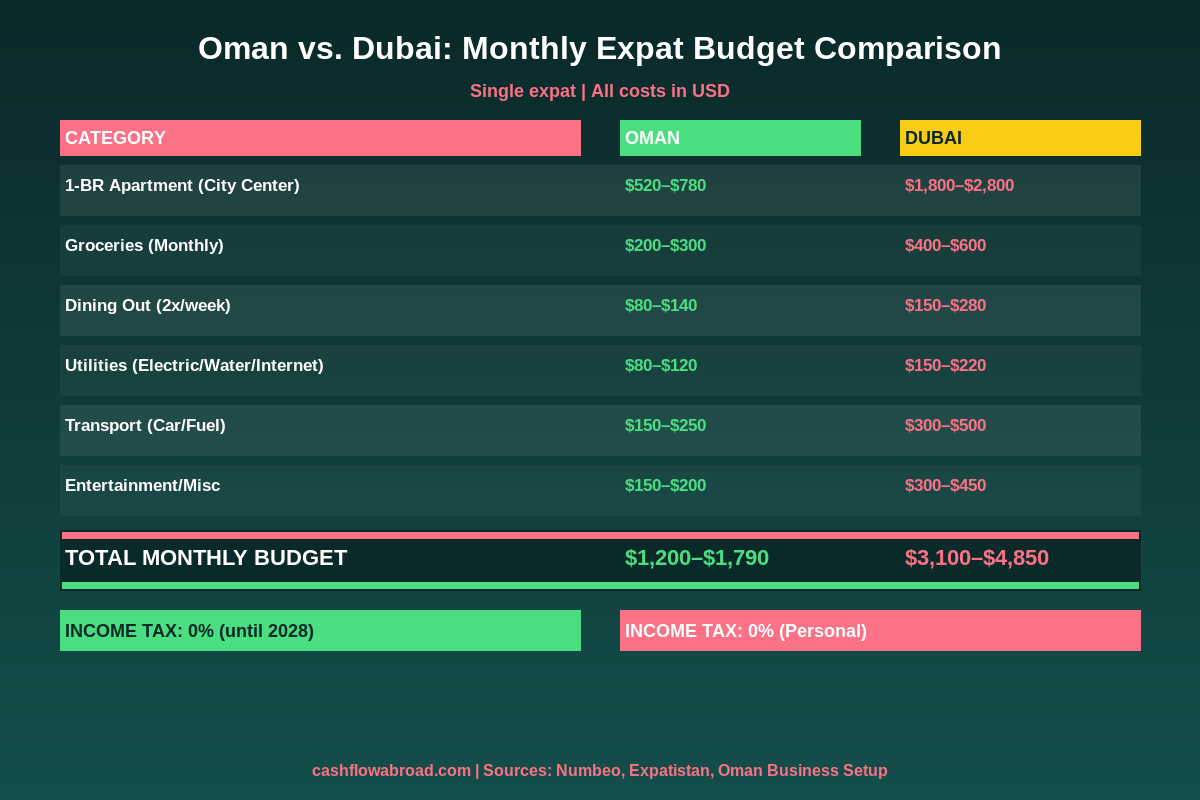
| Expense | Monthly Cost (USD) | Notes |
|---|---|---|
| 1-BR Apartment (city center) | $520–$780 | Al Qurum, Ruwi; upscale areas (Al Mouj, Shatti) run $780–$1,300 |
| Groceries | $200–$320 | Lulu Hypermarket and Carrefour throughout Muscat |
| Dining out (2–3x/week) | $100–$180 | Good sit-down meal: $12–$20/person; street food cheaper |
| Utilities (electric, water, internet) | $80–$130 | A/C costs spike in summer; 300 Mbps fiber ~$50/mo |
| Transport (car + fuel) | $150–$250 | Fuel ~$0.63/liter; Muscat is almost entirely car-dependent |
| Health insurance | $80–$200 | Mandatory for residency; local plans widely available |
| Entertainment + misc | $150–$250 | Beach clubs, weekend desert trips, cafes |
| Total | $1,280–$2,110 | Comfortable single expat lifestyle in Muscat |
Alcohol is legal in Oman but sold only at licensed hotel restaurants and a handful of retail outlets. Prices run 2–3x higher than Western grocery stores. Budget an extra $100–$200/month if you drink regularly, or plan on adjusting habits. For families, a 3-bedroom villa in an expat area runs OMR 700–1,200/month ($1,820–$3,120), bringing total monthly costs to $3,500–$5,500 depending on school fees — international schools in Muscat charge $8,000–$18,000/year.
Summer in Muscat (June–September) regularly hits 40°C+ with high humidity, which drives A/C bills from $80 to $150–$200/month. Most long-term expats use those months for home visits or regional travel — Nairobi, Colombo, and Bangkok are all under 4 hours by air from Muscat International.
Visa Options for US Expats
Oman doesn't have a dedicated digital nomad visa. But several pathways provide legitimate long-term residency:
Employer-Sponsored Work Visa
The most common route. Your Omani employer sponsors your residency permit, typically renewed every 2 years. Oman has a substantial expat workforce across oil and gas, construction, hospitality, finance, education, and healthcare. The visa is tied to your employer, but Oman relaxed job-switching rules significantly in 2021 — you can change employers without leaving the country, provided both parties agree or a dispute resolution process is followed.
Freelancer / SPC Business Visa
Form a Single Person Company (SPC) in Oman — your own company then sponsors your work visa as the shareholder and director. Setup costs run OMR 500–1,500 ($1,300–$3,900) depending on business type and whether you use a formation agent. Annual maintenance: OMR 200–400. This is the cleanest path for remote workers and freelancers who want to be legally self-employed without depending on a local employer sponsor. Processing time: 4–8 weeks.
Property or Investment Residency
Oman launched a formal long-term residency program in August 2025 as part of Vision 2040:
- Silver Residency: Invest OMR 250,000 (~$650,000) in an Omani company or qualifying property → 5-year renewable residency for applicant, spouse, and children
- Golden Residency: Invest OMR 500,000 (~$1.3 million) → 10-year renewable residency with expanded property rights, including purchase outside standard foreign-ownership zones
For most expats, the investment thresholds are prohibitive. But if you're planning to buy property in Oman anyway, several Integrated Tourism Complexes (ITCs) — The Wave Muscat, Al Mouj, Jebel Sifah — allow foreigners to purchase freehold, and the associated residency can be valuable for the right buyer profile.
Retirement Residency
US retirees over 60 can apply for a 5-year residency with proof of fixed income of at least OMR 4,000/month (~$10,400). That threshold is steep — it's designed for wealthier Gulf-region retirees. If you're drawing Social Security plus a pension plus investment distributions that add up, it's worth checking. Otherwise, the SPC route is typically more practical for retirees who want flexibility. For a broader comparison of retirement destinations abroad, see the retirement abroad guide.
What Life in Muscat Actually Looks Like

Muscat is compact, clean, and genuinely safe. The Global Peace Index consistently places Oman in the top 15 globally, ahead of most Western European nations. Crime against foreigners is rare. The legal system is Sharia-based but applied pragmatically — alcohol is tolerated in licensed venues, Western dress is acceptable in most areas, and expats encounter minimal harassment from authorities.
The expat community is large and self-organizing. Roughly 45% of Oman's 4.9 million residents are foreign nationals. There's a substantial South Asian workforce in construction and service industries, a Gulf-region professional expat layer (finance, oil, education), and a smaller but active Western community centered in Al Qurum, Madinat Sultan Qaboos, and coastal neighborhoods. Networking happens through international chambers of commerce, private club events, and the inevitable expat Facebook groups that cover everything from plumbers to tax accountants.
Internet infrastructure is solid. Multiple 5G providers and fiber rollout throughout Muscat deliver 200–500 Mbps at reasonable prices. VPN usage is legal (unlike some neighboring countries), though some streaming platforms geo-restrict content. For consistent access to US streaming services and banking platforms, NordVPN handles it cleanly.
Healthcare quality is high by regional standards. The private system — Royal Hospital, Muscat Private Hospital, Al Shifa — handles most expat medical needs without excessive waits. Health insurance is mandatory for residency holders. Many expats use international plans that work across the Gulf region; SafetyWing covers Oman starting around $80/month, though a local Omani plan is often more cost-effective once you have residency and a stable base.
Banking and Money
Opening a local bank account requires a residency visa, passport, and employment or sponsor letter. Bank Muscat is the largest and most widely used local bank. HSBC and Citibank maintain branches. International transfers are generally frictionless — Oman doesn't have the capital controls you'd find in Egypt or Argentina.
For US-side banking, the standard expat setup is a Charles Schwab international checking account — Schwab reimburses all ATM fees worldwide with no monthly fee, which matters when you're pulling cash in Muscat. For business banking if you're running a remote company, Mercury handles US-based business accounts with no monthly fees and clean international wire support.
One underrated friction point: maintaining a US mailing address. You need it for IRS correspondence, US bank accounts, state domicile documentation, and credit card statements. A virtual mailbox like Traveling Mailbox gives you a real US street address in 50+ cities for about $15/month, scans your mail on demand, and handles check deposits. Set this up before you leave the US — retroactively changing addresses on bank accounts from abroad is a headache. See our full expat virtual mailbox guide for how to structure this.
For USD-to-OMR transfers: Remitly handles this competitively. The OMR-USD peg eliminates exchange rate risk entirely — 1 OMR has equaled $2.60 since 1986. That predictability is a genuine advantage over living in a floating-currency country.
Oman vs. Other Gulf Tax Havens
| Country | Income Tax | Single Monthly Budget | Best For |
|---|---|---|---|
| Oman | 0% (5% above $109K from 2028) | $1,300–$2,100 | Value, safety, slower pace, outdoor life |
| Dubai (UAE) | 0% | $3,000–$5,000 | Career networking, luxury lifestyle, finance sector |
| Bahrain | 0% | $2,000–$3,200 | Gulf finance sector, weekend access to Saudi |
| Qatar | 0% | $2,500–$4,000 | Oil and gas industry, high salary packages |
| Kuwait | 0% | $2,200–$3,500 | Government/corporate jobs, large expat community |
The pattern across the Gulf is clear: zero personal income tax is the baseline, not the differentiator. Cost of living is where the real spread emerges. Oman occupies the cheapest position among livable Gulf options by a significant margin. Dubai wins on career networking density and global connectivity. Oman wins on value per dollar, natural environment (desert, mountains, fjords, and pristine coastline all within a 3-hour drive), and stability.
For the digital nomad or remote worker comparing options, Oman sits in an interesting middle tier: more affordable than the UAE or Qatar, far safer and more stable than many Southeast Asian alternatives, and offering a genuinely different quality of life for people who've tired of the standard Bali/Chiang Mai circuit.
The Honest Downsides
No arbitrage setup is perfect. Oman's friction points are real:
- Summer heat. June–September in Muscat is brutal: 40°C+ with high humidity. Outdoor activity becomes impractical midday. Most long-term expats treat summer as travel season.
- Car dependency. Muscat has negligible public transit. A car is essential, which means navigating a local license (your US license gets a 1-year grace period for most nationalities), insurance, and registration paperwork.
- Limited nightlife. Oman is socially conservative. Bars are confined to hotel venues and a few licensed clubs. This is a genuine lifestyle consideration for anyone whose social life centers on bar culture.
- No digital nomad visa. Without a dedicated DN visa, you need an employer sponsor or must form an SPC, which adds setup cost ($1,300–$3,900) and complexity versus a simple visa on arrival.
- Banking friction for new arrivals. Opening an Omani bank account before you have a residency card is slow. Budget 4–8 weeks from arrival to functional local account.
- 2028 regulatory uncertainty. The implementing regulations for the income tax law haven't been published. The foreign-income exemption could be interpreted narrowly in ways that surprise some expats. Anyone planning a multi-year stay should monitor the regulatory guidance as it develops.
Who Should Seriously Consider Oman
Oman works best for a specific expat profile: someone earning remotely (or in a regional role) who values zero-tax status, wants genuine safety without the Dubai price premium, and can handle a conservative social environment. Remote workers running US-based freelance businesses can structure a clean setup — form an SPC, take the FEIE, maintain a US virtual mailbox and Schwab account — and end up with a combined US + Oman tax bill close to zero on income under $132,900.
Retirees with decent passive income who qualify for the retirement visa will find the cost structure exceptionally comfortable. Families willing to pay international school fees get access to a safe, outdoor-friendly environment with desert camping, rock climbing, whale shark diving, and weekend road trips to Wahiba Sands.
It's the wrong fit if your priority is career climbing in global finance (Dubai), vibrant nightlife (Southeast Asia or Eastern Europe), or cutting monthly spend below $1,000 (geographic arbitrage in Latin America or Southeast Asia covers that ground better).
But if "Gulf lifestyle quality at 35% below Dubai cost" is an interesting problem to you — Oman rewards a 30-day trial. Fly into Muscat, take a furnished apartment in Al Qurum for a month, and let the math and the lifestyle compete for your attention. Most people who try it either leave immediately (heat and conservatism rule them out quickly) or quietly extend their lease for another year.
Conclusion
Oman is the Gulf's most overlooked expat destination. Zero personal income tax through the end of 2027, a 5% rate starting 2028 that only applies above $109,000, cost of living 30–35% below Dubai, and a stable, safe country that has quietly welcomed expat workers for decades. The window before 2028 is real and wide open. The 2028 reform is far less disruptive than the headlines suggest — 99% of residents will pay nothing, and the foreign-income exemption may exempt most remote workers entirely.
The setup is straightforward: FEIE excludes up to $132,900 in earned income from US federal tax, a US virtual mailbox handles your domestic presence, Schwab provides fee-free ATM access globally, and an Omani SPC gives you legal freelance status. The result is a tax-efficient, affordable, genuinely livable base that most expats skip because they've never looked past the Dubai billboard.
This post is for informational purposes only and does not constitute tax, legal, or financial advice. US tax law is complex and individual circumstances vary substantially. Consult a qualified US expat CPA or enrolled agent before making any decisions about your tax strategy, residency, or financial structure abroad.
This guide is general information, not personalized tax, legal, or investment advice. Rules change; verify current thresholds with official sources or a qualified professional before acting.
Related guides
 Geographic ArbitrageOctober 25, 2026
Italy Nomad Visa Income Requirements
Italy's nomad visa income test is €25,500 on 2026 sheets. See the $133.60 Washington fee and the US return you still file.
 Geographic ArbitrageOctober 4, 2026
Greece Nomad Visa: The €3,500 Monthly Test
See whether your pay clears Greece's digital nomad visa: €3,500 net a month, or €4,200 with a spouse, before you apply now.
 Geographic ArbitrageSeptember 21, 2026
Korea F-1-D Workation Income Rules for Expats
As of June 2026, Korea’s F-1-D visa starts at ₩52.4M outside Seoul for ages 18–34. Map income tiers, US FEIE, and where you park the paycheck.