No-Code AI Income: Build $5K/Month Without Writing Code
The average AI automation consultant on Upwork earned 44% more than the platform average in 2025 — and most of them couldn't write a single line of Python.
The average AI automation consultant on Upwork earned 44% more than the platform average in 2025 — and most of them couldn't write a single line of Python.
Disclosure: this article contains affiliate links. If you open an account through one of them, Cashflow Abroad may earn a referral commission at no extra cost to you.
The average AI automation consultant on Upwork earned 44% more than the platform average in 2025 — and most of them couldn't write a single line of Python. The no-code AI wave isn't coming. It's already here, and the people living in Chiang Mai or Medellín on $1,800 a month are quietly pocketing $5,000–$15,000 monthly servicing US and European clients who have no idea where their contractor lives.
This post covers three concrete no-code AI income paths — automation freelancing, building micro-SaaS products, and selling workflow templates — with specific tools, real pricing, and step-by-step workflows you can start this week.
Why No-Code AI Is the Best Entry Point for Expats
Traditional software development has a years-long learning curve. No-code AI doesn't. Platforms like n8n, Make, Bubble, and Glide have reduced the technical barrier so far that the primary skill isn't coding — it's problem diagnosis. Can you look at a business process and identify where three hours of weekly manual work could become a 15-minute automated flow? That judgment is worth $75–$200/hour.
The geographic arbitrage angle is particularly sharp here. Your clients are paying Silicon Valley–adjacent rates for a skill that can be practiced from anywhere with a $50/month Airbnb WiFi connection. Meanwhile your cost of living is a fraction of theirs. A $3,000/month retainer in Medellín buys a lifestyle that would require $9,000+ in San Francisco.
The global no-code AI platform market was valued at $6.56 billion in 2025 and is projected to hit $75 billion by 2034. Businesses are buying — the question is who sells to them.
The Three No-Code AI Income Paths
Path 1: AI Automation Freelancing
This is the fastest path to your first dollar. You use tools like Make, n8n, or Zapier to build automated workflows for small businesses, agencies, and e-commerce operators. No code required — just drag, drop, and connect.
What you're actually building: Lead follow-up sequences that fire when someone fills out a contact form. Invoice reminders that chase overdue clients automatically. Customer service pipelines that route support tickets to the right inbox, send an AI-generated first response, and log everything in a CRM. CRM-to-email flows, Shopify-to-accounting syncs, social post schedulers. Most clients don't need anything exotic.
Income ranges from the market:
- Beginners (0–6 months): $500–$1,500/month
- Intermediate (6–18 months): $3,000–$8,000/month
- Advanced with retainers: $8,000–$25,000/month
- Hourly rate (once established): $75–$200/hour
One automation consultant in the Make community automated a client's e-commerce customer service flow — abandoned cart emails, return request routing, review follow-ups — and charges a $4,000/month retainer for maintenance and new builds. That's one client. Most established freelancers have three to five.
Which tool to learn first: Start with Make (formerly Integromat). The free plan gives you 1,000 operations/month and two active scenarios — enough to complete your first five client projects before you need to spend anything. Make's visual canvas is intuitive and its 1,000+ integrations cover almost every tool a small business uses.
Once you're charging $2,000+ per project, evaluate n8n. n8n's cloud starts at €20/month for 2,500 workflow executions, but the real power is self-hosting — you spin up a $12/month DigitalOcean droplet, install n8n via Docker, and you have unlimited executions with no per-run cost. n8n raised $180M at a $2.5 billion valuation in late 2025 — it's not a toy.
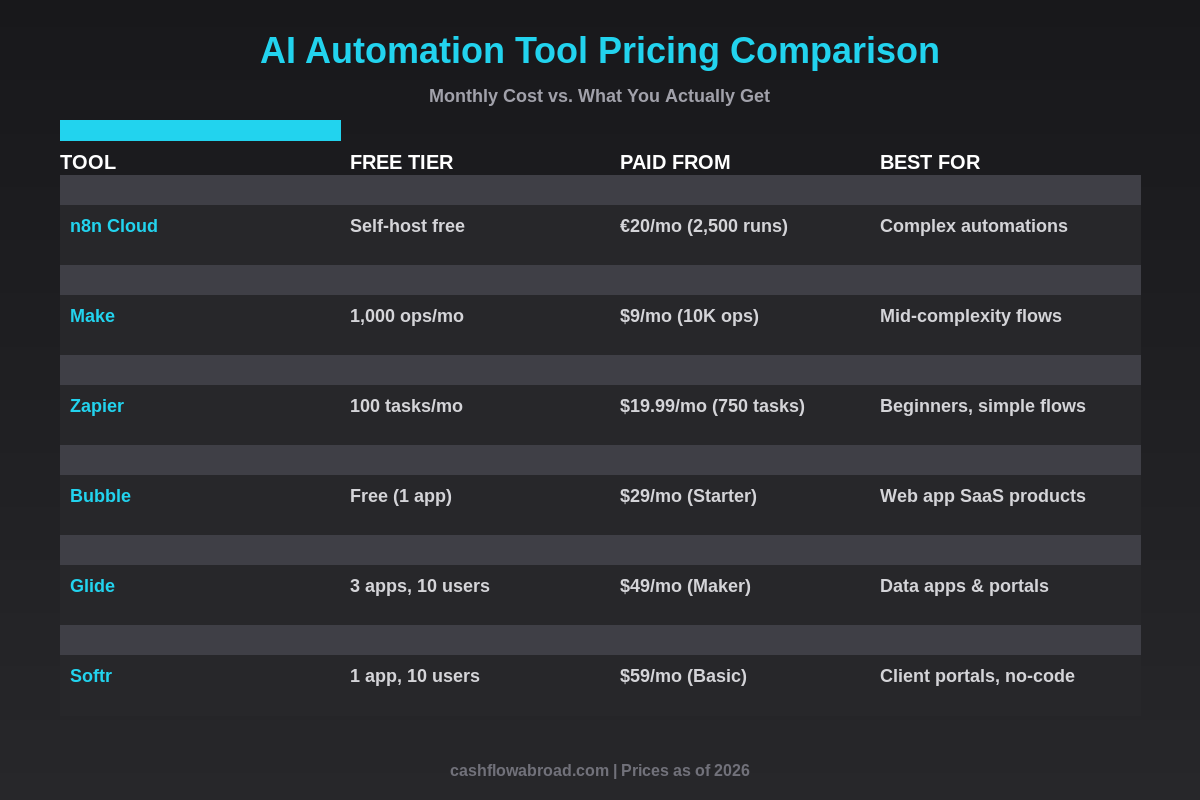
Avoid Zapier for agency work. Its 100-task free tier and $19.99/month "Professional" plan (just 750 tasks) get expensive fast when you're managing multiple clients. A multi-step e-commerce workflow running 20,000 times per month would cost $500+/month on Zapier versus maybe $30 on n8n self-hosted.
Path 2: No-Code AI SaaS Products
This path requires more upfront work but produces income that doesn't require you to trade hours for dollars. You build a product once on a no-code platform, hook it up to an AI API, charge $29–$299/month, and let it run.
Real example: A solo founder built a quiz and assessment tool on Bubble, connected it to OpenAI's API for personalized analysis, and priced it at $29/month. After 14 months he had 380 paying users — $11,020 MRR. His total tool cost: under $150/month (Bubble Growth plan plus OpenAI API usage).
The tool stack for a no-code SaaS:
| Platform | Use Case | Free Tier | Paid From |
|---|---|---|---|
| Bubble | Full web app with complex logic, databases, user auth | 1 app (Bubble branding) | $29/mo (Starter) |
| Glide | Data-driven apps from spreadsheets or Airtable | 3 apps, 10 users | $49/mo (Maker) |
| Softr | Client portals, membership sites, directories | 1 app, 10 users | $59/mo (Basic) |
| MindStudio | AI-native apps without traditional workflow builders | Limited AI credits | $19/mo |
How to add AI to any of these: Every major no-code platform supports HTTP requests. You send data to OpenAI, Anthropic, or any open-source model endpoint, get back a response, and display it. The technical skill required is knowing how to make a POST request with a JSON body — which every platform handles with a point-and-click interface. OpenAI's API costs roughly $0.002 per 1,000 tokens for GPT-4o-mini, meaning most user interactions cost fractions of a cent.
Proven SaaS niches that work without coding:
- AI proposal generators for freelancers and agencies
- Niche content brief tools for SEO agencies
- Job description generators for HR teams
- AI-powered intake forms that summarize and route leads
- Industry-specific document analyzers (lease review, contract summary, medical notes)
- Custom chatbots trained on client documentation
Bubble is the right choice when your product needs user authentication, a database, complex conditional logic, or payment processing (it integrates with Stripe natively). Glide is faster when your data lives in a Google Sheet. Softr is the path of least resistance for client-facing portals and membership sites.

Path 3: Sell Pre-Built Workflow Templates
The most passive path. You build automation workflows in Make or n8n, export them as templates, and sell them on marketplaces. No ongoing client work. No support calls at 2am.
Where to sell:
- Gumroad — zero upfront cost, 10% fee plus payment processing. Best for launching fast.
- Payhip — 5% fee on the free plan, lower than Gumroad.
- n8n's official template library — free exposure, drives buyers to your paid extended versions.
- Make's template library — free templates as lead gen, premium bundles on Gumroad.
- Etsy — Yes, Etsy. Digital downloads of automation templates sell there with surprisingly low competition.
Realistic pricing: Individual templates sell for $19–$97. Bundles (5–10 templates for a specific industry) go for $149–$299. Build 20 templates in your first 90 days, price at $39 average, sell 40 copies per month — that's $1,560/month in passive income stacked on top of whatever you're making from clients.
The leverage is in niching down. "CRM automation template" is too broad. "Monday.com-to-Slack standup bot for remote teams" is specific enough that someone Googling exactly that problem finds you and buys immediately.
The Geographic Arbitrage Edge
Here's the math that makes this work so well from abroad. An automation consultant with two US clients at $5,000/month retainer earns $10,000 gross. Living in Medellín or Tbilisi, that $10K covers rent, food, travel, and tool costs — with $6,000–$7,000 left over for savings or investment.
The same person living in Austin, Texas takes home maybe $6,500 after taxes and burns $4,000 on rent. Net savings: $2,500. The expat's net savings: $6,500+. That's the arbitrage. It's not a trick — it's a structural advantage that compounds over time. A deep breakdown of which countries work best for this is worth reading if you're choosing where to base yourself.
One practical consideration: client calls. If your clients are US-based, you'll need overlap with Eastern or Central time. Colombia, Peru, and Mexico share time zones with the US. Southeast Asia requires blocking early morning. This matters more than most people admit — a client who can't reach you during their business hours won't renew.
For keeping a US business address while abroad, a virtual mailbox like Traveling Mailbox ($15–$25/month) gives you a real street address in any US state — critical for banking, LLC registration, and looking legitimate to US clients who are nervous about offshore contractors.
Getting Your First Client: A Realistic Plan
Don't touch Upwork or Fiverr until you have one portfolio piece. Before that, your pitch is "I want to learn your automation stack" — which is a low-conversion conversation.
Week 1–2: Build your portfolio piece. Pick a real business process — your own, a friend's, a local business. Build an automation that solves a real problem. Document it with a Loom walkthrough. This is your proof of concept.
Week 3–4: Outreach. Target businesses with obvious automation gaps: real estate agencies that manually follow up leads, e-commerce stores without abandoned cart sequences, marketing agencies manually compiling client performance reports. Send 20 direct messages per day on LinkedIn with a specific observation about their process: "I noticed you don't have automated follow-ups on your contact form — that's typically a $3K–$8K/year problem for businesses your size. I can fix that in a week."
First client pricing: Charge $500–$1,000 for your first build. It's below market, but you'll learn what clients actually need versus what they say they need. After three projects you'll have enough pattern recognition to charge $2,000–$5,000 per build and justify every dollar.
Once you have two or three clients:
- Create a Upwork profile with your case studies and Loom demos.
- Post one educational piece of content per week on LinkedIn — short-form, specific automation tip.
- Price retainers at $500–$1,500/month for "maintenance plus one new flow per month." Most clients say yes because it's cheaper than hiring someone full-time.
Your Business Infrastructure Stack
Running this from abroad requires a few non-negotiables:
Banking: Mercury is the standard for expat entrepreneurs running a US LLC. Free business checking, ACH transfers, international wires, and no monthly fees. Clients pay you in USD, Mercury holds it, you transfer to a local account as needed.
Self-hosting your tools: Once you're charging $2,000+ per project, self-hosting n8n on DigitalOcean saves $100–$300/month compared to cloud plans. A $12/month Droplet running n8n via Docker handles 50+ client workflows. Install it with:
docker run -it --rm \
  --name n8n \
  -p 5678:5678 \
  -e N8N_BASIC_AUTH_ACTIVE=true \
  -e N8N_BASIC_AUTH_USER=admin \
  -e N8N_BASIC_AUTH_PASSWORD=yourpassword \
  -v ~/.n8n:/home/node/.n8n \
  n8nio/n8n
That's the entire install. Your n8n instance is live at your droplet's IP on port 5678. Add a domain and SSL with nginx + certbot and you have a production-grade automation server for $12/month.
VPN: Client calls, accessing US-only tools, and keeping browsing private abroad all benefit from a VPN. NordVPN works on up to 6 devices simultaneously and has servers in 111 countries — useful when hopping between Colombia, Mexico, and Spain.
Contracts: Use a simple service agreement. Bonsai and AND.CO have free templates. Scope, deliverables, payment terms, revision limits. Most no-code automation disputes come from scope creep — "can you just add one more thing?" becomes a three-hour unpaid project without a contract that says no.
Realistic Income Timeline
| Month | Focus | Realistic Monthly Income |
|---|---|---|
| 1–2 | Learning Make/n8n, building portfolio pieces | $0 (investment phase) |
| 3–4 | First 1–2 paying clients, below-market rates | $500–$1,500 |
| 5–8 | 3–4 clients, raising rates, first retainer | $2,000–$4,000 |
| 9–14 | Productized service, 2–4 retainers, templates passive income | $4,000–$8,000 |
| 15–24 | Niche authority, premium retainers, SaaS side income | $8,000–$20,000 |
These are medians from communities like Make's official Facebook group, the n8n subreddit, and automation-focused Discord servers — not guarantees. Your results depend heavily on how fast you develop client instincts and whether you specialize in a vertical (real estate, e-commerce, marketing agencies) versus staying generalist. Specialization almost always wins. "AI automations for real estate agencies" is easier to sell, commands higher rates, and generates better referrals than "automation for anyone."
Where to Start Right Now
If you're starting from zero today:
- Create a free Make account at make.com. Complete their official beginner course — free, 4–6 hours, covers 80% of what clients ask for.
- Build three portfolio automations: a lead notification flow, a CRM-to-email sync, and a social media post scheduler.
- Set up a US LLC in Delaware or Wyoming ($50–$150/year in state fees). You'll need it for Mercury and for invoicing US clients. The guide to running a US business from abroad covers the full setup.
- Get a US virtual address via Traveling Mailbox for LLC registration and banking.
- Start outreach in week 3. LinkedIn is the best channel. Agency owners, e-commerce founders, real estate team leads.
You don't need a website. You don't need a logo. You need one working automation demo and one person who believes it solves their problem. Everything else comes after that.
The expat who figures this out early — earns in dollars, lives on pesos or baht, invests the difference — is compounding at a rate that people back home working 60-hour office weeks can't replicate. That's the actual arbitrage, and it's available to anyone willing to spend six weeks learning a tool rather than six years learning a language. For more on building scalable online income from abroad, see the passive income streams guide and the full $100K online business blueprint.
The Bottom Line
No-code AI isn't a shortcut — it's a legitimate professional skill that pays $75–$200/hour, can be learned in under 60 days, and works from anywhere with a decent internet connection. The combination of low living costs abroad and high USD earning rates creates a financial advantage that's hard to replicate any other way. Start with Make, get one paying client, and build from there. The timeline isn't sexy but it's real: $5,000/month is achievable within 12 months for anyone who takes this seriously.
Financial disclaimer: Income figures cited reflect reported ranges from freelancer communities and industry surveys. Individual results vary based on experience, market conditions, client acquisition, and skill level. This post does not constitute financial or professional advice. Always conduct your own due diligence before making business or financial decisions.
This guide is general information, not personalized tax, legal, or investment advice. Rules change; verify current thresholds with official sources or a qualified professional before acting.
Related guides
 AI Income & Cash FlowJune 13, 2026
4 No-Code AI Products: $1k–$3k Per Build, No Coding
Four no-code AI products — chatbots, lead bots, content pipelines, review automation — that generate $1k–$3k builds and monthly retainers from abroad.
 AI Income & Cash FlowJune 12, 2026
Sell AI Cold Email as a Service From Abroad
Launch a done-for-you AI cold email lead gen service for US clients abroad. Tool stack under $600/month. Realistic path to $10K+ net monthly.
 AI Income & Cash FlowJune 11, 2026
Telegram AI Bots: A Zero-Fee Service Business Abroad
Build and sell Telegram AI bots using a free API, $12/mo VPS, and Claude Haiku. Charge $1,200-$7,000 per build and $75-$500/mo in retainers from