Mexico Temporary Residency: The Legal Fix for Expat Americans
Over 1.6M Americans live in Mexico, most on tourist cards. The legal residency fix costs under $1,700 — and Mexico is now tracking repeat border runners.
The Residente Temporal visa costs under $1,700 and is the legal path for 1.6M Americans living in Mexico. Step-by-step process, 2026 fees, and city costs.
Here's a number that should stop you mid-scroll: roughly 1.6 million Americans live in Mexico — the largest US expat population anywhere on Earth. And a significant chunk of them are technically in violation of Mexican immigration law, doing repeated "border runs" every 180 days to reset a tourist card that was never designed for long-term residence.
Mexico started tracking this in real-time. Officers now pull your full entry and exit history the moment your passport is scanned. The free ride is ending — and the legal alternative has been sitting there the whole time for under $1,500 to set up.
The FMM Card Was Never a Residency Strategy
US citizens don't need a visa to enter Mexico. At the border or airport, you receive an FMM (Forma Migratoria Múltiple) — a tourist permit that grants up to 180 days in the country. Notice: up to. The officer decides how many days you get, not you. And it's one-use. Once you leave Mexico, it expires, and a new one starts on re-entry.
The "perpetual tourist" strategy — where you leave Mexico every 180 days, cross into the US or Guatemala for a day, then re-enter for another 180-day clock — has been widely used and openly discussed in expat forums for years. It's now dying a fast death.
Mexico's INM (Instituto Nacional de Migración) has fully computerized border tracking since 2024. Every entry and exit is time-stamped and linked to your passport. Officers at any port of entry can see your entire history. The practical consequences:
- Officers can (and do) limit your days on re-entry if the pattern looks suspicious — you show up requesting 180 days, they grant 30
- Repeated border-runners at land crossings (Tijuana, Nogales) are increasingly questioned and sometimes denied entry
- If you overstay, the fine is only $35–$350 — but the record follows you
There's no mass deportation campaign targeting Americans specifically. But the calculation has shifted. Relying on FMM resets as a long-term strategy now carries real risk, and the legal alternative costs less than most people assume.
What Residente Temporal Actually Gets You
The Residente Temporal is Mexico's standard legal residency visa. It's not a digital nomad visa — Mexico doesn't have one of those. It's a general-purpose temporary residency permit available to anyone who can prove sufficient income or savings to support themselves without working in Mexico.
What you can do on it:
- Live in Mexico indefinitely (renewable annually for up to 4 years)
- Work remotely for employers or clients outside Mexico — fully legal
- Open a Mexican bank account (requires the card, not just approval)
- Access voluntary IMSS public health insurance
- Leave and re-enter Mexico freely with no day-count anxiety
What you cannot do: work for a Mexican employer, earn income from Mexican sources, or access the public education and welfare systems on the same basis as citizens. For most remote workers, none of that matters.
The Income Threshold Just Jumped — Again
Mexico ties its residency income requirements to the UMA (Unidad de Medida y Actualización), a government index that adjusts every January. The 2026 numbers are significantly higher than 2025 — about a 15–18% jump in USD terms:
| Route | 2025 Threshold | 2026 Threshold |
|---|---|---|
| Monthly income (6-month average) | ~$3,738/month | ~$4,400/month |
| Savings/investments (12-month balance) | ~$70,000 | ~$74,000 |
You qualify via one or the other — not a combination. Social Security, pension income, dividends, rental income, and remote work income all count toward the monthly threshold. Most consulates want six months of bank statements; some ask for twelve.
The threshold varies slightly by consulate — each Mexican consulate in the US interprets the rules with some discretion — so always confirm the exact number with your specific consulate before your appointment. One important note: if you're married to a Mexican citizen, have a Mexican parent or child, or are 60+ with a pension, you may qualify for Permanent Residency directly, skipping the 4-year temporary path entirely.
The Process: Consulate, Border, INM
This is a three-step sequence, and the order matters.
Step 1: Gather Documents (While Still in the US)
Before your consulate appointment, assemble: valid US passport with 6+ months remaining, 6–12 months of bank statements showing qualifying income or savings, completed visa application form (download from the consulate's website), and passport photos (3.9cm × 3.1cm, white background, no glasses).
No apostilles, no criminal background check, no medical certificate required at the consulate stage. Mexico's application is leaner than Paraguay's or Panama's — it's mostly a financial verification exercise.
Step 2: Consulate Appointment (Before You Move)
Book an appointment at any Mexican consulate in the US. This is where the income verification happens. Major cities (Houston, Los Angeles, Chicago, Miami, New York) all have consulates, but availability varies — waits of several weeks are common at high-demand locations. Plan ahead if your timeline is tight.
If approved, the consulate places a temporary residency visa sticker in your passport, valid for 180 days to make your entry into Mexico. The consulate fee: approximately $36–$50 USD.
Step 3: INM Appointment (Within 30 Days of Arriving)
Once you enter Mexico with your visa sticker, you have 30 days to visit your local INM office and exchange the sticker for the actual tarjeta (residency card). Bring your passport, INM fee payment receipt, and photos. The physical card takes 1–4 weeks to arrive. Some offices issue a temporary paper receipt in the meantime, which is valid for banking until the card shows up.
The 2026 INM card fees — which doubled after Congress passed a new fee schedule in November 2025:
| Card Type | 2026 Fee (MXN) | Approx. USD |
|---|---|---|
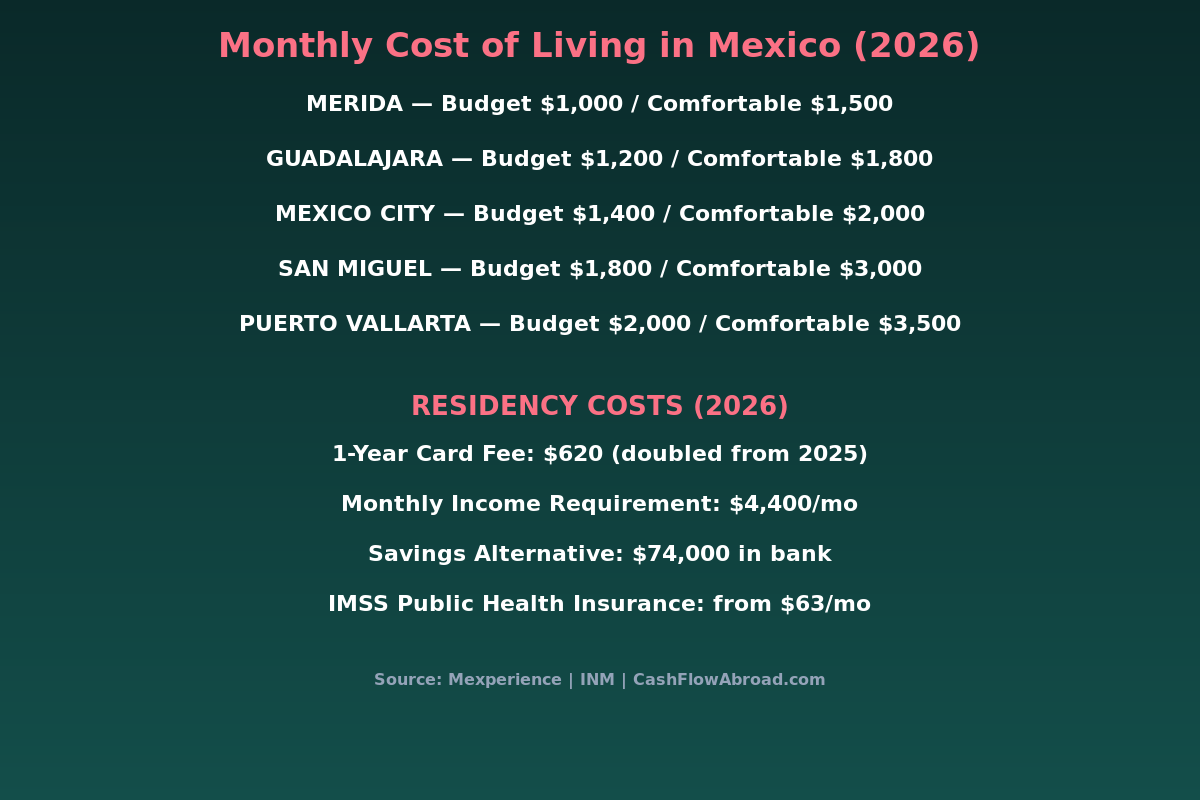
| 1-year Residente Temporal | 11,141 MXN | ~$620 |
| 2-year renewal | 16,693 MXN | ~$930 |
| 3-year renewal | 21,143 MXN | ~$1,175 |
The first-year card is always issued as a 1-year card regardless of what you paid for. Renewals from year 2 onwards are done inside Mexico at INM — no return to a US consulate required.
Total first-year cost: Consulate fee (~$50) + first-year card (~$620) + immigration lawyer if you want help ($500–$1,000 optional) = $670–$1,670 all-in. Cheaper than one month's rent in most US cities.
Where to Live: The City-by-City Breakdown
Mexico is not one cost of living. A comfortable life in Mérida runs about $1,500/month; the same lifestyle in Puerto Vallarta costs double. Here's the honest 2026 breakdown:
Mérida: Cheapest Major Expat Hub
The Yucatán capital has become the go-to for budget-conscious expats. Mid-range 1-bedroom apartments run $360–$440/month. A comfortable couple lives well on $1,300–$2,000/month total. The catch: summer temperatures regularly exceed 100°F, and air conditioning bills spike to $80–$200+/month from May through September. Build that into your budget.
Guadalajara: Mexico's Second City, First in Value
Comfortable neighborhoods like Chapalita and Providencia offer 1BR apartments at $440–$540/month. The city has a solid tech scene, a large expat community, and a pleasant year-round climate with no extreme heat or coastal humidity. Single expat budget: $1,200–$1,800/month all-in.
Mexico City: The Digital Nomad Capital
CDMX is where most remote workers land — and many stay for years. The key is neighborhood selection. Roma Norte and Condesa are the epicenter of expat life: walkable, full of cafes with fast WiFi, strong restaurant scene. Rents there run $945–$1,165/month for a 1-bedroom. Older or peripheral neighborhoods cut that to $555–$830/month. Fiber internet citywide costs about $18/month for 100 Mbps. Total monthly budget for a single person living comfortably: $1,400–$2,000.
San Miguel and Puerto Vallarta: Premium Pricing
San Miguel de Allende's colonial charm and high expat density push rents to $700–$1,200/month for a 1BR in the Centro. Puerto Vallarta is the most expensive rental market in all of Mexico — beach proximity commands a steep premium, and comfortable couple budgets hit $2,000–$3,500/month. These cities work on a strong retirement income or senior remote salary; they're tight on $4,400/month gross.
The Tax Question Most Americans Get Wrong
People assume Mexico is a territorial tax country like Paraguay or Panama — that is, zero tax on foreign income. It's more complicated than that.
The rule: if you spend fewer than 183 days per year in Mexico, you're not a Mexican tax resident, and Mexico doesn't tax your foreign income. But if you're living there full-time — which is the point of getting residency — you likely cross that threshold, and Mexico can theoretically claim you as a tax resident, subjecting worldwide income to Mexican tax rates up to 35%.
The practical reality: Most long-term expats earning exclusively from US sources (US employer, US retirement accounts, US investments) have not been pursued by Mexico's SAT (tax authority). The tax authority has historically focused on Mexican-source income. But this is a genuine gray area that is evolving, and relying on enforcement gaps is not a plan. A cross-border CPA — one familiar with both US expat tax law and Mexican SAT rules — is worth the consultation fee before you establish full-time residency.
On the US side, your obligations are unchanged: you file a US return regardless of where you live. The Foreign Earned Income Exclusion excludes up to $130,000 (2025) of foreign-earned income if you qualify via the Physical Presence Test. Unlike Paraguay, Mexico does have a US-Mexico tax treaty that provides some double-taxation protections — worth understanding if you end up paying Mexican taxes. FBAR required if Mexican bank accounts exceed $10,000 at any point during the year.

Banking and Health Insurance After You Arrive
Banking Setup
You need your physical Residente Temporal card — not just approval — to open a Mexican bank account. That means a 1–4 week wait after your INM appointment. In the meantime:
- Charles Schwab International reimburses all ATM fees worldwide and has no foreign transaction fees — the ideal bridge account while your Mexican card is processing, and a permanent solution for pulling pesos from ATMs at interbank rates
- Remitly is the go-to for international transfers from your US account to Mexico — consistently better rates than bank wires
- To maintain a US mailing address for your bank and IRS correspondence while abroad, Traveling Mailbox provides a real US street address in 50+ cities with mail scanning for ~$15/month — essential for keeping your US banking and state domicile intact
Once your card arrives, BBVA Mexico is the most expat-friendly local bank: solid English-language app, international wire capabilities, widely available branches. Required documents: passport, residency card, proof of address (a lease works), and your CURP number (assigned automatically with your residency card).
Health Insurance: The Critical Gap
Your US health insurance almost certainly does not cover you in Mexico. Medicare doesn't work there at all. Options, ranked by cost:
IMSS Voluntary Enrollment — Mexico's public health system, available to foreign residents with a residency card. Age-based pricing: roughly $63/month for ages 50–59, under $100/month even in your 70s. Pre-existing conditions not covered at enrollment; quality and wait times vary by region. Best as a low-cost backstop.
Private Mexican health insurance — A comprehensive plan for a healthy 40-year-old runs $100–$200/month, roughly 60–80% cheaper than comparable US coverage. Providers: GNP Seguros, AXA Mexico, Bupa Mexico, Seguros Monterrey.
International expat insurance (through providers like SafetyWing) covers you in both Mexico and the US — the right call if you're splitting time between countries or expect to use US medical facilities for major procedures. Costs $200–$500+/month depending on age and coverage level. See the full expat health insurance guide for a detailed comparison.
After 4 Years: Permanent Residency
Hold Temporary Residency for four consecutive years and you become eligible to convert to Residente Permanente — Mexico's equivalent of a green card. The conversion is done at INM in Mexico, and no income re-verification is required. You don't need to re-prove you still meet the $4,400/month threshold — you just show up and convert.
Permanent Residency lets you stay indefinitely, work for Mexican employers if you want, and live a full Mexican life without annual renewals or consulate appointments. It doesn't grant voting rights or a Mexican passport; citizenship requires a separate 5-year process from the permanent residency date.
For most long-term expats, this is the target: four years of small annual renewals, then permanent stability. The geographic arbitrage math often works out strongly over that timeframe — the cost savings more than offset the visa fees.
Who Should Stay on FMM
Temporary residency isn't for everyone. If you're genuinely testing Mexico for 3–6 months, the FMM is fine — no need to go through the consulate process for a short stay. If you split six months in Mexico with six months elsewhere, you may not cross the 183-day threshold that triggers tax residency concerns. And if you're under the income threshold ($4,400/month) and don't have $74,000 in savings, you don't qualify anyway.
The calculus changes when you're spending 8+ months per year in Mexico with no clear end date. At that point, the legal and practical risks of perpetual FMM resets — combined with INM's increasingly sophisticated tracking — make formalization the smarter, cheaper long-term play.
The Bottom Line
Mexico is the most popular destination for US expats in the world, and the economics make it obvious: comfortable life in Guadalajara for $1,200–$1,800/month, world-class food culture, 2–4 hour flight from anywhere in the US. The residency process is more expensive after the 2026 fee doubles, but it still comes in under $1,700 for the first year and gives you legal certainty that border runs never could.
The window where informal FMM living worked smoothly and without consequence is narrowing. For anyone already there — or planning to be — running the Residente Temporal process is the move that makes long-term Mexico life actually sustainable.
Financial Disclaimer: This article is for informational purposes only and does not constitute legal, immigration, or financial advice. Immigration rules, income thresholds, and fees change frequently — always verify current requirements directly with the relevant Mexican consulate and a licensed immigration attorney. US citizens living abroad have ongoing IRS filing obligations regardless of foreign residency status. Consult a cross-border tax professional for advice specific to your situation. Some links in this post are affiliate links; we may earn a commission at no extra cost to you.
This guide is general information, not personalized tax, legal, or investment advice. Rules change; verify current thresholds with official sources or a qualified professional before acting.
Related guides
 Digital Nomad & Visa GuidesMay 15, 2026
Taiwan Gold Card: Asia's Overlooked Expat Tax Break
How Taiwan’s Gold Card gives foreign professionals a 50% income tax cut + tax-free overseas income for 5 years. Step-by-step application guide.
 Digital Nomad & Visa GuidesApril 30, 2026
Brazil Digital Nomad Visa: Full Cost & Tax Guide
Brazil VITEM XIV visa needs just $1,500/mo income. Real cost-of-living figures for 4 cities, the 183-day tax trap, and full US expat tax breakdown.
 Geographic ArbitrageAugust 31, 2026
Hungary White Card: The €3,000 Subsistence Test
Prove €3,000 net for six months, pay €110, and model Hungary's 15% PIT. The White Card is a two-year Budapest permit, not a path to settle.