Mexico City for US Expats: Taxes, Visas & the $1,800/Mo Life
More Americans now live in Mexico City than in any other foreign city on Earth. That's not budget backpacker math. Going direct saves 20–30%.
More Americans now live in Mexico City than in any other foreign city on Earth. That's not budget backpacker math. Going direct saves 20–30%.
Disclosure: this article contains affiliate links. If you open an account through one of them, Cashflow Abroad may earn a referral commission at no extra cost to you.
More Americans now live in Mexico City than in any other foreign city on Earth. The official US State Department estimate puts 1.6 million American citizens across Mexico as a whole — but the real number in the capital metro area alone is closer to 700,000, making CDMX the unofficial capital of the American diaspora. And for good reason: you can live in a world-class city with Michelin-starred restaurants, 400+ museums, ultra-fast fiber internet, and direct flights to nearly every major US hub — for $1,300 to $2,000 a month all-in.
That's not budget backpacker math. That's a furnished apartment in a walkable neighborhood, eating out four times a week, a gym membership, Netflix, and taxis everywhere. In comparable US cities — Austin, Miami, Denver — you'd need $4,500+ to live the same way.
Here's the full breakdown: where to live, what it costs, how to get legal, and exactly what you owe in taxes.
Why Mexico City Keeps Winning
CDMX isn't a compromise — it's an upgrade for a specific type of expat. The infrastructure rivals European cities. The food scene is genuinely world-class (the city has more taquerías per capita than anywhere on the planet, plus a Nobu, a Pujol ranked in the world's top 20 restaurants, and enough farm-to-table bistros in Roma Norte to rival Brooklyn). The altitude (2,240 meters) keeps temperatures between 55°F and 75°F year-round, which means no air conditioning bill and no heating bill.
Internet speeds in the central neighborhoods average 100–300 Mbps for $25–40/month. WeWork, Selina, and dozens of independent coworking spaces cluster in Roma, Condesa, and Juárez — day passes run $12–18. The city also has a functional metro system charging 5 pesos (under $0.30) per ride, plus an Uber scene so cheap that locals use it instead of taxis.
The dollar-peso exchange rate has been the other driver. Even after the peso strengthened in 2023–2024, $1 still buys roughly 17–18 pesos, which means a $2,500/month remote income in the US delivers $3,000–3,500 in purchasing power in Mexico City.
Best Neighborhoods for US Expats
Mexico City has 16 boroughs and hundreds of colonias. Most expats cluster in a handful of central ones. Here's how they compare:
| Neighborhood | 1-BR Rent (USD/mo) | Vibe | Best For |
|---|---|---|---|
| Roma Norte | $900–1,200 | Trendy, walkable, cafe-dense | Digital nomads, young professionals |
| Condesa | $950–1,300 | Art Deco architecture, park-adjacent | Couples, remote workers |
| Polanco | $1,400–2,200 | High-end, corporate, expat-heavy | Executives, luxury lifestyle |
| Narvarte | $600–850 | Local feel, quieter, excellent food | Budget-conscious expats, families |
| Del Valle | $550–780 | Residential, underrated, authentic | Long-termers, retirees |
| Juárez | $750–1,000 | Emerging, arty, LGBTQ+ friendly | Solo expats, creatives |
Roma Norte and Condesa are where most arriving expats land — the coworking density, English-friendly cafes, and strong expat social scene make the transition easier. But the smart money moves to Narvarte or Del Valle after 6 months. You'll pay 30–40% less rent, still be a 15-minute Uber from Roma, and actually live among Mexicans rather than other Americans.
One critical caveat: do not use Airbnb pricing as a benchmark for long-term rents. Airbnb listings in Roma Norte and Condesa grew 74% between 2019 and 2023 as landlords switched from annual leases to nightly rentals. The long-term rental market is tighter than it looks, but it's negotiable — especially if you find apartments through local Facebook groups (Expats in CDMX, Mexico City Housing) rather than platforms. Going direct saves 20–30%.
Monthly Cost Breakdown
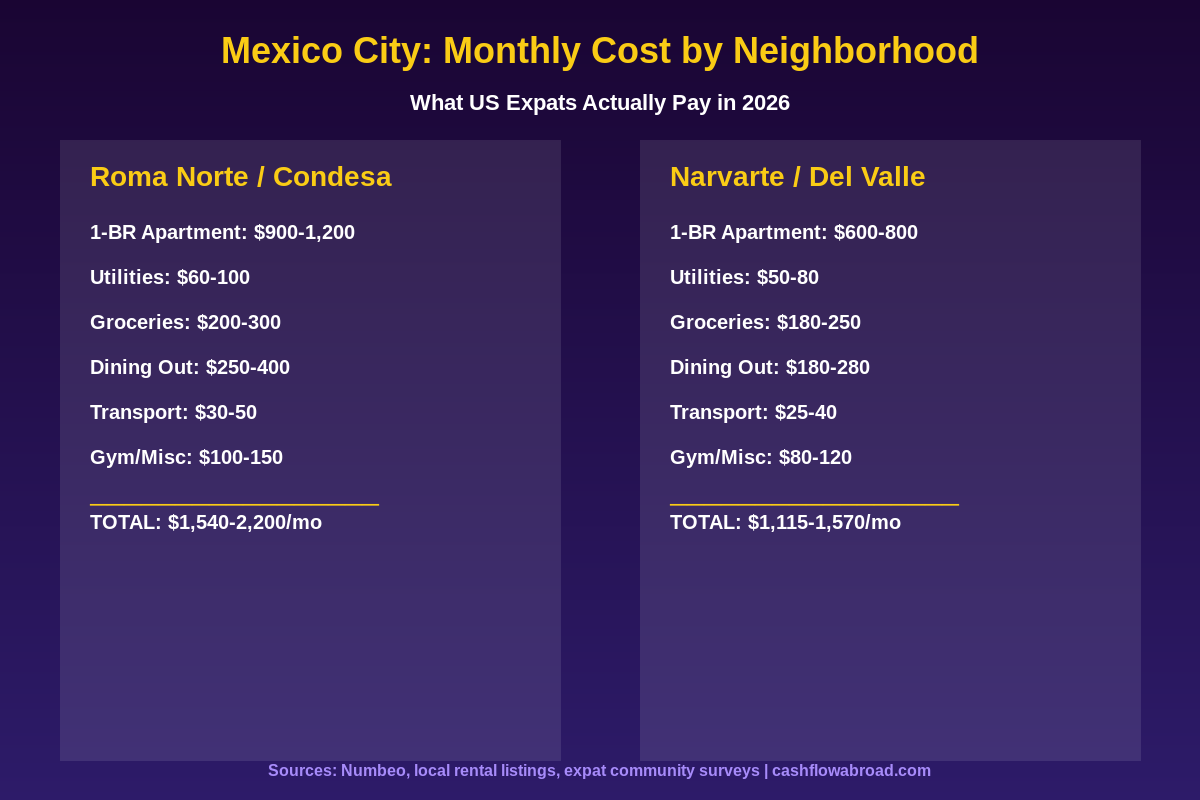
Here's what a realistic monthly budget looks like across spending levels:
| Expense | Budget ($) | Comfortable ($) | Upscale ($) |
|---|---|---|---|
| Rent (1-BR) | $600–700 | $900–1,100 | $1,400–2,000 |
| Utilities | $50–70 | $70–100 | $100–150 |
| Groceries | $150–200 | $200–300 | $300–450 |
| Dining out | $150–200 | $250–400 | $500–800 |
| Transport | $25–40 | $50–100 | $150–300 |
| Health insurance | $50–80 | $80–150 | $150–300 |
| Entertainment/misc | $50–100 | $100–200 | $200–500 |
| Total | $1,075–1,390 | $1,650–2,350 | $2,800–4,500 |
A few line items that surprise people: utilities are almost nothing because Mexico City's mild climate means you rarely touch an AC or heater. Electricity bills for a 1-BR apartment average 200–400 pesos ($12–24) every two months. Internet runs $25–40 for gigabit speeds. The big variable is dining — eat at local taquerías and mercados and you'll spend $4–8 per meal; stick to the Roma Norte expat restaurant circuit and expect $15–25 per plate.
Getting Legal: Visas and Residency
Americans can enter Mexico visa-free and stay up to 180 days on a tourist permit (Forma Migratoria Múltiple). But if you're planning to stay longer — or want to open a bank account, sign a lease, or obtain a Mexican driving license — you'll need residency status.
Temporary Residency (Residente Temporal)
The most common path. You apply at a Mexican consulate in the US, then complete the card issuance in Mexico. In 2026, the income requirement is approximately $4,400/month in documented income (pension, Social Security, salary, rental income, investment distributions). Alternatively, you can qualify with $74,000+ in savings or investments.
Important 2026 update: Mexico's Congress passed a law in late 2025 doubling government processing fees for foreign residency cards. First-year temporary residency now costs roughly 6,000–8,000 pesos ($350–475) in government fees alone, before legal assistance. Budget $500–800 total for the process.
Temporary residency is valid for one year initially, renewable for 1, 2, or 3 more years at the discretion of immigration authorities. After 4 years as a temporary resident, you can convert to permanent residency.
Permanent Residency (Residente Permanente)
After 4 years on temporary residency — or immediately if you're married to a Mexican citizen, are a retiree with sufficient income (~$2,500/month), or have a Mexican-born child — you can apply for permanent residency. No renewal required. Full work authorization included. There's no dedicated digital nomad visa in Mexico yet (unlike Spain, Portugal, or Colombia), so most remote workers use the temporary residency route.
The Real Mexico City Experience
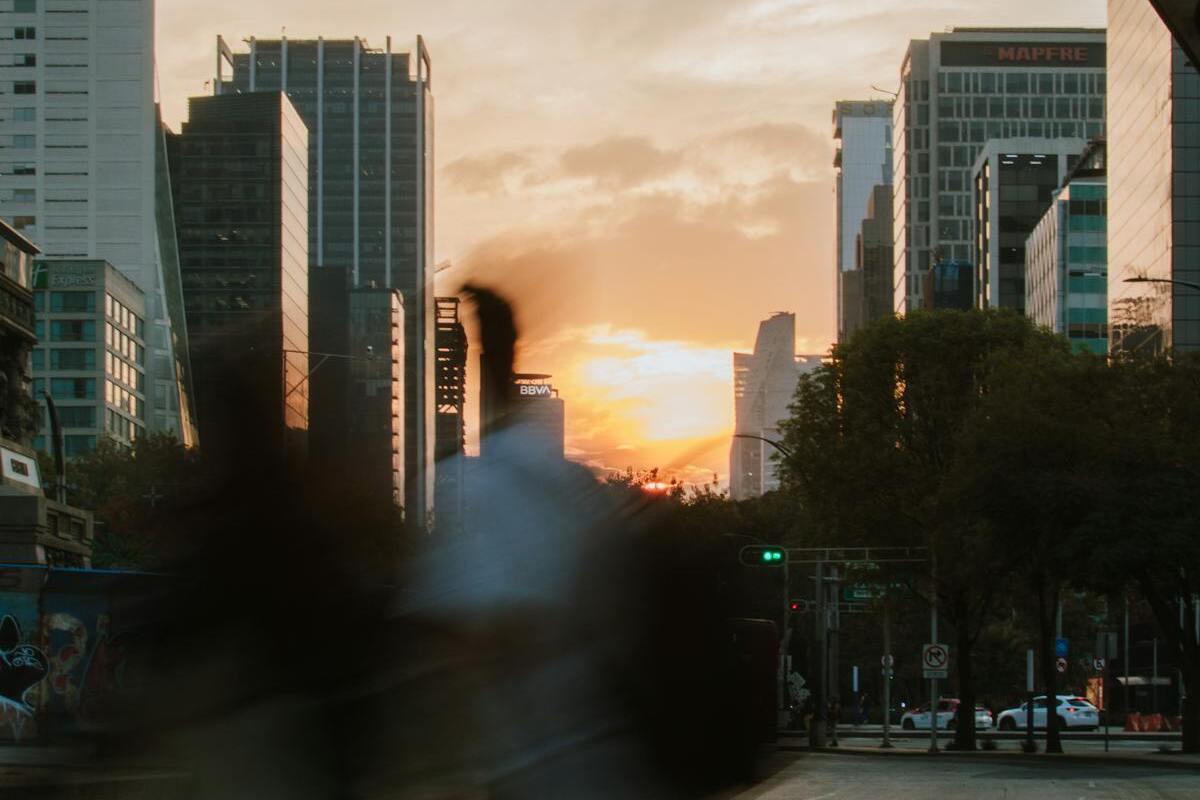
The city that shows up in expat blogs — quiet mornings in a Roma Norte cafe with a cortado and fast WiFi, wandering the Mercado de Medellín for lunch, catching a lucha libre match on a Tuesday — is real. But so is the traffic, the noise, and the occasional earthquake drill. CDMX is a megacity of 22 million people in the metro area. It's magnificent and chaotic in equal measure.
Safety is the question everyone asks. The short answer: it depends heavily on neighborhood. Roma, Condesa, Polanco, Narvarte, Juárez — these areas see very low violent crime. Petty theft (phone snatches, pickpocketing on crowded metros) is the main risk. The same precautions you'd take in New York or Chicago apply: be aware of your surroundings, avoid flashing expensive gear on busy streets, use Uber over hailing street taxis at night.
US Tax Obligations: What You Actually Owe
Living in Mexico doesn't get you off the US tax hook. American citizens owe US taxes on worldwide income regardless of where they live. But there are real tools to reduce what you pay.
Foreign Earned Income Exclusion (FEIE)
The FEIE lets you exclude up to $132,900 of foreign earned income from US taxation in 2026 if you pass either the Physical Presence Test (330+ days outside the US in a 12-month period) or the Bona Fide Residence Test (established resident of a foreign country). If you're earning $80,000 remotely in Mexico City, you could owe zero US federal income tax on that income via FEIE. See the deep dive on FEIE vs. Foreign Tax Credit to determine which fits your situation.
Mexican Tax (SAT)
Mexico taxes residents on worldwide income once you cross the 183-day residency threshold in a calendar year. Rates run from 1.92% to 35% on a progressive scale — broadly similar to US rates. However, the US-Mexico tax treaty prevents true double taxation: taxes paid to Mexico offset your US bill dollar-for-dollar via the Foreign Tax Credit.
For most remote workers earning under $80,000, the FEIE wipes out the US liability entirely. For higher earners or those with passive income, the treaty and Foreign Tax Credit combination typically prevents any double-taxation scenario. You'll need to register for an RFC (Registro Federal de Contribuyentes) — Mexico's tax ID — once you establish residency, and file annual SAT returns.
FBAR and FATCA
Open a Mexican bank account (you'll need one for leases and local payments), and you'll need to file an FBAR if your foreign account balances exceed $10,000 at any point during the year. The form is free and filed separately with FinCEN — deadline April 15, auto-extended to October 15. Miss it and penalties start at $10,000 per violation. The complete FBAR/FATCA guide covers the filing process step by step.
Healthcare in Mexico City
Private healthcare in CDMX is excellent and cheap. The private hospital network — Médica Sur, ABC Medical Center, Hospital Ángeles — matches US standards at 15–25% of US prices. A specialist consultation runs $40–80. A full blood panel: $30–60. An emergency room visit without complications: $150–300.
For insurance, most US expats use one of two approaches:
- International health insurance via SafetyWing — the Nomad Insurance plan starts at $56/month for ages 18–39, covering emergency medical plus hospitalization across 185 countries. Good for the first 1–2 years while you establish residency.
- Local private insurance through Mexican insurers (BUPA Mexico, GNP Seguros, MetLife Mexico) — comprehensive local coverage for $80–200/month, often with dental included. Better value once you have residency locked in.
Mexico also has a public healthcare system (IMSS) that permanent residents can access for approximately $400–600/year in contributions. Quality varies by location. Most expats in CDMX stick to private care for anything serious. See the full expat health insurance comparison for a SafetyWing vs. Cigna Global vs. Allianz breakdown.
Banking and Moving Money
Mexican banks are notoriously difficult for foreigners to join — BBVA, Santander, and HSBC Mexico all technically allow it, but requirements vary by branch. The easiest path in 2026: use Banorte or its digital banking arm Bineo, which have streamlined foreign resident onboarding. You'll need your CURP (Clave Única de Registro de Población) — a Mexican ID number issued as part of the residency process.
For your US side, keep a US bank account open. Closing it creates headaches with credit scores, IRS correspondence, and ACH transfers. Mercury is excellent for freelancers and business owners — no monthly fees, strong ACH, and it doesn't close accounts because you're living abroad (unlike some traditional banks). For a physical US address on banking and IRS records, a Traveling Mailbox gives you a real US street address in 50+ cities for $15/month — they scan your mail, deposit checks, and forward packages. The site owner uses this service personally. More on that in the virtual mailbox expat guide.
For transferring money between the US and Mexico, Remitly consistently offers mid-market rates with transfers completing in minutes. On a $2,000 transfer, the difference between Remitly and a traditional wire can be $40–80 in hidden fees. The expat money transfer guide benchmarks every major service's actual cost.
The Gentrification Problem
It would be dishonest to write a guide to Mexico City for expats without addressing this directly: the influx of American remote workers has contributed to a housing crisis that has displaced long-term local residents from Roma Norte, Condesa, and Juárez. Rents in these neighborhoods have more than doubled over the past decade. Property values are up 150–200% since 2014. The Airbnb count in the four core colonias grew from 2,898 units in 2019 to 5,033 by 2023 — a 74% increase that directly removed housing stock from the long-term rental market.
There have been protests. Signs reading "Gentrifier go home" have appeared on neighborhood walls. The tension is real, and dismissing it misses the economic reality: Mexican median wages haven't kept pace with dollar-denominated demand for housing.
The practical upshot for arriving expats: consider living in neighborhoods like Narvarte, Del Valle, or Doctores — areas with authentic local fabric, better value, and less direct displacement pressure. Learn Spanish beyond menu phrases. The city will treat you well in return.
Practical Pre-Move Checklist
- Start residency paperwork before you arrive — apply at a Mexican consulate in the US. Once in Mexico on a tourist permit, switching to temporary residency without leaving the country is difficult.
- Get a Mexican phone number immediately — required for banking, apps, and signing leases. Use a Saily eSIM for data connectivity on arrival while you sort a local SIM.
- Maintain your US address — your IRS address, US bank accounts, and credit cards need a real US street address. A virtual mailbox solves this cleanly.
- Check your state tax obligations — California, New York, Virginia, and South Carolina aggressively pursue tax on former residents. The expat banking and tax guide covers domicile breaks and when to formally cut state ties.
- Get CURP and RFC registered — the CURP is your Mexican personal ID number; the RFC is the tax ID. You'll need both for leases, banking, and formal contracts.
- Budget for year-one setup costs — apartment deposit (usually 1–2 months), residency fees (~$500–800 in 2026), healthcare setup. First-year costs run $2,000–4,000 above ongoing monthly expenses.
Is Mexico City the Right Move?
Mexico City works best for people who want an intellectually stimulating, culturally rich urban environment at a significant discount to comparable US cities — not people chasing the cheapest possible cost of living. If pure price minimization is the goal, Southeast Asia or Eastern Europe win on budget. If you want a sophisticated city with world-class food, excellent infrastructure, short flights home, and a massive pre-existing expat community — CDMX is difficult to match.
The city is enormous, occasionally overwhelming, and genuinely addictive. Most people who come for three months end up staying three years. The 700,000 Americans who've already made that calculation aren't wrong.
For a broader look at how geographic arbitrage actually works across different countries and income levels, see the geographic arbitrage playbook.
Conclusion
A single person can live well in Mexico City for $1,400–1,800/month. A couple can thrive for $2,200–2,800. Those numbers include a quality apartment in a central neighborhood, consistent dining out, health insurance, and occasional travel — all things that cost $4,500–7,000/month in equivalent US cities. The FEIE covers most remote workers' US tax liability entirely. The residency process has gotten more expensive in 2026 after fee doublings, but it remains straightforward. The Mexican food alone is worth it.
Financial Disclaimer: This article is for informational purposes only and does not constitute tax, legal, or financial advice. Tax laws change frequently and individual circumstances vary. Consult a qualified tax professional or attorney before making decisions about international relocation, tax residency, or financial arrangements abroad.
This guide is general information, not personalized tax, legal, or investment advice. Rules change; verify current thresholds with official sources or a qualified professional before acting.
Related guides
 Geographic ArbitrageOctober 25, 2026
Italy Nomad Visa Income Requirements
Italy's nomad visa income test is €25,500 on 2026 sheets. See the $133.60 Washington fee and the US return you still file.
 Geographic ArbitrageOctober 4, 2026
Greece Nomad Visa: The €3,500 Monthly Test
See whether your pay clears Greece's digital nomad visa: €3,500 net a month, or €4,200 with a spouse, before you apply now.
 Geographic ArbitrageSeptember 21, 2026
Korea F-1-D Workation Income Rules for Expats
As of June 2026, Korea’s F-1-D visa starts at ₩52.4M outside Seoul for ages 18–34. Map income tiers, US FEIE, and where you park the paycheck.