Medical Tourism: Save $80,000+ on Surgery and Dental Abroad
Americans save $80,000+ on surgery, dental, and procedures abroad. Compare costs across 12 countries with real pricing data and safety ratings.
Americans save $80,000+ on surgery, dental, and procedures abroad. Compare costs across 12 countries with real pricing data and safety ratings.
A heart bypass surgery in the United States costs $123,000 on average. In India, the exact same procedure — performed by a cardiac surgeon trained at Johns Hopkins or Cleveland Clinic — costs $7,000. That's not a rounding error. That's $116,000 still in your pocket after airfare, hotel, and every recovery meal.
Americans spent more than $4.5 trillion on healthcare in 2023. The US spends 18.5% of GDP on healthcare — more than any other developed nation — while simultaneously ranking 37th in health outcomes. The math has never made less sense. Which is why over 14 million people now travel internationally for medical care every year, and why 780,000 Americans flew abroad for dental work alone in 2024.
If you're an expat, a digital nomad, or simply someone who has run the numbers on what US healthcare actually costs versus what the rest of the world charges, medical tourism isn't just a budget hack. It's rational. This guide breaks down exactly where to go, what procedures are worth traveling for, how much you'll actually save, and the logistics that separate successful medical tourists from cautionary tales.
Related: expat health insurance guide
Why Medical Tourism Works (And Why the Savings Are Real)
The first question most Americans ask: "Is it really safe?" The second: "Can the quality actually be comparable?"
Both are fair questions. The answer to both is yes — with caveats.
The global medical tourism market was worth $31.23 billion in 2024 and is projected to hit $162.80 billion by 2032. That's not a niche trend; it's a restructuring of global healthcare. The hospitals attracting international patients aren't rural clinics or back-alley procedure rooms. They're Joint Commission International (JCI)-accredited facilities — the same quality standard used to evaluate US hospitals — staffed by doctors who trained at American, British, and German medical schools.
JCI accreditation requires the same rigorous safety protocols, documentation standards, and patient outcomes reporting as US hospital accreditation. Colombia alone has six JCI-accredited hospitals. Thailand's Bumrungrad International in Bangkok has treated over 1.1 million patients from 190 countries. These aren't experimental programs. They're mature, industrialized healthcare systems built specifically to serve international patients.
The patient satisfaction rate among medical tourists is consistently above 90%. Complication rates are comparable to — and in some studies slightly better than — US averages, partly because these hospitals have extremely specialized, high-volume surgical teams doing the same procedure hundreds of times per year.
The price gap exists not because of quality differences but because of structural differences. Labor costs, malpractice insurance, administrative overhead, hospital billing complexity, and pharmaceutical pricing in the US are all dramatically higher than in Southeast Asia, Latin America, and Eastern Europe. A hospital in Medellin doesn't need a 40-person billing department to navigate insurance claims. An orthopedic surgeon in Mumbai isn't paying $200,000 per year in malpractice premiums. That's where the savings come from — not from cutting corners on care.
The Numbers That Matter
Here is what Americans actually pay versus what the same procedures cost abroad:
| Procedure | USA Cost | Best Abroad Price | Destination | You Save |
|---|---|---|---|---|
| Heart Bypass Surgery | $123,000 | $7,000 | India | $116,000 |
| Hip Replacement | $50,000 | $8,000 | Colombia / India | $42,000 |
| Knee Replacement | $35,000 | $5,000 | India | $30,000 |
| Gastric Sleeve | $20,000 | $6,000 | Mexico | $14,000 |
| Breast Augmentation | $10,000+ | $3,200 | Thailand | $6,800 |
| Dental All-on-4 (full arch) | $24,000+ | $5,000 | Hungary | $19,000 |
| Single Dental Implant | $5,000 | $700 | Colombia | $4,300 |
| IVF Cycle | $15,000 | $3,500 | India | $11,500 |
| LASIK (both eyes) | $4,000 | $1,000 | India | $3,000 |
| Hair Transplant (FUE) | $10,000 | $2,200 | Turkey | $7,800 |
| Rhinoplasty | $11,500 | $2,500 | Colombia | $9,000 |
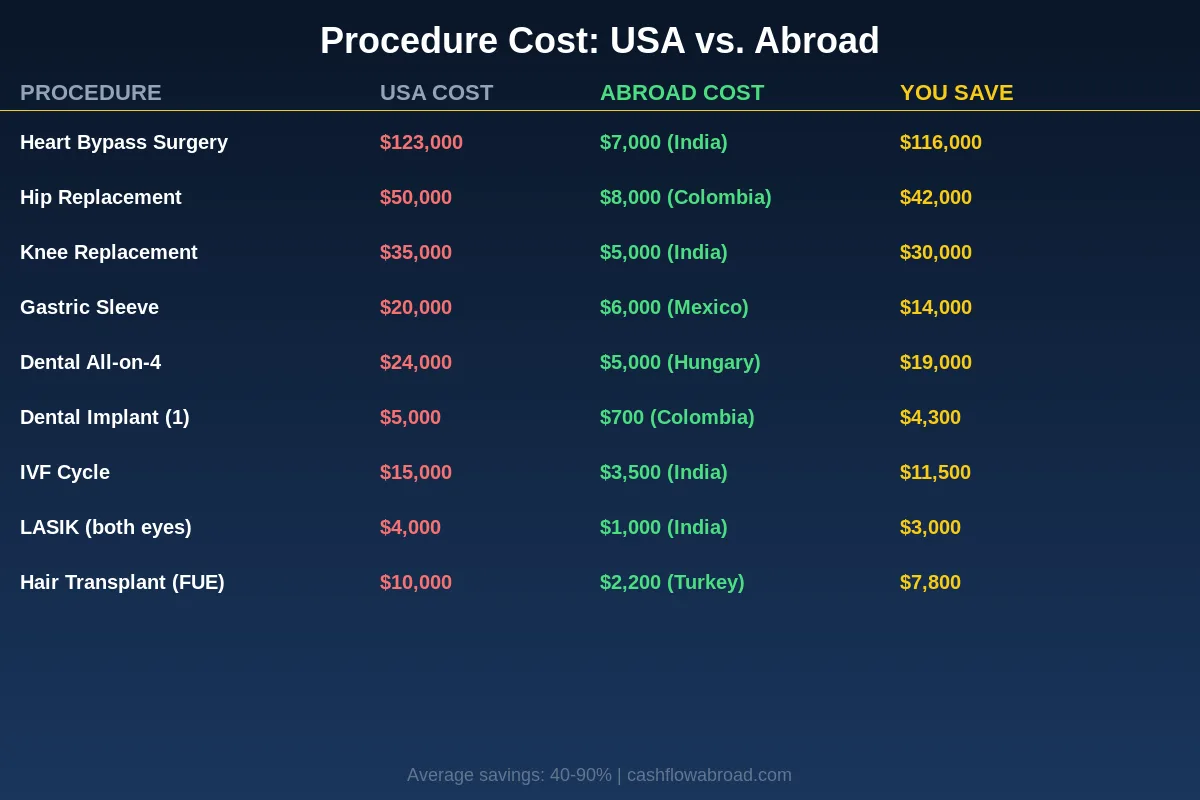
These are not cherry-picked outliers. These are median market prices. For expats who are already living abroad or planning to relocate, the calculus becomes even simpler: you're already there. The "travel cost" to get a procedure done in Colombia or Thailand is often zero because you live there or are passing through anyway.
If you pair this with a solid international health insurance plan — something like SafetyWing, which covers expats and nomads starting at about $56/month — you can actually plan elective procedures around your travel schedule and use your insurance to cover emergencies while self-funding planned procedures at a fraction of US cost. Read the full breakdown in our expat health insurance guide.
The Best Destinations — Country by Country
Not every country is equally strong for every procedure. Here is where to go based on what you need.
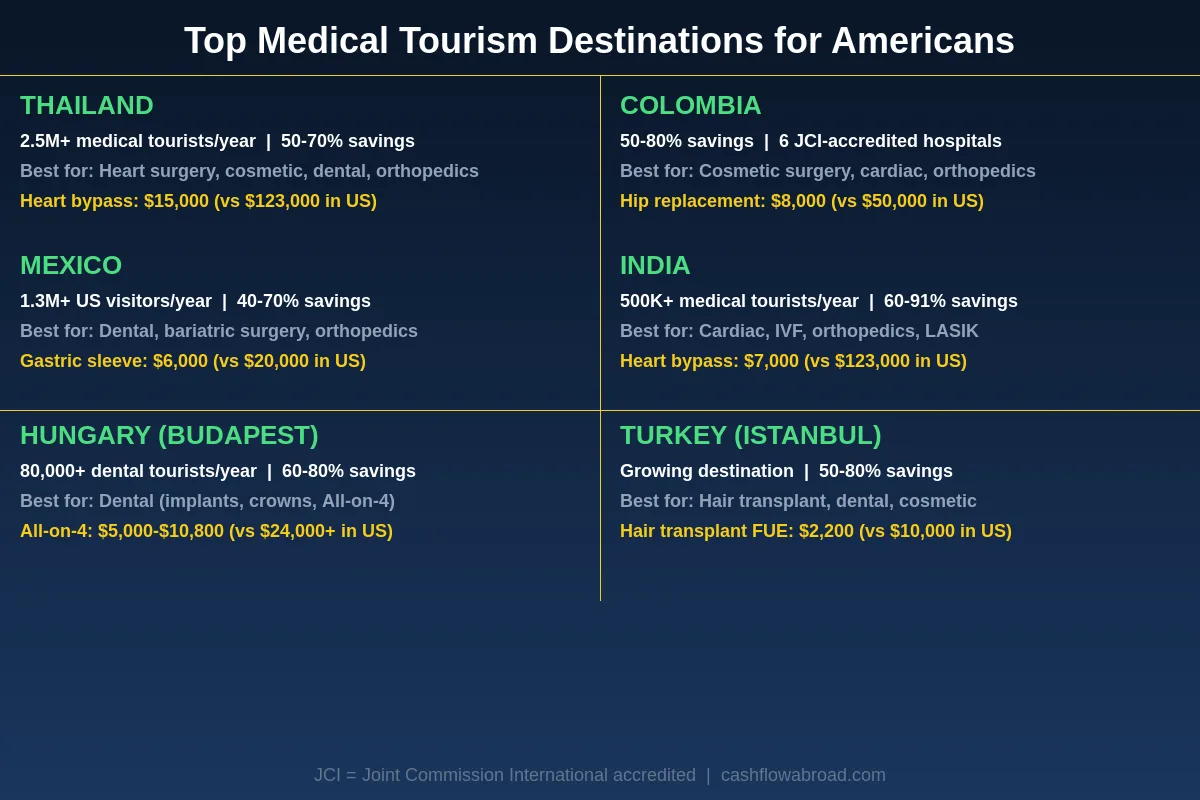
Thailand: The Cardiac and Cosmetic Capital
Thailand attracts 2.5 million medical tourists per year and has been doing so for over 30 years. Bangkok's Bumrungrad International Hospital alone handles more than 1.1 million patients from 190 countries annually. The country's medical infrastructure for international patients is the most mature in Southeast Asia.
Thailand's strengths are cardiac surgery, orthopedics, cosmetic procedures, and dental work. A heart bypass that runs $123,000 in the US is $15,000–$25,000 in Bangkok — still a substantial multiple below US pricing, though India edges out Thailand on pure cardiac cost. Where Thailand wins is on the overall experience: English-speaking staff at top hospitals, dedicated international patient coordinators, and recovery infrastructure that is genuinely world-class.
Savings range: 50–70% below US prices across most procedures.
Best hospitals: Bumrungrad International (Bangkok), Bangkok International Dental Center, Samitivej Sukhumvit.
Mexico: The Closest Option for Most Americans
For Americans in the Southwest, driving across the border to get dental work done in Tijuana or Los Algodones is less disruptive than a trip to the dentist three states away. Los Algodones — nicknamed "Molar City" — is a town of fewer than 5,000 residents that has over 350 dental clinics. It exists almost entirely to serve Americans and Canadians who drive across the border for dental care.
An estimated 550,000 US citizens crossed into Mexico for dental procedures in 2024. The proximity advantage makes Mexico the de facto default for elective dental, bariatric surgery, and straightforward orthopedic procedures.
A gastric sleeve (bariatric surgery) in Mexico costs roughly $6,000 versus $20,000 in the US — a $14,000 savings for a single trip. Dental work in Tijuana or Monterrey runs 40–70% below US prices. Single crowns: $500 vs. $1,200. Single implants with crown: $1,500 vs. $5,000.
Savings range: 40–70% below US prices.
Best for: Dental, bariatric surgery, LASIK, orthopedics.
Related: cheapest countries guide
Colombia: The Rising Star for Cosmetic and Complex Procedures
Colombia has quietly become one of the most sophisticated medical tourism destinations in the Western Hemisphere. Bogota holds the highest concentration of JCI-accredited hospitals in Colombia, and Hospital Internacional de Colombia in Bucaramanga operates as a clinical affiliate of the Mayo Clinic. These aren't budget clinics — they are genuine peer institutions to US academic medical centers.
Medellin has emerged as the cosmetic surgery capital of South America. The city's year-round spring climate (perpetually between 65–80°F) is ideal for post-surgical recovery. Cosmetic procedures here run 30–67% below US prices: liposuction $2,000–$5,000, breast augmentation $3,000–$5,000, rhinoplasty $2,500–$4,500.
Colombia also shines for dental work. Bogota and Medellin clinics consistently quote single implants at $700–$1,200, and full-mouth All-on-4 packages at $12,000–$18,000 versus $24,000+ in the US. More than 20,000 foreign dental patients visited Colombia in 2024.
Savings range: 50–80% below US prices.
Best for: Cosmetic surgery, cardiac procedures, complex orthopedics, dental.
India: The Best Value on Earth for Major Surgery
If you're facing a major cardiac procedure, a complex orthopedic surgery, or an IVF journey, India offers the best pure cost-to-quality ratio on the planet. Heart bypass surgery at Apollo Hospitals in Delhi: $7,000–$10,000 versus $123,000 in the US. That's a 91% savings on a surgery that, for many Americans, creates catastrophic financial outcomes even with insurance.
India attracts over 500,000 medical tourists per year. Apollo Hospitals, Fortis Healthcare, and Medanta — The Medicity are all JCI-accredited. Their cardiac surgery teams perform hundreds of procedures per week at volumes that exceed most US hospitals.
IVF in India is particularly cost-competitive: a full cycle runs $3,500 versus $15,000 in the US, making it the most logical destination for fertility treatment for Americans without IVF insurance coverage (which is most Americans). LASIK runs $1,000 for both eyes versus $4,000 in the US.
The trade-off with India is travel time and recovery logistics — you're looking at a 15–20 hour journey from most US cities. For major surgery where the savings are $50,000+, the math still works overwhelmingly in your favor.
Savings range: 60–91% below US prices.
Best for: Cardiac surgery, orthopedics, IVF, LASIK, oncology.
Hungary: The Dental Capital of Europe
Budapest has built an entire industry around dental tourism. Over 80,000 dental tourists visit Hungary annually, primarily from the UK, Germany, and increasingly from the US. Entire districts of Budapest are dedicated to dental clinics catering to international patients.
The numbers are striking. A single dental implant with crown in Hungary runs $950–$1,400 versus $5,000–$6,000 in the US — an 80% savings. An All-on-4 full-arch implant system is $5,000–$10,800 in Budapest versus $24,000+ in the US. A standard crown is $300 in Budapest versus $1,200 in America.
Hungary is inside the EU, with EU healthcare standards and oversight. Budapest is also a genuinely beautiful city to recover in — world-class thermal baths are legitimately therapeutic post-dental work, and the city's hotel and restaurant infrastructure is excellent. European patients fly to Budapest specifically for dental work, attach a short vacation, and return home with $15,000+ still in their accounts.
Savings range: 60–80% below US prices (dental-focused).
Best for: Dental implants, All-on-4, crowns, full-mouth reconstruction.
The Tax Angle: What the IRS Actually Allows
Here is something most medical tourists don't know: the IRS treats foreign medical expenses the same as domestic ones under IRS Publication 502. If you itemize deductions, medical expenses exceeding 7.5% of your Adjusted Gross Income (AGI) are deductible — regardless of which country the procedure was performed in.
Deductible costs for a medical trip include:
- The procedure itself — any medically necessary treatment
- Airfare and transportation — to and from the medical facility
- Lodging — up to $50 per night per person (patient plus one traveling companion)
What is NOT deductible:
Related: geographic arbitrage playbook
- Meals (unless part of a hospital stay)
- Cosmetic surgery — unless reconstructive or medically necessary
- Vacation costs attached to the trip
So if you fly to Colombia for a $12,000 knee replacement, spend $800 on flights, and $500 on qualifying lodging during recovery, you've got potentially $13,300 in deductible medical expenses. At a 22% marginal tax rate, that's $2,926 back at tax time — on top of the $23,000 you already saved versus US pricing.
For expats already abroad, the picture gets more interesting. Your foreign address doesn't disqualify you. Your FEIE exclusion doesn't affect medical deductions. You're still eligible to itemize US medical expenses on Schedule A. Keep all receipts, get itemized invoices from the hospital or clinic (most international facilities are experienced at producing IRS-compatible documentation), and work with an expat-focused CPA. See our US Expat Tax Guide for how this fits into the broader expat tax picture.
What Your Insurance Actually Covers (And What It Doesn't)
Most US health insurance — employer-sponsored plans, ACA marketplace plans, Medicare — provides zero coverage for planned procedures performed abroad. Emergency care while traveling is often covered to some degree, but elective surgery in Medellin? Not a chance.
This creates a planning opportunity rather than a barrier. If you're uninsured, underinsured, or facing a procedure that would generate catastrophic out-of-pocket costs under your current coverage, the foreign price tag already includes what you'd be paying in the US net of any coverage. Often the foreign price is cheaper than your US deductible alone.
For expats and long-term travelers, international health insurance through providers like SafetyWing covers emergency and unexpected medical care globally. SafetyWing's Nomad Insurance starts around $56/month for a 30-year-old and provides coverage in most countries. Their Remote Health plan — designed for longer-term expats — includes routine and specialist care in addition to emergencies.
The hybrid strategy that works best for many expats: carry a lean international plan for emergencies and unexpected illness, then self-fund major planned procedures at foreign prices. A $120/month international insurance plan plus $8,000 out-of-pocket for a Colombian hip replacement is still dramatically cheaper than US insurance premiums plus US cost-sharing for the same procedure.
For expats who maintain US brokerage and banking accounts to manage their savings and investments, Charles Schwab International offers a checking account with fee-free ATM withdrawals worldwide — useful when you need to access funds during a medical trip without paying $5 in foreign ATM fees every time you need local currency for clinic co-pays.
How to Find a Qualified Facility — And Avoid the Bad Ones
This is where due diligence matters. Medical tourism is not a monolith. For every excellent JCI-accredited hospital in Bangkok or Bogota, there are unlicensed clinics advertising rock-bottom prices online. The framework below filters out the bad actors.
Step 1: Verify JCI Accreditation
The Joint Commission International maintains a public database of all accredited hospitals worldwide. Before booking anything, verify the facility appears in that database. JCI accreditation requires rigorous on-site assessment of safety protocols, infection control, staff credentialing, and patient outcomes — the same standards applied to US hospitals.
Not every excellent hospital is JCI-accredited (accreditation is expensive and some quality facilities haven't pursued it), but JCI accreditation is the easiest quality filter to apply from a distance.
Step 2: Verify the Surgeon's Credentials
Ask for the surgeon's CV. Look for:
- Medical school and residency training (many top surgeons in Thailand, India, and Colombia trained in the US, UK, or Germany)
- Board certification in the relevant specialty
- Annual procedure volume — a surgeon doing 200 knee replacements per year vs. 20 is not the same risk profile
- Published research or institutional affiliations
Serious international hospitals have this information readily available in English. If a facility can't produce basic credentials documentation, walk away.
Step 3: Consider a Medical Tourism Facilitator
Medical tourism facilitators are agencies that act as intermediaries between patients and international hospitals. Reputable ones are accredited by the Medical Tourism Association and provide services including: hospital selection and vetting, appointment coordination, translation services, travel logistics, and post-procedure follow-up coordination.
A good facilitator typically charges $200–$500 for their service, which is trivial relative to the procedure cost, and can save significant time on research and logistics. For a first medical trip to an unfamiliar country, using a facilitator is often worth the fee.
Red Flags to Avoid
- No English-language communication option
- No verifiable physical address or hospital affiliation
- Prices dramatically lower than other facilities in the same country (if Colombia charges $8,000–$13,000 for a hip replacement and someone quotes $2,000, that is a red flag)
- Unwillingness to share surgeon credentials
- No documented post-procedure care plan
- Cash-only payment terms with no paperwork
Logistics and Planning: What Actually Goes Into a Medical Trip
The mechanics of a medical trip are less complicated than most people assume, but they do require planning. Here is a practical timeline.
8–12 Weeks Before the Procedure
- Research destinations and facilities for your specific procedure
- Obtain quotes from 2–3 facilities (most international hospitals have English-speaking international patient coordinators who respond to email inquiries within 24–48 hours)
- Share medical records and imaging with the facility for pre-consultation
- Arrange travel insurance that covers medical emergencies — separate from the procedure — for complications requiring additional treatment or emergency evacuation
- Book flights and accommodation; factor in recovery time. A dental crown is done in a day. A knee replacement requires 5–7 days minimum before it's safe to fly. Cardiac surgery recovery takes 2–3 weeks
Documentation You'll Need
- Passport (valid 6+ months beyond travel dates)
- Complete medical history and recent lab work
- Imaging files (MRI, X-rays) — most hospitals can work with digital files sent in advance
- List of current medications
- Travel insurance documentation
- Contact information for your US physician for post-procedure follow-up
Post-Procedure and Follow-Up
One aspect of medical tourism that requires planning is post-procedure care coordination. Your US primary care physician needs to be looped in, needs access to your operative reports and discharge documentation, and needs to provide any necessary ongoing care or physical therapy upon your return.
Quality international hospitals produce full English-language operative reports, discharge summaries, and follow-up instructions specifically designed to enable seamless care continuity with a physician at home. Get copies of everything before you leave the facility.
For expats who live abroad full-time, follow-up care is simpler — you remain in the same country and see the same medical team for post-procedure check-ins. This is one reason medical tourism is even more practical for expats than for Americans making a single trip; you have the luxury of genuine recovery time in the country where your procedure was done.
Dental Tourism Deep Dive: The Easiest Win in Medical Tourism
Dental care is the most accessible entry point into medical tourism, and the savings are staggering. Americans collectively spend over $150 billion on dental care annually, much of it out-of-pocket since dental insurance typically covers only $1,500–$2,000 per year in benefits.
Related: Social Security abroad guide
Los Algodones, Mexico — a 45-minute drive from Yuma, Arizona — processes an estimated 800 dental patients per day during peak season. The town's 350+ dental clinics offer comprehensive dental work at 40–70% below US prices, all within driving distance of millions of Americans. A crown that costs $1,200 in Phoenix costs $300–$400 in Los Algodones. A full set of veneers that runs $15,000 in Los Angeles is $3,000–$5,000 in Tijuana.
For full-mouth reconstruction — All-on-4 dental implants — the cost difference is life-altering for many Americans. An All-on-4 system that costs $24,000+ per arch in the US is:
- $4,800–$8,000 per arch in Mexico
- $5,000–$10,800 per arch in Budapest
- $6,000–$10,000 per arch in Colombia
That's a savings of $14,000–$19,000 per arch, or $28,000–$38,000 for full upper and lower reconstruction. Patients often find that the cost of a Budapest dental vacation — flights, hotel, and full All-on-4 treatment — still totals less than half of what the same procedure costs domestically.
| Dental Procedure | USA Price | Mexico | Colombia | Hungary | Thailand |
|---|---|---|---|---|---|
| Crown (per tooth) | $1,200 | $400–$500 | $300–$500 | $300 | $400 |
| Single Implant + Crown | $5,000 | $1,200–$1,800 | $700–$1,200 | $950–$1,400 | $1,800 |
| All-on-4 (per arch) | $24,000+ | $4,800–$8,000 | $6,000–$10,000 | $5,000–$10,800 | $9,000–$12,000 |
| Veneers (per tooth) | $1,500 | $300–$500 | $350–$600 | $350–$500 | $400 |
| Root Canal | $1,500 | $300–$500 | $200–$400 | $250–$400 | $300 |
The Expat Advantage: Why This Is Even Better If You Already Live Abroad
If you're already an expat — or considering becoming one — the medical tourism equation is fundamentally different from that of a US-based tourist. You're not booking a special trip to get a procedure done. You're accessing the local healthcare system you already live near.
Expats living in Medellin, Colombia get their dental work done locally for $700–$1,200 per implant because that's the local market price. Expats in Bangkok don't "go to Thailand for a procedure" — they walk to Bumrungrad. The $40,000 hip replacement that would financially derail a 65-year-old living on Social Security in Iowa costs $8,000 in the country where that same retiree might be living comfortably on $2,000/month.
This is one of the most underappreciated financial arguments for geographic arbitrage: it's not just that your cost of living is lower, or that your dollars go further at restaurants and hotels. It's that your entire exposure to catastrophic US healthcare pricing largely disappears. The emergency appendectomy in Medellin that would cost $30,000+ in the US without insurance — because American hospitals can charge whatever they want — costs $3,000–$5,000 in Colombia.
For expats who've relocated or are planning to, see our Geographic Arbitrage Playbook and Retirement Abroad guide for how healthcare cost differentials factor into the full financial picture of living abroad.
A Bonus Win for Expat Retirees: The Social Security Fairness Act
Expat retirees considering medical tourism just got an unexpected financial tailwind. The Social Security Fairness Act, signed into law on January 5, 2025, repealed both the Windfall Elimination Provision (WEP) and Government Pension Offset (GPO) — two provisions that had quietly reduced Social Security payments by up to 50% for Americans who worked abroad and received foreign pensions.
The impact is substantial: by July 2025, the Social Security Administration had distributed $17 billion in back payments to 3.1 million beneficiaries, five months ahead of schedule. The repeal is retroactive to January 2024, meaning lump-sum back payments cover the gap period. Monthly benefit increases began in April 2025.
For expat retirees who worked in countries with US totalization agreements — including Germany, France, the UK, Switzerland, Canada, Japan, and 27 others — their Social Security benefits are now unpenalized by their foreign pension income. That's potentially hundreds of dollars per month in additional income that can be directed toward funding medical procedures abroad at a fraction of US cost.
Retirees abroad on fixed income have historically faced the most catastrophic exposure to US healthcare costs during visits home. The combination of restored Social Security benefits and access to affordable quality care in the country where they live is a meaningful quality-of-life improvement for hundreds of thousands of Americans.
Maintaining Your US Financial Infrastructure During Medical Trips
A practical note for medical tourists making extended trips: maintaining access to US financial accounts and correspondence is important. If you're spending 3–4 weeks in Thailand for a cardiac procedure and recovery, bills, statements, and time-sensitive financial correspondence can pile up.
A virtual mailbox service like Traveling Mailbox provides a real US street address in 50+ cities, scans all incoming mail to a secure online portal, and can deposit checks on your behalf — starting at $15/month. For expats, this is already essential infrastructure for maintaining US banking relationships, satisfying IRS correspondence addresses, and keeping state domicile. For domestic medical tourists spending extended time abroad, it solves the "who's checking my mail" problem cleanly. We covered this in full in our Virtual Mailbox guide.
For banking during a medical trip, Charles Schwab's international checking account refunds all ATM fees worldwide with no foreign transaction fees — one less thing to worry about when you're managing a medical recovery in a foreign country and need to access cash or make local payments. Their brokerage arm also allows expats to maintain US investment accounts without the PFIC complications that plague foreign-domiciled alternatives. See our Expat Investing Playbook for the full picture.
The Most Common Medical Tourism Mistakes (And How to Avoid Them)
Underestimating Recovery Time
The most common mistake first-time medical tourists make is booking a return flight too soon. A knee replacement requires 5–7 days minimum before it's safe to fly at normal altitude and pressure. Cardiac surgery recovery takes weeks. Book flexible return tickets and plan for longer recovery windows than you think you'll need.
Skipping the Pre-Consultation
Every reputable international facility offers pre-operative consultations — many now via video call. Do not show up in a foreign country for major surgery without having communicated your case to the surgical team in advance. Share your imaging, your medical history, and your current medications. A pre-consultation also lets you assess the facility's communication quality and responsiveness before you're in a hospital bed.
No Follow-Up Care Plan
Who handles your physical therapy when you get home? Who monitors your post-surgical labs? Identify your US-based follow-up provider before you travel, brief them on what procedure you're having and where, and confirm they'll provide ongoing care when you return. Some US physicians are reluctant to manage post-operative care for procedures done abroad; find out in advance, not after you land.
Choosing the Wrong Procedures to Travel For
Medical tourism makes the most sense for high-cost elective and planned procedures with established foreign expertise. It does not make sense for true emergencies, complex multi-stage treatments where continuity of care is essential, or procedures where the US price differential is small. The sweet spot: procedures costing $5,000+ in the US, where foreign alternatives are 50%+ cheaper, and where recovery time is well-defined and finite.
Conclusion: Medical Tourism Is a Financial Decision, Not a Compromise
The framing of medical tourism as "cutting corners on care" is outdated and, frankly, false. JCI-accredited hospitals in Bangkok, Medellin, Mumbai, and Budapest are not inferior facilities staffed by inferior doctors. They are modern, specialized institutions that happen to exist in countries where administrative overhead, malpractice litigation, and pharmaceutical pricing haven't inflated healthcare costs to levels that bankrupt middle-class families.
The global medical tourism industry is a $31 billion market growing at 12.2% annually because millions of people have already run the numbers and acted on them. 780,000 Americans went abroad for dental care alone in a single year. They didn't do it because they wanted an adventure — they did it because the math is overwhelming.
For expats and geographic arbitrageurs, medical tourism is often less a deliberate choice than a natural consequence of living somewhere with a functioning, affordable healthcare system. The $116,000 you'd save on a heart bypass in India isn't hypothetical — it's the difference between financial devastation and financial security for a retired American on a fixed income.
The US healthcare system is not going to fix itself. But the world is large, the quality care is accessible, and the savings are very, very real.
Financial Disclaimer: This article is for informational and educational purposes only and does not constitute medical or financial advice. Consult qualified medical professionals before making any healthcare decisions. All prices cited are approximate market rates and may vary significantly based on individual circumstances, facility selection, and case complexity. International medical procedures involve risks that should be carefully evaluated with qualified professionals. Affiliate links in this post may generate commissions at no additional cost to you.
This guide is general information, not personalized tax, legal, or investment advice. Rules change; verify current thresholds with official sources or a qualified professional before acting.
Related guides
 Expat Health & InsuranceSeptember 24, 2026
Group LTD Tax Rules After You Move Abroad
Learn when employer-paid group LTD stays taxable after a move, why the FEIE misses it, and how a 12-month foreign cap can stop the check.
 Expat Health & InsuranceAugust 18, 2026
Expat Hospital Deposits: Build a Cash Buffer
Size a hospital-deposit cash buffer, verify direct billing, and set up two payment routes before an overseas medical emergency.
 Expat Health & InsuranceAugust 15, 2026
Medical Claim Approval: Avoid a 50% Benefit Cut
Avoid costly overseas claim errors with nine checks for approval, direct billing, documents, deadlines, and emergency notice.