

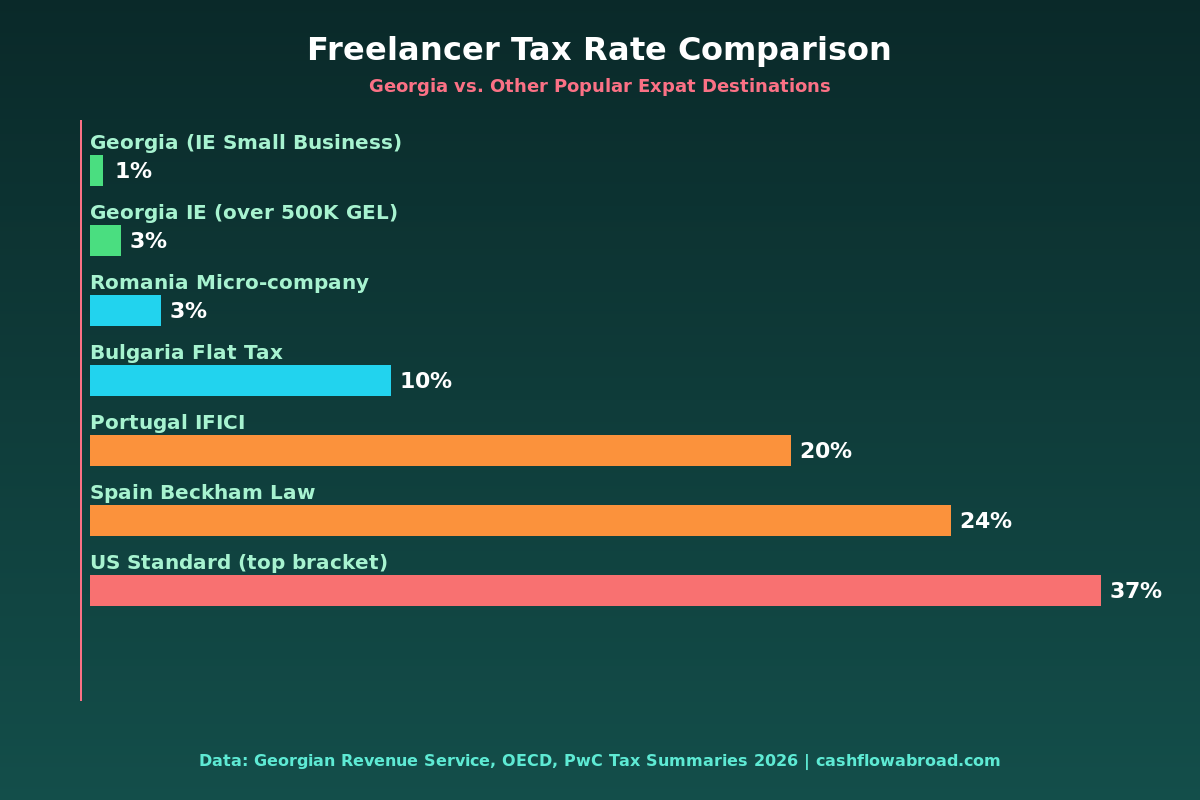
Most freelancers assume taxes are negotiable only at the margins — maybe 28% instead of 37%, maybe an LLC saves you a few grand. Georgia, the small Caucasian country wedged between Russia and Turkey, blows that assumption apart. Under its Individual Entrepreneur (IE) regime with Small Business Status, you pay 1% flat tax on every dollar you earn — up to roughly $180,000 a year. Not 10%. Not 15%. One percent. Registration takes a single business day, costs about $7, and requires no prior residency. This isn't a loophole. It's the published, official Georgian tax code, and thousands of freelancers and remote workers have already quietly relocated to Tbilisi to use it.
What Is Georgia's 1% Tax Regime?
The Georgian Revenue Service offers a designation called Small Business Status (SBS), applied to registered Individual Entrepreneurs. It's a legal simplification specifically designed for sole proprietors and freelancers who run simple service or product businesses. The mechanics are straightforward: instead of calculating profit, deducting expenses, and applying progressive rates, you simply owe 1% of total turnover each quarter. No accounting firm required. No balance sheet. Gross revenue × 0.01 = your tax bill.
The threshold is 500,000 GEL per year — approximately $180,000 USD at current exchange rates. If you stay under that ceiling, you pay 1%. If you cross it during a given year, the rate shifts to 3% for all revenue in the month you exceeded it and every month after for that calendar year. Exceed 500,000 GEL two years in a row, and your status is revoked entirely — you'd fall back into Georgia's standard 20% flat personal income tax rate.
For the overwhelming majority of freelancers, consultants, and remote workers, $180,000 is a very comfortable ceiling. At that income level, you'd owe $1,800 in annual taxes. A US freelancer earning the same amount typically pays $45,000–$65,000 in combined federal, state, and self-employment taxes.
How the Regime Actually Works
The SBS is attached to the Individual Entrepreneur (IE) structure, Georgia's version of a sole proprietorship. Unlike a limited liability company, an IE carries no corporate veil — you and the business are legally the same entity. That's fine for most freelancers since their risk is limited to contracts and deliverables, not physical product liability.
Here's the full breakdown of what you pay under each scenario:
| Annual Revenue (GEL) | USD Equivalent (approx.) | Tax Rate | Example Annual Tax |
|---|---|---|---|
| Under 500,000 GEL | Under ~$180,000 | 1% | $600 on $60,000 |
| Over 500,000 GEL (crossing year) | $180,000+ | 3% from the crossing month | Varies by timing |
| Over threshold 2 consecutive years | $180,000+ | SBS revoked; 20% flat PIT applies | Significant increase |
VAT is exempt for IE owners whose turnover stays under 100,000 GEL (~$36,000). Above that, you'd register for VAT — but if all your clients are outside Georgia, those services are typically zero-rated anyway. In practice, most international freelancers pay 1% income tax and 0% VAT.
Georgia also operates a territorial tax system. Tax residents are only taxed on Georgian-source income — foreign income is off the table entirely. For an IE with SBS, even Georgian-source income is swept into the flat 1% rate. The territorial system doesn't save you extra here, but it confirms there's no double-dipping from the Georgian side on foreign revenue.
Who Qualifies — and Who's Locked Out
SBS is not available for every type of self-employed work. The Revenue Service maintains a prohibited activities list where the simplified regime doesn't apply:
- Prohibited: Legal services, medical services, architectural services, financial consulting, gambling operations, and most categories of professional advisory/consulting work
- Allowed: Software development, graphic design, content writing, translation, digital marketing (non-consulting), e-commerce, photography, tutoring, and most creative or technical services
The consulting prohibition catches people off guard. A freelance UX designer? Clear. A "business strategy consultant"? Potentially prohibited. The distinction often turns on how you describe your activity during registration. Many compliance firms in Tbilisi help expats frame their services to maximize SBS eligibility — this is legal positioning, not evasion, but it's worth professional input if your work sits in a gray zone.
You also must operate as an individual with no partners under your IE. You can subcontract work, but you can't have employees on the IE structure. If your business grows and you need a team, you'd graduate to a Georgian LLC, which has its own tax considerations.
Registering in One Business Day: Step by Step
The process is genuinely as fast as advertised. Georgia runs a unified Public Service Hall system where multiple government agencies share space — no appointment needed in most cities.
What you need:
- Valid passport (with certified Georgian translation if your name uses non-Latin script)
- A Georgian mobile phone number (local SIM card available from airport kiosks for ~$5)
- A registered legal address in Georgia (your rental apartment works fine)
The process:
- Walk into the Public Service Hall in Tbilisi, Batumi, Kutaisi, or other cities
- Submit an IE registration application — 30–60 minutes, fee is approximately 20 GEL (~$7)
- Receive your Georgian Tax Identification Number (TIN) within hours or the next morning
- Log into the Revenue Service portal (rs.ge) and submit the SBS application online
- SBS status becomes effective on the submission date — often same-day
As of 2026, this same-day effectiveness is a meaningful improvement over earlier years when there was a processing lag. You can arrive in Tbilisi on a Sunday, visit the Public Service Hall Monday morning, and be invoicing at 1% by Monday afternoon.
Many expats hire a local agent ($150–$400) to handle the process and any translation requirements. If you're comfortable with bureaucracy and have the patience for a Georgian government portal, DIY is straightforward. Note the 2026 addition: foreign nationals physically employed by Georgian companies now need a labor activity permit — but this applies to employment relationships, not self-employed IE owners serving their own foreign clients.
The Virtual Zone: 0% Corporate Tax for IT Companies
If you're building actual software products — a SaaS tool, a mobile app, a dev shop serving overseas clients — the IE/SBS route may be suboptimal. The better structure is a Georgian LLC with Virtual Zone Person Status, awarded by the Ministry of Finance to IT companies that export their services.
Virtual Zone companies get:
- 0% corporate profit tax on income from clients outside Georgia
- 0% VAT on exported IT services (versus standard 18%)
- 5% dividend tax when distributing profits to shareholders
For a solo developer taking everything out as dividends, the effective rate is 5%. For a team distributing a portion and reinvesting the rest, the undistributed profits accumulate tax-free. A software company with $500,000 in annual revenue pays $25,000 in tax — versus $185,000+ in the US at comparable income levels.
The requirement: Virtual Zone companies must employ qualified IT professionals physically based in Georgia and conduct genuine development work in the country. The Revenue Service reviews applications seriously and can revoke status if the company is a shell. For real software businesses with actual local operations, this is a non-issue. For someone trying to qualify a one-person company doing all its work elsewhere, it's a real barrier.
Cost of Living: The Arbitrage Math

The 1% tax rate alone makes the numbers compelling. Georgia's cost structure multiplies the effect. Tbilisi is one of the cheapest capitals in the broader European/Caucasus region while still offering reliable infrastructure, fast fiber internet, good coffee, and a growing expat community concentrated in neighborhoods like Vera, Vake, and the Old Town.
| Expense | Tbilisi (Monthly) | Batumi (Monthly) |
|---|---|---|
| 1BR apartment (central) | $400–$600 | $300–$500 |
| Groceries | $150–$250 | $120–$200 |
| Coworking space | $80–$150 | $60–$120 |
| Utilities + fiber internet | $60–$100 | $50–$90 |
| Dining out (daily meals) | $5–$15 | $4–$12 |
| Comfortable monthly total | $1,000–$1,500 | $900–$1,400 |
A freelancer earning $80,000/year who relocates to Tbilisi pays roughly $800/year in Georgian tax and ~$15,000/year in living costs. That's $15,800 in total annual outgoings against income — versus $50,000–$70,000 in combined taxes and living costs in a US metro. The $35,000–$50,000 annual surplus is the real prize. Invested consistently through a brokerage like Charles Schwab International — which offers fee-free accounts and free ATM withdrawals worldwide for US expats — that gap compounds into material long-term wealth.
On health coverage: Georgia has local insurance options for $30–$80/month, but quality varies. For expats planning to travel or split time across countries, SafetyWing Nomad Insurance (~$56/month) provides global coverage that follows you across borders — more practical than a local Georgian plan if you're not staying year-round.
The US Expat Wrinkle: FEIE Still Applies
Non-US expats who move to Georgia get the full benefit immediately: 1% tax, done. US citizens and green card holders carry their IRS obligation everywhere they go. But the damage is more manageable than people assume.
The Foreign Earned Income Exclusion (FEIE) lets you exclude up to $126,500 (2024, indexed annually) of foreign earned income from US federal income tax, provided you pass the physical presence test (330 days outside the US in a 12-month period) or the bona fide residence test. That means a US freelancer earning $120,000 in Georgia could theoretically pay $1,200 to Georgia and $0 in US federal income tax on that income. See our complete FEIE guide for the full mechanics before assuming it applies cleanly to your situation.
The catch that trips up freelancers specifically: FEIE does not eliminate self-employment tax (15.3% on net earnings, or roughly 14.1% after the deduction). You can exclude the income from income tax but still owe SE tax on it. A US freelancer earning $80,000 in Georgia might owe zero income tax via FEIE, then still owe ~$11,000 in SE tax. It's real money — but still far less than the $28,000–$35,000 combined federal and state liability they'd face in the US.
For maintaining US banking and financial infrastructure while abroad — critical for SE tax payments, IRS correspondence, and keeping your US credit accounts active — a Traveling Mailbox virtual US address ($15/month) handles IRS mail, bank statements, and state domicile requirements. Our US Expat Banking and Taxes Guide covers the full infrastructure setup.
Three Mistakes That Kill Your SBS Status
1. Underestimating GEL currency risk. The 500,000 GEL ceiling sounds enormous — but GEL fluctuates against USD. If GEL weakens relative to USD, your USD-denominated invoices look larger in GEL terms when converted. A freelancer earning $150,000 USD might be near or over the 500,000 GEL threshold depending on the exchange rate. Track your GEL-equivalent turnover quarterly, not annually, so you're not discovering a threshold breach in December.
2. Registering under a prohibited activity category. If the Revenue Service later determines your activity was ineligible for SBS, they can back-assess taxes at standard rates plus penalties. The safest move: spend $150–$300 on a consultation with a Georgian tax attorney before submitting the SBS application. The conversation is worth every lari.
3. Conflating IE registration with tax residency. Registering an IE in Georgia does not automatically make you a Georgian tax resident. Tax residency requires 183 days of physical presence within a rolling 12-month period. This distinction matters most for US expats: if you're running the FEIE physical presence test, you need 330 days outside the US anyway — and 183 of those in Georgia satisfies both. But if you're using the bona fide residence test in a different country, verify exactly where your tax residency sits before assuming Georgia's territorial system is protecting your foreign income.
Is Georgia the Right Move for You?
Georgia makes the most sense for non-US freelancers earning $30,000–$180,000 from foreign clients who want a near-zero tax burden in a livable, low-cost city. It's also compelling for US expats already committed to the physical presence FEIE path who want to collapse their living costs and widen the gap between income and expenses. Tech founders building genuine software products with a local team have the Virtual Zone option, which is arguably the most aggressive legal tax structure available to a small tech company anywhere.
It makes less sense for professionals in the prohibited activity categories who can't restructure their service description, for those earning above $180,000 who will outgrow SBS, or for anyone who needs EU access or Western European infrastructure. For a broader comparison of how Georgia stacks up against other geographic arbitrage destinations, our 10-country geographic arbitrage guide runs the full cost-tax-lifestyle matrix.
The honest summary: 1% tax in a city where $1,200/month covers comfortable living is one of the most aggressive legal tax optimizations available to a self-employed person — without venturing into offshore structures that carry far more legal and compliance complexity. Georgia isn't perfect, and it won't suit everyone. But for the freelancer who's willing to spend a few months in Tbilisi to test it, the downside is a very affordable experiment.
Financial disclaimer: This article is for informational purposes only and does not constitute tax, legal, or financial advice. Tax laws change frequently and individual circumstances vary significantly. Consult a licensed tax professional familiar with both your home country's tax rules and Georgian tax law before making decisions about residency, business registration, or tax strategy. US citizens and green card holders should consult a qualified expat CPA before restructuring their tax situation abroad.