Geographic Arbitrage + AI: Earn $150/hr, Live on $1,800/mo
A developer in San Francisco charges $150/hour for AI integration work. That's not a loophole. It's basic arithmetic. The data is in.
A developer in San Francisco charges $150/hour for AI integration work. That's not a loophole. It's basic arithmetic. The data is in.
A developer in San Francisco charges $150/hour for AI integration work. After taxes and a $3,500/month studio apartment, she keeps maybe $80K of a $250K year. Someone doing that exact same work from Medellín — same clients, same deliverables, same Zoom calls — keeps $140K or more. That's not a loophole. It's basic arithmetic. And in 2025, it's more achievable than ever, because AI skills are the most globally portable, highest-paid technical services on the planet right now.
This isn't a theoretical "what if" post. The data is in. Upwork's 2026 In-Demand Skills Report found that AI-related freelance work crossed $300 million in annualized contract value — and AI projects command a 44% higher hourly rate than comparable non-AI work. If you can build a RAG pipeline, wire up Claude or GPT-4o to a business's data, or automate a messy workflow with AI agents, you are selling a skill that companies are paying $100–$300/hour for. The question is just where you choose to cash those checks.
The Arbitrage Math Nobody Shows You
Let's put real numbers on this. A mid-level AI consultant billing 20 hours per week at $120/hour earns roughly $115,000 per year from part-time work. Here's what that looks like in two different cities:
| Expense | San Francisco | Medellín, Colombia |
|---|---|---|
| Monthly rent (1BR) | $3,200–$3,800 | $450–$750 |
| Food & groceries | $900–$1,200 | $250–$400 |
| Co-working space | $400–$600 | $80–$150 |
| Health insurance | $400–$700 | $80–$150 (SafetyWing) |
| Transport | $200–$400 | $40–$80 |
| Total monthly burn | $5,100–$6,700 | $900–$1,530 |
At $115K/year with a $6,000/month expense base in SF, you're left with $43K after living costs (before tax). In Medellín, the same income with a $1,400/month burn rate leaves roughly $98K — and that's before counting any tax advantages. That's the geographic arbitrage multiple, and it compounds fast when you're also investing the difference.
Chiang Mai pushes further: comfortable living runs $900–$1,400/month. Lisbon sits at $1,800–$2,500. All three have fast fiber, solid co-working scenes, and visa pathways that work for remote contractors. We'll get to those specifics below.
Which AI Skills Actually Command $100+/Hour
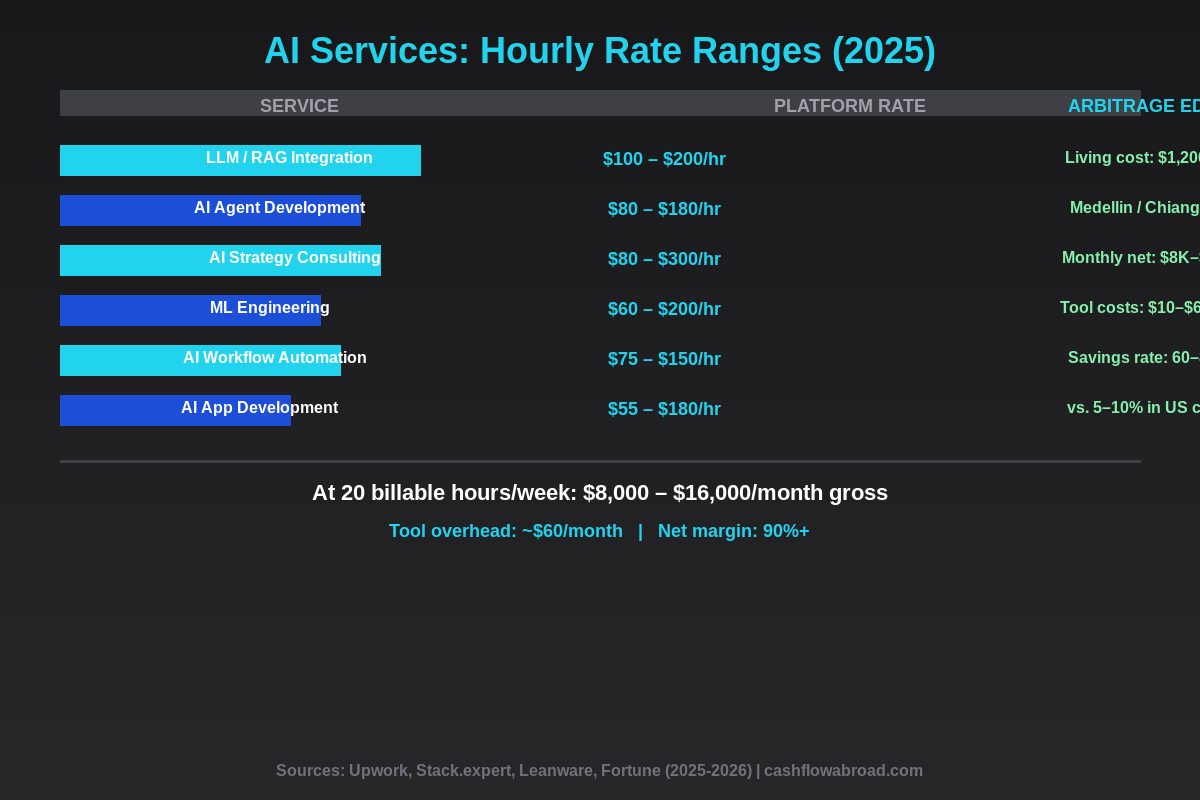
Not all "AI skills" are equal on the rate spectrum. Here's where the real money sits, based on platform data from Upwork, Toptal, and Fortune's 2025 enterprise consulting survey:
LLM Integration & RAG Architecture — $100–$200/hr
Retrieval-Augmented Generation is the dominant enterprise AI pattern right now. Companies have proprietary data — contracts, product docs, support tickets — and they need AI that can actually use it without hallucinating. Building a RAG pipeline means connecting a vector database (Pinecone, Weaviate, or ChromaDB) to an LLM API, handling chunking, embedding, retrieval ranking, and prompt engineering to keep outputs grounded. Demand for LLM specialists jumped 135.8% year-over-year. This is the single highest-leverage skill to develop in 2025.
AI Agent Development — $80–$180/hr
Autonomous agents that can browse, call APIs, run code, and loop on tasks are moving from research to production. Frameworks like LangGraph, CrewAI, and Anthropic's Agent SDK have made this buildable without a PhD. Clients want agents for customer service triage, lead research, proposal generation, and data extraction. This is where Upwork's top-rated AI developers are consistently charging $150+.
Workflow Automation with AI — $75–$150/hr
Most businesses have manual processes that a well-engineered LLM call could handle: invoice processing, email triage, contract review, report generation. Connecting GPT-4o or Claude to existing business tools via APIs — Zapier, Make.com, or custom Python scripts — is unglamorous but wildly in demand. This is accessible to developers with solid Python skills and API experience. No ML background required.
AI Strategy Consulting — $80–$300/hr
Enterprises need someone to evaluate AI vendors, define implementation roadmaps, and train internal teams. This segment pays the highest rates but requires business communication skills more than pure engineering chops. Retainer models run $2,000–$10,000/month for ongoing advisory or embedded implementation work. Fortune's 2025 survey documented premium AI engineers deployed as consultants charging $900/hour — an outlier, but it illustrates where the ceiling sits for specialists with deep enterprise experience and track records.
The Exact Tech Stack (With Prices)
The monthly tool overhead to run a $10K+/month AI consulting practice is about $60. That's not a rounding error — it's the actual cost structure. Here's the full stack:
| Tool | Purpose | Cost |
|---|---|---|
| GitHub Copilot | AI coding assistant — completions, agent mode, Claude Opus access | $10/mo |
| Cursor Pro | AI IDE for complex refactors and multi-file context edits | $20/mo |
| Claude API (Sonnet 4.6) | Primary LLM for client project builds and RAG systems | $3/1M input tokens |
| OpenAI API (GPT-4o) | Alternative LLM, vision tasks, structured output | $5/1M input tokens |
| LangChain / LlamaIndex | RAG orchestration, agent frameworks, data connectors | Free (open source) |
| DigitalOcean | Host client apps, APIs, and managed databases | $12–$48/mo |
| NordVPN | Encrypted connection on café and co-working WiFi | ~$4/mo (annual plan) |
For hosting client-facing AI apps, DigitalOcean is the practical choice for solo consultants — managed Postgres, App Platform for containerized deployments, and GPU Droplets for inference workloads, without the AWS credential sprawl. A typical client MVP comfortably runs on a $24/month Droplet until usage justifies scaling.
The LLM costs themselves are negligible at consulting scale. At $3/1M input tokens for Claude Sonnet 4.6, processing 10,000 pages of client documents costs about $0.60. API costs only become significant at production scale — at which point you're billing infrastructure back to the client anyway. Anthropic's Batch API cuts costs by 50% for asynchronous workloads if you need to stay lean.
On security: NordVPN is non-negotiable when you're regularly on café and co-working WiFi. Client API keys, database credentials, and Zoom calls do not belong on unencrypted public networks.
The One Programming Language That Matters
Python is the lingua franca of AI development. You don't need to be a ten-year Python veteran to bill $100+/hour for AI work — but you do need to be genuinely capable with it. Here's a realistic skills progression for someone starting from scratch:
- Month 1–2: Python fundamentals,
requestsfor API calls, JSON handling, writing automation scripts - Month 3–4: OpenAI/Anthropic SDK integration, prompt engineering, building a functional chatbot
- Month 5–6: LangChain or LlamaIndex basics, vector embeddings with ChromaDB or Pinecone, first working RAG demo
- Month 7–9: LangGraph or CrewAI for agents, FastAPI for building endpoints, deploying to DigitalOcean
- Month 10+: First paid client project, portfolio of 3–4 live demos, raising rates from $75 → $100+/hour
Upwork's data makes a specific and important point: engineers with two or more AI-specific skills earn 43% more than single-skill specialists. The trifecta that unlocks the $150+/hour tier is LLM integration plus RAG architecture plus agent development. Get comfortable with all three and you're positioned in the top 10% of what the market is buying right now.

Where to Find Clients Paying US Rates
Location arbitrage only works if your clients are in high-income markets. Here's where to find them — and how to position yourself to close at premium rates:
Upwork — The Volume Play
Upwork's AI category is the fastest-growing segment on the platform. Position around outcomes, not tools. "I build RAG systems that cut enterprise support ticket volume by 30%" outperforms "Python | LangChain | GPT-4" every time. Upwork's fee structure runs 20% on the first $500 with a client, dropping to 10% up to $10K, then 5% above that — so long-term retainer clients quickly become effectively fee-free.
Toptal — The Premium Tier
Toptal accepts roughly 3% of applicants, but passing their technical screens places you in a network where $60–$150/hour is the floor and multi-month engagements are standard. If you have 3+ years of software engineering experience and can demonstrate AI-specific depth, the vetting process is worth grinding through. One Toptal retainer covers most months entirely.
LinkedIn — The Direct Channel
For AI strategy and enterprise clients, LinkedIn outperforms all platforms. Publish 2–4 posts monthly with actual case studies — what problem you solved, what approach you used, what the outcome was (anonymized if needed). Comment substantively on posts from CTOs and VPs of Engineering at 50–500-person companies. Don't pitch. Demonstrate competence. Inbound inquiries follow within weeks for anyone with genuine depth to share.
Cold Outreach — The Fastest First Client
Find 50 companies that posted "AI Engineer" or "ML Engineer" job listings in the last 90 days but haven't filled the role. Email the hiring manager directly: "I can start your AI integration project in two weeks — no equity, no full-time commitment, just a 3-month contract to ship your MVP." Companies with unfilled AI roles are nearly always open to a capable contractor who can start immediately. Close rate on this approach: 20–30% for initial conversations if your portfolio is solid.
Best Countries to Base Your AI Practice
The ideal base for a location-independent AI consultant needs three things: reliable fast internet, a legal visa path for 6–12+ months, and a cost structure that actually captures the arbitrage. Here's where those conditions align best right now:
Medellín, Colombia — Best Overall
Medellín's El Poblado and Laureles neighborhoods are effectively built for remote tech workers. Fiber internet in apartments is standard, co-working spaces are dense and cheap ($80–$150/month), and the city has a large, active expat tech community. Colombia's Digital Nomad Visa covers up to 2 years. Monthly burn: $1,200–$1,800 including accommodation, food, co-working, and social life. Year-round spring weather is a non-trivial quality-of-life bonus.
Chiang Mai, Thailand — Lowest Cost
Chiang Mai still holds its title for cost-to-quality ratio. Comfortable living — private apartment, gym, eating out regularly — runs $900–$1,300/month. Thailand's Long-Term Resident visa offers a 10-year stay for qualifying remote workers. NIMMAN neighborhood is the digital nomad hub, with reliable gigabit at most co-working spaces and a mature social scene for English-speaking expats.
Lisbon, Portugal — EU Access
Lisbon's D8 Digital Nomad Visa grants Portuguese residency and a path to EU permanent residency. Monthly costs run $1,800–$2,500 — higher than Asia options, but the EU timezone dramatically simplifies working with European enterprise clients. Lisbon also has arguably the best food-to-cost ratio of any Western European capital, which matters when you're there for a year or more.
Tbilisi, Georgia — The Tax-Zero Option
Georgia offers 0% tax on foreign-sourced income for Virtual Zone companies — a legitimate structure where you operate a Georgian entity and pay zero corporate tax on work done for clients outside Georgia. Tbilisi has solid internet, a rapidly growing tech expat community, and monthly costs around $900–$1,400. The Airbnb-to-long-term-lease arbitrage is significant: a furnished 2BR that runs $2,500/night on short-term rental goes for $600/month on a 6-month lease.
The Tax Angle: Keeping More of Every Billable Hour
For US citizens abroad, the biggest lever is the Foreign Earned Income Exclusion (FEIE). In 2025, FEIE lets qualifying expats exclude up to $126,500 of foreign-earned income from US federal income tax. At $120/hour billing 20 hours/week, that covers roughly your entire income — meaning zero federal income tax on the excluded amount.
To qualify, you either pass the Physical Presence Test (330 days outside the US in a 12-month period) or establish bona fide foreign residence. Self-employment income still carries SE tax (15.3%) on net earnings, but eliminating federal income tax on $126K+ is a material difference. Run the full calculation with a qualified expat CPA — the math almost always wins at consulting income levels above $80K/year.
Non-US citizens in territorial tax countries — Georgia, Paraguay, Panama — have an even simpler structure: foreign-sourced income is untaxed by default. Your consulting revenue from US clients is simply not their government's business.
Keeping Your US Business Infrastructure Intact
US clients expect a US business presence. Here's the minimal infrastructure stack that maintains it without requiring you to live there:
- Wyoming or Delaware LLC: Wyoming's $100/year LLC fee and strong privacy laws make it the default for US remote businesses. Delaware works if you need VC-compatible structure later.
- US banking: Mercury is the best US business bank account for remote founders — no monthly fees, fully online onboarding, works perfectly for receiving ACH and wire payments from US clients while living abroad.
- US mailing address: Your LLC needs a real street address for IRS correspondence and state filings. Traveling Mailbox provides a real US address with mail scanning and forwarding — critical for maintaining a US business presence without a physical presence. See the full virtual mailbox guide for setup details.
Mercury accepts international addresses for account holders while keeping the account US-domiciled — you receive wire transfers, ACH, and checks exactly as any US business would. No currency conversion drama, no international transfer fees eating 2–4% of every invoice.
A 90-Day Roadmap to Your First $100/Hour Client
This is not a someday plan. Here's a concrete sequence:
Days 1–30 — Build the foundation: Complete a focused Python + LangChain learning path. Fast.ai's Practical Deep Learning is free and excellent. Build three demo projects: a document Q&A bot using LlamaIndex and ChromaDB, a web scraping + summarization agent with LangChain, and a customer service chatbot connected to GPT-4o. Host all three on GitHub with clean READMEs.
Days 31–60 — Create the surface area: Set up your Upwork profile with outcome-focused positioning. Optimize LinkedIn with "AI Integration Consultant" in the headline and publish a post about one demo project that includes real performance numbers. Reach out to 10 businesses in your existing network offering a free 1-hour "AI readiness audit" — these convert to paid projects 25–30% of the time.
Days 61–90 — Close the first paying engagement: Apply to 15–20 Upwork jobs weekly, targeting projects under $5,000 to lower the sales threshold. Accept $50–$75/hour for the first 1–2 projects to build reviews fast. After three completed projects with 5-star reviews, raise rates to $100+/hour and stop competing for low-end work. Continue LinkedIn content and cold outreach in parallel. One US enterprise retainer client — the kind who books 10–20 hours/month at $150/hour — changes the entire income picture.
The median exclusive freelance income on Upwork hit $85,000 in 2025, surpassing the median full-time employee income of $80,000. That's the floor. AI specialists doing specialized RAG and agent work are billing 2–3x that figure consistently.
For the broader strategic framework on building a location-independent business — entity choice, client management, revenue diversification across service types — the $100K online business guide covers the structural decisions that apply regardless of your specific AI niche.
The Bottom Line
Geographic arbitrage existed before AI, but AI is what makes the math genuinely unfair. You're billing $120–$200/hour for work that requires a $60/month tool stack, from a country where your entire monthly expenses run $1,200–$1,800. The client doesn't know or care that you're answering their Zoom call from a co-working space in Poblado rather than a WeWork in SoMa. They care that the RAG pipeline works, the agent doesn't hallucinate, and the integration shipped on time. That's it.
The skills are learnable. The visa paths exist. The client platforms are open to anyone with a strong portfolio. The only thing keeping most people in expensive home cities is the assumption that proximity to the client matters. In AI consulting, it never did — and now the data proves it.
Financial Disclaimer: This article is for informational purposes only and does not constitute financial, tax, or legal advice. Income figures are based on platform data and published industry surveys; individual results vary significantly based on skills, experience, market conditions, and client acquisition ability. Tax treatment for US citizens abroad is complex — consult a qualified expat CPA before making residency or business structure decisions. Some links in this post are affiliate links that may earn a commission at no additional cost to you.
This guide is general information, not personalized tax, legal, or investment advice. Rules change; verify current thresholds with official sources or a qualified professional before acting.
Related guides
 AI Income & Cash FlowJune 13, 2026
4 No-Code AI Products: $1k–$3k Per Build, No Coding
Four no-code AI products — chatbots, lead bots, content pipelines, review automation — that generate $1k–$3k builds and monthly retainers from abroad.
 AI Income & Cash FlowJune 12, 2026
Sell AI Cold Email as a Service From Abroad
Launch a done-for-you AI cold email lead gen service for US clients abroad. Tool stack under $600/month. Realistic path to $10K+ net monthly.
 AI Income & Cash FlowJune 11, 2026
Telegram AI Bots: A Zero-Fee Service Business Abroad
Build and sell Telegram AI bots using a free API, $12/mo VPS, and Claude Haiku. Charge $1,200-$7,000 per build and $75-$500/mo in retainers from