The FEIE-Roth IRA Trap Costing Expats $500K at Retirement
Using the FEIE abroad legally blocks your Roth IRA contributions — a little-known trap that can cost expats $400,000+ in tax-free retirement wealth over a decade.
The FEIE excludes income from U.S. tax — but blocks Roth IRA contributions. Learn the 5-year trap and preserve retirement savings abroad.
Disclosure: this article contains affiliate links. If you open an account through one of them, Cashflow Abroad may earn a referral commission at no extra cost to you.
Here's a number most expats never calculate: if you use the Foreign Earned Income Exclusion (FEIE) for just 10 years while living abroad, you could forfeit $400,000 to $500,000 in tax-free retirement wealth — not through bad investing, but through a single well-intentioned tax election on Form 2555.
The FEIE is the crown jewel of expat tax planning. It lets you exclude up to $132,900 of foreign earned income from U.S. taxation in 2026. Zero federal income tax on six figures of income sounds like a slam dunk. And for many expats in low-tax countries, it is.
The problem nobody tells you before you sign Form 2555: the moment you exclude that income, it stops being "earned income" for IRA purposes. And without earned income, you legally cannot contribute to a Roth IRA — or any IRA.
The IRS Definition That Creates the Trap
IRC Section 219(f)(1) defines "compensation" eligible for IRA contributions as earned income — but with a critical carve-out: income excluded under the FEIE does not count. The IRS treats your excluded income as if it doesn't exist for retirement contribution purposes.
The practical effect: if you earn $90,000 abroad and exclude all of it under the FEIE, your IRA-eligible "compensation" is $0. You cannot contribute to a traditional IRA. You cannot contribute to a Roth IRA. The backdoor Roth doesn't save you either — it still requires earned income to make the initial non-deductible traditional IRA contribution. Exclude everything, lose everything.
This isn't a gray area. The IRS is explicit about it, and tax professionals see this mistake constantly among expats who discover years later they were making "excess contributions" — a problem that carries its own 6% annual penalty until corrected.
The Dollar Impact Nobody Talks About
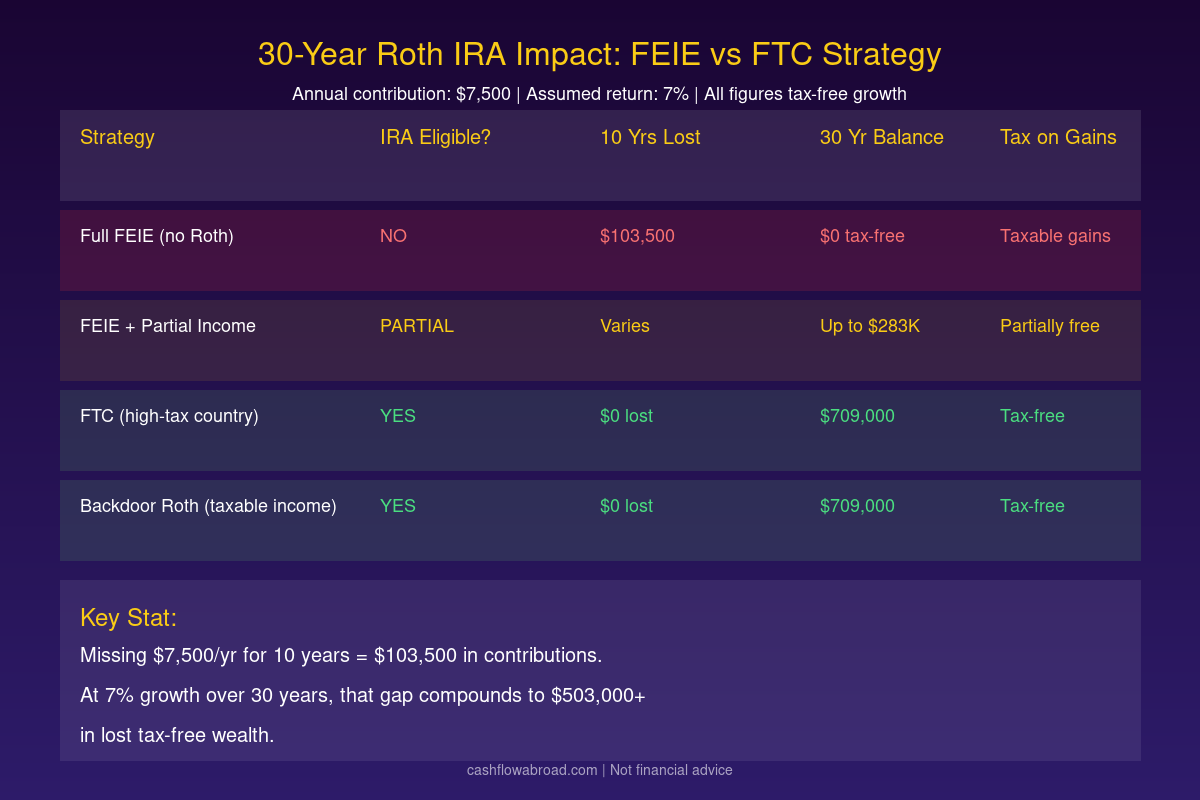
Let's quantify the actual cost. The 2026 Roth IRA contribution limit is $7,500 per year (or $8,600 if you're 50 or older). Roth IRA gains grow tax-free — no capital gains tax, no tax on withdrawals in retirement.
At a 7% average annual return, $7,500 per year compounded over 30 years grows to approximately $709,000 in tax-free wealth. If you spend 10 years abroad fully FEIE'd — unable to contribute — and then contribute for only the remaining 20 years of your working life, you end up with about $307,000. The gap: $402,000 in lost tax-free retirement wealth.
For expats who stay abroad 15 to 20 years, the math gets worse. Every year the Roth stays empty is a year of compounding you can never recover — missed contribution room does not carry forward.
Who Gets Hit Hardest
The FEIE-Roth trap hits specific profiles especially hard:
- Digital nomads and remote workers in low/no-tax countries — Thailand, UAE, Mexico, Colombia, Georgia. FEIE is obviously attractive when local taxes are minimal, but that's precisely where the Roth cost goes unnoticed.
- Expats in their 30s and 40s — these are peak earning years where Roth contributions carry the most compounding runway. Missing this decade costs more than missing your 50s.
- Self-employed expats — they're already paying the 15.3% self-employment tax (since FEIE doesn't eliminate SE tax), and then they lose Roth access on top of that.
- Single-income expat households — no spouse with U.S. earned income means no spousal IRA workaround.
The 5-Year Revocation Trap
Here's where the FEIE gets genuinely punitive: once you elect it, switching strategies is expensive.
If you decide to revoke your FEIE election to restore Roth IRA eligibility — say, by switching to the Foreign Tax Credit (FTC) — the IRS bars you from re-electing the FEIE for five years without IRS permission. This means you can't simply toggle between strategies year by year. Revoking costs you five years of FEIE access, during which you'll owe full U.S. income tax on foreign earnings (offset only by FTC credits).
For expats in low-tax countries, this can mean five years of owing tens of thousands in U.S. taxes that FEIE would have eliminated — a cost that likely dwarfs the Roth contributions you restore.
The lesson: the FEIE election is not a minor administrative choice. It's a long-horizon tax architecture decision with compounding consequences for your retirement balance sheet.
FEIE vs. Foreign Tax Credit: The Retirement-Focused Comparison
| Factor | FEIE (Form 2555) | Foreign Tax Credit (Form 1116) |
|---|---|---|
| 2026 tax benefit | Exclude up to $132,900 | Dollar-for-dollar credit for foreign taxes paid |
| Roth IRA eligibility | Eliminated if all income excluded | Preserved — income stays on return |
| Best for | Low/zero-tax countries | High-tax countries (UK, Germany, France, Japan, Australia) |
| Child Tax Credit access | Reduced | Fully preserved |
| FTC carryforward | N/A | Up to 10 years |
| Switching penalty | 5-year lockout if revoked | Can switch to FEIE within limits |
| SE tax impact | Does NOT eliminate SE tax | Does NOT eliminate SE tax |
The FTC is automatic for expats in high-tax countries. If you're paying 30–45% income tax in Germany or the UK, those foreign taxes wipe out your U.S. liability entirely — and you still have U.S.-recognized earned income, which means full Roth IRA eligibility.
Expats in countries with tax treaties (much of Western Europe, Canada, Japan, Australia) typically benefit from the FTC approach. A year where you pay excess foreign taxes builds a credit bank you can draw on for up to 10 years forward.
For a deeper breakdown of the investing side for expats, including the PFIC trap that affects foreign mutual funds, read our Expat Investing Playbook.
Strategies That Actually Work
Don't Exclude Everything
You don't have to claim the maximum FEIE. If your foreign earned income is $132,900, you can elect to exclude only $125,400 and leave $7,500 as U.S. taxable income — enough earned income to fund a full Roth IRA contribution. You'll owe some U.S. income tax on that $7,500, but at your marginal rate it's often a small price for restoring Roth access.
This partial FEIE approach is underutilized and rarely discussed. It threads the needle: significant tax savings from exclusion plus preserved retirement savings access.
Use FTC in High-Tax Countries
If you live in a country with a tax treaty and income tax rate at or above the U.S. rate, the FTC is usually more valuable anyway. Your foreign tax payments offset your U.S. liability, potentially reducing it to zero — while your income stays on your U.S. return as earned income, allowing full Roth contributions. In high-tax environments, FTC often outperforms FEIE on both current-year tax savings and long-term retirement outcomes.
Spousal IRA if Your Partner Has Taxable Income
If you're married filing jointly and one spouse has U.S.-recognized earned income (working remotely for a U.S. company, or not using the full FEIE), that income can support a Roth IRA contribution for both spouses. A spousal IRA lets a non-earning or fully FEIE-excluded spouse contribute up to $7,500 based on the other spouse's compensation. Combined, a couple can put $15,000 per year into Roth accounts even if one partner is fully excluded.
Backdoor Roth With Caveats
The backdoor Roth — contribute after-tax dollars to a traditional IRA, then convert to Roth — is an income-limit workaround for high earners. But it doesn't solve the FEIE problem. You still need taxable earned income to make the initial traditional IRA contribution. If your entire income is excluded, the backdoor is closed.
However, high-income expats earning above the FEIE cap naturally have excess earned income that qualifies. An expat earning $175,000 who excludes $132,900 has $42,100 in U.S.-recognized earned income — enough to fund a full Roth contribution and then some.

One Silver Lining: The FEIE Roth Conversion Window
There's a scenario where FEIE users actually win on the Roth front: Roth conversions.
If you have pre-tax funds in a traditional IRA or 401(k) from before your expat years, you can convert them to Roth while living abroad. Because your FEIE eliminates most other taxable income, the converted amount may be taxed at extremely low U.S. marginal rates — sometimes 0% for amounts within the standard deduction ($15,000 for singles in 2026).
A $50,000 Roth conversion that would cost $11,000+ in taxes at your U.S.-resident marginal rate might cost a fraction of that when you're abroad with no U.S. taxable income from wages. You can't contribute new money with FEIE-excluded income, but you can move old money very cheaply. This is one of the genuine tax advantages FEIE users have over their stateside counterparts, and most expats never act on it.
Keeping Your Roth Alive While Abroad
A common fear: will a U.S. brokerage close my IRA if I live abroad? Many do restrict accounts for non-U.S. residents due to compliance costs. Charles Schwab International is the expat community standard — they explicitly maintain accounts for U.S. citizens abroad, offer free worldwide ATM withdrawals, and won't force-close your IRA simply because you moved.
Brokerages also require a valid U.S. address. A Traveling Mailbox virtual address ($15/month) gives you a real U.S. street address, scans incoming mail digitally, and can deposit checks — letting you maintain brokerage and banking relationships without interruption. For anyone managing IRA accounts, tax correspondence, and state domicile from abroad, a virtual mailbox is non-negotiable infrastructure.
For a comprehensive look at how expat banking and tax compliance intersect, the US Expat Banking & Taxes Guide covers FBAR reporting thresholds, account maintenance, and keeping your financial infrastructure intact while living abroad.
Your FEIE-Roth Action Checklist
| Situation | Recommended Action |
|---|---|
| Living in low-tax country, earning under $132,900 | Consider partial FEIE — leave $7,500 unexcluded to fund Roth |
| Living in high-tax country (UK, Germany, France, Japan) | Use FTC instead of FEIE; preserve full Roth IRA eligibility |
| Earning over $132,900 abroad | Excess income qualifies; fund Roth up to $7,500 or $8,600 (50+) |
| Married, one spouse has taxable U.S. income | Spousal IRA — both partners can contribute $7,500 each |
| Have old traditional IRA/401(k) from U.S. years | Convert to Roth while abroad — low taxable income = cheap conversion |
| Considering switching from FEIE to FTC | Model the full 5-year cost before revoking; get an expat CPA involved |
The FEIE Is Not Free
The FEIE is a legitimate and powerful tool. For expats in Dubai, Thailand, Paraguay, or anywhere with no income tax, excluding $132,900 from U.S. taxation is a real financial advantage. The point isn't to abandon the FEIE — it's to understand the full cost of the decision, including the retirement savings trade-off that never makes it into the headline numbers.
A $7,500 Roth IRA contribution costs roughly $0 to $1,800 in U.S. taxes at most marginal rates relevant to expats (using the partial FEIE approach). Skipping that contribution to avoid any U.S. tax exposure isn't saving money — it's trading a small tax bill for a $400,000+ long-term shortfall.
For more on building tax-efficient wealth from abroad, see the complete FEIE guide and the Expat Investing Playbook for structuring your portfolio without triggering PFIC rules. If you need a U.S. brokerage that works for expats, Charles Schwab International remains the community standard — no account minimums, no foreign transaction fees, and full expat account support.
This article is for informational purposes only and does not constitute tax, legal, or financial advice. Tax rules change frequently and vary based on individual circumstances. Consult a qualified expat CPA or enrolled agent before making any FEIE, FTC, or IRA contribution decisions. Relevant authority: IRC Section 219, IRS Publication 54.
This guide is general information, not personalized tax, legal, or investment advice. Rules change; verify current thresholds with official sources or a qualified professional before acting.
Related guides
 Expat Tax & FinanceAugust 25, 2026
FEIE 5-Year Lockout If You Switch to FTC
Switching from Form 2555 to Form 1116 can lock out the FEIE for five tax years. Price the move before you file either form.
 Expat Tax & FinanceMay 3, 2026
The FEIE Retirement Trap: Why Your Tax Break Costs More
Claiming the FEIE can zero out your Solo 401(k) and IRA contribution limits. Learn how the 5-year lock-in affects self-employed expats.
 Expat Tax & FinanceSeptember 6, 2026
Why 330 Days Abroad Can Still Fail FEIE
Pass the IRS tax home and abode tests before you file Form 2555. A 330-day count without a foreign tax home can wipe out the $130,000 FEIE.