
Here's a tax fact that stops most expats cold: you can owe zero dollars in federal income tax and still rack up $16,536 in government fines — simply for forgetting to file a single form about a foreign bank account you already pay taxes on. No fraud. No evasion. Just a missed checkbox.
FBAR and FATCA are the two reporting requirements that US expats most commonly overlook, and the penalties for missing them make late tax filing look quaint. This guide breaks down exactly what each form requires, what the fines actually look like in practice, and — critically — how to come clean if you've been missing them for years.
What Is the FBAR and Who Has to File It
The FBAR — formally FinCEN Form 114, Report of Foreign Bank and Financial Accounts — isn't an IRS form at all. It's filed with FinCEN, the Treasury's Financial Crimes Enforcement Network, and it predates the internet. The Bank Secrecy Act has required it since 1970.
The trigger is simple: if you're a US person (citizen, green card holder, or resident) and the combined value of your foreign financial accounts exceeded $10,000 at any single moment during the calendar year, you must file. The accounts don't need to hold $10,000 at year-end. They don't need to earn interest. If your combined balance hit $10,001 on March 3rd for one day, you're required to file.
Accounts that count toward the $10,000 threshold include:
- Foreign bank accounts (checking, savings, fixed deposits)
- Foreign brokerage accounts
- Foreign pension funds you have signatory authority over
- Accounts you control but don't own (a company account you can sign on)
- Cryptocurrency held on foreign exchanges — if the exchange is foreign-incorporated
The FBAR is filed electronically at the BSA E-Filing System. Deadline: April 15, with an automatic extension to October 15 — no request needed. It's free to file and takes about 15 minutes once you have your account information ready. For a comprehensive look at how FBAR fits into the broader picture of expat banking compliance, see our US expat banking and taxes guide.
What Is FATCA and Form 8938
FATCA — the Foreign Account Tax Compliance Act — is the 2010 law that forced foreign banks worldwide to report US account holders to the IRS. The reporting form on your end is Form 8938, Statement of Specified Foreign Financial Assets, and it attaches directly to your Form 1040.
The thresholds for expats are significantly higher than FBAR's:
| Filing Status | Year-End Balance Triggers Filing | Any Point During Year |
|---|---|---|
| Single / MFS (living abroad) | $200,000+ | $300,000+ |
| Married Filing Jointly (living abroad) | $400,000+ | $600,000+ |
| Single / MFS (living in US) | $50,000+ | $75,000+ |
| Married Filing Jointly (living in US) | $100,000+ | $150,000+ |
Form 8938 covers a broader range of assets than FBAR. In addition to bank accounts, it requires reporting foreign stocks, foreign partnership interests, foreign pension plans, and certain foreign life insurance policies with cash value. If an asset is reportable on Form 8938, you may still need to file FBAR separately — the two forms overlap but don't replace each other.
The FATCA filing deadline matches your tax return: April 15, or June 15 if you're living abroad, with extensions available through October 15.
The Penalty Structure That Will Make Your Stomach Drop
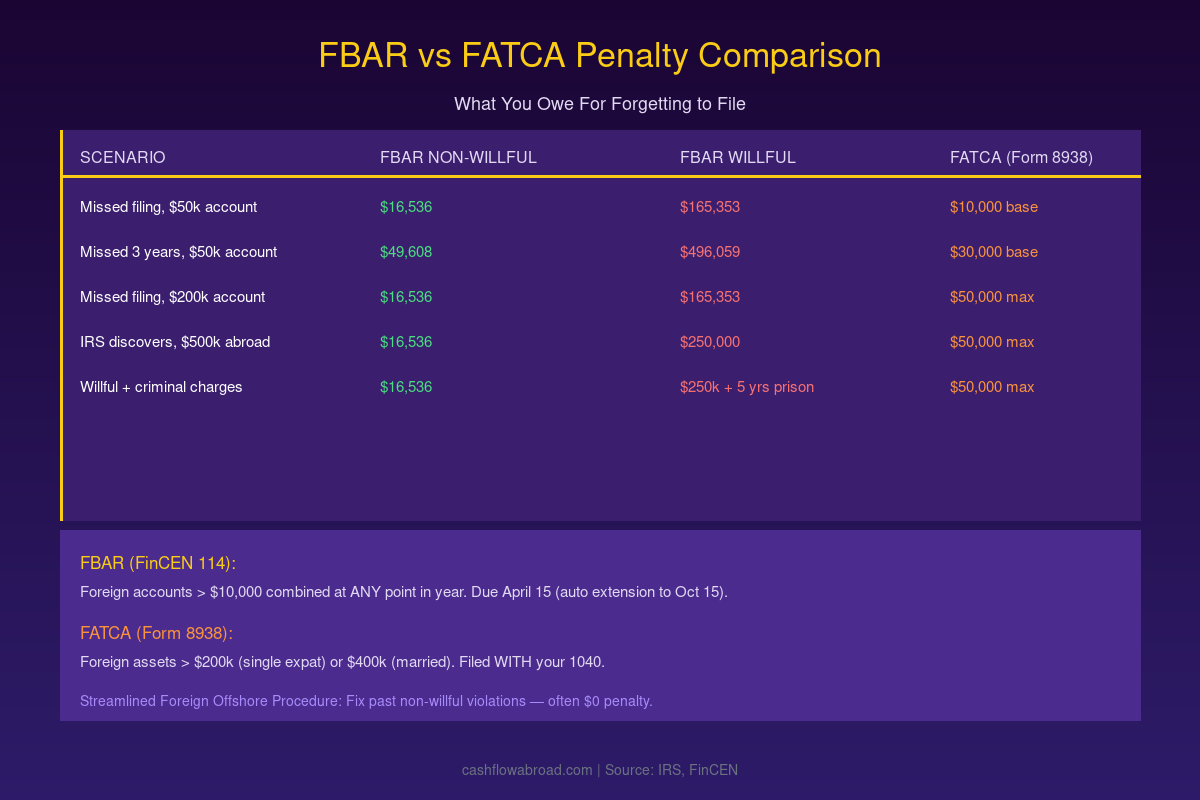
Penalties for failing to file an FBAR are assessed by FinCEN (not the IRS), and they are completely disconnected from your actual tax liability. You can owe $0 in taxes and still face six-figure fines.
Non-Willful Violations
A non-willful violation is one where you didn't know you had to file, or made an honest mistake. Thanks to a 2023 Supreme Court decision in Bittner v. United States, the penalty for non-willful violations is now assessed per FBAR form, not per account. Before that ruling, the IRS had argued it could assess up to $10,000 per account per year — which meant someone with five foreign accounts who missed three years could face $150,000+ in fines for genuine ignorance.
Post-Bittner, the inflation-adjusted non-willful penalty is up to $16,536 per year of missed filing. Miss three years? That's potentially $49,608 — for a free form that takes 15 minutes to file.
Willful Violations
If FinCEN determines your failure to file was willful — meaning you knew about the requirement or recklessly ignored it — the penalties are a different category entirely. The 2026 willful penalty is the greater of:
- $165,353 per year, or
- 50% of the highest balance in all unreported accounts during that year
Miss three willful years with $300,000 abroad? That's potentially $450,000 in FBAR fines — 150% of the account balance — plus potential criminal prosecution.
A January 2026 ruling in United States v. Reyes (Second Circuit) confirmed that "reckless disregard" of FBAR requirements is sufficient for willful penalties. You don't need to have deliberately hidden accounts. If you received tax advice, signed a tax return that referenced foreign income, or worked with an accountant who should have flagged it — the government can argue you had constructive knowledge. Six other circuit courts have adopted the same standard, meaning this interpretation now applies across virtually every US jurisdiction.
Criminal Exposure
The criminal tier applies to willful violations: fines up to $250,000 and up to five years in federal prison. In practice, criminal FBAR prosecution is rare and reserved for deliberate concealment with large sums. But it's on the statute books and prosecutors have used it.
FATCA (Form 8938) Penalties
FATCA penalties are assessed by the IRS and are more structured:
| Violation | Penalty |
|---|---|
| Failure to file Form 8938 | $10,000 per year |
| Continued failure after IRS notice | Additional $10,000/month, capped at $50,000 total |
| Underpayment linked to undisclosed foreign assets | 40% accuracy-related penalty on understated tax |
| Fraudulent failure to disclose | 75% civil fraud penalty on underpaid tax |
Both FBAR and FATCA penalties can apply simultaneously on the same underlying accounts. The IRS does not double-count the tax owed, but the filing penalties stack independently. If you missed both forms for three years, you could face $49,608 in FBAR fines plus $30,000+ in FATCA penalties — on income you owe no additional tax on.

FBAR vs. Form 8938: The Critical Differences
| Feature | FBAR (FinCEN 114) | Form 8938 (FATCA) |
|---|---|---|
| Filed with | FinCEN (Treasury Dept) | IRS (attached to 1040) |
| Threshold | $10,000 combined at any point | $200k+ (single expat) / $400k+ (married expat) |
| Asset types covered | Bank & financial accounts only | Accounts + stocks, pensions, insurance, partnerships |
| Deadline (expats) | April 15 (auto Oct 15 extension) | June 15 / Oct 15 with extension |
| Non-willful penalty | Up to $16,536/year (per form) | $10,000/year base |
| Willful penalty | $165,353 or 50% of balance (higher) | 40–75% of underpaid tax + $50k filing max |
| Statute of limitations | 6 years from due date | 3–6 years depending on severity |
| How IRS knows about it | FATCA bank reporting, treaty exchanges | Foreign bank FATCA reports directly to IRS |
The most important distinction: FBAR has a $10,000 trigger. If you've had more than that in a foreign bank account at any point since moving abroad, you likely owed FBARs. Most expats with a basic foreign checking account hit the threshold within months of arriving.
The Relief Programs: How to Fix Years of Non-Filing
If you've been missing FBARs or Form 8938, the single most important fact is: the IRS has formal programs to let you come clean before they find you, often with zero or minimal penalties. That window closes permanently the moment the IRS contacts you first.
Streamlined Foreign Offshore Procedures (SFOP)
This is the path for expats who missed filings due to non-willful conduct. To qualify, you must:
- Have lived outside the US (330+ days outside the US in at least one of the last 3 tax years)
- Certify, under penalty of perjury via Form 14653, that failures were non-willful
- File 3 years of amended or original federal tax returns
- File 6 years of delinquent FBARs
- Pay all back taxes owed, plus interest
The result: FBAR penalties waived entirely. FATCA filing penalties waived. The only cost is the back taxes themselves — which for most expats claiming the FEIE and Foreign Tax Credits are minimal or zero — plus statutory interest. A potential six-figure penalty exposure gets reduced to a filing project.
The Form 14653 certification is the linchpin. It must be detailed, credible, and signed under penalty of perjury. A tax attorney who regularly handles SFOP submissions is worth the cost, typically $1,500–$4,000 for the full package. A generic preparer who doesn't understand the non-willfulness standard can undermine your case. For more on how the FEIE reduces back taxes in an SFOP submission, see our FEIE guide.
Delinquent FBAR Submission Procedures
If you missed FBAR filings but properly reported all foreign income on your US tax returns, the Delinquent FBAR Submission Procedures offer a simpler path: file the late FBARs with an explanatory statement, and FinCEN's stated policy is to not impose penalties when income was properly reported and the IRS hasn't already flagged you. No amended returns required, no formal certification — just file the missing FBARs with a cover explanation of why they were late.
This is the fastest route for expats who were filing their taxes correctly but simply didn't know FinCEN Form 114 existed.
When You Think It Might Be Willful
If you knew about FBAR, had a tax professional who mentioned it, or received IRS notices about foreign accounts in the past and still didn't file — don't use the streamlined procedures. Filing a fraudulent non-willfulness certification is a crime. Consult an international tax attorney about the IRS Criminal Investigation Voluntary Disclosure Practice before doing anything. The process is slower and more expensive, but it protects you from criminal exposure.
Why Detection Risk Is Higher Now Than Ever
FATCA has fundamentally transformed how much foreign financial institutions know the IRS knows about you. Over 100 countries have signed FATCA intergovernmental agreements. Your bank in Spain, Colombia, Thailand, or Portugal is required to report your account data — balance, income, name, passport number — to its local tax authority, which forwards it to the IRS annually.
As of 2026, the Common Reporting Standard (CRS) has layered on top of FATCA, creating near-complete cross-border financial transparency. The IRS receives data from foreign banks on US account holders even when those account holders never filed an FBAR. That data sits in IRS systems. When an IRS examiner pulls your file, the first thing they see is often a list of foreign accounts the agency already knows about — accounts you haven't reported.
The practical consequence: waiting is not a strategy. The delinquent-filer amnesty programs exist precisely because the government prefers voluntary compliance. Once IRS contact happens, those programs close. The longer you wait, the larger the potential penalty exposure and the fewer options available.
Account Types That Expats Most Often Miss
Beyond the obvious foreign checking account, several less-obvious account types trip up expats who think they're already reporting correctly:
- Foreign employer pension plans — A mandatory pension contribution to a foreign government or employer retirement scheme counts if you have signatory authority or a beneficial interest and the balance exceeds $10,000.
- Cryptocurrency on non-US exchanges — The IRS has expanded guidance on crypto reporting. Crypto held on exchanges incorporated outside the US may trigger FBAR requirements; the rules are still evolving, but conservative treatment means reporting.
- Joint accounts where you're a signatory — If your spouse is the primary account holder on a foreign account but you can sign on it, it counts toward your FBAR threshold even though it's not "your" money in the traditional sense.
- Business accounts you control — If you have signatory authority over a foreign corporate bank account — your own company or an employer's account — that account factors into your personal FBAR threshold.
- Short-lived accounts — An account you opened and closed within the same tax year still counts if its balance exceeded $10,000 at any point.
Keeping Your Financial Stack Reportable
The easiest way to stay compliant is to build a foreign account structure that's simple to report. Charles Schwab International keeps your primary brokerage and checking in the US — no FBAR required since Schwab is a US institution. For international transfers, Remitly moves money between your US account and foreign accounts without creating additional reportable foreign account relationships.
If you're holding stablecoins or dollar-denominated savings in a foreign fintech — platforms like ARQ Finance which holds USDc/EURc balances for Latin American expats — treat those balances as potentially FBAR-reportable and get the question answered by a tax professional before assuming they're not.
For IRS correspondence and state domicile while abroad, a virtual mailbox is essential. IRS penalty notices and compliance letters go to your address of record. If that's a hotel in Chiang Mai, you may miss the 30-day response window that could have protected you. Traveling Mailbox gives you a real US street address with mail scanning — IRS letters arrive digitally within 24 hours. For crypto holdings abroad that intersect with FBAR questions, our crypto taxes for US expat guide covers the current reporting framework.
The Five-Step Action Plan
- Inventory every foreign account you've ever held. Include accounts you closed mid-year, accounts in your spouse's name where you have signatory authority, and brokerage accounts held at non-US firms. The $10,000 FBAR threshold is aggregate — across all accounts combined.
- Determine your FBAR filing history. If you've been abroad for 5 years and never filed an FBAR, you have 5 years of delinquent filings to address. FinCEN looks back 6 years for willful violations.
- Check whether Form 8938 also applies. If your total foreign assets ever exceeded $200,000 (single) or $400,000 (married) while living abroad, both forms are in scope.
- Act before the IRS contacts you. Streamlined programs and delinquent procedures require proactive filing. Once the IRS opens an exam or sends a delinquency notice, your options narrow to paid penalty negotiation or litigation.
- Use an expat-specialized CPA or tax attorney. This isn't a DIY situation. A professional who routinely handles SFOP submissions knows how to draft a credible non-willfulness certification, run the FEIE and FTC math to minimize back taxes, and file the package correctly the first time.
The Bottom Line
FBAR and FATCA feel like tax forms, but they're not. FBAR is a Treasury disclosure requirement with criminal law roots going back to 1970. FATCA is a financial surveillance infrastructure that has turned foreign banks into IRS informants worldwide. Neither cares whether you owe any additional tax.
The system is working as designed: the IRS receives data on your foreign accounts from foreign banks, compares it against FBAR filings, and flags discrepancies. For the millions of Americans abroad who never knew about these requirements, the streamlined programs exist as a genuine second chance — but only if you use them before the IRS does the comparison first.
Get the filings done. The alternative is much more expensive.
This article is for informational purposes only and does not constitute legal or tax advice. FBAR and FATCA compliance requirements depend on individual circumstances and can change. Consult a qualified CPA or international tax attorney with expertise in US expat reporting before acting on past delinquencies. Streamlined filing procedures referenced above are subject to IRS eligibility requirements and may be modified at any time.