The Expat Money Transfer Bible: Move $10K–$500K Without Hidden Fees
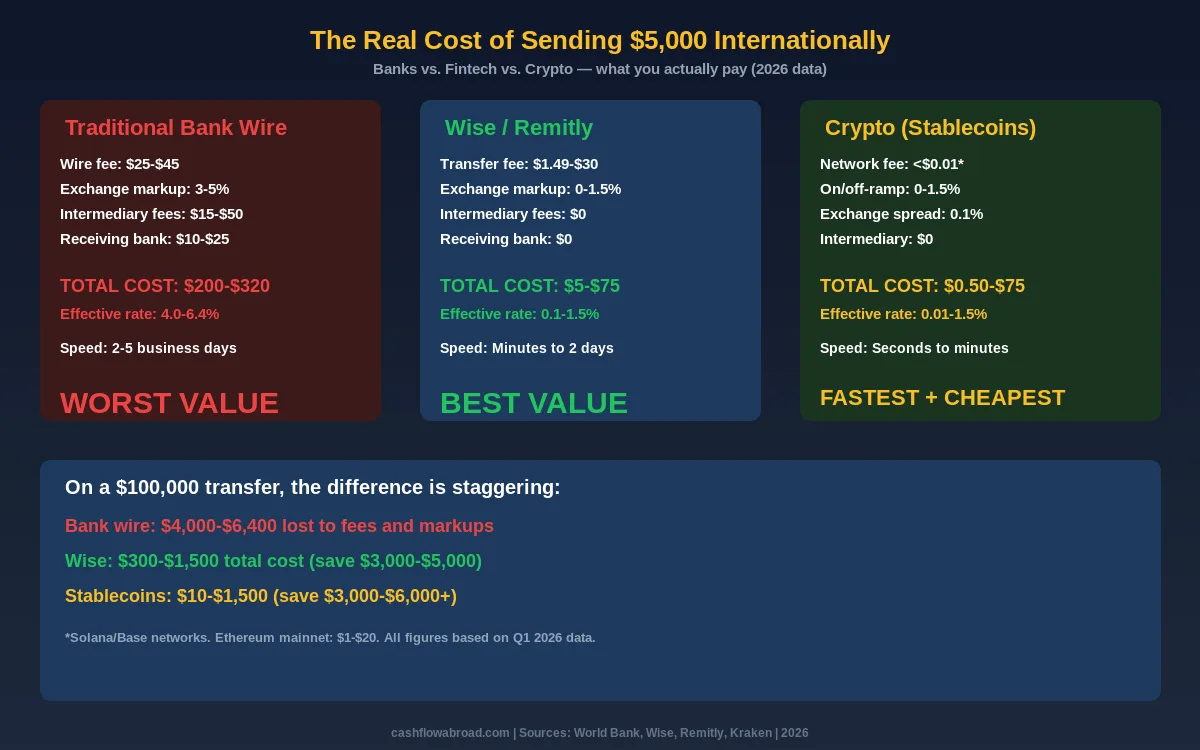
The average American expat loses $4,000 to $6,400 on every $100,000 they move internationally through their bank. Most don't even realize it's happening.

The average American expat loses $4,000 to $6,400 on every $100,000 they move internationally through their bank. Most don't even realize it's happening.
The average American expat loses $4,000 to $6,400 on every $100,000 they move internationally through their bank. Most don't even realize it's happening.
It's not the wire fee that kills you — that $45 charge from Chase or BofA is just the decoy. The real money vanishes in the exchange rate markup: a hidden 3-5% spread that banks quietly bake into the conversion rate. They show you a number that looks reasonable, but it's thousands of dollars away from the actual mid-market rate. Add intermediary bank fees, correspondent charges, and receiving bank costs, and a simple $5,000 transfer can cost you $200-$320 — a 4-6% haircut.
Meanwhile, a Remitly transfer of the same $5,000 costs a fraction of that. Stablecoins on Solana? Under a dollar.
Related: zero-fee banking stack
If you're living abroad — paying rent in pesos, funding a property purchase in euros, or just moving savings between continents — the method you choose to transfer money is one of the biggest financial decisions you'll make. Get it wrong over a decade, and you've quietly hemorrhaged the price of a car. Get it right, and that money stays in your portfolio, compounding.
This is every option, compared. The fees nobody tells you about. The services that actually work. And a few tricks that can save you thousands on your next transfer.
Why Your Bank Is Quietly Robbing You
According to the World Bank's most recent data, the global average cost of sending remittances is 6.49% — more than double the UN Sustainable Development Goal target of 3%. Digital channels average 4.85%, while non-digital channels average a staggering 7.16%.
But here's what's truly infuriating: the technology to transfer money for under 1% has existed for years. Banks simply choose not to use it because the markup is too profitable.
Let's break down what the major US banks actually charge:
| Bank | Wire Fee | Exchange Markup | True Cost on $5,000 |
|---|---|---|---|
| Chase | $40 | 3-5% | $190-$290 |
| Bank of America | $45 | 3-5% | $195-$295 |
| Wells Fargo | $25-$40 | 3-5% | $175-$290 |
| Citi | $35 | 2-4% | $135-$235 |
| Remitly | $0 | 0.33-1.5% | $17-$75 |
| Remitly | $1.49-$4.99 | 0.5-2% | $26-$105 |
Read that last column again. You're paying 3-10x more through your bank than through a fintech service for the exact same transfer. On a $100,000 property purchase or business investment, the difference is $3,000-$6,000. That's not a rounding error — it's a vacation fund.
The 5 Hidden Fees in Every International Transfer
The wire fee is just the beginning. Here's where the rest of your money goes:
1. The Exchange Rate Markup (The Big One)
Banks don't charge the real exchange rate — the "mid-market rate" you see on Google or XE.com. Instead, they add a markup of 2-5% on top. On a $10,000 transfer, a 4% markup means $400 disappears into the bank's pocket before the money even leaves.
The mid-market rate is the midpoint between the buy and sell price of a currency on the global market. It's the rate banks use when trading with each other. They just don't extend it to you.
2. Intermediary (Correspondent) Bank Fees
International bank wires use the SWIFT network, and money often hops through one or more intermediary banks before reaching its destination. Each intermediary can skim $15-$50 off the transfer. You might send $5,000 and the recipient gets $4,920 with zero explanation.
The worst part? You usually don't know how many intermediaries are involved until the money arrives short.
3. Receiving Bank Fees
The recipient's bank often charges its own fee — typically $10-$25 — for the privilege of accepting an incoming international wire. So both the sender and receiver get hit.
4. Currency Conversion at the Receiving End
If you send USD and the receiving account is in a different currency, the receiving bank applies its own exchange rate markup. Double conversion, double margin. On a US-to-Colombia transfer, you might get marked up by Chase on the way out AND by Bancolombia on the way in.
5. The 2026 Excise Tax (New This Year)
Under the One Big Beautiful Bill Act (signed July 4, 2025), a 1% federal excise tax now applies to international remittances funded by cash or money orders, effective January 1, 2026. The good news: bank account and card-funded electronic transfers are exempt. Another reason to ditch cash-based services like Western Union walk-in locations.
The Fintech Revolution: Remitly and the New Wave
The fintech revolution didn't just make international transfers cheaper — it made the entire banking model for cross-border payments look like a scam. Here are the players that matter.
Remitly — The Gold Standard for Expat Transfers
Remitly is the benchmark for expat money transfers. Here's why:
- Uses the real mid-market rate with zero markup
- Transparent fees: 0.33-1.5% depending on corridor and payment method
- Speed: 74% of transfers arrive in under 20 seconds
- Limits: Up to $1 million per wire transfer
- Multi-currency account: Hold 50+ currencies with local account details in 9 currencies
- Debit card: Spend in any currency at the mid-market rate
Cost example: Sending $1,000 to Europe costs $1.99–$3.99 via Remitly. The same transfer through Chase costs $190-$240. That's not a marginal improvement — it's a different universe.
Remitly now serves 170+ countries with Express transfers arriving in minutes — plus cash pickup at 470,000+ locations for recipients without bank accounts.
Remitly — Best for Frequent, Smaller Transfers
Remitly excels at smaller, frequent transfers — the kind expats make regularly for rent, support payments, or daily expenses abroad.
- Fees: $1.49-$4.99 per transfer (often free for first transfer)
- Exchange markup: 0.5-2% above mid-market
- Speed: Express delivery in minutes for many corridors
- Delivery options: Bank deposit, mobile money, cash pickup
- Best corridors: Mexico, Philippines, India, Colombia, Guatemala
For recurring transfers of $500-$2,000, Remitly is extremely competitive on total cost in specific corridors, especially Latin America and Southeast Asia. The cash pickup option is also invaluable in countries where bank infrastructure is limited.
OFX — Best for Large Transfers ($10K+)
OFX doesn't charge transfer fees at all — they make money on a 0.5-2% exchange rate margin. For large transfers, this can be surprisingly competitive:
- No transfer fees on any amount
- Minimum: ~$1,000
- Forward contracts: Lock exchange rates up to 12 months ahead
- 24/7 phone support with dedicated dealers for large transfers
- Best for: Property purchases, business payments, one-time large moves
Western Union / MoneyGram — Avoid Unless Necessary
Exchange rate markups of 2-5% plus transfer fees make these legacy services expensive. The only scenario where they make sense is cash pickup in remote locations where digital services don't reach. For everything else, they're a relic.
The Crypto Method: Stablecoins as a Transfer Tool
This is the option nobody talks about at the bank, and it's becoming one of the most powerful tools in the expat financial toolkit.
The concept is simple: Convert USD to a stablecoin (USDC or USDT, pegged 1:1 to the dollar), send it to a wallet or exchange in your destination country, and convert to local currency. The transfer itself is nearly free and nearly instant.
How the Numbers Work
| Step | Cost | Time |
|---|---|---|
| Buy USDC on Coinbase | $0 (zero fee for USDC purchases) | Instant |
| Send USDC on Solana/Base | < $0.01 | Seconds |
| Receive at destination exchange | $0 | Seconds |
| Sell USDC for local currency | 0.1-1.5% (exchange fee) | Instant |
| Withdraw to local bank | $0-$5 | 1-2 days |
| TOTAL | 0.1-1.5% | Minutes to 2 days |
Stablecoin transaction volumes hit $33 trillion in 2025 — up 72% year-over-year. Visa is now settling transactions in USDC on Solana. This isn't fringe anymore; it's the future of cross-border payments.
Kraken operates in 190+ countries and is one of the most reliable exchanges for expats. They support direct fiat off-ramps in many currencies, making the stablecoin-to-local-currency conversion straightforward. If you're already holding crypto as part of your expat investment portfolio, this is a natural extension.
The Caveats
- Tax events: Selling USDC at a gain (rare but possible due to tiny fluctuations) is technically taxable. More importantly, the IRS may view the conversion as a reportable transaction. See our crypto tax guide for US expats.
- On/off-ramp friction: Not every country has good local exchanges. Colombia has Bitso; Thailand has Bitkub; the Philippines has Coins.ph.
- Regulatory risk: Some countries are tightening crypto regulations. Always check local rules.
- Learning curve: If you've never used crypto, the wallet/network/gas fee concepts require some homework.
Head-to-Head: Every Method Compared
| Method | Cost ($5K) | Speed | Max Transfer | Best For |
|---|---|---|---|---|
| Bank Wire | $200-$320 | 2-5 days | Unlimited | Nothing (legacy) |
| Remitly | $17-$75 | Seconds-2 days | $1M/wire | Most transfers |
| Remitly | $26-$105 | Minutes-2 days | $25K | LATAM, Asia, regular transfers |
| OFX | $25-$100 | 1-3 days | $500K+ | Large transfers, property |
| USDC (Solana) | $0.50-$75 | Seconds | Unlimited | Crypto-savvy, large amounts |
| Western Union | $100-$250 | Minutes-days | $7,499 | Cash pickup in remote areas only |
The Best Service by Corridor (Country-Specific)
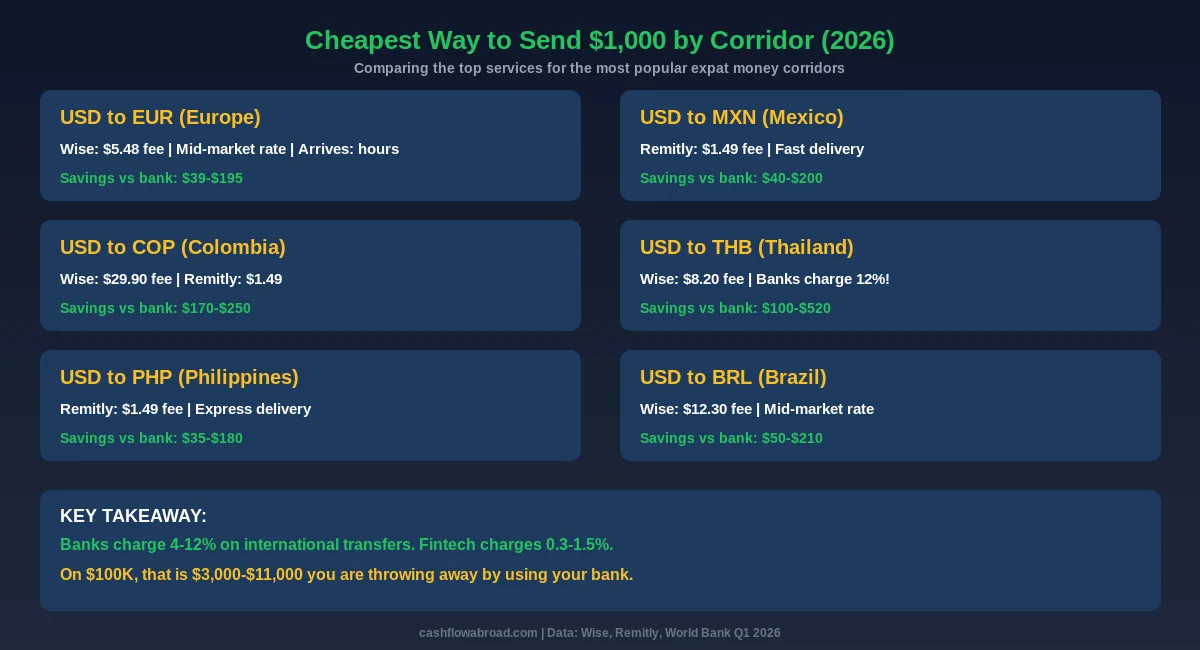
Not all transfer services are equal in every corridor. The cheapest option for USD-to-EUR might be different from USD-to-COP. Here's what actually works best for the most popular expat destinations.
USD to Colombian Peso (COP)
Colombia is one of the most popular expat destinations — and one of the trickiest for money transfers. The COP is volatile, and exchange rate markups can be severe.
- Remitly: $1.99–$3.99 fee on $1,000. Competitive rates. Express arrives in minutes, Economy in 3-5 days.
- Remitly: $1.49 fee. Express delivery to major banks (Bancolombia, Davivienda). Slightly higher markup.
- Crypto (Bitso): Send USDC, sell for COP on Bitso, withdraw to Bancolombia. Total cost under 1%.
Best strategy: Use Remitly for weekly/monthly living expenses under $2,000. Use Remitly for all transfer sizes (up to $100K with verification). Use crypto if you're already in the ecosystem.
If you're living in or moving to Colombia, our sister site ColombiaMove.com has a detailed guide on the best banks for foreigners in 2026 — critical for setting up the receiving end of your transfers. Their Medellín cost of living breakdown will also help you plan how much you need to transfer monthly.
USD to Euro (EUR)
The most competitive corridor. Remitly charges $1.99–$3.99 on $1,000 with instant delivery to most European banks.
USD to Mexican Peso (MXN)
Extremely competitive. Remitly is very competitive here at $1.49-$3.99 per transfer with express delivery. Mexico is Remitly's strongest corridor.
USD to Thai Baht (THB)
This is where banks absolutely destroy you — markups of up to 12% on the USD-THB exchange. Remitly offers competitive rates with Express delivery in minutes. The savings are enormous.
Related: rental property abroad guide
USD to Philippine Peso (PHP)
Remitly dominates this corridor with $1.49 fees and express delivery. Cash pickup at 24,000+ locations for recipients without bank accounts.
Moving Large Sums: $50K-$500K+
Transferring money for a property purchase, business investment, or portfolio rebalancing is a different game than sending $1,000 for monthly rent. The stakes are higher and the savings potential is massive.
The Math on a $200,000 Property Purchase
| Method | Estimated Cost | You Lose |
|---|---|---|
| Bank wire (4% markup) | $8,045 | A semester of college |
| Remitly ($1.99–$3.99) | $1,200 | A nice dinner |
| OFX (0.5% negotiated) | $1,000 | Acceptable |
| USDC on Solana | $200-$1,500 | Depends on off-ramp |
$8,045 vs $1,000-$1,200. That's $6,845-$7,045 in savings on a single transaction. Enough to furnish the entire property.
Tips for Large Transfers
- Negotiate rates. For transfers over $50K, call OFX or Remitly business for a custom rate. Banks won't negotiate — fintech will.
- Split across services if single-transfer limits are an issue (Remitly caps at $1M, Remitly at $25K).
- Time your transfer. Currency markets fluctuate. A 1% swing on $200K is $2,000. Use rate alerts on Remitly or XE.
- Use a forward contract if closing is weeks or months away (more on this below).
- Document everything for tax reporting. Large international transfers attract IRS attention.
Forward Contracts: Locking Your Exchange Rate
If you're making a large purchase abroad — buying property, funding a business, or pre-paying a year of rent — exchange rate volatility is a real risk. A 5% swing on $100,000 is $5,000. Forward contracts eliminate that risk.
How Forward Contracts Work
- Agree on a rate today for a transfer that happens in the future (up to 12 months with OFX)
- Pay a deposit (typically 10% of the transfer amount)
- Complete the transfer at the locked rate on the agreed date, regardless of market movement
OFX is the most accessible provider for retail forward contracts, with a minimum of approximately $1,000. They assign you a dedicated dealer who can help time your contract.
When forward contracts make sense:
- Property closing 1-6 months away
- Committing to a year of rent payments in local currency
- Business expenses with known future dates
- Any time the transfer amount is large enough that a 3-5% swing would hurt
Multi-Currency Accounts: The Expat's Secret Weapon
If you're living abroad long-term (not just traveling), a multi-currency account fundamentally changes how you manage money across borders.
Remitly Multi-Currency Account
- Hold 50+ currencies simultaneously
- Local bank details in 9 currencies (USD, EUR, GBP, AUD, NZD, SGD, RON, HUF, TRY) — receive money like a local
- Debit card that auto-converts at mid-market rate
- No monthly fee
- Interest on balances in selected currencies
The killer feature: local bank details. Your US client pays you in USD to a US account number. Your Colombian landlord receives COP from a local transfer. You never actually "wire" money internationally — you receive locally and pay locally, with Remitly handling the conversion in between.
For Business Owners: Mercury
If you're running a US business from abroad (like many readers following our guide to running a US business from Colombia), Mercury is the business banking solution that just works.
- USD-focused but integrates perfectly with Remitly for conversions
- No foreign address restrictions for US-entity businesses
- Treasury accounts earning 4%+ APY on idle cash
- API integrations for automated bookkeeping
- FDIC-insured up to $5M with sweep
The optimal setup: receive business income in Mercury, transfer personal income to Remitly, convert and spend locally. Clean separation, maximum efficiency, minimal fees.
For personal banking stateside, SoFi pairs well — their checking account has no foreign transaction fees and reimburses ATM fees globally. It serves as a solid US banking anchor while you manage money across borders. For quick domestic transfers between US accounts or splitting costs with other expats, Cash App is hard to beat — instant free transfers, plus a Visa debit card that works internationally.
Tax and Reporting Requirements You Can't Ignore
Moving money internationally isn't just a logistics problem — it's a compliance obligation. Miss the reporting requirements, and the penalties make bank transfer fees look like pocket change.
FBAR (FinCEN Report 114)
If the aggregate value of all your foreign financial accounts exceeds $10,000 at any point during the calendar year, you must file an FBAR. This includes:
- Foreign bank accounts
- Remitly multi-currency balances
- Foreign crypto exchange accounts (Kraken non-US, Bitso, etc.)
- Pension accounts, investment accounts, insurance policies with cash value
Penalty for non-willful violation: up to $16,536 per violation. Willful violation: up to $165,353 or 50% of account balance. Criminal penalties can reach $250,000 and 5 years imprisonment.
We covered FBAR in exhaustive detail in our expat banking and taxes guide.
FATCA Form 8938
Separate from FBAR, FATCA Form 8938 is filed with your tax return if foreign financial assets exceed:
- Living abroad: $200,000 at year-end or $300,000 at any point (single filers)
- Married filing jointly abroad: $400,000/$600,000
Currency Transaction Reports (CTR)
Banks automatically file a CTR with FinCEN for any transaction over $10,000. This isn't something you file — your bank does it. But it means the IRS knows about every large transfer you make. Don't try to split a $15,000 transfer into two $7,500 transfers to avoid the threshold — that's "structuring" and it's a federal crime.
Gift Tax Implications
Sending money to non-US-persons? If it exceeds the annual exclusion of $19,000 per recipient, you may need to file Form 709 (Gift Tax Return). The lifetime exemption jumped to $15 million in 2026, so you likely won't owe tax — but the reporting is still required.
For the full picture on how all these tax obligations interact, including the FEIE and Foreign Tax Credit, check our guide to paying zero federal income tax as an expat.
Keeping Your Money Safe in Transit
When you're moving tens or hundreds of thousands of dollars through digital platforms, security is everything.
Essential Precautions
- Use a VPN for all financial transactions. NordVPN encrypts your connection and prevents man-in-the-middle attacks on public WiFi. Never access Remitly, your brokerage, or crypto exchange on an open network without it.
- Enable 2FA on every financial platform — hardware keys (YubiKey) are best, authenticator apps are acceptable, SMS is the weakest link.
- Verify recipient details twice. Crypto transactions are irreversible. Send a small test amount first.
- Use unique, strong passwords for every financial service. A password manager (1Password, Bitwarden) is non-negotiable.
- Watch for phishing. "Your Remitly account has been limited" emails are almost always fake. Always navigate directly to the site.
Protecting Your Health Protects Your Wealth
One medical emergency without insurance can wipe out everything you've carefully transferred and invested abroad. If you don't have coverage, SafetyWing offers global health insurance from ~$120/month covering 185+ countries. See our full expat health insurance comparison.
Your International Transfer Action Plan
Here's exactly what to do, in order:
Step 1: Stop Using Your Bank (Today)
Open a Remitly account right now. It's free, takes 10 minutes, and you'll immediately start saving 80-95% on transfer fees. For frequent LATAM/Asia transfers, open Remitly too.
Step 2: Set Up Your Multi-Currency Stack
Remitly for personal transfers. Mercury for business banking. SoFi as your US banking anchor.
Step 3: Learn the Crypto Option (Optional But Valuable)
Open a Kraken account and learn the USDC transfer process. Even if you don't use it as your primary method, having it as a backup gives you optionality — especially for large transfers or in countries with limited fintech penetration.
Step 4: Get Your Compliance In Order
If you have foreign accounts, set up an FBAR tracking system now. Note every account, the maximum balance, and the account details. This takes 15 minutes and saves you from $16,536+ penalties.
Step 5: Calculate Your Savings
Add up every international transfer you've made in the past year. Multiply the total by 4% (the average bank markup). That's approximately how much you've been overpaying. Now you know what's at stake.
The Bottom Line
The international transfer system is rigged in favor of banks — but only for people who don't know the alternatives. Every dollar you lose to hidden fees and inflated exchange rates is a dollar that could be compounding in your investment portfolio, funding your online business, or extending your runway in a low-cost country where your money goes 3x further.
The technology to move money internationally for under 1% exists today. The only question is whether you'll use it.
One more thing: If you're still using a regular US bank card to withdraw cash abroad, you're bleeding 1-3% on every ATM transaction. Charles Schwab International reimburses every ATM fee worldwide — no cap, no limits. Combined with a low-cost transfer service like Remitly or Remitly, you'll keep an extra $500-$2,000/year that would otherwise disappear into bank fees.
If you're planning a move to Colombia specifically, grab our Colombia Relocation Kit on Gumroad — it includes a full financial setup checklist including banking, transfers, and local payment methods. And check ColombiaMove.com's resource page for up-to-date tools and services.
How are you currently moving money internationally? Drop a comment below — I want to hear what's working (and what's not) in your specific corridor. If you've been using your bank this whole time, run the numbers and share how much you've been losing. Sometimes seeing the actual dollar amount is the wake-up call.
Found this useful? Share it with a fellow expat who's still wiring money through Chase. You might save them thousands.
Disclaimer: This article contains affiliate links. If you sign up through our links, we may earn a commission at no extra cost to you. We only recommend services we personally use or have thoroughly researched. This content is for informational purposes only and should not be considered financial or tax advice. Consult a qualified professional for advice specific to your situation.
This guide is general information, not personalized tax, legal, or investment advice. Rules change; verify current thresholds with official sources or a qualified professional before acting.
Related guides
 International Money TransfersJune 17, 2026
Sending $10,000+ Abroad: Wire Rules Every Expat Must Know
Before wiring $50,000 abroad, learn what actually gets reported, how to avoid structuring violations, and how to compare transfer costs for expats.
 International Money TransfersJune 2, 2026
How US Expats Receive Client Payments Abroad
Zelle fails abroad. Here are the six rails US expat freelancers use: Schwab ACH, Stripe + LLC, Payoneer, wire transfer, and stablecoins — with exact
 Geographic ArbitrageJune 19, 2026
Nairobi Expat Guide: M-Pesa Banking and Class N Permit
How US expats use M-Pesa, open Kenyan bank accounts, handle FBAR, and get the Class N permit ($1,200/year) with zero Kenyan tax on foreign income.