El Salvador for US Expats: Taxes, Visas & the $1,500/Month Life
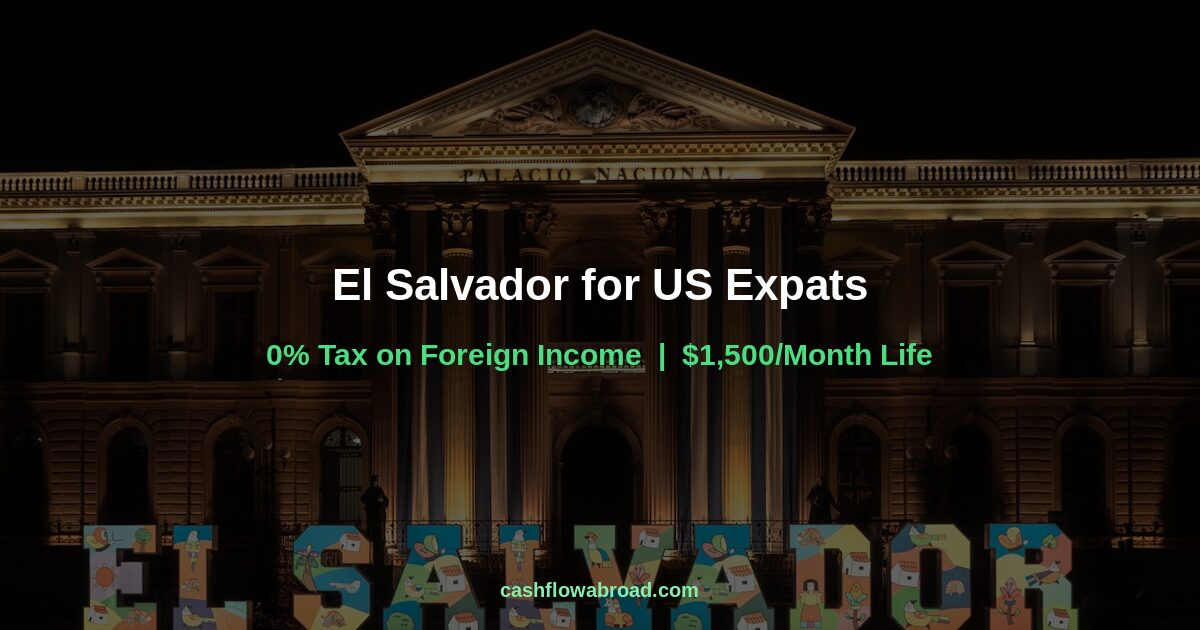
By 2024, that number had collapsed to 1.9 per 100,000. Zero. Most expats still associate El Salvador with gang violence and Bitcoin gimmicks.
By 2024, that number had collapsed to 1.9 per 100,000. Zero. Most expats still associate El Salvador with gang violence and Bitcoin gimmicks.
In 2018, El Salvador had a homicide rate of 53.1 per 100,000 people — among the highest in the world, placing it alongside active war zones on global crime indices. By 2024, that number had collapsed to 1.9 per 100,000. That's a 98% decline in six years, and it now ranks as the safest country in the Western Hemisphere outside Canada.
Meanwhile, El Salvador runs a territorial tax system: if you earn income outside the country, El Salvador taxes none of it. Zero. The country also runs entirely on US dollars, meaning no exchange rate volatility eating into your savings. And a comfortable expat life — good apartment, nice dinners out, private health coverage — runs roughly $1,200 to $1,800 per month.
Most expats still associate El Salvador with gang violence and Bitcoin gimmicks. That narrative is six years out of date. Here's what's actually going on.
The Safety Transformation Nobody Saw Coming
President Nayib Bukele launched a nationwide State of Exception in March 2022, suspending certain civil liberties and authorizing mass arrests of suspected gang members. The operation was controversial — Human Rights Watch and international observers raised due-process concerns — but the numbers are impossible to argue with.
From March 2022 through early 2025, Salvadoran authorities detained over 84,000 individuals allegedly connected to MS-13 and Barrio 18, the two gangs that had controlled large swaths of the country for decades. The homicide rate went from 53 per 100,000 in 2018 to under 2 per 100,000 in 2024. For reference, the US rate sits around 6.3 per 100,000.
Neighborhoods that were impassable five years ago — parts of Soyapango, Apopa, central San Salvador — now have tourists walking around at night. Tourism surged 300% in some sectors between 2022 and 2025. Expat forums that once warned people away from El Salvador are now full of posts about underpriced apartments and surprisingly good coffee.
The honest caveat: the transformation came with democratic erosion. Bukele's government extended the State of Exception for years, and civil society groups document wrongful imprisonments. El Salvador is safer, but it's not a liberal democracy. That context matters when you're deciding where to plant your life.
El Salvador's Tax System: What Foreign Income Actually Owes
El Salvador uses a pure territorial tax system. Income is only taxable in El Salvador if it originates from sources inside the country. Rent from a US property, dividends from a US brokerage, freelance payments from clients anywhere in the world — none of that is taxable in El Salvador.
The domestic income tax brackets, for any income you do earn locally, are:
| Annual Income (USD) | Tax Rate |
|---|---|
| Up to $4,064 | 0% |
| $4,064 – $9,142 | 10% |
| $9,142 – $22,857 | 15% |
| $22,857 – $45,714 | 20% |
| Above $45,714 | 25% |
The kicker for crypto holders: El Salvador imposes 0% capital gains tax on cryptocurrency transactions, including Bitcoin. When Bitcoin was made legal tender in 2021, crypto became exempt from capital gains tax. That exemption survived the May 2025 amendment that made Bitcoin acceptance voluntary for merchants — the tax treatment on gains didn't change.
If you're running a consulting business, doing affiliate marketing, earning freelance income from clients abroad, or living off investment returns from overseas accounts, El Salvador takes nothing. You become a tax resident after spending 200 consecutive days in the country per year.
What US Citizens Still Owe (This Part People Get Wrong)
Here's the part that catches people off guard: the US taxes citizens on worldwide income regardless of where they live. Moving to El Salvador doesn't exit you from the US tax system. You still file every year. What changes is how much you actually owe.
The two main tools are the Foreign Earned Income Exclusion (FEIE) and the Foreign Tax Credit (FTC).
The FEIE for tax year 2026 lets you exclude up to $132,900 of foreign earned income from US federal taxes. To qualify, you need to pass either the Bona Fide Residence Test (establish legal residency in El Salvador) or the Physical Presence Test (330 days outside the US in any 12-month period). Since El Salvador taxes zero of your foreign income, you can't stack the FTC on top of the FEIE — but the FEIE alone is powerful enough that most freelancers and remote workers earning under $132,900 end up with a $0 federal tax bill.
Above that threshold, or for investment income (which the FEIE doesn't cover), you're still exposed to US rates. That's why El Salvador works best for people earning primarily active foreign income, not passive investment returns. For the full picture on FEIE vs. Foreign Tax Credit tradeoffs, see the zero federal tax guide for US expats.
You'll also need to file FBAR (FinCEN Form 114) if you hold more than $10,000 in foreign bank accounts at any point in the year. For the complete expat banking and tax framework, the US expat banking and taxes guide covers FBAR, FATCA, and account strategy in detail.
The combination of El Salvador's 0% foreign income tax and the FEIE means many US expats here face near-zero combined tax liability on their primary income. That's the real pitch.
Residency Visas: Three Realistic Paths
El Salvador offers several residency categories. Here are the three most relevant for expats:
Pensionado Visa (Retirement)
Requires a minimum of $1,095 per month in pension or retirement income — three times the national minimum wage. If your income comes from a private pension or 401k distribution rather than Social Security, some attorneys cite $1,500/month as the practical threshold depending on documentation requirements.
The permit costs just $140 for one year or $260 for two years. You need to maintain at least six months of physical presence in El Salvador annually to renew. After five years of residency you can apply for permanent residency. After ten years, citizenship.
Rentista Visa (Passive Income)
For people whose income comes from passive sources — rental income, dividends, trust distributions — rather than a formal pension. The income requirement is similar: roughly $1,095–$1,500 per month documented from passive sources. This is the right path for investors and anyone living off their portfolio rather than a formal pension plan.
Investor/Employee Residency
If you're running a business or working for a local employer, El Salvador offers employee and investor residency categories. Requirements vary significantly depending on business type and investment size. For digital entrepreneurs operating a US or foreign LLC, the Rentista visa is usually cleaner and less bureaucratically intensive.
| Visa Type | Min. Monthly Income | Permit Cost | Physical Presence | Best For |
|---|---|---|---|---|
| Pensionado | $1,095 (pension) | $140/yr | 6 months/yr | Retirees, Social Security recipients |
| Rentista | ~$1,095 (passive) | $140/yr | 6 months/yr | Investors, landlords, dividend earners |
| Employee/Investor | Varies | Varies | Required | Business owners, local employees |
Important note: both the Pensionado and Rentista programs require consistent, documented income. If you're living off a 4% portfolio drawdown with variable monthly payouts, you'll need to document your income carefully. Work with an immigration attorney familiar with El Salvador's DGME (Dirección General de Migración y Extranjería) before applying.
Cost of Living: The Real Numbers
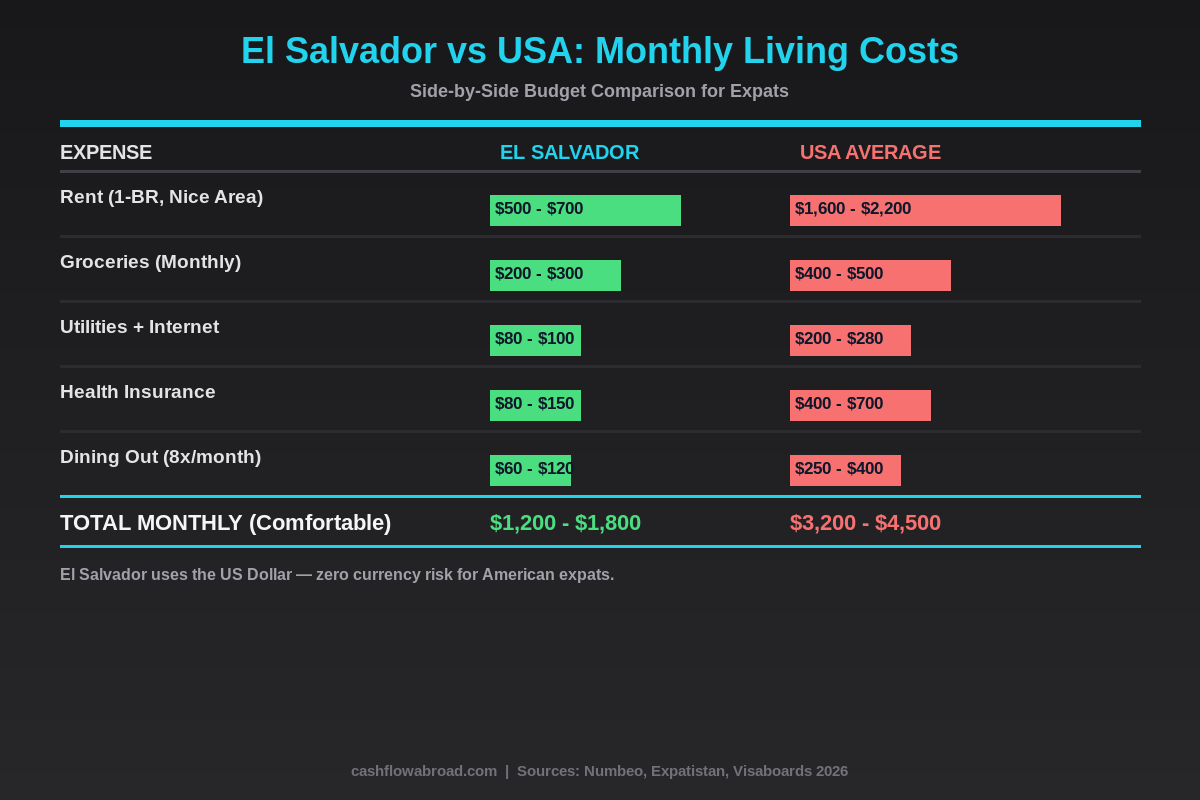
El Salvador runs entirely on the US dollar — the country officially dollarized in 2001 and has used USD as its sole legal tender ever since. For American expats, this eliminates the currency risk and exchange rate anxiety that makes financial planning difficult in most Latin American countries. What you budget in dollars is what you spend in dollars.
Here's a realistic monthly breakdown for a single expat living comfortably in a good neighborhood (Santa Tecla, Antiguo Cuscatlán, or a quality San Salvador district):
| Category | Budget Level | Comfortable Level | Premium Level |
|---|---|---|---|
| Rent (1-BR apartment) | $400–$500 | $550–$750 | $900–$1,500 |
| Groceries | $180–$220 | $250–$320 | $350–$450 |
| Utilities + Internet | $70–$90 | $90–$120 | $120–$160 |
| Health Insurance | $80–$100 | $100–$150 | $200–$400 |
| Transportation | $40–$60 | $80–$120 | $150–$250 |
| Dining Out | $60–$100 | $120–$200 | $300–$500 |
| Entertainment/Misc | $50–$80 | $100–$150 | $200–$400 |
| TOTAL | $880–$1,150 | $1,290–$1,810 | $2,220–$3,660 |
A few things worth noting: electricity bills spike during hot months when AC runs constantly — $60 in December can become $110 in March. Many apartments include water in the rent. And grocery prices for imported goods (cheese, wine, specialty items) run close to US prices since El Salvador imports heavily from the US. Don't budget as if everything is Panama City cheap — it's not.
The sweet spot for most expats is the "comfortable" column: roughly $1,400–$1,600/month total for a real apartment, real meals, and real health coverage. That's approximately half what a comparable lifestyle costs in a major US city.
Best Places to Live in El Salvador
Santa Tecla
About 12 miles west of San Salvador, Santa Tecla has become the default suburb for expats who want urban amenities without the capital's chaos. Good restaurants, modern gyms, walkable commercial zones, solid internet infrastructure, and a genuine expat community. Rent runs $500–$800 for a decent 1-bedroom. Not cheap by El Salvador standards, but the quality-to-cost ratio is strong.
Antiguo Cuscatlán
The upscale suburban corridor south of San Salvador — home to embassies, multinational offices, and the highest expat concentration in the country. Clean streets, good malls, leafy residential zones. Rent is higher ($700–$1,200 for a 1BR), but security and lifestyle infrastructure are best-in-class. If you have kids in international school, this is almost certainly your zone.
El Zonte ("Bitcoin Beach")
The small surf town where Bitcoin adoption began grassroots in 2019, well before the government made it legal tender. El Zonte has a strong expat/nomad subculture, legitimate world-class surfing, and a pace of life that San Salvador can't replicate. It's about 1.5 hours from the capital. Monthly rent for a house or apartment runs $500–$900. The Bitcoin infrastructure here — merchants, ATMs, mobile wallets — actually functions in daily life. If you want to live somewhere crypto is embedded in commerce rather than just a theoretical asset class, this is it.
Suchitoto
A colonial town about 45 minutes north of San Salvador, perched above Lake Suchitlán. Cobblestone streets, a beautiful white cathedral, art galleries, and a genuinely slow pace of life. Very affordable ($400–$600 for a nice apartment), but limited in terms of amenities and internet reliability. Good for semi-retirement, less ideal if remote work requires consistent high-bandwidth connectivity.
Banking in a Dollar Economy
El Salvador's dollar-based economy solves one of the most persistent expat headaches: there's no local currency to manage. Your US bank account works normally, ATM withdrawals are in dollars, and prices are already in the currency you think in.
That said, you still need robust US banking infrastructure. Charles Schwab's brokerage account with the linked debit card remains the gold standard for expats — zero foreign transaction fees, ATM fee rebates worldwide, and your investment portfolio is in the same account as your spending money. Pull dollars from any ATM in El Salvador at zero cost.
For your US mailing address — required to maintain most US bank and investment accounts — Traveling Mailbox provides a real US street address in 50+ cities starting at $15/month, with mail scanning and check deposit. Without a valid US address, most financial institutions will eventually close expat accounts once they detect the foreign address. The virtual mailbox guide breaks down exactly what to look for.
Local Salvadoran banks — Banco Agrícola, Banco Cuscatlán, and Banco Davivienda — are accessible to legal residents with your residency documentation, passport, and proof of income. Useful for local transactions and direct deposit from Salvadoran clients, but most expats keep their primary financial infrastructure in the US.
For international transfers, Remitly offers competitive rates and covers most international corridors reliably. On a dollar-to-dollar transfer, the spread is minimal.
Bitcoin in El Salvador: The 2026 Reality Check
A lot of people move to El Salvador with Bitcoin fantasies that don't quite match what they find on the ground. Here's the actual picture:
In 2021, El Salvador became the first country to make Bitcoin legal tender — mandating all merchants accept it. In May 2025, the government walked that back under IMF pressure (the $1.4 billion loan package required removing mandatory adoption). Bitcoin acceptance is now voluntary, and the practical reality is that most merchants in San Salvador prefer dollars.
The Chivo wallet launched with 3 million registrations, but most users downloaded it only to collect the $30 government incentive — 60% made no additional transactions after cashing out the bonus. Actual merchant adoption is concentrated in El Zonte and tourist-heavy parts of San Salvador.
What IS real: El Salvador's government holds 6,246 BTC in its national treasury (as of mid-2025), purchased through a systematic daily acquisition program. The country is politically committed to Bitcoin as a reserve asset. And the 0% capital gains tax on crypto is on the books and currently enforceable.
If you're a Bitcoin holder looking for legitimate tax residence where unrealized and realized gains face zero local tax, El Salvador delivers that. Just don't expect to buy groceries in BTC outside of Bitcoin Beach.
For US tax compliance on the crypto side, the IRS still requires reporting all transactions regardless of where you live. The expat crypto tax guide covers how to handle Form 8949 and FBAR obligations for crypto holdings abroad without overpaying.
Healthcare: Better Than You'd Expect
El Salvador has a tiered healthcare system. The public ISSS system is available to formal employees but not practically accessible for most expats. Private healthcare is where you'll end up, and at the top tier it's genuinely good — modern hospitals like Hospital de Diagnóstico and Centro Médico Escalón in San Salvador have US-trained physicians and facilities that would pass muster in most American cities.
A private doctor consultation costs around $34. Specialist visits run $60–$100. Comparable appointments in the US run $200–$500 without insurance.
For coverage, most expats use an international health plan. SafetyWing's Nomad Insurance starts around $56–$80/month for adults under 40 and covers inpatient, outpatient, and emergency evacuation across 180+ countries — useful if you travel beyond El Salvador regularly. For more comprehensive coverage with lower deductibles, the expat health insurance guide compares SafetyWing against Cigna Global and Allianz on real claim scenarios.
Dental care is a legitimate value-add: cosmetic and restorative dentistry in El Salvador runs significantly cheaper than the US, with quality that frequently surprises American patients. Implants costing $3,000–$4,000 per tooth in the US run $800–$1,200 in San Salvador's better clinics. If you have significant dental work pending, the savings alone could fund several months of living expenses.
What El Salvador Gets Wrong: The Honest Section
No country guide is worth reading without an honest accounting of the downsides.
Democratic backsliding. Bukele has concentrated power substantially — extending emergency rule, stacking the Supreme Court, and getting reelected under constitutional provisions that most legal scholars say should have prevented it. If political stability tied to a single strongman makes you nervous, pay attention to that instinct.
Infrastructure gaps outside cities. Outside the capital corridor and major urban centers, road quality, internet reliability, and utility consistency drop off sharply. If you want to live in a small rural town, budget for a generator and a backup mobile hotspot.
Small expat community. El Salvador's expat community is growing but still small compared to Panama City, Medellín, or Mexico City. If you need a large ready-made English-speaking social network on arrival, you'll need to build it more actively here.
Political transition risk. The current safety environment depends heavily on the continuation of Bukele's security policies. Gang infrastructure was disrupted, not dismantled — and 84,000 mass arrests without full due process create grievances that don't simply disappear when political winds shift.
No dedicated digital nomad visa. El Salvador doesn't have a purpose-built digital nomad visa. The Rentista/Pensionado route works but requires documented passive income of $1,095+/month. If you're a freelancer without formal passive income documentation, you'll need to structure your application carefully with an immigration attorney.
Who El Salvador Actually Works For
El Salvador is a compelling base for:
- Retirees on Social Security or pensions — SSA income qualifies for the Pensionado visa, and $1,500–$1,800/month buys a genuinely comfortable life in Santa Tecla or Antiguo Cuscatlán.
- Freelancers and remote workers — Dollar economy, zero tax on foreign income, low cost of living, adequate internet in the capital area, and a growing nomad scene in El Zonte.
- Bitcoin and crypto holders — The 0% capital gains tax on Bitcoin and other crypto is legitimate and currently on the books. If you have significant unrealized gains to realize, this is worth modeling carefully with a tax attorney.
- Geographic arbitrage seekers — If you earn in US dollars and want to cut your cost of living by roughly 50% without dealing with foreign currency risk, El Salvador's dollarized economy is a rare find in the region. The geographic arbitrage playbook compares El Salvador against Panama, Colombia, and Mexico on the key metrics.
It's less ideal for people who need a large established English-speaking expat community on arrival, who want easy multi-hop access to Europe, or who are not comfortable with political environments that don't fit standard liberal democratic norms.
Bottom Line
El Salvador in 2026 is one of the most misunderstood expat destinations in the Western Hemisphere. The gang violence that defined its reputation for decades has been suppressed at a scale that was statistically implausible just a few years ago. The territorial tax system means foreign income faces zero local taxation. The dollar economy eliminates currency risk entirely. And the cost of living gives American earners a genuine 50% discount on their lifestyle without sacrificing modern amenities.
That doesn't make it right for everyone. The political trajectory deserves watching, democratic norms have been strained, and nomad infrastructure outside major cities is still thin. But if the numbers in this guide match your income profile and lifestyle preferences, El Salvador deserves serious consideration — not as an adventurous risk, but as a financially rational move backed by solid data.
Financial Disclaimer: This article is for informational purposes only and does not constitute tax, legal, or financial advice. Tax laws change frequently and vary based on individual circumstances. US citizens living abroad must comply with all IRS filing requirements regardless of their country of residence. Consult a qualified expat tax professional before making residency or tax decisions. Some links in this article are affiliate links — we may earn a small commission at no additional cost to you.
This guide is general information, not personalized tax, legal, or investment advice. Rules change; verify current thresholds with official sources or a qualified professional before acting.
Related guides
 Geographic ArbitrageOctober 25, 2026
Italy Nomad Visa Income Requirements
Italy's nomad visa income test is €25,500 on 2026 sheets. See the $133.60 Washington fee and the US return you still file.
 Geographic ArbitrageOctober 4, 2026
Greece Nomad Visa: The €3,500 Monthly Test
See whether your pay clears Greece's digital nomad visa: €3,500 net a month, or €4,200 with a spouse, before you apply now.
 Geographic ArbitrageSeptember 21, 2026
Korea F-1-D Workation Income Rules for Expats
As of June 2026, Korea’s F-1-D visa starts at ₩52.4M outside Seoul for ages 18–34. Map income tiers, US FEIE, and where you park the paycheck.