Dominican Republic: The Tax-Free Residency 3 Hours from Miami
Law 171-07 gives qualifying DR residents a permanent 0% rate on all foreign income. Here's how the territorial tax play works — and why it's underreported.
How Law 171-07 gives DR residents a permanent 0% rate on foreign income — costs, requirements, and how it compares to Panama and Paraguay.
While everyone's arguing about Panama's Pensionado visa and Paraguay's $1,300-a-month residency deal, the Dominican Republic has been sitting three hours from Miami quietly offering one of the most generous foreign-income exemptions in the hemisphere — and almost nobody in the expat finance world talks about it.
Here's the hook: under Law 171-07, qualifying residents get a permanent, lifetime exemption on all foreign-source income. Not five years. Not a temporary holiday. Permanent. That means your US dividends, your rental income from a property back home, your online business revenue — all of it outside the DR's taxing authority, forever, as long as you keep your qualifying status.
Compare that to Uruguay's 5-year foreign income holiday (after which you're negotiating) or Portugal's NHR replacement (now capped and means-tested), and the DR starts looking like an underrated play for anyone whose income is already foreign by nature.
How the DR's Territorial Tax System Actually Works
The Dominican Republic operates a source-based territorial tax system: the government only taxes income earned within the DR. If your income originates outside Dominican borders — a US brokerage account, a foreign employer, rental income from a property abroad, a Substack you run from the beach — the DR has no legal claim to it.
This isn't a loophole or a gray area. It's codified in Dominican tax law and confirmed by KPMG's 2026 guidance on the application of the territoriality principle for tax residents.
That said, there's a layered system worth understanding:
- All new residents get a 3-year grace period — during which 100% of foreign income, including financial investments like foreign stocks, bonds, and bank deposits, is fully exempt.
- After year 3, the default territorial rules apply — foreign income from employment or business is exempt, but some passive investment income from abroad can become taxable depending on classification.
- Law 171-07 creates a permanent exemption for retirees and rentiers who meet specific income thresholds — effectively locking in the tax-free status indefinitely.
For most digital nomads and early retirees, the goal is to qualify under Law 171-07 from the start. It requires a bit more income documentation, but the payoff is a lifetime exemption with no re-negotiation every five years.
Law 171-07: The Permanent Exemption Most Expats Don't Know About
Law 171-07 was originally designed to attract retirees and passive-income earners to the DR. It creates three qualifying categories:
| Category | Requirement | Tax Benefit |
|---|---|---|
| Retiree / Pensioner | Minimum $1,500/month from a foreign pension or retirement fund | Permanent 0% on all foreign income |
| Rentier (Passive Income) | Minimum $2,000/month in stable foreign passive income | Permanent 0% on all foreign income |
| Investor | $200,000+ deployed in DR real estate or approved local business | Permanent 0% on all foreign income |
The income thresholds are not high by US standards. A Social Security check plus a small dividend portfolio can clear the $1,500 pension threshold. Remote workers earning $2,000/month gross — which is below US median wages — qualify under the rentier category if their income qualifies as stable and passive.
One nuance: the IRS still taxes you on worldwide income regardless of where you live — the DR exemption only removes the Dominican side of the equation. Your US tax situation is separate and handled through the FEIE, Foreign Tax Credit, or other strategies. More on that below.
Triggering Tax Residency and Getting Your Card
The DR's tax residency trigger is 182 cumulative days in a calendar year — not necessarily consecutive. Cross that threshold and you're a Dominican tax resident by default, which activates the 3-year grace period.
For those pursuing Law 171-07 status intentionally, the process goes through the Dirección General de Migración (DGM) and requires:
- Passport valid for 6+ months
- Apostilled birth certificate
- Clean criminal background check (apostilled)
- Proof of income meeting your chosen threshold (pension statements, brokerage statements, bank letters)
- Medical certificate from a DR-licensed physician
- DR-based bank account
Government filing fees run approximately $1,000–$1,500. Add attorney fees of $1,500–$3,000 for a smooth process, and you're looking at roughly $2,500–$5,000 all-in — significantly cheaper than Panama's Friendly Nations process (which has crept up to $5,000–$8,000 all-in) and a fraction of what European golden visa programs cost.
Processing time under Law 171-07: typically 3–6 months for permanent residency approval. The DR offers a temporary residency card while the permanent application is processed, so you're covered to live there legally within weeks of filing.
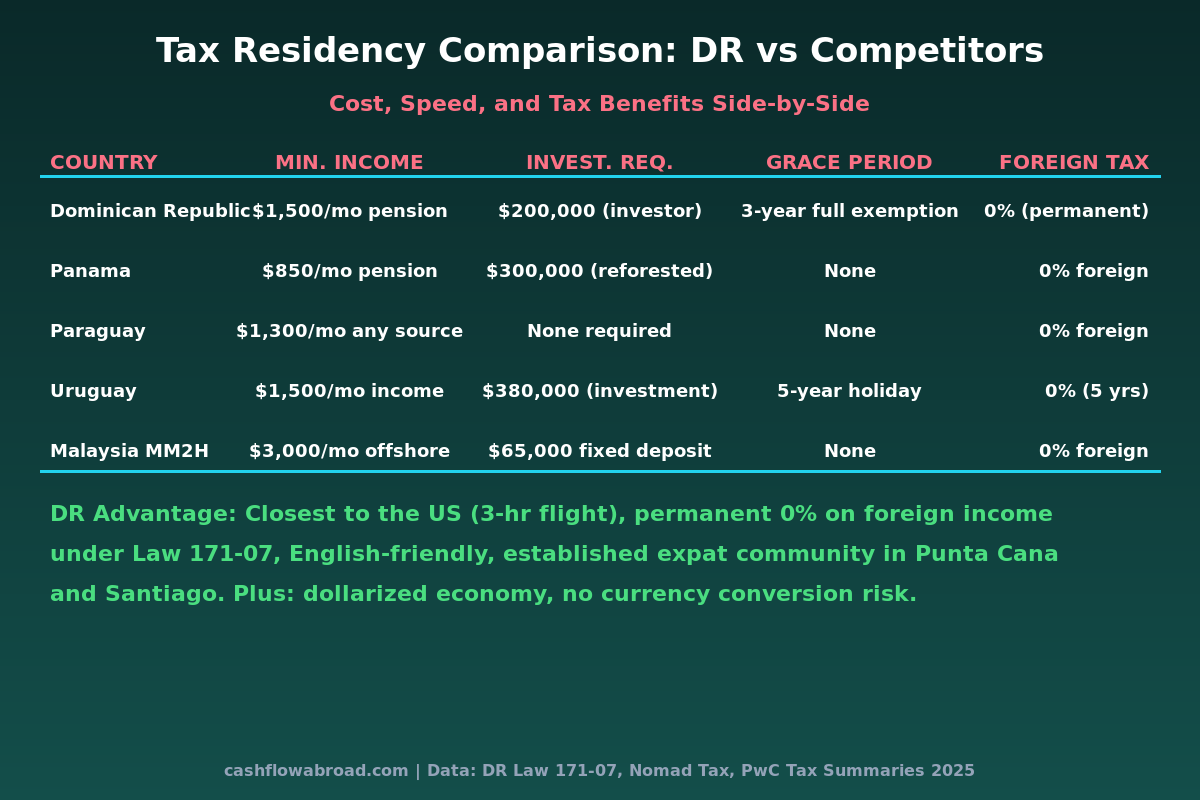
How the DR Stacks Up Against the Other Territorial Tax Countries
The DR isn't the only territorial tax game in town. Panama, Paraguay, and Uruguay are the names you'll see most often in geographic arbitrage discussions. Here's where the Dominican Republic wins, loses, and surprises:
| Factor | Dominican Republic | Panama | Paraguay | Uruguay |
|---|---|---|---|---|
| Foreign income tax | 0% (permanent under Law 171-07) | 0% (territorial) | 0% (territorial) | 0% for 5 years |
| Min. passive income | $2,000/mo (rentier) | $850/mo (pensionado) | $1,300/mo (any source) | $1,500/mo |
| Estimated all-in cost | $2,500–$5,000 | $5,000–$8,000 | $1,500–$3,000 | $4,000–$7,000 |
| Flight from Miami | ~2.5–3 hours | ~3 hours | ~10 hours | ~10 hours |
| English prevalence | Medium (high in tourist zones) | Medium–High | Low | Medium |
| USD usage | Widely accepted | Official currency | Guaraní only | USD widely accepted |
Paraguay wins on cost and speed. Panama wins on USD liquidity and English access. But the DR's combination of geographic proximity to the US, a well-developed expat infrastructure, and a permanent income exemption puts it in a category of its own for Americans who don't want to feel like they've moved to another planet. Punta Cana alone has direct flights to 30+ US cities — you're not marooned.
Your US Tax Obligations Don't Disappear
This is where a lot of people get confused. The DR exempting your foreign income doesn't mean the IRS does the same. The US taxes citizens on worldwide income regardless of where they live — it's one of only two countries in the world that does this (the other is Eritrea).
The tools available to reduce your US tax bill as a DR resident:
- Foreign Earned Income Exclusion (FEIE): excludes up to $130,000 of earned income per person for 2025 if you pass the Physical Presence Test (330 days abroad) or Bona Fide Residence Test. Full FEIE breakdown here.
- Foreign Housing Exclusion: up to $39,000 in qualifying housing costs excluded separately from the FEIE.
- Foreign Tax Credit (Form 1116): since the DR's domestic tax rates are low to zero on most foreign income, this credit is often minimal — but it's available for any DR-sourced income that does get taxed locally.
The practical result for a DR resident earning $120,000 in remote income: the DR taxes none of it under Law 171-07, the FEIE covers most of it on the US side, and the effective US tax bill can be near zero after the housing exclusion. Whether that structure works for your situation depends on income type, entity structure, and self-employment status. Our full US expat banking and tax guide covers the mechanics in detail.
State taxes are a separate trap. If you were a California, New York, Virginia, or South Carolina resident before moving, those states may attempt to continue taxing you. Document your move carefully — lease agreements, utility bills, and a formal domicile declaration before departing. California in particular does not let go easily.
Banking, Healthcare, and Day-to-Day Reality
A residency strategy that looks clean on paper but collapses in practice isn't a strategy — it's a daydream. Here's the honest picture:
Banking
The DR has a functioning local banking system — Banco Popular, Banreservas, Scotiabank DR. Opening an account as a foreign resident is required for the Law 171-07 application. Expect to need your residency card or application letter, a local reference, and source-of-funds documentation.
Keep your US banking intact simultaneously. Charles Schwab International is the gold standard for expats — no foreign transaction fees, free ATM withdrawals globally, and no account closure risk from a foreign address. Pair it with a virtual US mailing address from Traveling Mailbox to maintain a legitimate US domicile address for banking, IRS correspondence, and state compliance. It starts at $15/month and gives you a real street address in 50+ US cities.
For moving money between the US and DR, Remitly offers competitive USD-to-DOP exchange rates with transfers that typically clear within 24 hours.
Healthcare
Private hospitals in Santo Domingo and Punta Cana — Centro Médico Punta Cana, Hospiten Bávaro — are solid, with internationally trained doctors and English-speaking staff in tourist corridors. The public system is a separate story; expats don't rely on it.
SafetyWing's Nomad Insurance starts under $60/month for travelers under 39 and covers you across 180+ countries including the DR — ideal during the transition period before you've settled on a long-term plan. For permanent residents, a full expat policy from Cigna or Allianz may make more sense. Our expat health insurance comparison has the breakdown.
Cost of Living Snapshot
- Modern 2BR apartment in Punta Cana or Las Terrenas: $700–$1,200/month
- Electricity (the DR's biggest household expense): $150–$250/month depending on AC usage
- Groceries (supermarkets stock US brands): $300–$500/month for a couple
- Restaurant meals: $5–$15 at local spots, $20–$40 at international restaurants
- Private international school: $8,000–$15,000/year
Total comfortable monthly spend: $1,500–$2,500 for a single person, $2,500–$4,000 for a couple. Not Southeast Asia cheap, but substantially less than comparable coastal US metros — and you're earning in USD while spending in Dominican pesos.

The 2025 Tax Reform: What Changed (and What Didn't)
The DR passed the Fiscal Modernization Law in late 2024, effective January 1, 2025. Key changes expats should know:
- A new 27% income tax bracket was added for high earners on DR-sourced income, up from the previous 25% top rate. This only applies to income you actually earn within the DR — foreign income remains exempt under territorial rules and Law 171-07.
- Digital services taxation was introduced for cross-border digital purchases. Minimal practical impact for expat residents since they're consuming services, not providing them domestically.
- Enhanced anti-evasion reporting requirements for financial institutions — more FATCA-style transparency, which was already effectively in place between the US and DR.
The bottom line: the 2025 reform does not change the foreign income exemption. Law 171-07 is untouched. The 27% bracket only matters if you're earning locally in the DR, which most Law 171-07 residents aren't by design.
Who This Actually Makes Sense For
The DR play is most compelling for:
- Remote workers earning $2,000+/month who want to eliminate DR-side taxation permanently and stay within easy flight distance of the US
- Early retirees with $1,500+/month in pension or investment income who want warm weather, solid private healthcare, and zero foreign income tax long-term
- Online business owners whose revenue comes entirely from outside the DR and who want a Latin American base without a 10-hour flight to South America
- Frequent Caribbean visitors who can easily hit 182 days by consolidating where they already spend time
It's less compelling if your primary income could be classified as DR-sourced, if you need robust public infrastructure, or if the language barrier is a hard stop for you. Santo Domingo rewards even basic Spanish investment significantly.
The Overlooked Arbitrage Right Next Door
The expat finance world spent years fixating on Paraguay's cheap process, Portugal's NHR (now dead), and Panama's pensionado — while the Dominican Republic sat three hours from Miami with a permanent foreign income exemption, an established expat community, and direct flights to half the US. Law 171-07 isn't new; it's been on the books since 2007. What's new is that more people are piecing together that the combination of proximity, permanence, and infrastructure makes the DR quietly one of the best-value tax residency moves available to Americans who aren't trying to move to the other side of the world.
The 3-year grace period is your runway to get established. The permanent exemption under Law 171-07 is the long game. Structure your US obligations correctly with the FEIE and Foreign Housing Exclusion, and you can engineer a situation where neither country takes much from you — all from a beachside apartment that costs less than a studio in Austin.
That's geographic arbitrage at its most straightforward — and it's been sitting there, underreported, the whole time. Check out our full digital nomad visa rankings to see how the DR compares on the mobility side as well.
Financial disclaimer: This article is for informational purposes only and does not constitute tax, legal, or financial advice. Tax laws change frequently and vary significantly by individual circumstances. Consult a qualified CPA or international tax attorney — ideally one with US expat and Dominican Republic experience — before making any residency, tax, or investment decisions. Affiliate links in this article may earn the site a commission at no additional cost to you.
This guide is general information, not personalized tax, legal, or investment advice. Rules change; verify current thresholds with official sources or a qualified professional before acting.
Related guides
 Geographic ArbitrageJune 1, 2026
Paraguay Tax Residency: Earn Globally, Pay Zero
Paraguay taxes 0% on foreign income. Get legal residency for under $2,000, visit once every 3 years. Complete 2026 guide for US expats.
 Geographic ArbitrageMay 28, 2026
Panama Residency: Live on $2,000/Month, Zero Local Tax
Panama taxes zero on foreign income and runs on the US dollar. Full guide to visas, costs, banking, and Pensionado discounts for expats.
 Geographic ArbitrageMay 27, 2026
Cambodia Expat Guide: Dollar Economy, $800/Month, No Foreign Tax
Cambodia uses US dollars, costs under $1,200/month, and exempts foreign income from local tax. Full guide for US expats with real numbers and IRS