Croatia for US Expats: Taxes, Visas & €1,600/Mo Life
You can live on the Adriatic coast, inside the Schengen Zone, with EU travel rights and Croatian healthcare access, for around €1,600 a month.
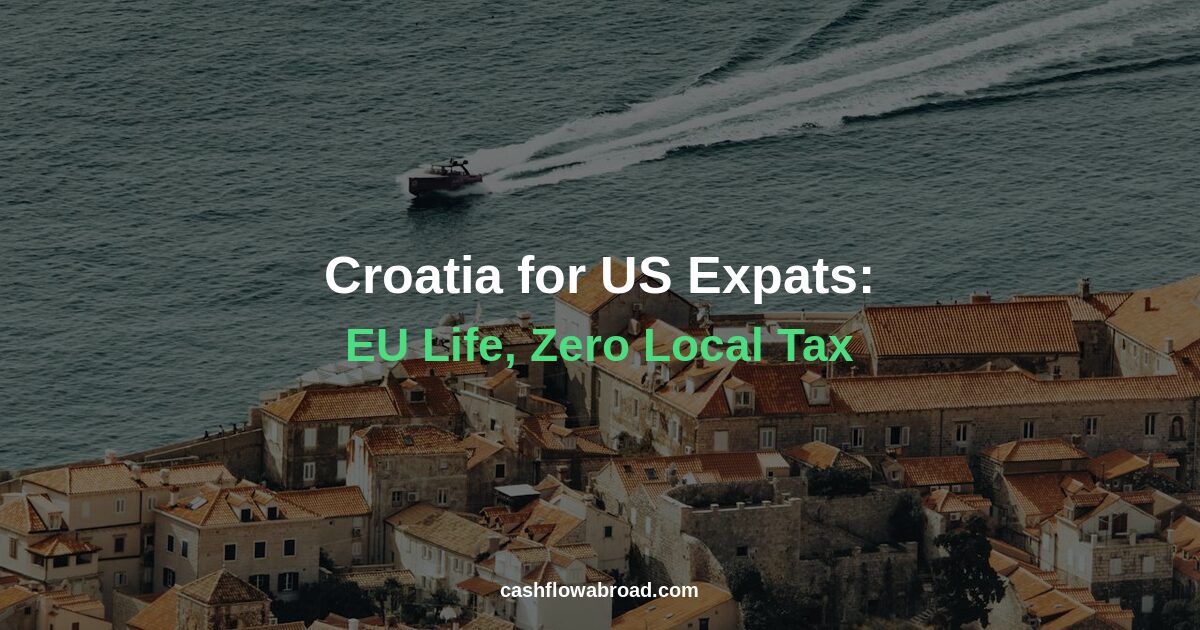
You can live on the Adriatic coast, inside the Schengen Zone, with EU travel rights and Croatian healthcare access, for around €1,600 a month.
Disclosure: this article contains affiliate links. If you open an account through one of them, Cashflow Abroad may earn a referral commission at no extra cost to you.
Croatia is the only EU member with a digital nomad visa that includes a full income tax exemption — and somehow most Americans mapping out their move abroad have never seriously looked at it. You can live on the Adriatic coast, inside the Schengen Zone, with EU travel rights and Croatian healthcare access, for around €1,600 a month. The visa costs between €60 and €100 in government fees. The Croatian tax bill on your foreign income? Zero.
That's not a rounding error. Digital nomad visa holders are completely exempt from Croatian income tax on earnings from outside Croatia. While Portugal's D8 hits you with roughly 20%, Spain's Beckham Law runs 24%, and Germany's progressive rates climb past 40%, Croatia charges exactly nothing on your remote work income — while offering an Adriatic lifestyle at roughly 40% below Western European prices.
There are real catches. One of them costs thousands per year specifically for freelancers and LLC owners. The income floor keeps rising automatically. And Dubrovnik has been Airbnb'd into unaffordability. But for the right profile — W-2 remote employees, contractors with non-Croatian clients, anyone considering Portugal or Spain who hasn't priced out the competition — Croatia belongs near the top of the list.
What Croatia's Digital Nomad Visa Actually Is
Croatia launched its digital nomad visa in January 2021, one of the first EU countries to do so. Originally valid for 12 months, the government extended it in March 2025 to a full three years — a significant change that makes the planning math work for serious relocations rather than just extended tryouts.
The visa covers non-EU/EEA nationals (Americans qualify) who work remotely for employers or clients not registered in Croatia. That last part is the hard constraint: no Croatian clients, no Croatian-registered businesses, no local employment. Your income must flow entirely from outside Croatia.
Visa holders receive a biometric residence permit (Boravišna Iskaznica), which grants:
- Up to 3 years of continuous residence in Croatia
- Unrestricted Schengen Zone travel (26 European countries)
- Right to open a Croatian euro bank account
- Enrollment eligibility in Croatia's healthcare system with private insurance
- Derivative visas for spouse, children, and parents
What the visa does not grant: local employment rights, Croatian social security eligibility, or a direct path to permanent residency. The time accumulated on the digital nomad permit doesn't count toward Croatia's 5-year naturalization track.
The Income Requirement — And Why It Keeps Rising
Croatia's threshold isn't arbitrary — it's set by law at 2.5 times the average Croatian net salary, recalculated automatically when wage data updates. In January 2026, Croatia's average net salary reached €1,511/month, pushing the digital nomad income requirement to approximately €3,622.50/month (roughly $3,900 at current rates).
When the visa launched in 2021, the floor was around €2,200/month. By 2024 it reached €2,870. The upward trajectory is structural, not political — Croatian wages have grown 7–10% annually in recent years, and the formula follows them automatically.
Two qualification paths:
- Monthly income: Consistent earnings of at least €3,622.50/month demonstrated through employer contracts, client invoices, or prior-year tax returns
- Bank savings: Approximately €39,540 held in accessible accounts (not locked in retirement funds or property equity)
The savings route works in practice but requires careful documentation. A standard bank statement showing liquid balances typically satisfies consulates, but verify your specific consulate's requirements — they vary.
How Americans Apply: The Full Process
US citizens apply through a Croatian consulate or embassy in the US, or through Croatia's official eVisa portal when available for your jurisdiction. Processing runs 15–60 working days depending on consulate volume and documentation completeness.
Required documents:
- US passport with at least 6 months remaining validity and 2 blank pages
- Completed application form (available at the consulate or online)
- Proof of income: 3 months of bank statements plus employer letter, client contracts, or recent tax return
- Proof of accommodation in Croatia: signed lease or hotel booking for initial arrival
- Private health insurance valid in Croatia for the full visa period
- FBI federal background check — the document most Americans fail to plan for
The FBI Background Check Requirement
Croatia requires a federal-level police clearance, not a state one. Two options: submit fingerprints electronically through an authorized US post office for a digital result via email, or use the standard mail-in process. Either way, budget 8–12 weeks for FBI turnaround, plus additional time for a US State Department apostille stamp. From decision to document in hand: 3–4 months minimum. Start this process before anything else.
Total government fees for the visa itself: €60–€100. Immigration lawyers or relocation agents typically charge €200–€500 to manage the paperwork, which is optional but reduces the back-and-forth with consulates that have varying interpretations of requirements.
The Tax Picture: What US Expats in Croatia Actually Pay
This is where Croatia gets genuinely compelling — and where the hidden trap lives for freelancers.
Croatian Side: Zero on Foreign Earnings
Digital nomad visa holders are completely exempt from Croatian income tax on foreign-sourced income. No Croatian tax filings, no PAYE, nothing. This exemption does not extend to passive income — dividends from Croatian assets, rental income from Croatian property, or capital gains on Croatian investments remain taxable if they arise within Croatia. For most remote workers with no Croatian financial ties, the passive income carve-out is irrelevant.
For context on what you're avoiding: Croatia's standard income tax rates are 20% on annual income up to €60,000 and 30% above that, with municipality surtaxes layered on top in Zagreb. The exemption represents real money.
American Side: Same as Always
The US taxes citizens on worldwide income regardless of residence. Moving to Split doesn't change your IRS filing obligations. What changes is your eligibility for the Foreign Earned Income Exclusion (FEIE), which allows qualifying expats to exclude up to $132,900 (2026 figure) of foreign-earned income from US federal taxable income, provided you meet either the bona fide residence test or physical presence test (330 days outside the US in a 12-month period).
For a remote employee earning $110,000/year working for a US company from Split: Croatian tax = $0, US income tax on that $110K = $0 (excluded under FEIE). Effective combined tax rate on earned income: essentially zero. Full mechanics at the FEIE guide.
No US-Croatia tax treaty exists, which matters for passive income treatment but doesn't significantly affect the typical remote worker scenario.
The Self-Employment Tax Trap: The Number That Kills the Math
This is the catch most Croatia guides bury or skip entirely: the US and Croatia have no totalization agreement. That means self-employed Americans — freelancers, single-member LLC owners, independent contractors receiving 1099s — owe the full 15.3% US self-employment tax on net earnings, with zero offset from Croatian contributions. The FEIE eliminates income tax exposure; it does not eliminate self-employment tax.
On $100,000 of net self-employment income, that's $14,130 in SE tax that cannot be excluded. On $150,000, it's roughly $18,400. W-2 employees of US companies face only the 7.65% employee share — and the employer side is handled separately. Freelancers pay both sides with no relief valve.
Solutions exist: operating through an S-Corp to pay yourself a reasonable salary and take the remainder as distributions (distributions aren't subject to SE tax), or contracting through an employer-of-record service that handles payroll. Neither is free or frictionless, but they substantially change the math for high earners. Full comparison at the expat investor playbook.
Cost of Living by City: The Real Numbers
Croatia joined the Eurozone in January 2023, which eliminated currency risk for EUR-earning expats and simplified banking — but also accelerated price convergence with Western Europe, particularly in coastal tourist areas. The arbitrage is real but narrowing, especially in Dubrovnik.
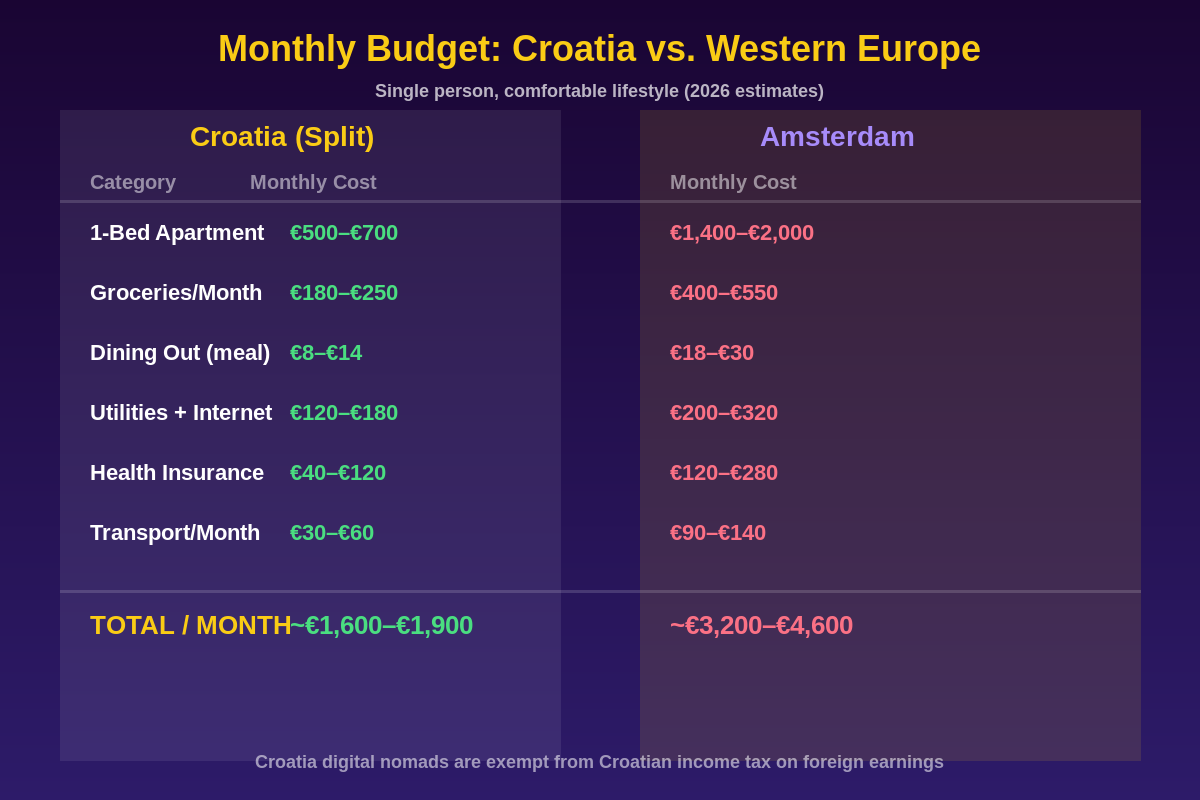
| Expense | Zagreb | Split | Dubrovnik | Smaller Towns |
|---|---|---|---|---|
| 1-Bed Apartment (long-term) | €500–€750 | €450–€700 | €700–€1,200 | €250–€450 |
| Groceries/Month | €200–€280 | €180–€260 | €220–€300 | €150–€220 |
| Dining Out (per meal) | €10–€16 | €8–€14 | €14–€25 | €6–€11 |
| Utilities + Fiber Internet | €130–€200 | €120–€180 | €140–€200 | €90–€150 |
| Health Insurance (private) | €50–€130 | €50–€130 | €50–€130 | €50–€130 |
| Transport (public + Uber) | €40–€80 | €30–€60 | €30–€60 | €20–€50 |
| Realistic Monthly Total | €1,700–€2,100 | €1,500–€1,900 | €1,900–€2,600 | €900–€1,300 |
Split is the consensus sweet spot. Adriatic access, ferry connections to Hvar, Brač, and the outer islands, 300 days of sunshine annually, a UNESCO-listed old town you actually live inside (not just photograph), and significantly cheaper than Dubrovnik without Zagreb's landlocked location. The digital nomad community is active but not overrun — coworking spaces exist, coffee shops have fast WiFi, and you're not fighting Instagram content creators for table space in every café.
The Dubrovnik trap: Game of Thrones tourism has driven Dubrovnik into a pricing tier that rivals Italian resort towns in peak season. Long-term lease inventory is thin because Airbnb typically pays landlords more. If you want Dubrovnik, negotiate in October–April, target neighborhoods at least one bus ride from the old town walls, and get a 12-month minimum lease in writing before you arrive. Summer pricing can run 40–60% higher than off-season on the same unit.
Banking and Moving Money
Croatia's Eurozone membership means you're working in euros at EU-standard ATMs. The issue for Americans is having accounts that don't eat 3% conversion fees and $5 ATM charges on every withdrawal.
Charles Schwab's investor checking account reimburses all ATM fees worldwide at end of month, charges zero foreign transaction fees, and has no minimum balance requirement. It's the most practical tool for expats in Croatia — withdraw euros from any ATM in Zagreb or Split and get the fee back automatically. Schwab's brokerage side also stays open when you update your address abroad, unlike Fidelity and Vanguard which have closed expat accounts.
For keeping a US business banking presence, Mercury runs cleanly for US LLCs managed from overseas — no monthly fees, strong API access, no friction with international operators.
For regular transfers from US accounts to cover Croatian rent and expenses, Remitly offers competitive USD-to-EUR rates with fast settlement. On a $3,000 monthly transfer, even a 0.4% rate improvement saves you roughly €12 per transfer — not dramatic, but consistent over a year it adds up.
Keeping a US street address is non-negotiable while abroad — most US banks, brokerages, and the IRS require one. Traveling Mailbox provides a real US address in 50+ cities for $15/month, with mail scanning and remote check deposits. The virtual mailbox guide for expats covers exactly how to set this up before you leave. Also see the complete US expat banking guide for FBAR filing, FATCA implications, and the full compliance stack.
What Life in Croatia Actually Looks Like
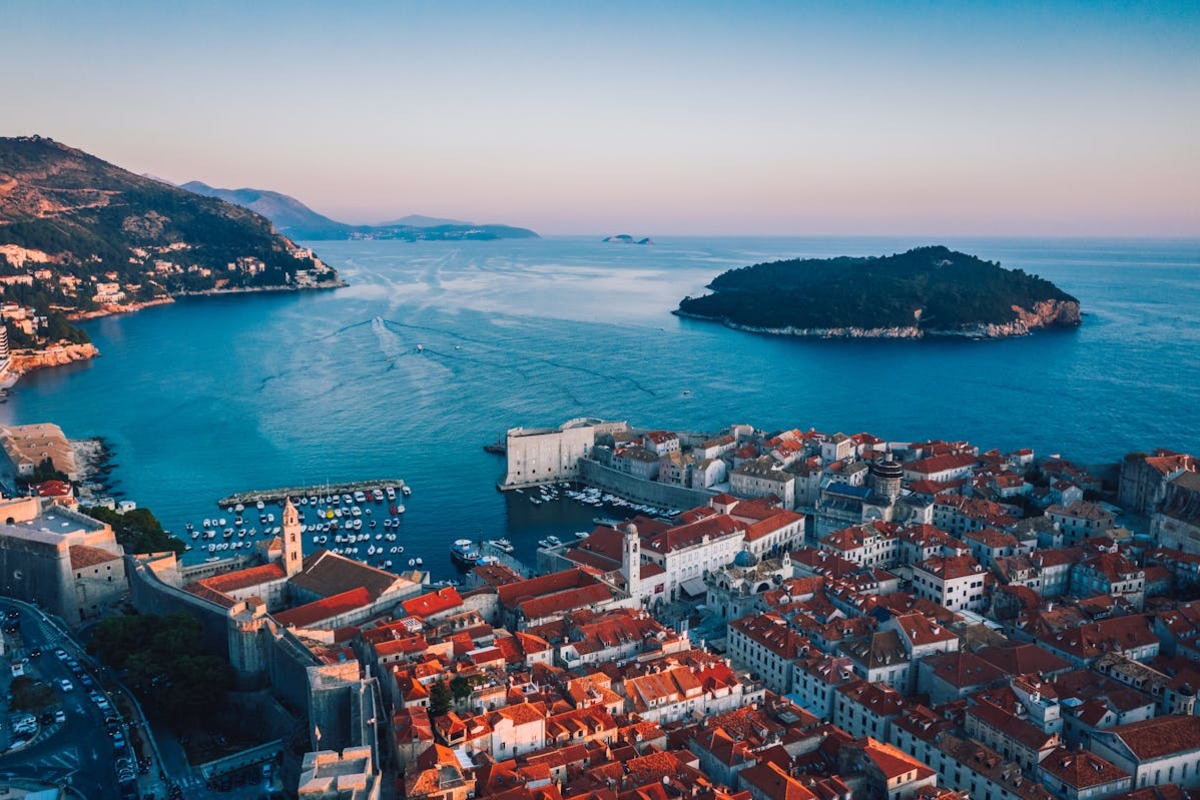
Croatia punches well above its price point on lifestyle quality. The country sits on 1,778 kilometers of coastline. EU infrastructure — roads, utilities, digital networks — operates at Western European standards. Fiber internet in Zagreb and Split delivers 100–200 Mbps for under €30/month, with coverage extending to most coastal towns. Healthcare facilities in Zagreb rival Western European standards; Split and coastal cities handle routine and emergency care competently, with Zagreb (2 hours by highway) for anything serious.
The food rewards exploration. Fresh grilled fish on a Split terrace: €12–€18. Peka — lamb or octopus slow-cooked under a bell-shaped lid in every konoba along the coast — is one of the better meals available anywhere in Europe. Wine from the Pelješac peninsula, particularly Plavac Mali, costs €5–€8 by the bottle in restaurants that would charge €25 in London for comparable quality.
English is widely spoken in Zagreb, Split, and among Croatians under 40 everywhere. Navigating government offices, landlord disputes, or healthcare administration requires either basic Croatian or a patient local contact. The language is Slavic and complex. Budget 6–12 months to reach functional daily use if you decide to learn it.
Health insurance: Required for the visa and genuinely necessary. SafetyWing's Nomad Insurance is accepted by most Croatian consulates and starts around $45/month for healthy adults under 40. Their Remote Health plan, starting around $75–$150/month, covers primary care rather than emergencies only — better for longer stays. Full comparison at the expat health insurance guide.
For connectivity while traveling within the 26-country Schengen Zone, Saily eSIM covers most European countries without SIM-swapping — useful for the inevitable island-hopping once you're based on the Dalmatian coast.
The Hidden Catches
1. Self-Employment Tax Double-Dip
Already detailed above, but worth repeating plainly: if you're a freelancer or LLC owner without an S-Corp or employer-of-record structure, you owe 15.3% US SE tax on net earnings up to ~$168,600, with no Croatian offset. FEIE doesn't help. This can cost €10,000–€20,000+ annually and fundamentally changes the tax efficiency calculation for non-employee remote workers.
2. Coastal Seasonal Pricing
Summer rental rates in Dubrovnik and popular Dalmatian islands run 40–100% above winter pricing. Landlords in tourist zones frequently refuse 12-month leases because Airbnb pays more for peak-season bookings. Arrive in autumn, negotiate multi-year terms, and get everything in writing.
3. Automatic Income Threshold Increases
The €3,622.50 floor will be higher next year. Croatian wages are growing. If you're borderline qualifying today, your 2027 renewal may require demonstrating income you don't yet earn. Build buffer into your qualification strategy rather than assuming the threshold stays flat.
4. Schengen Sequencing
Once you hold Croatian residency, you can travel freely in Schengen. But if you entered Europe as a US tourist before your Croatian residence permit was issued, the 90/180-day Schengen tourist rule still applies to that entry. The clean path: apply for a Croatian national D visa as your initial entry point, then convert to the digital nomad residence permit in-country. Getting the sequencing wrong creates compliance gaps and potential re-entry complications.
5. Passive Income Is Taxable
The Croatian income tax exemption covers foreign-earned active income only. Dividends, capital gains, rental income from non-Croatian assets, and certain crypto transactions remain taxable in Croatia under standard rates if you qualify as a tax resident. The distinction matters for anyone with substantial investment portfolios drawing down while abroad.
Croatia vs. Other European Digital Nomad Options
| Country | Local Tax on Foreign Income | Visa Duration | Income Requirement | 1-Bed Rent Range |
|---|---|---|---|---|
| Croatia | 0% (exempt) | 3 years | €3,623/mo | €450–€700 |
| Portugal D8 | ~20% (NHR ended) | 2 years | €3,680/mo | €900–€1,400 |
| Spain Nomad Visa | 24% flat (Beckham Law) | 1 yr + renewals | €2,646/mo | €900–€1,600 |
| Greece Digital Nomad | 50% income tax reduction | 2 years | €3,500/mo | €500–€1,000 |
| Germany Freelance Visa | 14–45% progressive | 3 years | Varies by field | €1,000–€1,800 |
On pure local tax efficiency, Croatia wins the European digital nomad comparison without contest. Portugal's rent inflation post-NHR has erased much of its lifestyle price advantage; Spain's Beckham Law only helps if 24% is better than your home rate (it often isn't for US expats using FEIE). Greece's 50% income tax reduction sounds good until you realize the remaining 50% still applies to a Greek progressive tax system. See the full country-by-country ranking at digital nomad visas ranked.
Who Croatia Actually Works For
The setup makes most sense for:
- W-2 remote employees of US companies earning $80K–$200K — Croatian exemption plus FEIE creates near-zero combined tax on earned income
- Contractors and freelancers who have structured through an S-Corp or employer-of-record to reduce SE tax exposure below the 15.3% default
- Couples where one partner's income clears the €3,622.50 threshold — one qualification covers the household, not per-person
- Anyone already comparing Portugal or Spain who hasn't factored in Croatia's lower rents and zero local income tax
It's a tougher fit for:
- Solo freelancers with high net self-employment income who haven't restructured to reduce SE tax — the 15.3% hit meaningfully dents the "zero tax" pitch
- Earners below €3,622.50/month — the income threshold is a hard stop with no workarounds short of the savings route
- Anyone specifically seeking an EU citizenship path — Croatia naturalizes after 5 years of standard residency, but nomad visa time doesn't count toward that clock
The Bottom Line
Croatia's digital nomad visa is one of the most underrated setups in the expat world — zero local income tax, three-year duration, Schengen access, Adriatic coast lifestyle, and a cost of living that sits 35–45% below comparable Western European cities. The income threshold is higher than it was three years ago and will keep rising, but €3,622.50/month is achievable for most remote professionals earning US or Western European rates. The FBI background check and 3–4 month lead time are the main logistical friction points.
The self-employment tax trap is real and should be stress-tested before you book the flight, especially if you're a freelancer. But for W-2 remote employees and properly structured contractors, the combined Croatian-US tax burden approaches zero in a way that almost no other EU country can currently match.
The income floor will be higher next year. The time to qualify on a comfortable margin is now, not when you're chasing a threshold that moved again.
Financial Disclaimer: This article is for informational purposes only and does not constitute tax, legal, or financial advice. US expat tax rules are complex, change frequently, and vary significantly based on individual circumstances. Consult a qualified CPA or attorney with experience in US expat taxation and Croatian immigration law before making residency or tax strategy decisions.
This guide is general information, not personalized tax, legal, or investment advice. Rules change; verify current thresholds with official sources or a qualified professional before acting.
Related guides
 Digital Nomad & Visa GuidesOctober 17, 2026
Costa Rica Nomad Visa Income Rules
Prove $3,000 a month, or $4,000 with family, for Costa Rica's nomad stay, then see the US tax that still applies to that pay.
 Digital Nomad & Visa GuidesOctober 12, 2026
Portugal Nomad Visa: €3,680 a Month
See how the €3,680 three-month average, the €110 consular fee, and a four-month entry window decide a Portugal nomad visa.
 Digital Nomad & Visa GuidesSeptember 22, 2026
Thailand DTV Visa: Fee and Stay Limit
See the $400 DTV fee, 500,000 baht month-end bank proof, and 180-day stay limit before you apply from the United States.