Chile for US Expats: Taxes, Visas & the $1,400/Month Life
Here's a statistic most Americans have never heard: Chile gives new residents up to six years of complete exemption from Chilean tax on foreign income.
Here's a statistic most Americans have never heard: Chile gives new residents up to six years of complete exemption from Chilean tax on foreign income.
Disclosure: this article contains affiliate links. If you open an account through one of them, Cashflow Abroad may earn a referral commission at no extra cost to you.
Here's a statistic most Americans have never heard: Chile gives new residents up to six years of complete exemption from Chilean tax on foreign income. Not a treaty loophole. Not an obscure carve-out. It's written directly into Chilean tax law. Pair that with a US-Chile totalization agreement that eliminates double Social Security taxation, a cost of living roughly 45% below the US average, and the most stable economy on the continent — and you have arguably the best-kept expat secret in the Western Hemisphere.
Chile consistently tops Latin American rankings for rule of law, infrastructure, and financial stability. Santiago has a metro that runs on time, a startup ecosystem drawing VC money from Silicon Valley, and steakhouses that would embarrass Argentina. The Atacama Desert, Patagonia, and Chile's wine valleys are all within a few hours. Yet expat forums are clogged with people debating Lisbon and Medellín while Santiago sits largely undiscovered.
This guide covers everything a US expat needs to know: the 6-year tax exemption mechanics, every viable visa path, the real cost of living neighborhood by neighborhood, US tax obligations, and the practical realities nobody warns you about.
Chile's 6-Year Foreign Income Tax Exemption
This is the headline. Under Chilean tax law, foreigners who establish residence are classified as "domiciled" rather than full tax residents for an initial period — which translates to a clean exemption from Chilean tax on any income sourced outside Chile.
The mechanics:
- Years 1–3: Taxed only on Chilean-source income. Foreign salary, freelance income, dividends, rental income, capital gains from foreign assets — all completely tax-free in Chile.
- Years 4–6: Apply to Chile's tax authority (Servicio de Impuestos Internos, or SII) for a three-year extension of nonresident tax status. Most expats who apply receive it without issue.
- Year 7+: Full tax resident; Chilean taxes apply to worldwide income at progressive rates of 0–35%.
Tax residency in Chile triggers after 183 days of presence in any 12-month period, or after six consecutive months in a calendar year. If you're splitting time between Chile and another country, you may be able to delay full residency status — though this requires careful planning with a Chilean tax advisor.
For the average American earning remote income, freelance consulting, or investment returns, the math is striking: six years in a high-quality, affordable country while paying zero Chilean tax on that income. Your US obligations remain (the US taxes on citizenship, not residency), but between the Foreign Earned Income Exclusion, Foreign Tax Credit, and the US-Chile tax treaty, most expats in Chile end up with a manageable US tax bill — often near zero if their income is primarily earned income under the FEIE threshold.
The US-Chile Tax Treaty (Finally Ratified)
After sitting in limbo for over a decade, the US-Chile income tax treaty officially entered into force on December 19, 2023. This matters for several reasons:
- Pension income: The treaty clarifies taxation rights on pensions and Social Security — US Social Security income received by Chilean residents is exempt from Chilean tax.
- Dividends: Reduced withholding rates on cross-border dividends: 5% for substantial shareholders, 15% standard.
- Business profits: Clear rules on when a US company creates a permanent establishment in Chile — critical for expat entrepreneurs running US LLCs from Santiago.
- Tie-breaker provisions: Determines tax residency when you qualify as a resident in both countries simultaneously.
Separately, the US-Chile Totalization Agreement covers Social Security. Self-employed Americans in Chile don't pay US self-employment taxes on income earned in Chile — a saving that can reach $14,000+ per year on a $100K income. More on the totalization angle in our complete expat banking and taxes guide.
Visa Options for US Expats
US citizens enter Chile visa-free for up to 90 days, extendable once for another 90 days at roughly $100. For longer stays, three practical pathways exist:
Temporary Residency (Rentista/Income Visa)
Chile's most popular route for expats without a local employer. You prove sufficient income from sources outside Chile — the SII currently considers $1,000–$1,500/month adequate for a single applicant, with higher amounts for dependents. Acceptable sources include remote employment salary, freelance income invoiced to foreign clients, pension or Social Security, and investment income.
The temporary residence visa is valid for one year and renewable. After 12 months of residency and at least 185 days spent in Chile per year, you can apply for permanent residency. Processing times have stretched to 6–8 months in 2026 due to immigration backlogs — apply before your 90-day tourist entry expires, or file from the US before departing.
Retiree Visa (Jubilado)
Designed for applicants over 55, this path requires proof of pension or passive income of approximately $1,000–$1,500/month. Social Security, 401(k) distributions, or rental income all qualify. Chile doesn't tax US Social Security income received by residents, making this exceptionally clean for American retirees.
Employer-Sponsored Work Permit
If you have a Chilean employer, they sponsor your temporary residency. Less relevant for remote workers but worth knowing if you're exploring Santiago's tech, mining, or financial sectors where English-speakers are actively recruited.
| Visa Type | Income Requirement | Initial Validity | Path to Permanent |
|---|---|---|---|
| Rentista (Income) | ~$1,000–$1,500/mo | 1 year | 12 months + 185 days/year |
| Jubilado (Retiree) | ~$1,000–$1,500/mo pension | 1 year | 12 months + 185 days/year |
| Work Permit | Job contract required | 1–2 years | 12 months + 185 days/year |
Permanent residency is valid for 5 years and renewable. After 5 years of total legal residency, you can apply for Chilean citizenship. Chile allows dual citizenship — no renunciation of your US passport required.
Cost of Living: The Real Numbers
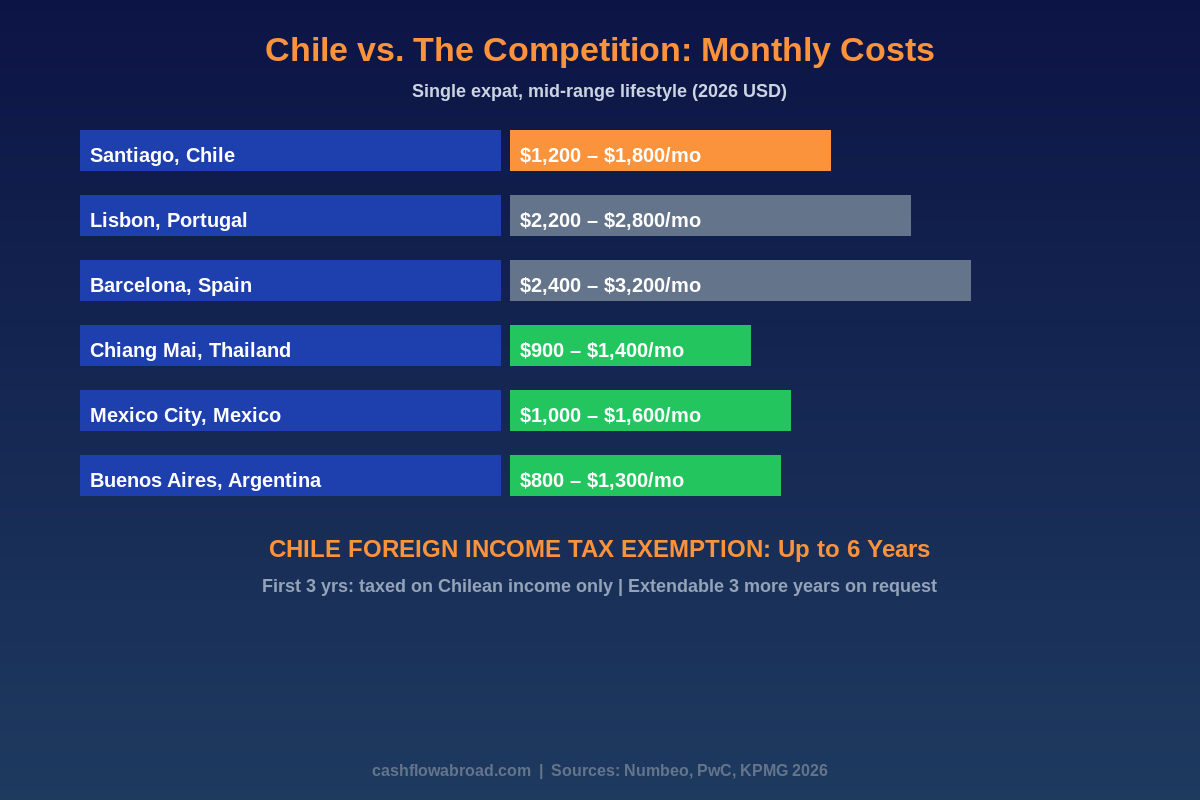
Santiago's expat zones — Providencia, Las Condes, and Vitacura — cost more than the city average but remain dramatically cheaper than comparable neighborhoods in Lisbon, Barcelona, or any major US city.
| Expense | Monthly (USD approx.) |
|---|---|
| 1BR furnished apt, Providencia | $550–$900 |
| 1BR furnished apt, Las Condes | $700–$1,100 |
| Groceries (single) | $150–$250 |
| Dining out (mid-range, 3×/week) | $80–$130 |
| Metro + rideshare transport | $40–$80 |
| Private ISAPRE health insurance | $80–$150 |
| Utilities + fiber internet (200 Mbps) | $60–$100 |
| Total (single expat) | $1,100–$1,900 |
A couple in Providencia — 2BR apartment, eating out three times per week, gym membership, occasional weekends in Valparaíso or at the ski slopes at Valle Nevado — runs about $2,500–$3,200/month combined. That same lifestyle in Berlin costs $4,500+.
One cost surprise: Santiago's dining scene punches well above its price point. A full lunch menu ("almuerzo") at a sit-down restaurant in Providencia — soup, main, dessert, drink — runs $6–$10. Fine dining at top-tier Santiago restaurants rarely exceeds $60–$80 per person with wine. And those wines cost $8–$15 at a local wine shop for bottles that retail for $35+ in the US.
Neighborhood Breakdown
- Providencia: The expat sweet spot — walkable, strong restaurant scene, good metro access, mid-range rents. Popular with digital nomads and younger professionals.
- Las Condes: Corporate Santiago — multinational offices, premium amenities, higher rents. Where most transferred executives land.
- Ñuñoa: More local flavor, slightly cheaper, artsy district. Best value-quality tradeoff for expats who want to integrate.
- Vitacura: Santiago's most upscale neighborhood. Stunning Andean views, top-tier restaurants. Budget: $1,500+/month for rent alone.
Healthcare: The Dual-Track System
Chile runs parallel healthcare systems: FONASA (public, employer-funded) and ISAPRE (private, similar to US insurance). For expats without a Chilean employer, ISAPRE is the path.
Private ISAPRE coverage runs $80–$200/month for a healthy adult in their 30s–40s, covering hospitalizations, specialist visits, and prescriptions at facilities like Clínica Las Condes and Clínica Alemana — legitimately world-class hospitals that appear regularly on Latin American quality rankings.
If you're in a transitional period or still waiting for residency to process, SafetyWing's Nomad Insurance ($56/month for adults under 40) covers medical emergencies globally until you can enroll in local coverage.

Banking and Money
Opening a Chilean bank account as a non-resident is genuinely difficult — major banks require a Chilean RUT (tax ID) and proof of residency, and the process involves significant Spanish paperwork. Most expats in their first year keep their US banking setup intact and access cash through ATMs.
For US business accounts, Mercury works cleanly from Chile for LLC banking. For USD-to-CLP transfers, Remitly offers competitive exchange rates that consistently beat local exchange houses. The CLP/USD exchange rate floats freely — in 2026 it runs around 980–1,020 CLP per dollar.
One critical piece many expats overlook: you need a real US street address while abroad or banks start closing accounts and IRS correspondence gets lost. Traveling Mailbox provides a real US address in 50+ cities, scans your mail digitally, and handles check deposits for $15/month. Our full breakdown is at the virtual mailbox expat guide.
US Tax Obligations in Chile
The US taxes based on citizenship — your obligations don't disappear when you land in Santiago. Here's how most expats structure it:
Foreign Earned Income Exclusion (FEIE)
If you qualify as a bona fide Chilean resident or meet the physical presence test (330+ days outside the US in a 12-month period), you can exclude up to $126,500 in earned income (2024, adjusted annually) from US federal income tax. This covers wages, freelance, and self-employment income — not passive income like dividends. Details in our FEIE guide.
Foreign Tax Credit
For years 7+ when you're paying Chilean tax on worldwide income, the Foreign Tax Credit prevents double taxation. Chilean taxes paid apply dollar-for-dollar against your US liability.
FBAR and FATCA
Any Chilean bank account(s) exceeding $10,000 at any point requires an FBAR filing. If aggregate foreign financial assets exceed $200,000 (single filer abroad), Form 8938 applies under FATCA. Non-willful FBAR violations carry penalties up to $10,000 per year. These aren't optional.
What Nobody Tells You Before Moving
Bureaucracy is real, but manageable. Chile's immigration platform (Trámite en Línea) handles applications online, but processing times run 6–8 months in 2026. Get all documents apostilled before leaving the US — birth certificates, police clearances, marriage certificates if applicable. Requests for additional documentation are common; budget 2–3 months of back-and-forth.
Spanish is non-negotiable. Unlike some expat bubble cities, Santiago requires functional Spanish for daily life outside the premium zones. Landlords, immigration officials, and most service providers don't speak English. Intermediate Spanish is a baseline requirement, not a bonus.
The seismic reality. Chile sits on one of the world's most active subduction zones. Major earthquakes occur every few decades; minor tremors are routine. Chilean buildings meet some of the world's most rigorous seismic construction standards — the 2010 magnitude 8.8 earthquake killed under 600 people in a country of 17 million, a testament to building codes. This is context, not a dealbreaker.
The lifestyle upside is real. Santiago sits at the edge of the Andes — ski resorts are 45 minutes from downtown. The Pacific coast is 90 minutes west. Patagonia and the Atacama Desert are domestic flights. Chilean wine culture means a $12 bottle of Carménère from Maipo Valley is better than most $40 bottles in the US. The food scene, unfairly maligned compared to Peru or Argentina, produces exceptional Pacific seafood and some of South America's best Italian and Lebanese fusion.
The Geographic Arbitrage Calculation
The geographic arbitrage playbook works best in countries that deliver high quality at low cost. Chile delivers on both in ways that feel institutional rather than provisional — the stability, infrastructure, and rule of law are genuine, not aspirational.
A US software engineer earning $120,000 remotely:
- Excludes ~$126,500 via FEIE → no US federal income tax on earned income
- Pays zero Chilean tax on foreign-source income for up to 6 years
- Lives on $1,800/month in Providencia with a comfortable lifestyle
- Saves $7,000–$8,000/month — effectively impossible in any US city
For retirees drawing Social Security, the math is equally compelling: US Social Security is exempt from Chilean tax. A couple drawing $3,500/month in combined Social Security who lives on $2,800/month in Santiago runs a monthly surplus — and does so in a country with genuine first-world private healthcare at $150/month per person.
For structuring the investment side of expat wealth building, see the expat investing playbook — particularly the PFIC rules that trap US expats who invest in local mutual funds or ETFs.
The Bottom Line
Chile doesn't get the hype it deserves in expat circles — probably because it requires real Spanish and sits at the bottom of the map. But the fundamentals are exceptional: a 6-year foreign income tax exemption written into law, the most stable political and economic environment in Latin America, infrastructure that rivals Southern Europe, and a cost of living that makes a $2,000/month budget feel genuinely comfortable.
The window on that 6-year exemption starts the day you establish domicile. Start with a 90-day tourist visit, get a feel for Providencia, open a coworking membership for a month. If the lifestyle fits, file for temporary residency before the 90 days expire. The paperwork is tedious; the financial upside runs to six figures over six years.
This post is for informational purposes only and does not constitute tax, legal, or financial advice. US expat tax law is complex and fact-specific. Consult a qualified CPA or tax attorney with international experience before making residency or tax decisions. Chilean immigration requirements change — verify current requirements with SERMIG (Chile's immigration service) or a licensed Chilean immigration attorney before applying.
This guide is general information, not personalized tax, legal, or investment advice. Rules change; verify current thresholds with official sources or a qualified professional before acting.
Related guides
 Geographic ArbitrageOctober 25, 2026
Italy Nomad Visa Income Requirements
Italy's nomad visa income test is €25,500 on 2026 sheets. See the $133.60 Washington fee and the US return you still file.
 Geographic ArbitrageOctober 4, 2026
Greece Nomad Visa: The €3,500 Monthly Test
See whether your pay clears Greece's digital nomad visa: €3,500 net a month, or €4,200 with a spouse, before you apply now.
 Geographic ArbitrageSeptember 21, 2026
Korea F-1-D Workation Income Rules for Expats
As of June 2026, Korea’s F-1-D visa starts at ₩52.4M outside Seoul for ages 18–34. Map income tiers, US FEIE, and where you park the paycheck.